
Key Takeaways
The Cost: Unplanned downtime costs the average manufacturer $260,000 per hour. It is the single biggest killer of profitability.
The Strategy: To prevent downtime, you must move beyond "tracking" it (Reactive) and start "detecting" it early (Proactive) using OEE signals and Condition-Based Maintenance.
Top Pick: Fabrico prevents downtime by combining OEE Detection (spotting performance drops) with Video Root Cause Analysis (ensuring the true problem is fixed permanently).
Quick answer: The best software to prevent unplanned downtime in 2026 combines three layers: (1) real-time OEE monitoring to catch micro-stops before they cascade, (2) preventive-maintenance scheduling tied to actual run hours not the calendar, and (3) condition-based triggers from vibration, temperature, or computer-vision signals. Fabrico bundles all three; standalone CMMS (Limble, MaintainX) covers layer 2 only; standalone OEE (Vorne, FactoryTalk) covers layer 1 only.
Related deep-dives: Software to increase MTBF · 6 root causes of unplanned downtime · The OEE reliability paradox · Best OEE software that takes action.
Most manufacturing software is designed to tell you what happened after the machine broke. It generates a nice report showing you lost $50,000 yesterday.
That is an autopsy. What you need is healthcare.
To survive in 2026, you cannot afford to wait for the breakdown.
Catching a failure early starts with seeing every stop, including the short ones nobody writes down. Fabrico's downtime tracking software logs each stop and its duration straight from the machine, so the early warning signs come from real data, not from memory.
You need software that identifies the Pre-Failure Signals, the micro-stops, the speed losses, the vibration spikes, and triggers maintenance before the line stops.
Here are the 5 best software tools designed specifically to Prevent Unplanned Downtime.
To stop a breakdown, your software must handle three specific tasks:
Early Detection: Identifying that a machine is "struggling" (e.g. Cycle time slowed by 10%).
Automated Action: Triggering a Work Order immediately without human intervention.
Root Cause Elimination: Ensuring the repair fixes the actual problem so it doesn't repeat tomorrow.
Best For: Preventing Recurrence via OEE & Video.
The "Visual Prevention" Advantage: Fabrico takes a unique approach to prevention. It recognizes that 80% of unplanned downtime is "Repeat Failures", machines breaking for the same reason because the root cause was never found.
Fabrico connects to the machine's PLC to monitor OEE (Overall Equipment Effectiveness) in real-time.
Prevention via OEE: If a machine's performance drops (e.g. speed loss), Fabrico recognizes this as a "Pre-Failure" condition and triggers a maintenance inspection automatically.
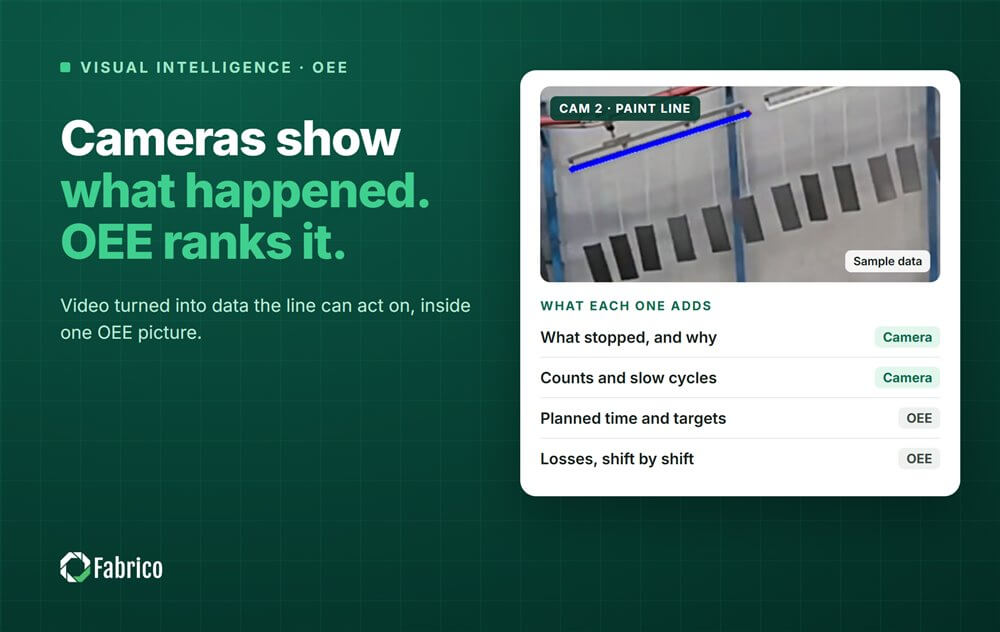
Prevention via Video: When a micro-stop occurs, the Inefficiencies Zoom-In feature captures a video clip of the event. Technicians can see exactly why it stopped (e.g. "The guide rail is loose"). By fixing the root cause (tightening the rail) instead of the symptom (clearing the jam), they prevent the major breakdown that would have happened an hour later.
Pros:
Turns "Performance Loss" into a maintenance trigger.
Video evidence eliminates "Trial and Error" repairs.
Unified platform handles both the Detection (OEE) and the Fix (CMMS).
Considerations:
Requires camera installation to unlock the full "Zoom-In" potential.
Best For: IoT Anomaly Detection (CNC/Machining).
Overview: MachineMetrics is a powerhouse for "Machine Listening." It connects directly to the control units of CNCs and PLCs to stream high-frequency data. It is incredibly effective at detecting Load Spikes or Tool Wear.
If a drill bit is about to shatter, MachineMetrics detects the increased torque load milliseconds before it happens and can even stop the machine automatically to prevent damage.
Key Prevention Features:
High-Frequency Data: Monitors load, speed, and temperature at millisecond intervals.
Predictive Algorithms: Learns "Normal" behavior and flags anomalies.
Operator Tablets: alerts operators to "Tool Life" remaining.
Pros:
The best tool for preventing catastrophic tool failure in machining.
Plug-and-play with most modern CNCs.
Considerations:
Not a CMMS: It detects the issue beautifully, but you often need a separate system to manage the Work Order, Spare Parts, and Technician scheduling to fix it.
Best For: Preventing Motor & Pump Failure (Vibration).
Overview: Tractian focuses on the physical health of rotating assets. Their "Smart Trac" sensors stick to the side of motors, pumps, and fans to monitor Vibration and Temperature.
Unplanned downtime often comes from bearings seizing up. Tractian’s software analyzes the vibration signature to predict bearing failure weeks in advance, allowing you to schedule the replacement during a planned shutdown rather than an emergency stop.
Key Prevention Features:
Vibration Analysis: Detects imbalance, misalignment, and looseness.
Spectral Analysis: "Fingerprints" the specific type of mechanical fault.
Mobile Alerts: Pushes notifications to phones when thresholds are crossed.
Pros:
Excellent for critical utility assets (Compressors, Chillers).
Easy "Stick and Play" installation.
Considerations:
Limited Scope: Only prevents mechanical failures. It is not positioned to detect process failures (e.g. jams, sensor errors, software faults) that Fabrico or MachineMetrics can catch.
Best For: Preventive Maintenance Compliance.
Overview: Sometimes, downtime happens simply because we forgot to grease the chain. Fiix is a robust enterprise CMMS that excels at Preventive Maintenance (PM) Compliance.
By organizing and enforcing strict PM schedules, Fiix ensures that the "Basics" are never missed. Its deep integration with Rockwell Automation also allows it to pull "Runtime Hours" to trigger maintenance, ensuring machines aren't over- or under-maintained.
Key Prevention Features:
PM Scheduling: Drag-and-drop calendar for balancing maintenance workload.
Asset Health Monitor: Visualizes which assets are overdue for service.
Parts Kitting: Ensures parts are ready so PMs aren't skipped due to stockouts.
Pros:
Great for enforcing discipline in large teams.
Prevents "Neglect-Based" downtime.
Considerations:
Passive: Relying solely on PMs is not enough to stop random failures in complex high-speed lines.
Best For: Operator Escalation.
Overview: Operators are your first line of defense. They hear the "weird noise" hours before the machine breaks. Limble CMMS makes it incredibly easy for an operator to scan a QR code and report an issue ("Work Request").
By removing the friction of reporting, Limble encourages operators to flag minor issues early. This allows maintenance to intervene before the minor issue becomes a major downtime event.
Key Prevention Features:
Work Request Portal: Simple mobile form for non-maintenance staff.
Photo Upload: Operators can snap a picture of the issue.
Push Notifications: Techs get the request instantly.
Pros:
Empowers the "Human Sensor" (the operator).
Very high adoption rates.
Considerations:
Manual: Relies on a human noticing and reporting the issue; misses invisible signals (heat/micro-stops).
| Feature | Fabrico | MachineMetrics | Tractian | Fiix | Limble |
| Primary Prevention Method | OEE & Video RCA | IoT Data (Load) | Vibration Sensors | PM Compliance | Operator Reporting |
| Detects Process Failures | Yes | Yes | No | No | Yes (Manual) |
| Detects Mechanical Wear | Yes (via Perf.) | Yes | Best-in-Class | No | No |
| Integrated Repair Workflow | Yes (Native) | No | No | Yes | Yes |
| Best For | Manufacturing Lines | CNC / Machining | Motors / Pumps | Enterprise PMs | Simple Teams |
Buying software to track downtime is like buying a scale to lose weight. It tells you the number, but it doesn't solve the problem.
To actually Prevent downtime, you need a system that connects all three steps:
Monitor the machine (Fabrico OEE).
Analyze the failure (Fabrico Video).
Execute the fix (Fabrico CMMS).
For CNC tooling protection, choose MachineMetrics.
For critical motor health, choose Tractian.
For preventing downtime on high-speed production lines, Fabrico is the superior choice.
By using Performance Data (OEE) as your early warning system and Video to ensure the root cause is killed, Fabrico turns maintenance from a "Fix-It" team into a "Reliability" team.
Want OEE captured straight from your machines, no manual logs?
Request a demoContact us







 Login
Login
 Blog
Blog