Key takeaways
CNC machine monitoring is the automatic collection of state and production data from CNC machine tools: mills, lathes, machining centers, grinders and multi axis machines. Instead of relying on a traveler sheet or an end of shift estimate, the monitoring system reads the control directly, or on older machines an external sensor, and records every change with a timestamp.
It is a specialized form of general machine monitoring. The difference is that a CNC control is far more talkative than most production equipment. It knows whether a program is running, which program it is, whether the operator has turned the feed override down, and which alarm stopped the cycle.
That detail matters, because in a machine shop the question is rarely "is the machine on". It is "is the spindle actually cutting, and if not, what is it waiting for".
Not every signal is worth collecting. These are the ones that drive decisions:
The right connection depends on the control, its age and the options that were bought with it. In broad terms there are four routes.
MTConnect is an open, royalty free standard for reading data from manufacturing equipment, originally developed for machine tools. Some controls support it natively; others need an adapter that translates the control's own interface into MTConnect. Its big advantage is a common vocabulary: "Execution" means the same thing on every machine that implements it. Our MTConnect guide explains how the standard works and what it deliberately does not do.
OPC UA is a general industrial communication standard, widely used on PLCs and increasingly available on newer CNC controls, sometimes as a paid option. If a plant already uses OPC UA for other equipment, extending it to machine tools keeps one integration approach across the floor.
For machine tools there is also a dedicated companion specification, OPC UA for Machine Tools (OPC 40501), started by the German machine tool builders' association VDW together with the OPC Foundation and promoted under the umati name.
It defines common machine states, job information and runtimes, so machines from different builders that support it report data in the same structure. The specification is free to download. When you order a new machine, ask the builder whether it supports it.
Control makers also offer their own interfaces. FANUC FOCAS is the best known example: a library that lets software read status, counters and alarms from FANUC controls, and write some data back, over Ethernet or FANUC's high speed serial bus (HSSB). Availability depends on the control series and on whether the Ethernet or HSSB hardware and the FOCAS function are enabled, so check the specific machine rather than the brand.
Older machines, and some controls with no accessible interface, can still be monitored from the outside. A current sensor on the spindle drive or main supply shows when the machine is working, and a stack light sensor shows alarm and ready states.
You lose program names and override data, but you gain a dependable running and stopped timeline for machines that would otherwise be invisible, and with a stack light wired to cycle start it comes close to in cycle. See our guide to monitoring machines without PLC access for the tradeoffs.
Most connection projects stall on networking, not software. Each control needs a working Ethernet port, a fixed IP address and a route to the data collector, usually on a separate machine network that IT controls.
Interfaces such as FOCAS and MTConnect listen on specific ports that the firewall has to allow. Set every control's clock from one time source, and give each machine one consistent name in the control, the monitoring system and your ERP, or the timelines will not line up.
A job shop runs a vertical machining center on two shifts, five days a week: 80 scheduled hours. The shop believed the machine was "busy all week" because it was always either running or being set up.
After a week of monitoring from the control, the timeline showed:
Those six categories add up to the full 80 hours. The first surprise was that alarms were the smallest loss. The shop had been planning a spindle rebuild to improve availability, when the data pointed at two cheaper changes instead:
Together that is roughly 12 hours a week. Time in cycle would rise from 44 to about 56 hours, from 55% to 70% of the schedule: about 27% more cycle time from the same machine, without buying another machine, as long as there is work queued to fill it. The average feed override of 85% during cycles became the next project.
Many shops run the last hours of the night with nobody at the machine. That is where a single missed stop costs the most: a machine that alarms out at 01:00 and sits until 06:00 loses five hours without anyone knowing.
Set a notification for any stop longer than a few minutes outside staffed hours, send it to whoever is on call, and review the next morning which stops a tool life setting, a bar feeder check or a chip conveyor fix could have prevented.
Idle time with no operator is often a staffing question, not a machine question. The timeline shows how long each machine runs on its own between interventions, and how often two machines in a cell need the same operator at the same moment.
That is the data you need to decide how many machines one person can tend, and which jobs to pair so that one machine's long cycle covers the load and unload on the next.
Machine shops often argue about which number to report. The two main options measure different things:
Most shops benefit from both: utilization for the weekly capacity conversation, OEE for improvement work on repeat parts. Our comparison of machine utilization and OEE covers when to use which, and OEE for CNC machining centers goes deeper on spindle utilization and tooling.
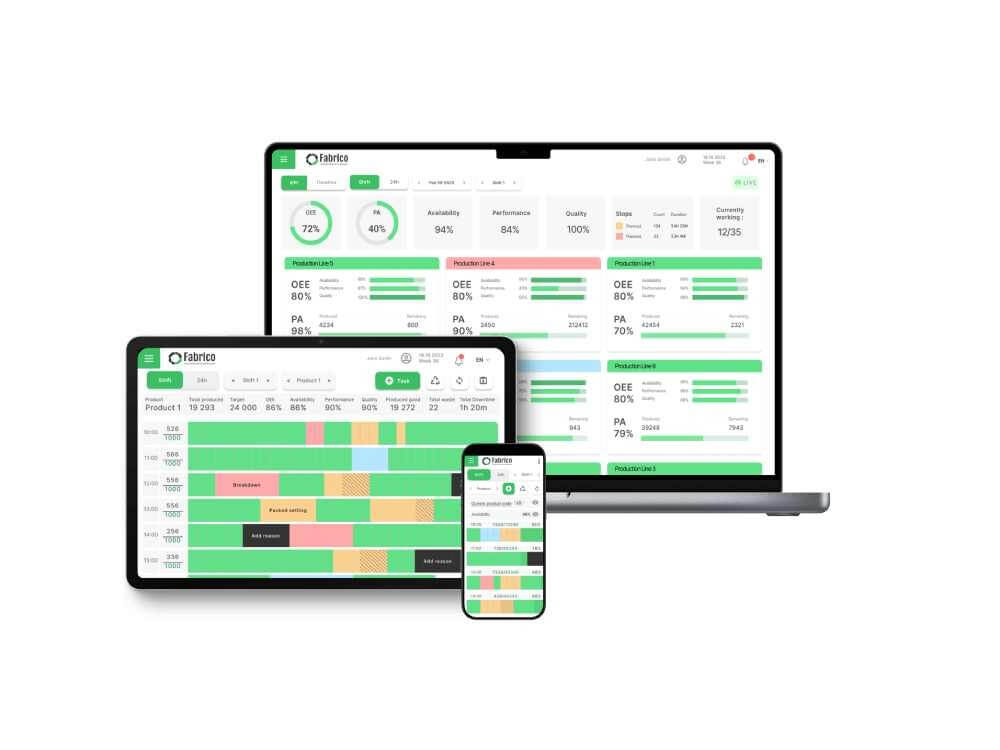
Fabrico collects machine data through PLC connectivity and IoT sensors, adds computer vision cameras where a stop leaves no signal, and turns it into real-time OEE dashboards and short stop detection. Because Fabrico is also a CMMS, when the same stop keeps coming back, the team can open a work order from that machine's record, with its history, parts and past fixes in one place.
Bring your machine list to a demo and we will go through which machines connect through a PLC, which need a sensor and where a camera adds the missing context.
Yes. A current sensor on the spindle drive or main supply and a sensor on the stack light will give you a dependable running, idle and alarm timeline that comes close to in cycle time. You will not get program names or override values, but you will see where the time goes.
No. Both are open standards for reading machine data, but MTConnect was designed around manufacturing equipment and machine tools with a standard vocabulary, while OPC UA is a general industrial communication framework. There is also a companion specification that maps MTConnect information into OPC UA.
It depends heavily on the mix. High volume cells running one part for weeks can sustain much higher in cycle time than a high mix shop changing jobs several times a shift. Measure your own baseline for a month and improve against that, rather than against a published average.
Usually not. Execution state, mode and alarms are read from the control without touching programs. Part counting sometimes needs a counter increment in the program if one is not already there.
CNC monitoring tracks what the machine is doing: cycles, stops, counts and alarms. Condition monitoring tracks the health of components such as spindle bearings, through vibration or temperature. The two complement each other, and our CNC spindle maintenance guide covers the health side.
See how Fabrico unifies OEE and maintenance in one platform.
Request a demo









 Login
Login
 Blog
Blog