
TL;DR
A machine monitoring system records what every production machine is doing in real time: running, idle, stopped, in setup or in alarm, plus part counts and cycle times. The data comes from the PLC, a retrofit sensor or a camera, and replaces shift-end estimates with a measured timeline.
A machine monitoring system is software, plus a small amount of connection hardware, that captures the state of a production machine automatically and in real time. Instead of an operator ticking boxes on a clipboard, the system reads a signal from the machine and logs every change of state with a timestamp.
The output is a timeline for each machine. You can see that a press ran from 06:02 to 07:41, stopped for 4 minutes, ran again, went into a 26 minute changeover, and so on, for every machine on the floor at once.
That timeline is the raw material for everything else a plant cares about: equipment downtime analysis, cycle time tracking, capacity decisions, and the overall equipment effectiveness (OEE) score.
In Fabrico, a cloud-based MES and OEE platform, machine monitoring builds that timeline automatically: every stop is recorded with its duration straight from the machine, and the same data feeds OEE by line and shift.
The core of every system is a state model. Each machine is always in exactly one state, and the software records how long it spends in each.
On top of the state model, most systems also capture:
You do not need dozens of signals to start. Two inputs and one number are enough for a first OEE score: a cycle or part signal, a good part or reject signal, and the ideal cycle time for each product.
From those, the system can work out run time, stops, short stops, speed loss and scrap. Add alarm codes, stop reasons and changeover tracking later, once the basic timeline is trusted.
The software side is similar across systems. The real difference is how the signal leaves the machine, and most plants end up using more than one method because their equipment spans several decades.
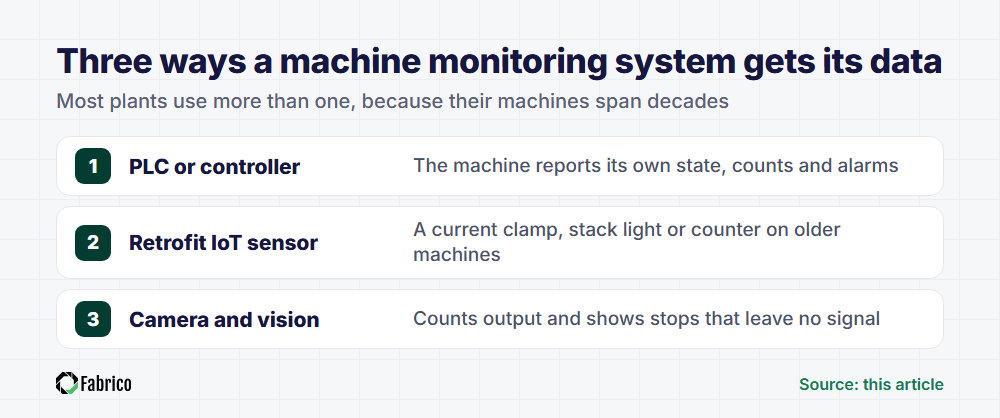
Most modern equipment already knows its own state. A PLC holds tags for running, faulted, part count and cycle complete, and CNC controllers expose spindle status, program state and alarms.
Industry standards such as OPC UA and, for machine tools, MTConnect exist to make that data readable by other software. Our guide to PLC connectivity for OEE monitoring covers the connection side in more depth.
This is usually the most accurate method, because the machine reports its own state instead of the system guessing it from outside. The tags still need checking: a running bit can stay on while the machine waits for material. It is also the one that needs the most coordination with whoever owns the controls, since you are reading from equipment that runs production.
Older machines often have no network port or no documentation for their tags. A retrofit sensor gets around that from the outside: a current clamp on the motor supply, a sensor on the stack light, a counter on the discharge chute. When current rises above a threshold, the machine is running; when the red light comes on, it is stopped.
Retrofit sensors are fast to install and do not touch the control logic. The tradeoff is that they see that a machine stopped, not always why. Our guide to monitoring older lines without PLC access compares the options in detail.
Some losses leave no electrical trace at all: an operator waiting for a forklift, a part hand-fed at half speed, product jammed at a transfer point while the motors keep turning. A camera with a trained vision model can count output and flag stops visually, and a short video clip of the stop gives the team the context a timestamp alone cannot.
Vision works best as a complement to machine signals, not a replacement. Use it where the signal is missing or where the question is "what actually happened here".
Take one CNC machining cell running two shifts. Planned production time is 900 minutes a day (two eight hour shifts, minus 60 minutes of planned breaks). The ideal cycle time is 60 seconds per part.
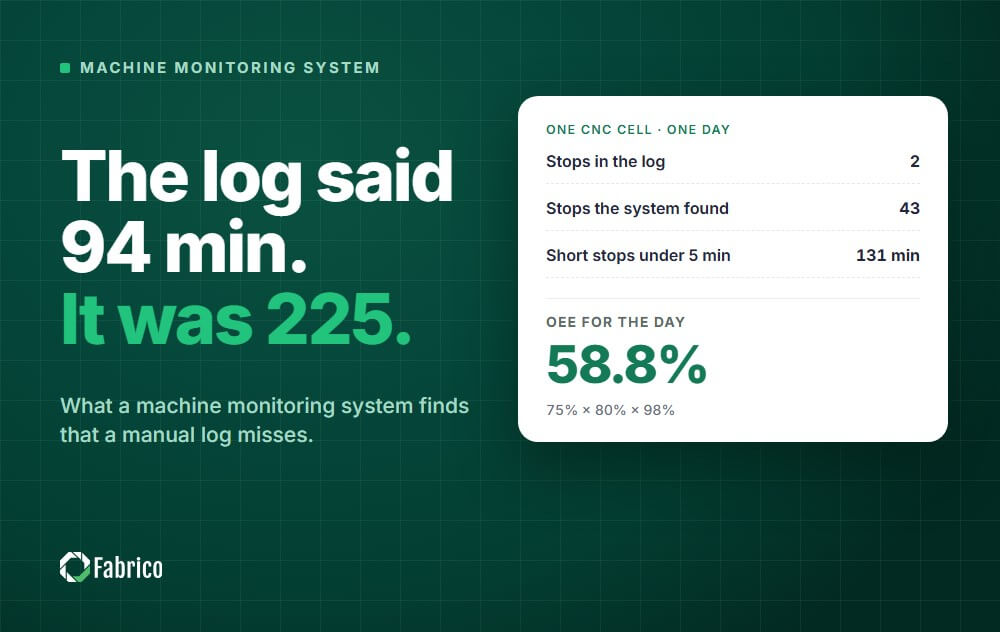
The operator log for a typical day records two stops: a 52 minute tool breakage and a 42 minute wait for material. That is 94 minutes of downtime, so on paper the machine ran 806 minutes.
The machine monitoring system, reading the cycle signal, shows something different:
Now the OEE calculation is straightforward:
The manual log accounted for 94 minutes of lost time. The system found 225, and the real picture is that short stops cost more time than the breakdown, while a slow cycle cost another 135 parts. Both are fixable, but only once someone can see them.
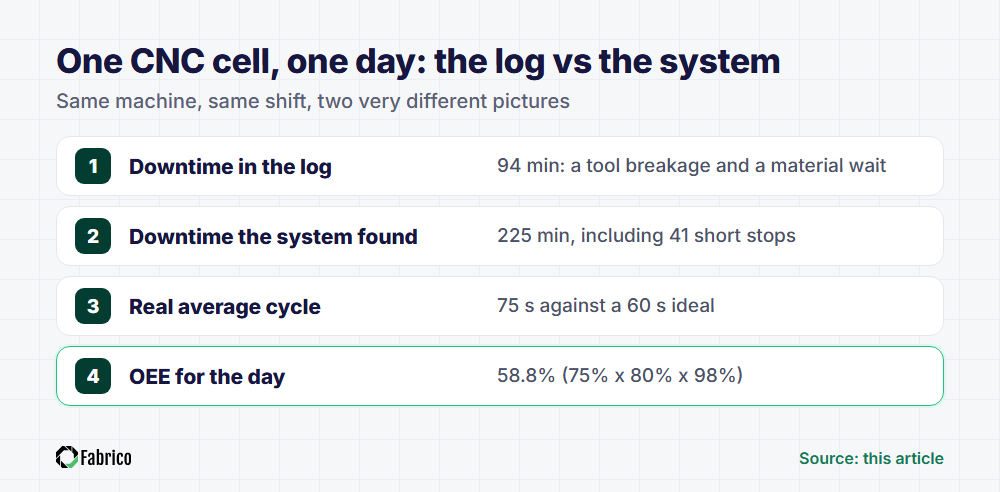
One note on method: here every stop the system detected counts against availability. Many OEE guides, including our OEE calculation guide, book stops of a few minutes as performance loss instead.
Done that way, availability is 806 / 900 = 89.6% and performance is 540 / 806 = 67%, and OEE comes out at the same 58.8%. Either rule works, as long as you write it down and use it on every machine.
The business case comes from the same timeline. Take the time you expect to recover and multiply it by what one extra hour on that machine is worth to you: the margin on the parts it makes if you are sold out, or the overtime and outsourcing you avoid if you are not.
In the example above, halving the short stops alone returns about 65 minutes a day, which is roughly 52 more parts at today's 75 second cycle. Count only time on a machine that limits output; an hour saved on a machine that waits for work is not worth much.
These terms overlap and vendors use them loosely. Here is how they differ in practice:
| System | Main question it answers | Typical data |
|---|---|---|
| Machine monitoring | Is the machine running, and if not, why and for how long? | States, stops, counts, cycle times, alarms |
| Condition monitoring | Is the machine healthy, or is a component wearing out? | Vibration, temperature, oil analysis, ultrasound |
| Production monitoring | Is the line or plant hitting its output targets? | Output by line, shift, product and order |
| OEE software | How well did the equipment perform against its potential? | Availability, performance and quality losses |
| MES | Is each production order being executed, tracked and documented correctly? | Orders, dispatching, genealogy, quality records |
Machine monitoring is the foundation layer. Production monitoring rolls it up by line and order, OEE scores it, and a full MES adds order execution and traceability on top.
Many plants that start out searching for an MES discover that what they need first is reliable machine data and OEE, and that the rest can wait. Our comparison of production monitoring and OEE covers where each one stops being enough.
Most machine monitoring solutions demo the same way: a colorful dashboard of green and red machines, updating in real time, viewable remotely from a phone or an office screen. The differences show up after go live. Ask about these six points:
The link to your ERP or MES should run in both directions. Order data flows in: which product is running, the quantity and its ideal cycle time, so every run is scored against the right target.
Results flow back out: actual run time, good parts and scrap per order, so costing and quoting use real figures instead of estimates. Ask each vendor which direction they support, and whether it is a standard connector, an API or a file export.
Expect questions from IT and OT security early. Where does the data go: a cloud service, a server on site, or both? Does the connection to the machines sit on a separate machine network, and which ports need to open?
Does the device on the machine only read, or can it also write? And what happens to the data if the network drops for an hour? Clear answers here save weeks during rollout.
Fabrico connects to machines through PLC connectivity, IoT sensors for older equipment and computer vision cameras for losses that leave no signal, and turns the result into real-time OEE dashboards, downtime records and short stop detection.
Because Fabrico is also a full CMMS, a recurring stop does not end as a chart: the team can open a work order from the same machine record, attach parts and track the fix, and the AI assistant can answer questions about one machine's history in plain language.
If you want to see what your own machines are doing minute by minute, book a demo and bring the machine you trust least.
They mean the same thing in practice. "Machine monitoring" is the activity of tracking machine state and output automatically; a "machine monitoring system" is the combination of connection hardware and software that does it. Searches for "machine monitoring software" usually refer to the software layer alone.
Yes. Retrofit sensors such as current clamps, stack light sensors and part counters can detect running, stopped and cycle events on almost any machine, and cameras can cover processes with no electrical signal at all. The data is slightly less detailed than a direct PLC connection, mainly around stop reasons.
The first timeline appears as soon as a machine is connected. A reliable baseline usually needs around 30 days, so that you see a full range of products, shifts and changeovers before setting targets.
A monitoring system provides the inputs: run time, planned time, part counts and good parts. Many systems, including Fabrico, calculate OEE from those inputs automatically. If a system only shows states and counts, you can still calculate OEE yourself with the standard formula.
It depends on how it is introduced. Machine monitoring is built to measure machines, not people, and cameras need clear rules on what is filmed, who sees it and how long it is kept.
The fastest way to build trust is to use the first month's data to remove problems operators already complain about, such as material shortages and recurring jams. Our article on production line cameras without surveillance covers this in more depth.
See how Fabrico unifies OEE and maintenance in one platform.
Request a demo










 Login
Login
 Blog
Blog