







 Login
 Blog
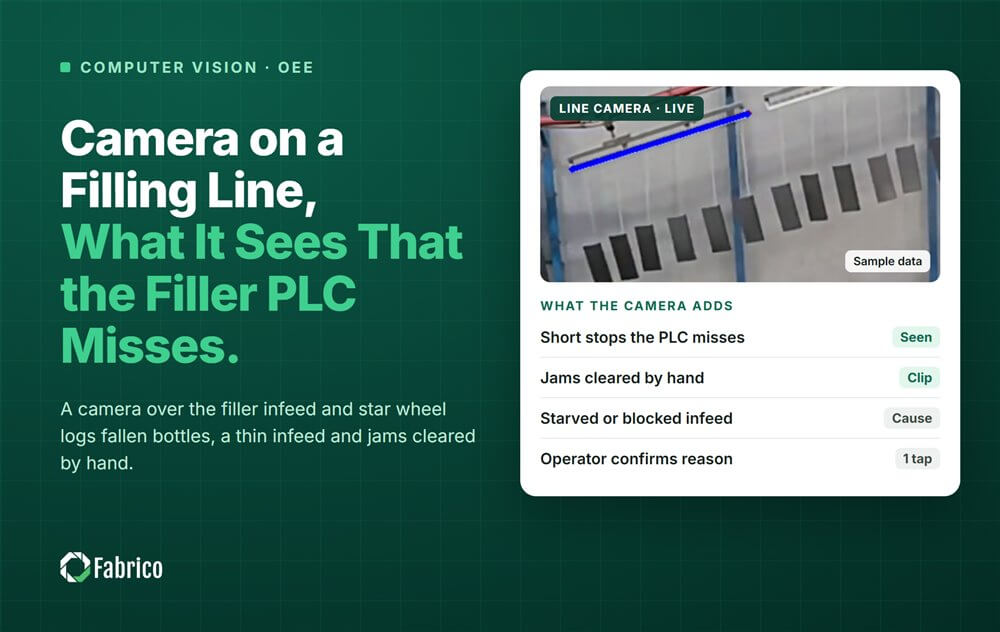
Camera on a Filling Line: What It Sees That the Filler PLC Misses

Key takeaways
- The filler PLC is the clock. A camera over the infeed is the witness: it shows fallen bottles, a thin infeed and jams cleared by hand.
- Many of these stops last under 60 seconds, so the OEE tool files them as speed loss.
- Each camera event gets a short clip, and the operator confirms the reason in one tap.
- Starved minutes belong to the machine upstream, not to the filler crew.
- On a sample filler, two stop types the PLC never logged were worth $315,000 a year.
A camera on a filling line watches the bottles, not the controller. Over the infeed and the star wheel, it records the stops the filler's PLC (programmable logic controller) misses or mislabels.
Fabrico is OEE (overall equipment effectiveness) and light MES (manufacturing execution system) software, with AI cameras as an add-on. Each camera event lands on the filler's timeline with a short clip and a reason the operator confirms in one tap. For the filler's OEE math, see our guide to filler OEE on a bottling line.
What does a camera see on a filler that the PLC does not?
The PLC knows the machine state: the motor ran, a fault bit went high, a guard opened. It does not know whether bottles were there to fill, or what jammed.
| Event on the filler | What the PLC records | What the camera adds |
|---|---|---|
| A bottle falls on the infeed | Nothing, or a short stop | The fallen bottle and the seconds lost |
| The infeed runs thin | Often "running", at a lower speed | Gaps in the infeed, so the minutes are starved, not slow |
| A jam in the infeed star wheel | One generic jam or overload fault | What jammed: a crushed bottle, a bad neck, a fallen bottle |
| A pause under the logging threshold | A stop the OEE tool filters out | The event, its clip and its count |
| The outfeed table is full | "Stopped" or "waiting" | Bottles backed up, so the minutes are blocked |
The PLC is the clock and the camera is the witness. You need both. Our comparison of computer vision and PLC data shows when each one wins.
Where should the camera point on a filling line?
Start with one fixed camera over the infeed: the last metres of the conveyor, the timing screw and the infeed star wheel. Most filler short stops start there, and that is where the PLC tells you least.
- Look down on the bottle path, with the whole infeed in one frame.
- Keep faces out of the frame. The view is bottles and guide rails.
- Avoid glare and spray. Wet surfaces, washdown water and steam cause false events.
- Check the view after a format change. New change parts change the scene.
An outfeed camera is optional: a back-up sensor usually shows blocked time already.
Which filler stops does the camera catch?
Four kinds of stop make most of the difference, and each one has a different owner.
Fallen bottles at the infeed
Light bottles tip over at a transfer or the screw entry. The operator stands them up. The filler pauses, or runs on with a gap.
In a published case study, New Belgium Brewing found its filler full of micro stops from bottles falling or hanging on rails.
Infeed starvation
When supply runs thin, many fillers slow down before they stop. The run bit stays high, so the PLC says "running". The camera shows the gaps.
Those minutes are starved. They belong upstream, often to the blow moulder. Our guide to starvation and blocking shows how to charge them there.
Jams cleared by hand
A bottle wedged in the star wheel trips the overload. The operator opens the guard, pulls it out and restarts. The PLC logs one generic jam code.
The clip shows what was in there. A crushed bottle, a deformed neck and a fallen bottle each need a different fix.
Short stops under the logging threshold
Many OEE tools ignore stops under 60 seconds, so these minutes land in Performance as speed loss. No standard sets the cutoff. The camera counts each stop, with its clip, whatever the threshold.
At the filler, seconds add up. Siemens puts a lost hour in FMCG (fast moving consumer goods) at $36,000 (True Cost of Downtime 2024). More in our guide to micro stops and computer vision.
How does a filler stop become a reason and a clip?
- The stop is marked. The filler signal or the camera marks its start and end.
- The clip is saved. A short clip of the event is attached to the stop as evidence.
- The screen suggests a reason. The operator accepts it or picks another, in one tap.
- The stop joins the OEE timeline with its minutes, its owner and its cost.
The camera suggests and the operator decides. A false alarm costs a few seconds of review. A missed stop costs the loss itself.
Worked example: what do hidden filler stops cost on a sample line?
Sample line (illustrative numbers, not a customer): a rotary filler on a 0.5 litre water line, rated at 400 bottles a minute. Each shift has 450 planned minutes, and the OEE tool ignores stops under 60 seconds.
| What happened | Stops | Minutes | In the PLC log | Charged to |
|---|---|---|---|---|
| Capper fault, blocked by labeller, starved by blow moulder | 3 | 42 | Yes, right reason | Capper, labeller, blow moulder |
| Star wheel jams cleared by hand | 5 x 2 minutes | 10 | Yes, as "infeed jam" | 3 neck defects: blow moulder. 2 fallen bottles: infeed |
| Fallen bottles stood up by hand | 18 x 40 seconds | 12 | No, under 60 seconds | Infeed conveyor and guides |
| Infeed running thin, filler slowed or paused | 12 x 45 seconds | 9 | No, run bit stayed high | Blow moulder (starved) |
| Total | 38 | 73 |
- The PLC saw 42 + 10 = 52 stopped minutes. Availability = (450 minus 52) / 450 = 398 / 450 = 88.4%.
- The PLC called the other 398 minutes "running". The camera found 12 + 9 = 21 of them stopped or starved: 21 / 450 = 4.7% of the shift.
- 21 minutes x 400 bottles = 8,400 bottles a shift.
- At a contribution of $0.05 a bottle (or €0.05 in a euro plant): $420 a shift. Over 750 shifts a year: $315,000.
- Fallen bottles: 12 x 400 = 4,800 bottles, $240 a shift, $180,000 a year, for the filler crew.
- Thin infeed: 9 x 400 = 3,600 bottles, $180 a shift, $135,000 a year, for the blow moulder.
- The clips moved 3 x 2 = 6 of the 10 jam minutes from "infeed jam" to neck defects, a blow moulder problem.
The filler crew got 12 minutes a shift to fix with guides and transfers. The blow moulder team got 9 + 6 = 15 minutes that used to sit on the filler's books.
The money counts only if the line is sold out, or the lost bottles cost overtime to make up. Agree that rule with your controller first.
What can a camera on a filler not do?
- It sees one field of view, not the inside of the filler or the whole line.
- It works in a lighting range. Glare, spray and steam cause errors.
- It can be blocked by a hand or a tool in front of the lens.
- It needs a check after changes to guides or change parts.
- It does not decide the cause alone. It suggests, and the operator confirms.
How do you keep the camera on the bottles, not the operator?
Point it at the bottle path and report OEE by line and shift, never by named operator. The clip shows the bottle, not a person to judge.
In Germany and France, the works council will ask about this first. Agree who sees clips and why before the first camera goes up. Our guide to production line cameras without surveillance covers the steps.
Where Fabrico fits
Fabrico is a computer vision enabled Manufacturing Performance Platform. OEE and light MES come first, and cameras are an add-on.
- Automatic downtime logging from the filler's machine signal.
- A camera clip as evidence for a stop at the infeed and the star wheel.
- The operator confirms the reason in one tap.
- Every loss priced in money and losses ranked by money.
- OEE live by line and shift, and one view across plants.
Named result: Ficosota, a Fabrico customer; the numbers are in the Ficosota story.
You start with a pilot on one line, with a baseline and a decision date agreed in advance. Devices are connected in about a month, and the full rollout takes 3 to 4 months. There is no free plan and there are no tiers: each plant gets a quote. See the computer vision OEE and MES page.
Frequently asked questions
Can a camera on a filler replace the PLC signal?
Not on a modern filler. The PLC gives exact machine states and fault codes. The camera adds what the PLC cannot see: fallen bottles, gaps in the infeed and what jammed. On an old filler with no usable controller, a camera can be the main signal for stops and counts.
Does the camera decide why the filler stopped?
No. It suggests a reason from what it saw, such as a fallen bottle or a thin infeed. The operator confirms it in one tap, and the clip stays with the stop as evidence for the daily meeting.
Should starved minutes count against the filler?
Show them in the filler's full OEE, because the line lost those bottles. But charge them to the machine upstream that ran short first. The clip of the empty infeed is the proof, so the filler crew is not blamed for a supply problem.
Does a camera on the filler watch the operators?
It should not. Point it at the bottle path, keep faces out of the frame and report by line and shift, never by person. In Germany, a works agreement is needed before the first camera goes up, even for a camera that records nothing.
See your filler's hidden stops in a demo
Bring one filling line and its last shift report. We will show where its short stops hide and what each one costs.
Latest from our blog
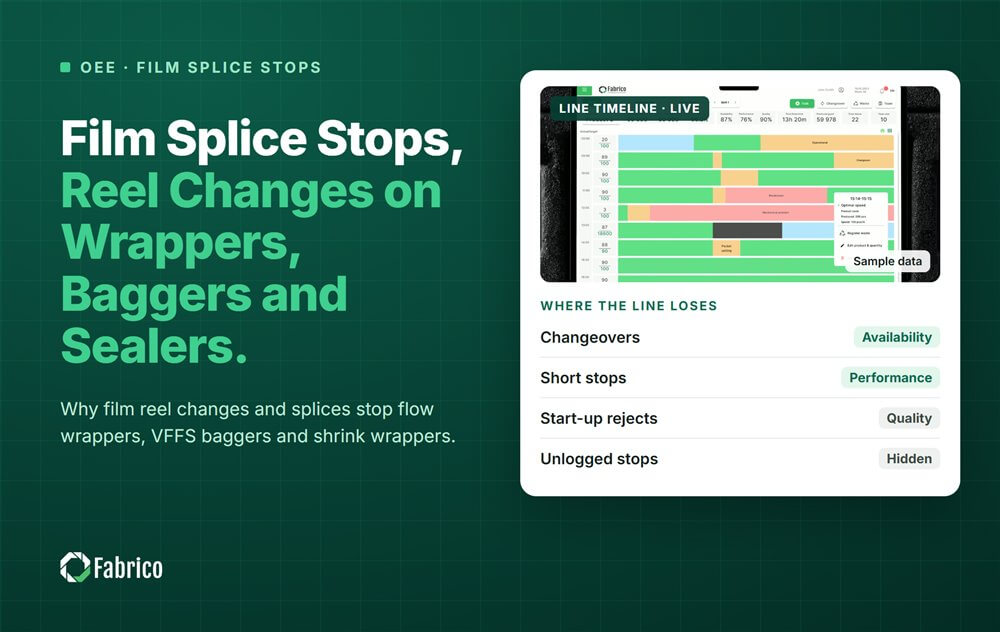
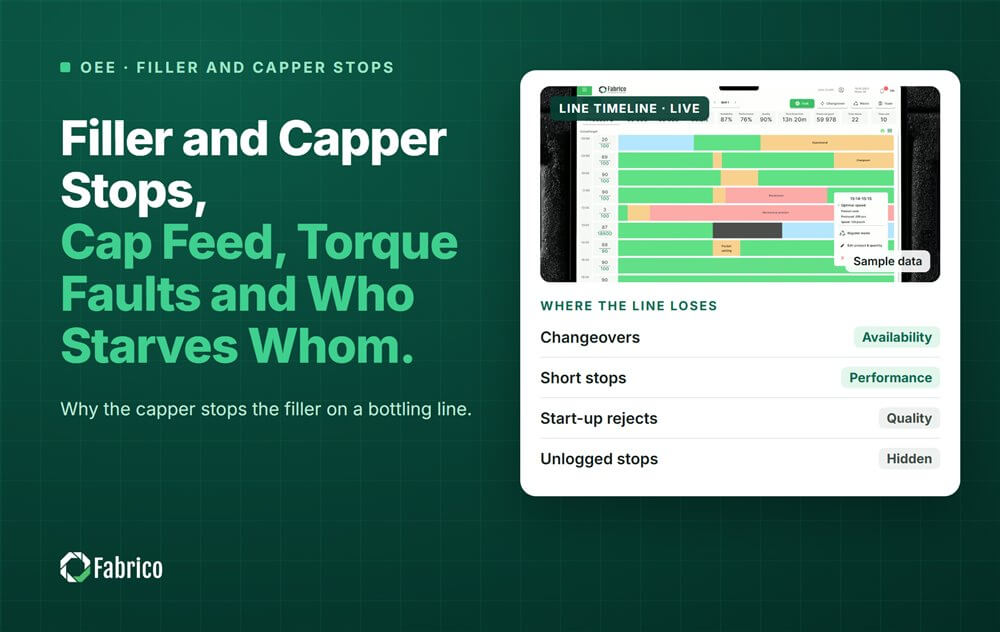
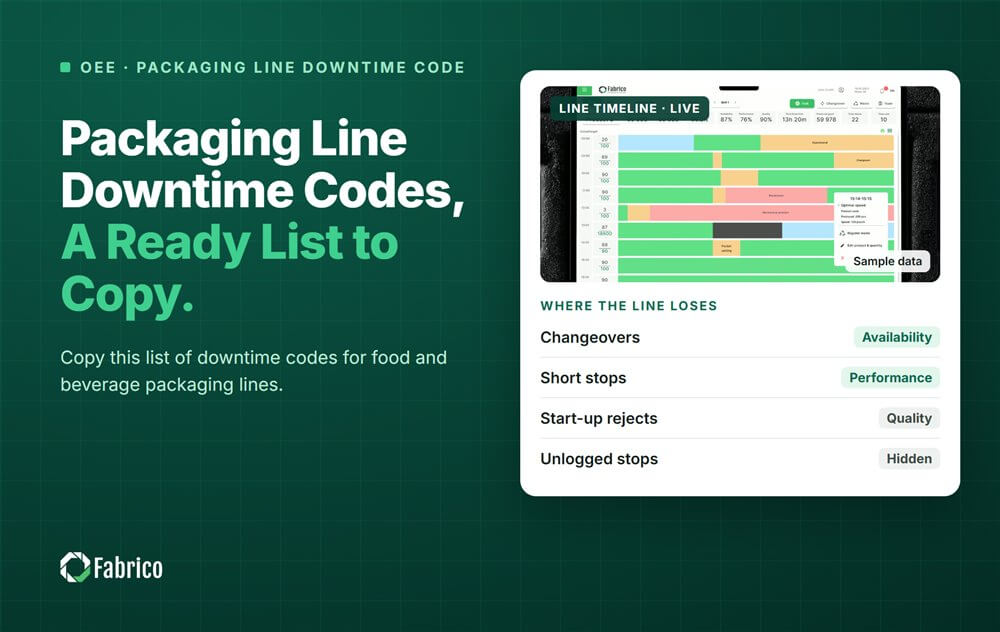
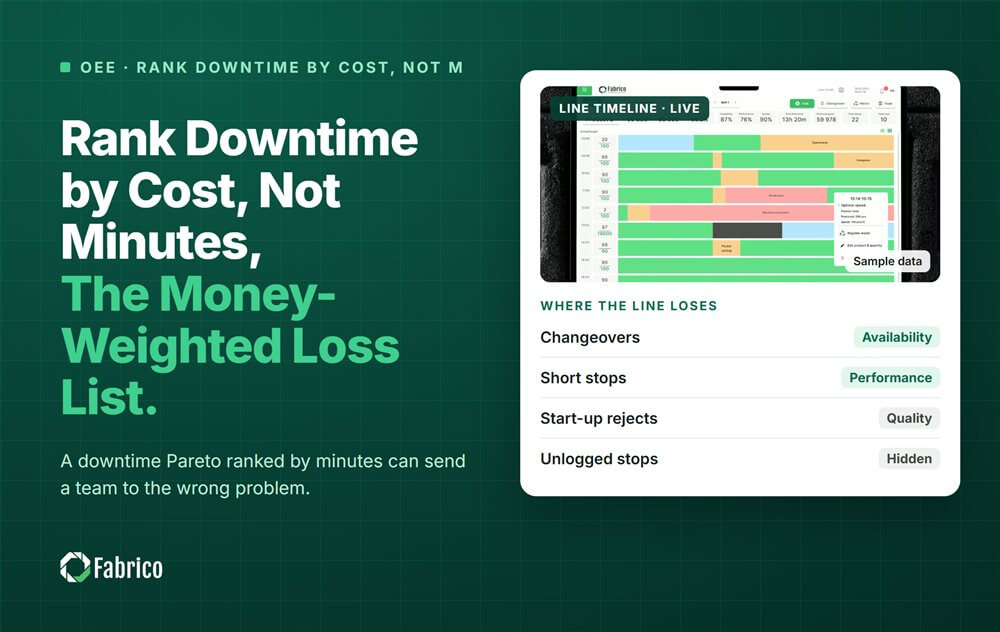
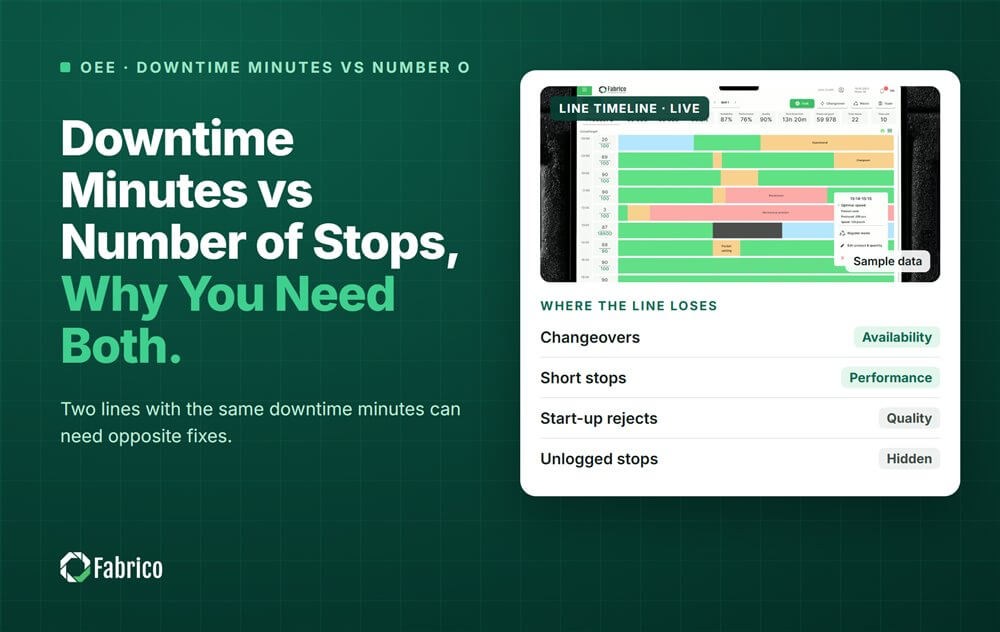



Real Fabrico tiles, sample data.