







 Login
 Blog
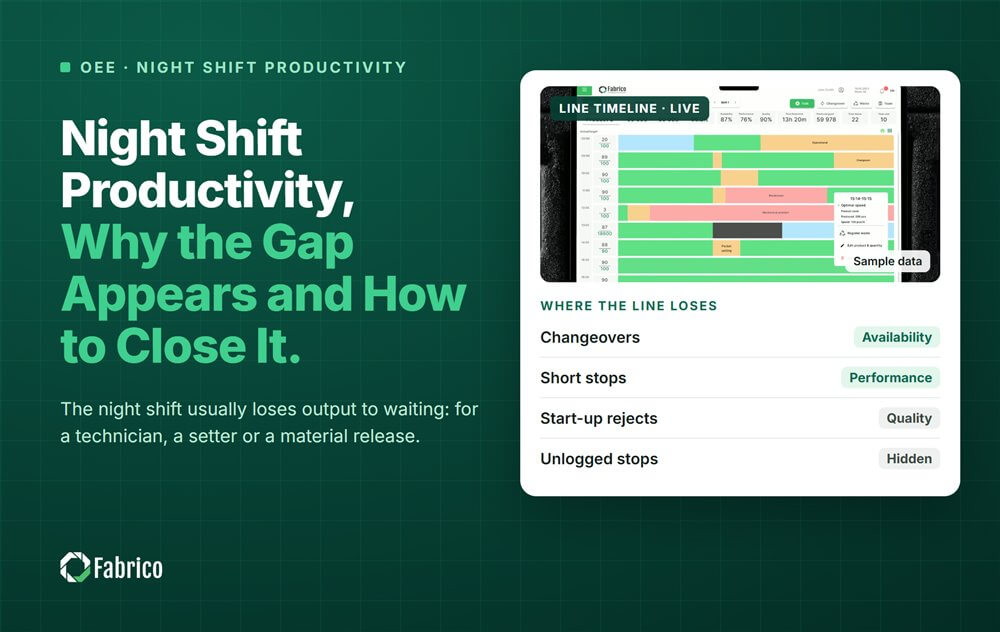
Night Shift Productivity: Why the Gap Appears and How to Close It

Key takeaways
- Night output is often lower, but the crew is rarely the cause.
- The usual cause: fewer support staff at night, so each stop takes longer to clear.
- Compare day and night on the same rules and the same products, split by cause.
- Fix response times and preparation first. Then look again.
Many plant managers know the feeling. The day shift hits the plan, the night shift falls short, and the morning meeting turns into an argument about who tried harder.
Fabrico, OEE and light MES software with AI cameras, compares shifts by line and by cause from the machine signal. This guide shows where the night shift gap usually comes from, how to measure it fairly and what closes it.
Is night shift productivity really lower?
Often, yes, but check the comparison first. Many night gaps shrink or vanish once both shifts are measured on the same rules.
- Does the night shift run the same products? Long runs by day and many small changes by night are not a fair test.
- Is planned time the same? A clean booked as planned on one shift and as a stop on another skews the result.
- Is the count taken at the same machine, the bottleneck?
Our guide to fair OEE comparison across shifts lists the rules to agree before you compare.
Why does the night shift lose more output?
Look at who is not in the building at 3 am. Fewer engineers, setters, quality staff and forklift drivers means more time spent waiting.
- Longer wait for a technician. The repair takes the same time; finding someone takes longer.
- Changeovers without a setter. The crew does it alone, or waits.
- Material and release waits. Nobody to approve a new batch of film or release product after a check.
- A weak handover. The night starts without knowing what the day left open.
Fatigue is real too. But it is hard to see in line data, and the waits above are easy to see. Start with the losses you can measure.
Worked example: how big is the night shift gap?
Sample line (illustrative numbers, not a customer): a filler rated at 400 bottles a minute. Both shifts have 450 planned minutes and run the same SKU. Both have 3 breakdowns, and each repair takes 10 minutes once the technician arrives.
| Loss | Day minutes | Night minutes | Difference |
|---|---|---|---|
| Breakdowns: wait plus repair | 3 x 16 = 48 | 3 x 30 = 90 | 42 |
| Changeover | 35 | 50 | 15 |
| Micro stops | 20 | 20 | 0 |
| Material or release waits | 0 | 15 | 15 |
| Total lost | 103 | 175 | 72 |
- Day run time = 450 minus 103 = 347 minutes. Night run time = 450 minus 175 = 275 minutes.
- Both shifts run at 92% Performance and 98% Quality when the line runs.
- Day OEE = 347 / 450 x 92% x 98% = 69.5%.
- Night OEE = 275 / 450 x 92% x 98% = 55.1%.
The gap is 14.4 points. Yet the breakdowns, repair times, micro stops and speed are the same. All 72 extra minutes are waiting.
Those 72 minutes cost 72 x 400 x 92% x 98% = about 25,970 bottles a night. At a sample contribution of $0.05 a bottle, that is about $1,300 a night. In a euro plant at €0.05 a bottle, it is about €1,300.
How do I compare day and night shifts fairly?
Split every shift's lost time into the same buckets. Then compare bucket by bucket, not just the final OEE.
- Agree one set of rules for planned time, rated speed and good units.
- Log waiting time apart from repair time. "Waiting for technician" needs its own reason code.
- Compare the same SKU, or weight the targets by SKU.
- Look at four weeks, not one night. One bad night is noise.
Our guide to the OEE shift comparison method shows the full method. Where a camera watches the line, a clip of the stop helps too. See comparing shifts with video evidence.
What closes the night shift gap?
Attack the waits, in order of the minutes they cost.
- Set a response rule for nights. Who is on call, how fast they must answer, and who is called next if they do not.
- Prepare night changeovers by day. Parts on a trolley, settings written down, film and labels staged.
- Give the night lead decision rights. Let them release a restart after a standard check, instead of waiting for the morning.
- Stage materials before the day shift leaves. Enough film, caps and cases for the first hours.
- Run a real handover. Open issues, machine state and the first hour target. Our shift handover checklist covers it.
Should I compare night shift crews by name?
No. Compare shifts and lines, not people. In the sample, the night crew did the same work as the day crew; the system around them made them wait.
A ranking by name also kills honest stop logging. People stop writing down the reason when the data is used to blame them. Measure the process, never the person.
How do I know the fix held?
Take a baseline of four weeks before the change, by shift and by loss bucket. Make one change at a time, then measure the same buckets for four more weeks.
If waiting for a technician falls and the night OEE rises with it, the fix worked. If the OEE rises but the waits do not, check whether the product mix changed.
Where Fabrico fits
Fabrico is a computer vision enabled Manufacturing Performance Platform. OEE and light MES come first. It shows the night shift gap by cause, not by crew.
- Automatic downtime logging, so night stops are counted even when the crew is busy fixing them.
- The operator confirms the reason in one tap, including "waiting for technician".
- A camera clip as evidence for a stop, which protects the crew as much as it informs the manager.
- OEE live by line and shift, so the gap is seen during the night, not the next morning.
You start with a pilot on one line. There is no free plan and there are no tiers: each plant gets a quote. See how stops are caught on our computer vision OEE page.
Frequently asked questions
Why is night shift output lower?
Usually because of waiting, not effort. Fewer technicians, setters, quality staff and forklift drivers work at night, so each stop or changeover takes longer to resolve. Products and planned time can also differ between shifts. Split lost time by cause before you decide the night crew is the problem.
How do I measure night shift productivity?
Use the same OEE rules on every shift: the same planned time, rated speed and good unit count. Then split lost minutes into buckets such as breakdowns, waits, changeovers and micro stops. Compare each bucket between day and night over four weeks, on the same products.
What is a normal gap between day and night shift OEE?
There is no standard figure. It depends on staffing, products and support at night. What matters is the cause. A gap made of waiting for people can be closed with response rules and preparation. A gap made of different products is not a real gap.
Should changeovers be scheduled on the day shift?
Where the plan allows it, yes. Setters and engineers are usually on days, so changeovers finish faster. If a change must happen at night, prepare it on days: parts staged, settings written down and materials ready, so the night crew only does the steps that need the line stopped.
Can cameras help compare shifts fairly?
Yes, as evidence. A clip of a stop shows what happened, so day and night can see the same facts. The camera suggests what it saw, and the operator confirms the reason in one tap. The clip is about the machine and the process, never about rating a person.
Bring four weeks of shift data to a Fabrico demo. We will split your night gap by cause, or contact us with a question.
Latest from our blog


Real Fabrico tiles, sample data.