


 Login
 Blog
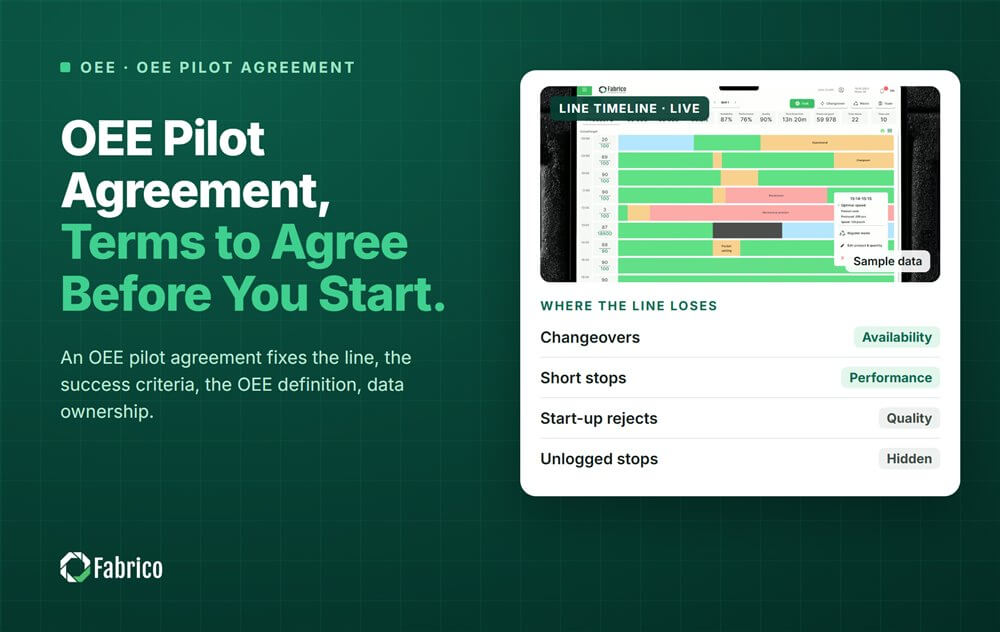
OEE Pilot Agreement: Terms to Agree Before You Start

Key takeaways
- An OEE pilot agreement is one page of terms, signed before any device goes in.
- Scope it to one line, with the machines, shifts and products named.
- Agree the success criteria and the OEE definition up front, so nobody moves the goalposts later.
- Book the decision meeting at kickoff, with the people who will decide.
- Agree what happens to devices and data after a no, while everyone is still friendly.
An OEE pilot agreement is one page of terms that the plant and the vendor sign before the pilot starts. It names the line, the success criteria and how OEE (overall equipment effectiveness) is counted. It also says who owns the data, who does what, the decision date and what happens after a no.
Picture line 3 at the end of a trial. The screens work and the operators like them. Then someone asks: did it succeed? Nobody can say, because nobody wrote down what success meant.
This guide is for plant managers, CI (continuous improvement) leads and IT teams about to start a pilot. It comes from Fabrico, a vendor of OEE and light MES software with computer vision on stops. Read it as a buyer's checklist that works with any vendor.
Why does an OEE pilot need a written agreement?
Because many pilots do not fail on the technology. They stall, and nobody decides what happens next.
McKinsey called this pilot purgatory. In 2018, McKinsey found that less than a third of manufacturers (30%) had moved digital programs from pilot to scale. In the same 2018 work, 92% felt level with or ahead of their peers.
A one-page agreement turns a vague trial into a test with a question, a measure and a date.
What should the pilot scope include?
One line, named in full. A pilot spread over three lines gives you three half-finished projects and no clear answer.
- The machines, from the first to the last, including the bottleneck.
- The shifts. Include the night shift if it runs, because losses often hide there.
- The products that run during the pilot, with their pack sizes.
- How each machine connects: its PLC (programmable logic controller), a small IoT device on a signal, a camera, or manual entry.
- What is out of scope: other lines, links to the ERP, custom reports.
How do you define success before you start?
Write the success criteria down before the first device is installed. If you agree them afterwards, each person picks the measure that suits their view. Good criteria test three things:
- The data is right. The stop log matches what the line lead saw on spot checks.
- People use it. Operators confirm stop reasons, and the shift meeting uses the screen.
- It led to action. The top losses are ranked by money and at least one fix is closed.
Be careful with an OEE target as the only criterion. A pilot often makes OEE look worse at first, because the machine counts stops that paper missed. Our guide on why your OEE number is wrong explains the gap.
How will the OEE number be counted?
Fix the inputs in the agreement. OEE is Availability x Performance x Quality, and the arguments always come from the inputs.
- Ideal cycle time per product, the fastest the machine can make one unit. The nameplate rate or the best rate the line has shown? Write down which. Our guide to ideal cycle time compares the two.
- Planned stops. List what counts as planned, such as breaks. Everything else is a loss.
- Minor stops. No standard sets the cutoff for a minor stop, so the plant picks one and keeps it.
- Good count. Reworked units should not count as good.
Christoph Roser describes three classic fudges: breakdowns booked as planned stops, a good day's speed taken as the ideal, and rework counted as good. A written definition blocks all three. See our downtime definitions that keep OEE honest.
Who owns the data, and who does what?
Data ownership
The plant should own its production data, during the pilot and after it. Then add where the data is hosted, who can see it, what leaves the plant network and who may view camera clips.
Cameras need their own line. In Germany, section 87(1) no. 6 BetrVG gives the works council a say over equipment that can monitor behaviour or performance. Show OEE by line and shift, never by named operator. Our works council guide has the steps.
Roles
- Plant sponsor, usually the plant manager: the decision and the date.
- Line owner: the shift routine with the new screen.
- CI lead: the definitions and the numbers.
- IT/OT: the network path, accounts and the security review.
- Vendor: install, setup, training and a named contact.
When do you decide, and what happens after a no?
The decision meeting
Book the decision meeting at kickoff, and put the date in the agreement. Name the three outcomes: scale to the next lines with the same definitions, extend once with a written reason, or stop.
The exit terms
- Who removes the devices and cameras, by when, and who carries that cost.
- A full export of the plant's data, such as a spreadsheet.
- Deletion of the data by the vendor, confirmed in writing.
- Closed user accounts and remote access.
A vendor who resists clear exit terms is telling you something. A confident vendor wants an honest test.
A worked example: one page of pilot terms
Sample line (illustrative numbers, not a customer): line 3 of a snack plant with 6 lines. It is a bagging line with a weigher, a bagger, a checkweigher and a case packer.
| Term | What the sample plant agreed |
|---|---|
| Scope | Line 3 only, both shifts, all 4 bag sizes. No ERP link. |
| Data sources | Bagger and checkweigher by PLC. Weigher by an IoT device. The old case packer by a camera. |
| Baseline | Paper reports, last 4 weeks: OEE 58%. First week of trusted machine data: OEE 51%. |
| Success criteria | Stop log matches spot checks on 18 of 20 stops. A reason confirmed for 90% of stops over 2 minutes. Screen used in each shift meeting. Top 3 losses ranked in money, 1 fix closed. |
| OEE definition | Ideal rate per bag size from the nameplate. Planned stops: breaks and the weekly deep clean only. Stops under 2 minutes are minor stops. Rework counts as bad. |
| Data | Owned by the plant, hosted in the EU, export on request. Clips seen by the line lead, CI lead and maintenance only. Works agreement first. |
| Decision | Booked at kickoff with the plant manager, production, CI, IT/OT and finance. Scale to lines 1 and 2, extend once, or stop. |
| Exit after a no | Devices removed within 10 working days. Full export, then deletion confirmed in writing. |
- Spot check target: 18 / 20 = 90% of sampled stops must match the line lead's notes.
- Reason target: if 200 stops run over 2 minutes, 200 x 0.90 = 180 need a confirmed reason.
- Baseline gap: 58% minus 51% = 7 points, the stops that paper never recorded.
The plant wrote that 7 point drop into the sheet before the start. So when OEE fell in week one, nobody called it failure. It was the stops paper had missed, and the first losses to price.
Mistakes plants make with OEE pilot agreements
- No written success criteria, so the result is judged on feelings.
- An OEE target as the only test, set before anyone knows the real baseline.
- OEE definitions left to the vendor's defaults.
- No decision date, so the trial drifts on.
- No exit terms, so a no becomes awkward for both sides.
Where Fabrico fits
Fabrico is a computer vision enabled Manufacturing Performance Platform. OEE and light MES come first, with every loss priced in money.
- A pilot on one line: one line, one baseline, one decision.
- Automatic downtime logging: the stop log comes from the machine signal, not from memory.
- The operator confirms the reason in one tap: where a camera watches, it suggests a reason and the clip stays as evidence.
- Losses ranked by money: the success criterion about action has a list to act on.
You start on one line, with a baseline and a decision date agreed in advance. Devices are connected in about one month, and the full rollout takes 3 to 4 months. There is no free plan and there are no tiers: each plant gets a quote.
See how stops are captured on the computer vision OEE page.
Frequently asked questions
What is an OEE pilot agreement?
It is a short written agreement between a plant and an OEE software vendor, signed before a pilot starts. It names the line, the success criteria, the OEE definitions, data ownership, roles, the decision date and the exit terms. One page is enough for most plants.
How long should an OEE pilot run?
There is no standard length. Run it until the data is trusted and the team has used it in real shift meetings. What matters is that the decision date is set before you start, so the trial cannot drift without a yes or a no.
Who should sign the pilot agreement?
The plant sponsor signs, usually the plant manager. IT approves the data and network terms, and finance agrees how losses are priced. On the vendor side, the signer should be able to commit people and dates, not only a salesperson.
Should OEE go up during a pilot?
Not always at first. Machine data often shows more stops than paper did, so the first OEE can look lower. Judge the pilot on trusted data, real use at the line and closed actions. The gains come from the fixes that follow.
What happens to our data if we stop the pilot?
Whatever the agreement says, so write it down. A fair term gives the plant a full export, then has the vendor delete the data and confirm in writing. Devices are removed by a named party by a named date, and accounts are closed.
Bring your pilot terms to a demo
Bring one line and your draft terms. We will show how the baseline, the stop reasons and the losses in money would look on that line.
Latest from our blog


Real Fabrico tiles, sample data.