


 Login
 Blog
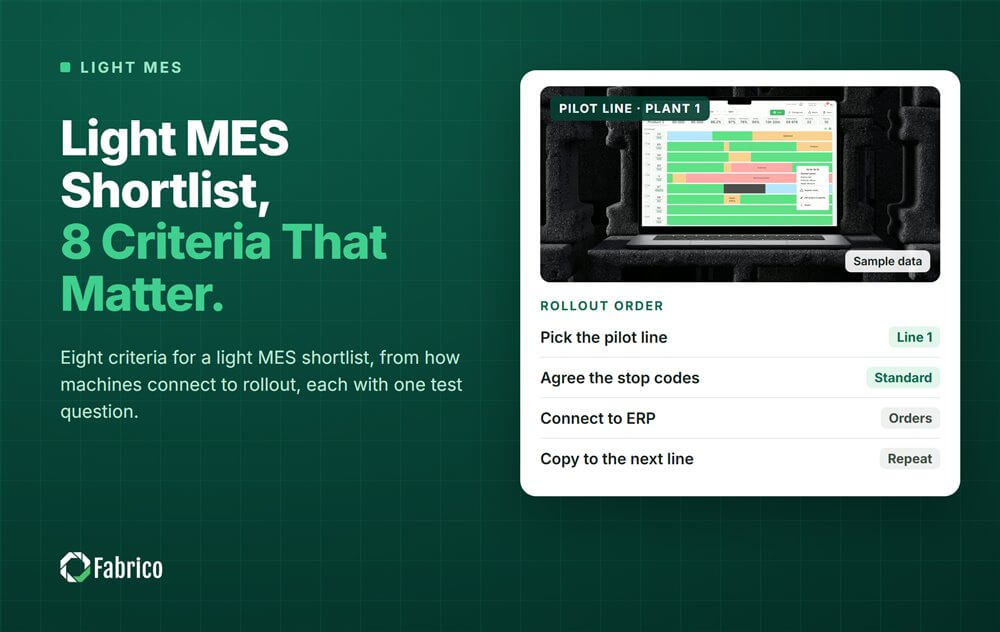
Light MES Shortlist: 8 Criteria That Matter

Key takeaways
- A light MES shortlist should test 8 criteria, from how machines connect to rollout and support, each with one question.
- The vendor answers each test question live, on your data where possible.
- A light MES watches the machines and leaves orders and stock to the ERP.
- Make a few criteria pass or fail, then weight all 8 so they total 100 points.
- Rank only the options that pass every must-have.
The short answer: shortlist a light MES on 8 criteria, and test each one with a question the vendor must answer live. The criteria are how machines connect, OEE logic, stop reasons and losses in money. Then come shop floor screens, one view across plants, what stays in the ERP, and rollout and support.
On night shift the labeller stops for the fourth time. The supervisor wants to know which machine cost the most this week. A light MES should answer that from the line screen, not from a spreadsheet someone builds on Monday.
A light MES is the part of an MES (manufacturing execution system) that watches the machines. It logs stops, shows OEE by line and shift, prices the losses, and leaves orders and stock to the ERP.
This guide is for plant managers and continuous improvement leads choosing one. It comes from Fabrico, a vendor of OEE and light MES software with computer vision on stops.
Which 8 criteria should a light MES shortlist test?
Use these 8, each with the question that tests it. Ask the question in the demo and watch the answer on screen.
| Criterion | Test question |
|---|---|
| 1. How machines connect | How does each machine on our line send its state and count: PLC, IoT device, camera or manual entry? |
| 2. OEE logic and definitions | Show us where ideal cycle time and planned stops are set, and how OEE is calculated. |
| 3. Stop reasons the operator confirms | How does an operator confirm a stop reason at the line, and how long does it take? |
| 4. Losses in money | Show last week's losses ranked by what they cost, not only by minutes. |
| 5. Shop floor screens | What does the line screen show the night shift, and can they read it from the machine? |
| 6. One view across plants | Can two plants use the same definitions and be compared on one screen? |
| 7. What stays in the ERP | What do you read from the ERP, what do you send back, and what never leaves it? |
| 8. Rollout and support | Who does what in the rollout, and who answers when a line stops logging at night? |
PLC means programmable logic controller, the machine's own control box. OEE (overall equipment effectiveness) needs agreed definitions, and our guide to OEE under ISO 22400 shows the standard terms.
What should a light MES leave to the ERP?
A light MES should leave orders, stock and costing to the ERP. It works at the line, in shifts, hours and minutes. The ERP works in days, weeks and months.
- Often read from the ERP: the product list, and sometimes which order runs on which line.
- Often sent back: good counts and scrap per shift, as a summary.
- Stays in the ERP: purchasing, stock, invoicing and the cost ledger.
Keep the link small at the start. A light MES that needs a two-way, real-time ERP link before line one goes live has stopped being light. Our guide to the difference between ERP and MES explains the split.
How do I test each criterion in a demo?
Make the vendor show, not tell, on your own material where you can.
- Send your machine list, stop reason list and one shift of counts before the demo.
- Bring a short video of a real stop, such as a jam at the case packer, and ask how it would be logged.
- Ask the operator question to an operator: hand them the screen and see if they confirm a stop in one tap.
- Ask for the multi-plant view with two different shift patterns, not one demo plant.
- Write the answer to each test question straight after, as shown, partly shown or not shown.
How should I weight the 8 criteria?
First pick the must-haves: criteria where a low score takes an option out, whatever its total. For most plants these are how machines connect and losses in money.
Then weight all 8 so they total 100 points. Weight by your problem. A plant with many old machines puts more on connection. A group with five sites puts more on one view across plants.
Score each option from 1 to 5 on each criterion, multiply by the weight, and divide the total by 5. Agree the weights before the first demo, so nobody tunes them to a favourite.
When is a light MES the wrong choice?
A light MES is the wrong choice when the plant's main need is not the machines.
- If a customer or regulator needs a full record of every lot through every step, that is full MES work.
- If the plant needs the MES to send orders to lines and enforce routings, look at a full MES.
- If you only need a part counter on one machine, a light MES may be more than you need.
Many plants run both: a light MES on most lines, and a full MES only where a product demands it. Our guide to light MES vs full MES covers that choice.
Sample: how does a plant rank 4 light MES options on 8 criteria?
Sample line (illustrative numbers, not a customer): a food plant with 3 packing lines and two older fillers with no PLC ranks 4 light MES options. Weights total 100 points. Must-haves: at least 3 on connection and at least 3 on losses in money.
| Criterion | Weight | Option 1 | Option 2 | Option 3 | Option 4 |
|---|---|---|---|---|---|
| 1. Machine connection (must-have) | 20 | 5 | 3 | 2 | 4 |
| 2. OEE logic | 15 | 4 | 5 | 4 | 3 |
| 3. Stop reasons | 15 | 4 | 3 | 5 | 4 |
| 4. Losses in money (must-have) | 15 | 5 | 2 | 4 | 4 |
| 5. Shop floor screens | 10 | 4 | 5 | 3 | 3 |
| 6. One view across plants | 5 | 2 | 5 | 3 | 4 |
| 7. What stays in the ERP | 10 | 4 | 5 | 3 | 4 |
| 8. Rollout and support | 10 | 4 | 3 | 5 | 3 |
- Option 1: (20 x 5) + (15 x 4) + (15 x 4) + (15 x 5) + (10 x 4) + (5 x 2) + (10 x 4) + (10 x 4) = 425, and 425 / 5 = 85 points.
- Option 4: 80 + 45 + 60 + 60 + 30 + 20 + 40 + 30 = 365, and 365 / 5 = 73 points.
- Option 2: 60 + 75 + 45 + 30 + 50 + 25 + 50 + 30 = 365, or 73 points, but a 2 on losses in money fails a must-have.
- Option 3: 40 + 60 + 75 + 60 + 30 + 15 + 30 + 50 = 360, or 72 points, but a 2 on connection fails a must-have.
Options 1 and 4 go forward. Option 2 ties with Option 4 on points, yet it cannot price a loss, which was the plant's reason to buy. The total ranks the options; the must-haves decide who is allowed to be ranked.
Mistakes plants make with light MES shortlists
- Scoring features from a brochure instead of answers shown on screen.
- Forgetting the old machines with no PLC until after the contract.
- Asking for a full two-way ERP link on day one.
- Changing the weights after the demos.
- Never letting an operator touch the screen before the decision.
Where Fabrico fits
Fabrico is a computer vision enabled Manufacturing Performance Platform. OEE and light MES come first, and Fabrico is not an ERP: orders and stock stay where they are.
- Automatic downtime logging: a machine connects through a PLC, a Fabrico IoT device or an AI camera (criterion 1).
- The operator confirms the reason in one tap: the camera suggests a stop reason, and the clip stays as evidence (criterion 3).
- Every loss priced in money, with losses ranked by what they cost (criterion 4).
- OEE live by line and shift on the line screen (criteria 2 and 5).
- One view across plants (criterion 6).
Devices are connected in about one month, and the full rollout takes 3 to 4 months. You start on one line, with a baseline and a decision date agreed in advance. There is no free plan and there are no tiers: each plant gets a quote. Our light MES guide explains the full scope.
Frequently asked questions
What is a light MES?
A light MES is the part of an MES that watches the machines. It logs stops, shows OEE by line and shift, and prices the losses, while orders, stock and costing stay in the ERP. It starts on one line and grows line by line, instead of trying to cover the whole plant at once.
How is a light MES different from a full MES?
A full MES also runs orders on the lines, enforces routings and keeps a full record of every lot. A light MES starts with the machines: stops, reasons, OEE and losses in money. Plants that need lot records for a product often run a full MES there and a light MES elsewhere.
Can a light MES work on machines without a PLC?
It should. Ask how the vendor connects machines with no usable signal: an add-on IoT device, a camera, or manual entry by the operator. Test it on your oldest machine. A light MES that only reads PLCs will leave part of your line blank, often the part that stops most.
What should a light MES send to the ERP?
Usually only a summary: good counts and scrap per shift or per order. Detailed stop data stays in the light MES, where the line team uses it. Agree the link with IT before the contract. Keep it small at the start, so the first line can go live quickly.
See the 8 criteria on your own line
Bring one line's machine list and your stop reasons. We will answer the 8 test questions on screen, with your losses in money.
Latest from our blog


Real Fabrico tiles, sample data.