


 Login
 Blog
ERP vs MES: Planning the Business vs Executing on the Floor
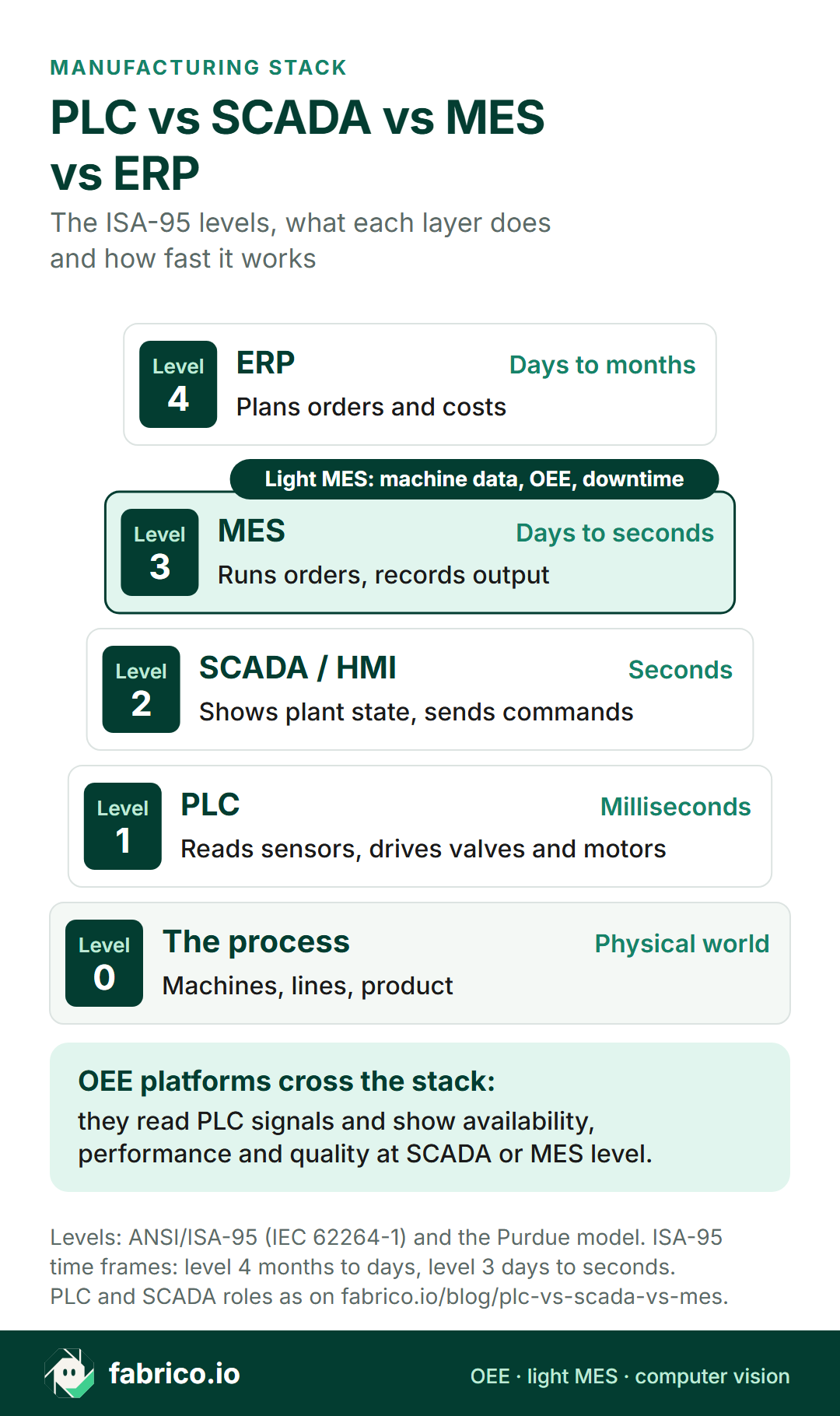
Usually yes, you need both, because they do different jobs. ERP decides what to make and when, and holds the orders, stock and money. MES runs that plan on the floor and records what really happened, in real time.
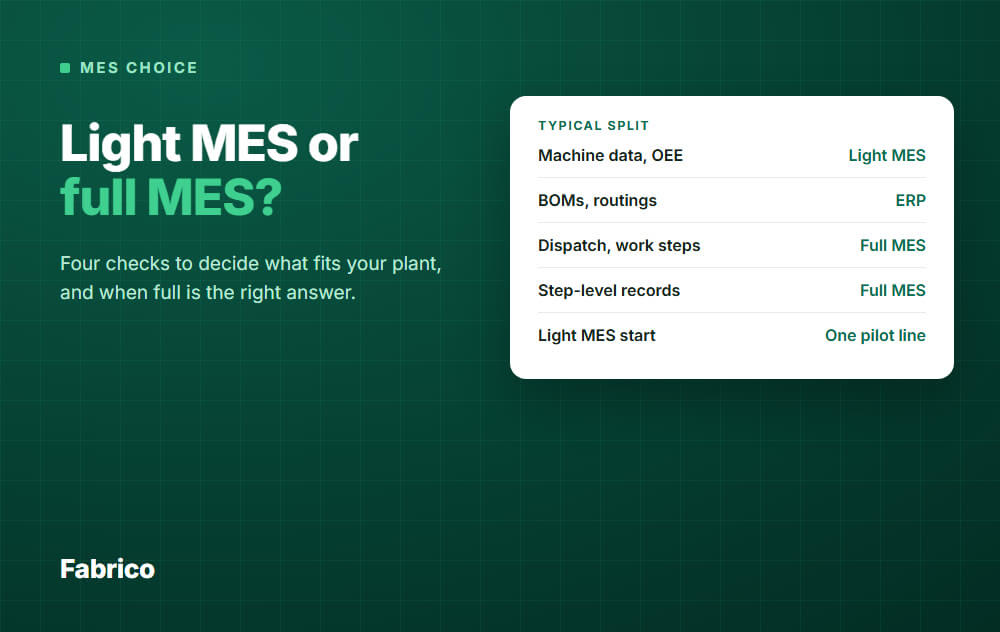
You may not need a full MES on day one. A light MES covers machine data, production monitoring, OEE and downtime analytics, and leaves routings, BOMs, dispatching and genealogy in the ERP.
| Question | ERP | MES |
|---|---|---|
| ISA-95 level | Level 4, business planning and logistics | Level 3, manufacturing operations |
| Answers | What to make, and when | How it is being made right now |
| Time scale | Months to days | Days to seconds |
| Who works in it | Finance, planning, purchasing, sales | Production, supervisors, operators, CI |
| What it holds | Sales and production orders, stock, cost | Counts, stops, scrap, and in a full MES, dispatching and genealogy |
| What it sends | Orders, schedules and material plans down | Actual output, consumption and status up |
They are partners, not competitors. For the layer below MES, see SCADA vs MES.
What ERP does
Enterprise Resource Planning is the business backbone. ERP integrates the core functions of a company, sales orders, inventory, procurement, finance, HR, and high-level production planning, into one system of record.
In manufacturing terms, ERP is where a customer order becomes a production order, where material requirements are planned, where costs and inventory are tracked at the business level.
It works in the language of orders, money, and plans, usually on a horizon of days, weeks, and months.
What ERP does not do well is the real-time, second-by-second reality of the shop floor: it knows a production order exists and is due, but not whether machine 3 is running slow right now or why last night's batch lost two hours.
That granular execution truth lives a level down.
What MES does
A Manufacturing Execution System lives on the floor, between the business plan and the machines.
MES takes the production orders ERP releases and manages their execution in real time: it dispatches work to specific lines, enforces the correct routing and recipe, collects what was actually produced and when, captures genealogy and quality, and reports performance back up.
Where ERP sees an order due Friday, MES sees that order running on Line 2 right now, at this rate, with this scrap, two hours behind because of a changeover.
MES is the system that turns a plan into tracked, enforced, recorded execution, the operational truth of how production is actually unfolding, which ERP needs but cannot see on its own.
Where they sit: the ISA-95 stack
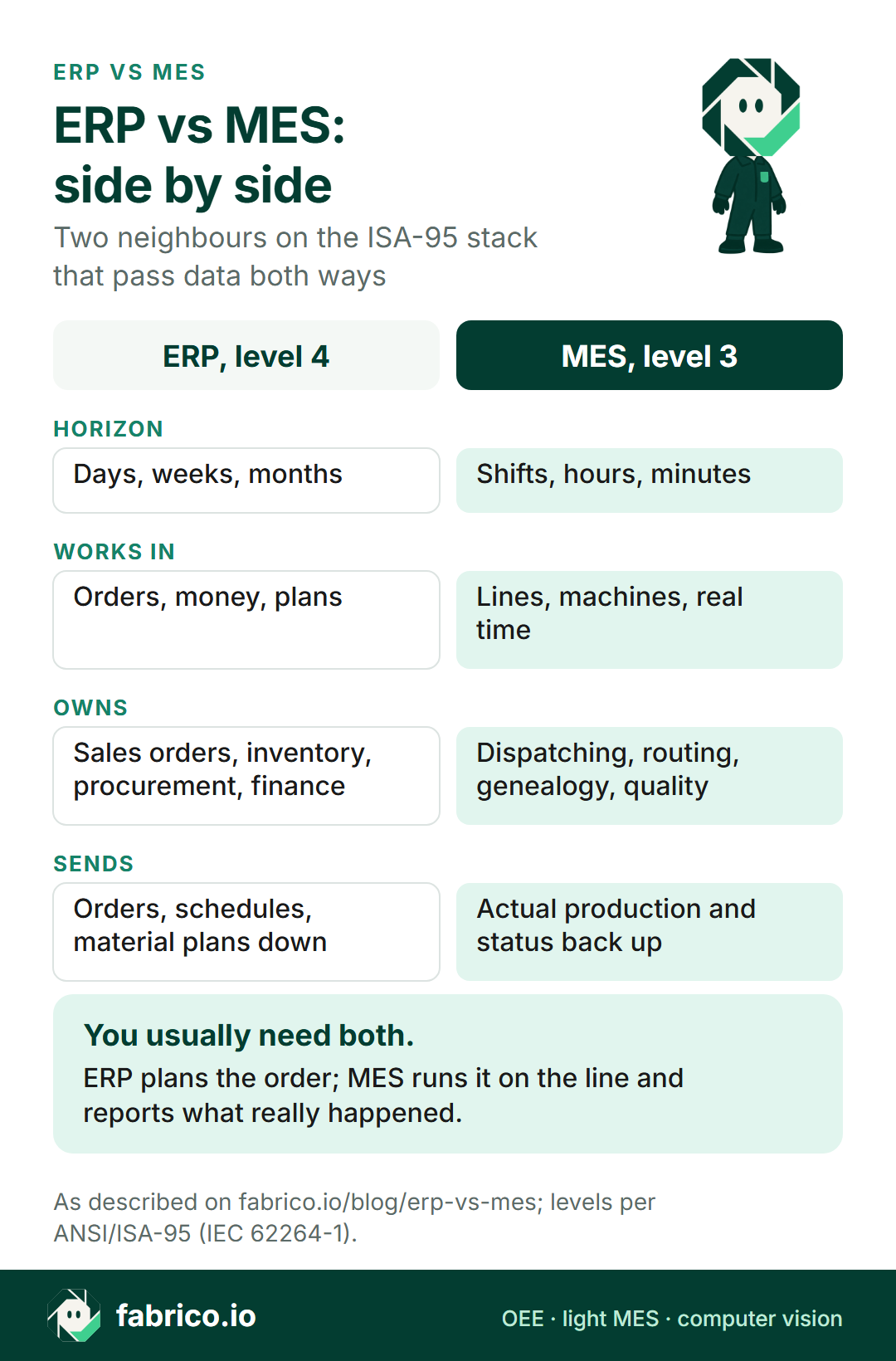
The ISA-95 model places them cleanly. Level 4 is ERP, business planning and logistics. Level 3 is MES, manufacturing operations management: dispatching, tracking, quality, and performance.
Below that, Level 2 is SCADA and control, and Levels 1 and 0 are the devices and the process itself.
ERP and MES are vertical neighbours that exchange information in both directions: ERP passes orders, schedules, and material plans down to MES; MES passes actual production, consumption, and status back up to ERP.
Trouble usually starts in one of two ways. A company runs the floor directly from ERP with no Level 3 layer, and ERP lacks the real-time detail. Or MES and ERP drift out of sync, so the plan and the reality no longer match.
For the data plumbing beneath, see unified namespace vs point-to-point integration.
A worked example
Illustrative example: a customer order for 10,000 units lands in ERP. ERP plans it: checks material availability, schedules it for next week, creates the production order, and commits a due date.
That order flows down to MES, which dispatches it to a specific line, enforces the routing, and starts tracking.
On the floor, MES records reality: the line ran at 85% of rate, lost ninety minutes to an unplanned stop, and scrapped 240 units.
MES feeds that actual production and consumption back to ERP, which updates inventory, cost, and the schedule. ERP planned the what and when; MES governed and recorded the how.
Neither could have done the other's job, and the loop between them is what keeps the business plan tied to floor reality.
Why you usually need both
The two answer fundamentally different questions, which is why most manufacturers of any scale run both.
Try to manage the floor from ERP alone and you get plans with no real-time execution, enforcement, or traceability, the order is due, but nothing governs or records how it is actually built.
Run MES with no ERP and the floor runs in isolation from orders, inventory, finance, and planning.
The value is in the connection: ERP gives MES the right work in the right priority; MES gives ERP the truth about what really happened.
Smaller operations sometimes start with ERP plus a lightweight execution or OEE layer, a light MES, and add full MES as traceability and complexity grow.
Why an ERP "production module" is not an MES
Most ERPs sell a production module. It tracks production orders, BOMs, routings, and can record completions. It is not a full MES, for three reasons:
- No real-time line connectivity. ERP production modules usually don't take PLC signals at machine cadence. They get summary updates from operators or batch imports.
- No operator-level execution. They usually don't dispatch operations to specific workstations with real-time work instructions, in-process quality checks, and genealogy capture.
- Reliability on the floor. A full MES is expected to keep working when the ERP is down, the network drops or shifts cross over. Ask whether your ERP module does.
If your plant is small and your reporting needs are loose, an ERP production module may be enough. If you need real-time visibility, genealogy, or are regulated, it is not.
Common mistakes
- Running the floor from ERP. ERP lacks the real-time granularity to dispatch, enforce, and track execution.
- MES as an island. Execution disconnected from orders, inventory, and planning loses half its value.
- Letting plan and actual drift. If MES results do not flow back to ERP, the business plans on fiction.
- Assuming either one gives you OEE. ERP does not measure machine losses, and some MES products include OEE while others leave it to a separate tool. Ask.
How it shows up in OEE
ERP is not an OEE system, and not every MES includes one, but both touch it. ERP supplies the order and schedule context; MES supplies the production counts, downtime, and quality events that OEE is built from.
A focused OEE layer ties them together with the high-resolution machine signals from the control level, turning order, execution, and equipment data into availability, performance, and quality, and attributing losses to the six big losses.
The test is simple: can someone tell you how much output line 2 lost yesterday, and to which cause? If not, that is the gap to close first.
How Fabrico fits
Fabrico, our product, is a cloud-based OEE and light MES platform, with maintenance (CMMS) built in. It is not an ERP and not a full MES.
It takes machine data from the PLC or a Fabrico IoT device, reports stops on connected machines, and shows OEE per line and shift. Operators add the stop reason on a tablet or phone.
Routings, BOMs, dispatching and genealogy stay in your ERP. If you need genealogy or dispatching in the MES layer, a full MES is the better first look.
A connection to SAP can be scoped per customer. Dynamics, Oracle and other ERPs go through a custom integration, and a REST API and webhooks are there for the rest. Production planning is on the roadmap, so keep planning where it is.
Book a demo to see live OEE on lines like yours.
Related reading
Frequently asked questions
Is a light MES enough next to our ERP?
It is enough if your first problem is lost time on the line. A light MES covers machine data, production monitoring, OEE and downtime analytics. Routings, BOMs, dispatching and genealogy stay in the ERP. If you must dispatch orders to stations or keep genealogy in the MES layer, you need a full MES.
Does Fabrico replace our ERP or our MES?
It does not replace your ERP. If you run a full MES, it can sit next to it for OEE and downtime. If you have no MES, Fabrico can be your light MES.
What is the difference between ERP and MES?
ERP (Enterprise Resource Planning) manages business-wide resources, orders, inventory, finance, and high-level planning. MES (Manufacturing Execution System) manages and tracks the real-time execution of production on the floor. ERP plans what and when; MES governs and records how.
Do I need both ERP and MES?
Most manufacturers of any scale benefit from both. ERP plans the business and releases orders; MES executes, enforces, and tracks them on the floor, then feeds reality back. Running the floor from ERP alone lacks real-time execution, while MES alone is disconnected from planning.
Where do ERP and MES sit in ISA-95?
ERP is Level 4 (business planning and logistics) and MES is Level 3 (manufacturing operations management). They exchange information vertically: ERP passes orders and plans down, MES passes actual production and status up.
Can ERP run the shop floor without MES?
Not well. ERP lacks the real-time granularity to dispatch work, enforce routing, capture genealogy, and track second-by-second execution. Those are MES functions, and trying to do them in ERP usually leads to plans disconnected from floor reality.
Can a full MES run if ERP is down?
Usually, yes: it's part of the design of a full MES. Ask each vendor what happens to actuals while the ERP is down.
How do ERP and MES relate to OEE?
ERP supplies order and schedule context, MES supplies production counts and downtime events, and a focused OEE layer combines them with machine signals to produce availability, performance, and quality and attribute losses to the six big losses.
See live OEE and stops on lines like yours.
Book a demoRelated articles




Latest from our blog
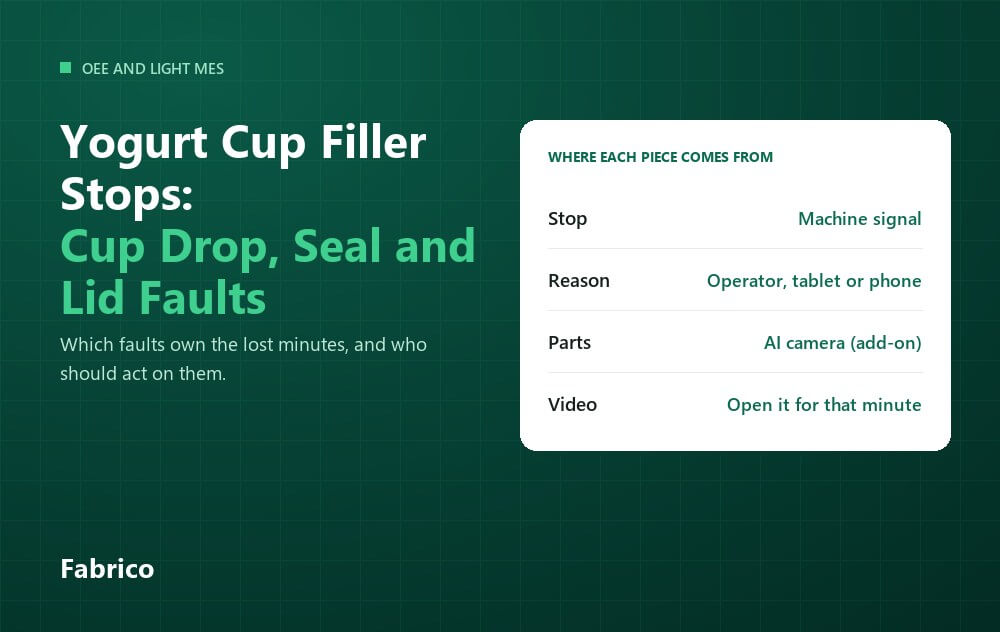
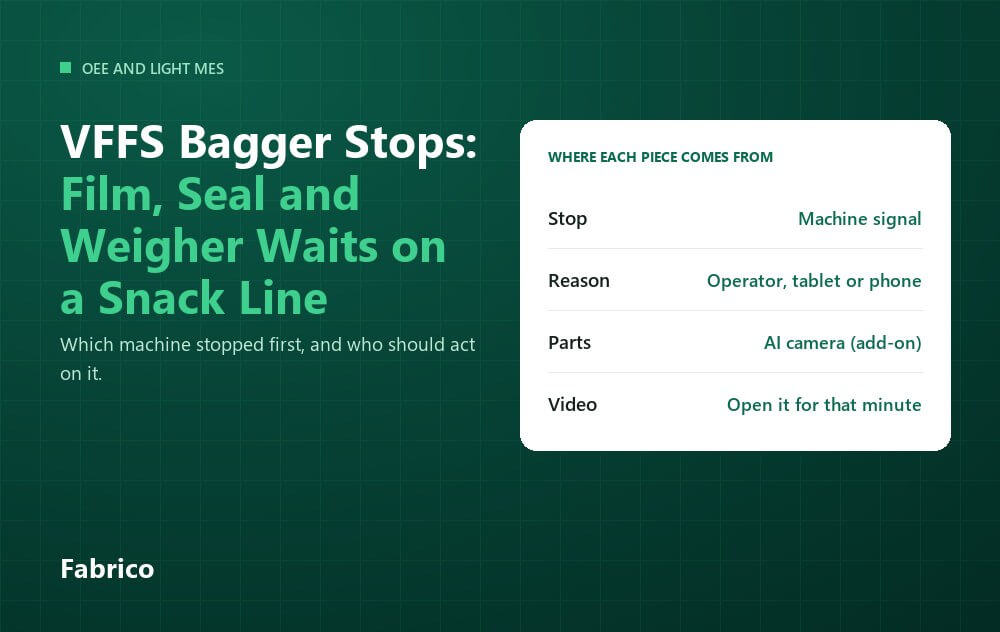
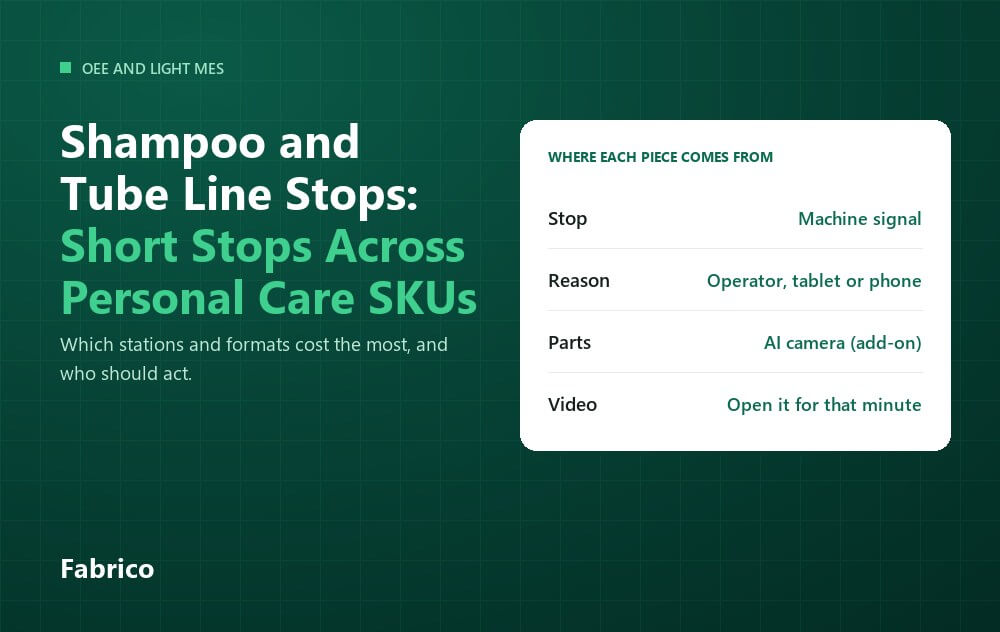



Real Fabrico tiles, sample data.