


 Login
 Blog
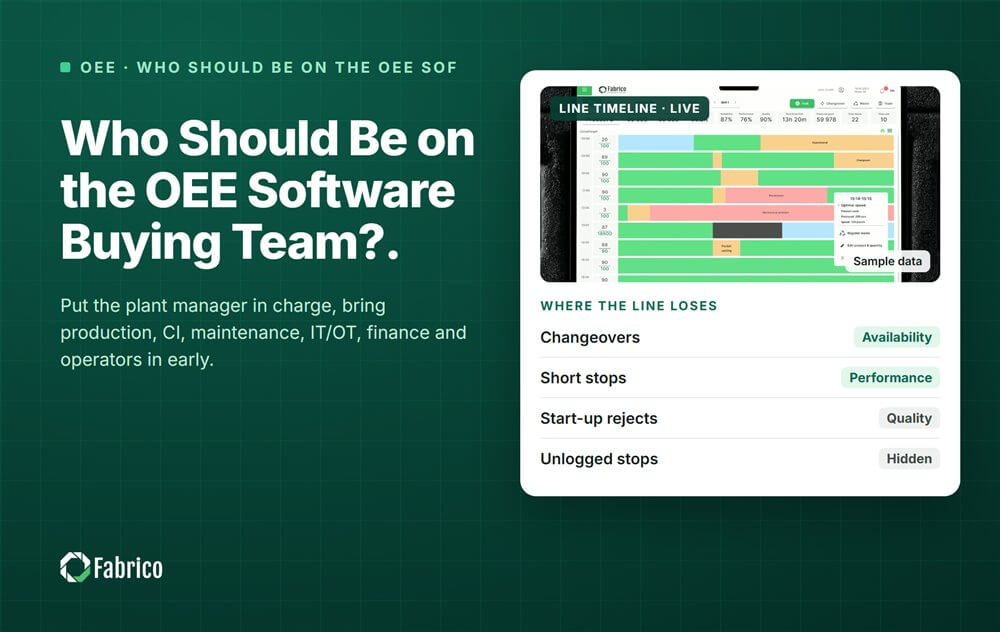
Who Should Be on the OEE Software Buying Team?

Key takeaways
- The plant manager should own the purchase, with a small team around them.
- Build the core team from production, CI, maintenance, IT/OT and finance, plus two operators.
- Bring IT in on day one: integration and security top the list of buying needs.
- Where a works council exists, involve it before any camera or screen goes live.
- Give each role one clear decision, written in a simple RACI table.
The plant manager should own an OEE software purchase. Around them sits a small team: production, CI (continuous improvement), maintenance, IT/OT, finance and two operators, plus the works council where one exists. Each person owns one decision, and IT joins at the first meeting, not at contract time.
The usual story: production picks a tool, the line likes it, and IT stops it at the security review. The line waits while a firewall question goes round.
This guide is for plant managers putting that team together. It comes from Fabrico, a vendor of OEE and light MES software with computer vision on stops. We see these teams from the other side of the table. The advice works for any OEE tool.
Why does OEE software need a buying team?
Because it touches the line, the network, the money and the people. If one function buys it alone, another blocks it later.
- IT picks a tool, and the operators never use it.
- Finance was never asked, so nobody trusts the savings.
- Operators see the screen for the first time on the day it goes live.
A team also guards against pilot purgatory. In 2018, McKinsey found that less than a third of manufacturers (30%) had moved digital programs from pilot to scale.
Who owns the decision?
One person: usually the plant manager, or the operations director when the choice covers several plants.
The owner sets the problem, keeps the decision date and breaks ties. The owner is not IT and not the vendor. A team with no single owner reaches a decision slowly, if at all.
What does each role decide?
Each role owns one part of the choice, and only that part.
- Plant manager: the problem in loss minutes, the decision date and the final yes.
- Production manager and line leads: which line goes first, and whether the stop reasons fit it.
- CI or OEE lead: the OEE definitions, the demo script and the scoring.
- Maintenance: access to machines and PLC signals, and how a breakdown reaches a technician.
- IT/OT: the network path from the line, hosting, accounts and the security review.
- Finance: the rate for a lost minute and what counts as a saving.
- Operators: whether the screen at the line is quick enough on a busy shift.
Finance needs one rule above all: price a lost minute at the margin the plant loses on the bottleneck, not at a machine-hour rate. Our OEE business case guide shows the math.
When should IT join the buying team?
On day one. IT questions decide many OEE purchases, so they should shape the shortlist, not end it.
In one industry survey of 1,560 manufacturing decision makers in 17 countries, integration topped the MES buying needs at 44%. Security and compliance came second in that survey, at 43%.
Give IT the vendor's security answers early. Our vendor security questionnaire is a good start, and our guide for IT managers covers the network side.
Does the works council need a say?
In Germany, yes, and early. Section 87(1) no. 6 BetrVG gives the works council a say over technical equipment that can monitor behaviour or performance. What the system could do is enough; the employer's intent does not matter.
Even a camera that records nothing needs a works agreement. Other countries have their own rules, so check with HR and your legal team.
Measure the process, never the person: show OEE by line and shift, not by named operator. Our works council guide covers the steps.
How do you keep a big team from slowing the decision?
Keep the core small and the rhythm fixed.
- The owner plus 5 or 6 people. Everyone else is asked or told.
- One page of decisions after each meeting.
- A decision date set at the start, and kept.
- Each role signs off on its own part only. IT does not score usability, and operators do not review firewalls.
A worked example: a RACI for one purchase
Sample line (illustrative numbers, not a customer): line 2 of a food plant with 4 lines, the first line in an OEE software purchase. A = owns the decision, R = does the work, C = asked before the decision. Hours are what each role gave across the whole selection.
| Role | A: owns | R: does | C: is asked about | Hours |
|---|---|---|---|---|
| Plant manager | Problem, decision date, final yes | Business case, with finance | Shortlist | 10 |
| Production manager | Pilot line choice | Shift routine with the new screen | Stop reason list | 8 |
| CI lead | OEE definitions, demo script | Demo scoring, reference calls | Rate for a lost minute | 20 |
| Maintenance | Machine access plan | PLC signals, device install | Stop reason list | 6 |
| IT/OT | Security review sign-off | Network path, accounts | Hosting, data that leaves the plant | 12 |
| Finance | Rate for a lost minute | Business case numbers | Commercial terms | 4 |
| 2 operators, 2 shifts | None | Usability test at the line | Stop reasons, screen layout | 6 |
| Works council | Co-decides on cameras and screens | None | Scope | 2 |
- Decisions owned: 3 + 1 + 2 + 1 + 1 + 1 + 1 = 10, each with exactly one owner.
- Total hours: 10 + 8 + 20 + 6 + 12 + 4 + 6 + 2 = 68.
- CI share: 20 / 68 = 29% of all hours, the biggest single load.
The table shows one owner per decision and who carries the work. Because the CI lead gave 29% of the hours, the plant moved one of the lead's projects before the first demo.
Mistakes plants make with OEE software buying teams
- No single owner, so the decision drifts.
- IT invited at contract time.
- Operators left out until go-live.
- Finance asked to sign numbers it never agreed.
- The works council told after the camera is up.
Where Fabrico fits
Fabrico is a computer vision enabled Manufacturing Performance Platform. OEE and light MES come first, and each seat on the team gets its own answer.
- OEE live by line and shift: for the plant manager and production.
- Every loss priced in money: for finance, at the rate the controller agrees.
- The operator confirms the reason in one tap: for operators and the CI lead, with a camera clip as evidence where a camera watches.
- One view across plants: for the operations director.
- A pilot on one line: for IT, a bounded scope to review.
You start on one line, with a baseline and a decision date agreed in advance. Devices are connected in about one month, and the full rollout takes 3 to 4 months. There is no free plan and there are no tiers: each plant gets a quote.
See how stops are captured on the computer vision OEE page.
Frequently asked questions
Who should lead an OEE software selection?
The plant manager, or the operations director for a choice across several plants. The leader owns the problem, the decision date and the final yes. IT, CI and finance each own their part, but one person must break ties, or the choice drifts.
Should operators be on the buying team?
Yes, at least two, from different shifts. They test the stop screen at the line and say whether it is quick enough on a busy shift. If operators skip the reasons, the data is weak, however good the reports look.
When should finance join?
Before the demos. Finance should agree the rate for a lost minute and what counts as a saving. If finance joins only at contract time, it may reject the business case, because it never agreed the numbers behind it. Agreeing the rate early also stops the loss numbers being argued later.
Does the works council have a say in OEE software?
In Germany, yes. Section 87(1) no. 6 BetrVG covers technical equipment that can monitor behaviour or performance. That includes screens and cameras, even if nobody plans to monitor people. In other countries, check local law with HR. Talk to them before any screen or camera goes up.
How big should the buying team be?
For most single plants, a core team of the owner plus 5 or 6 people works. Everyone else is asked or told. A bigger core team meets less often and decides more slowly, which is how purchases stall. Keep the rest informed with one page of decisions after each meeting.
Bring your buying team to a demo
Bring the core team and one line's stop log. Each person gets the answers for their own seat in the same call.
Latest from our blog


Real Fabrico tiles, sample data.