


 Login
 Blog
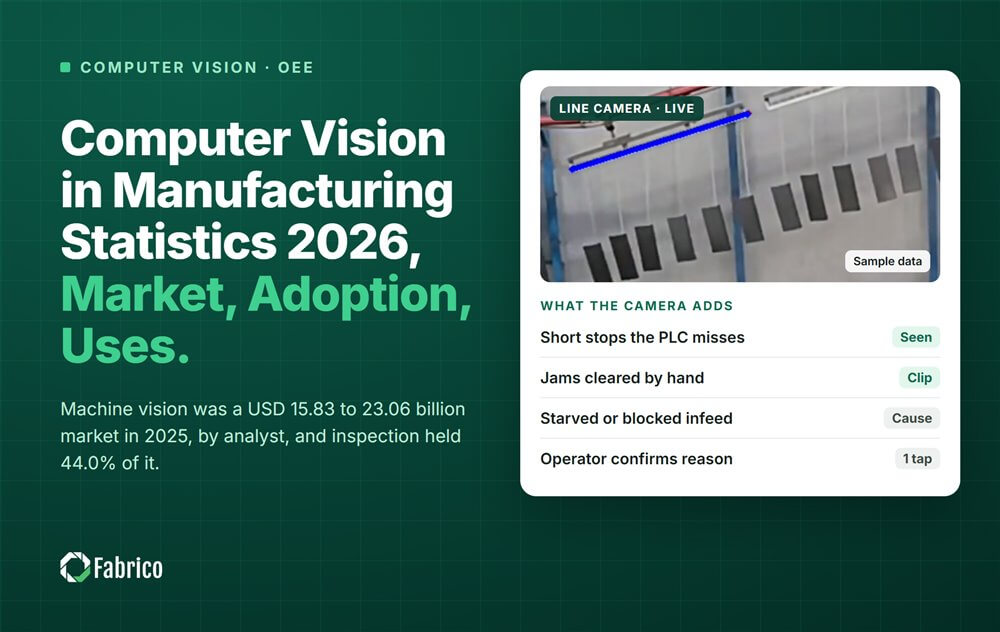
Computer Vision in Manufacturing Statistics 2026: Market, Adoption, Uses

Key takeaways
- Market size depends on scope. Machine vision was USD 15.83 billion to USD 23.06 billion in 2025, by analyst (MarketsandMarkets, 2025; Precedence Research, 2026).
- Inspection leads. Quality assurance and inspection held 44.0% of the machine vision market in 2025 (Grand View Research, 2026).
- Many started, fewer scaled. 29% of large US manufacturers use AI or machine learning at facility or network level, and 23% more are piloting it (Deloitte, 2025).
- Vision is on the budget list. 28% of large US manufacturers rank vision systems a first or second investment priority (Deloitte, 2025).
- Pilots still stall. In consumer goods, 70% of companies were at pilot phase or beyond, but only 26% had reached rollout (McKinsey, 2018).
By the numbers
- Automated optical inspection is the leading industrial AI use case, with a share of about 11% across 48 tracked use cases (IoT Analytics, 2025).
- Analytical AI and machine learning sit in nearly 62% of the top five use cases at Global Lighthouse Network sites (World Economic Forum, 2026).
- Industrial AI spending is still only about 0.1% of manufacturers' revenue (IoT Analytics, 2025).
The machine vision market was worth USD 22.6 billion in 2025, and quality assurance and inspection held 44.0% of it (Grand View Research, 2026).
Fabrico is a computer vision enabled Manufacturing Performance Platform. Its OEE (overall equipment effectiveness) and light MES (manufacturing execution system) software uses cameras for a different job from inspection. They watch the process for stops and cycles. Below are the market, use case and adoption numbers, each linked to its primary source.
How big is the computer vision market in manufacturing?
It depends on what the analyst counts. Machine vision is the factory side: cameras and software that inspect or guide on the line. Computer vision covers all industries. AI in computer vision counts the AI part.
| Analyst and scope | 2025 value | Forecast | Growth a year (CAGR) |
|---|---|---|---|
| Grand View Research, 2026: machine vision | USD 22.6 billion | USD 61.0 billion by 2033 | 13.4% |
| MarketsandMarkets, 2025: machine vision | USD 15.83 billion | USD 23.63 billion in 2030 | 8.3% |
| Precedence Research, 2026: machine vision | USD 23.06 billion | about USD 76.89 billion by 2035 | 12.80% |
| Grand View Research, 2026: computer vision | USD 23.6 billion | USD 101.5 billion by 2033 | 20.1% |
| MarketsandMarkets, 2024: AI in computer vision | USD 23.42 billion | USD 63.48 billion in 2030 | 22.1% |
| IoT Analytics, 2025: industrial AI, all uses | USD 43.6 billion (2024) | USD 153.9 billion by 2030 | 23% |
Why do the estimates differ? CAGR is the compound annual growth rate each firm forecasts. Three things differ:
- Scope. These are three different markets. The wider the scope, the bigger the number.
- Horizon. Forecasts end in 2030, 2033 or 2035. A longer horizon gives a bigger end value, even at a lower growth rate.
- Model. Each firm decides which products and vendors count. For machine vision in 2025, MarketsandMarkets is lowest and Precedence Research highest.
Quote the analyst, the year and the scope together, or the number cannot be checked.
What is computer vision used for in manufacturing?
Mostly quality inspection. The share numbers point the same way.
| Stat | Number | Source |
|---|---|---|
| Quality assurance and inspection, share of the machine vision market in 2025 | 44.0% | Grand View Research, 2026 |
| Automated optical inspection, share of industrial AI across 48 use cases | about 11% | IoT Analytics, 2025 |
| Lighthouse sites' top five use cases with generative AI (9% in 2024) | 23% | World Economic Forum, 2026 |
The Capgemini Research Institute (2019) named product quality control among the three best AI use cases to start with.
Camera OEE is a different job. These shares measure quality inspection: checking each product for defects. A camera for OEE watches the process: when the line stops, how many cycles it runs, and whether a machine is starved or down.
No report here sizes camera OEE, so do not read the 44.0% as an OEE number. Our guide to computer vision for OEE explains how a camera turns a stop into a record.
How many manufacturers use AI and computer vision?
Many have started. Fewer run AI at scale.
| Stat | Number | Source |
|---|---|---|
| Large US manufacturers using AI or machine learning at facility or network level | 29% | Deloitte, 2025 |
| Large US manufacturers piloting AI or machine learning | 23% | Deloitte, 2025 |
| Large US manufacturers ranking vision systems a first or second investment priority | 28% | Deloitte, 2025 |
| Top manufacturers in Europe with at least one AI use case in operations (2019) | 51% | Capgemini Research Institute, 2019 |
| Lighthouse sites' top five use cases with analytical AI and machine learning | nearly 62% | World Economic Forum, 2026 |
In the Deloitte 2025 survey, vision systems came after factory automation hardware and active sensors in the investment plans. To see where a camera adds most on the line, read camera based production monitoring.
How many vision and AI projects make it from pilot to scale?
Fewer than start. The step from one line to many is the hard part.
| Stat | Number | Source |
|---|---|---|
| Manufacturers that had rolled out digital manufacturing company wide (2018) | about 30% | McKinsey, 2018 |
| Manufacturers that felt level with or ahead of competitors (2018) | 92% | McKinsey, 2018 |
| Consumer goods companies at pilot phase or beyond, and at rollout (2018) | 70% and 26% | McKinsey, 2018 |
| Lighthouse top five solutions scaled to three or more sites | 63% | World Economic Forum, 2026 |
| Lighthouse solution development time spent on implementation and adoption | 45%, about seven months | World Economic Forum, 2026 |
| 2025 Lighthouses using a best of breed stack from several vendors (full stack: 39%) | 61% | World Economic Forum, 2026 |
McKinsey (2018) called this gap "pilot purgatory". Few had scaled, yet most felt they were keeping up. In 2025, Deloitte still finds 23% piloting next to 29% at facility or network level.
Lighthouse sites put 45% of solution development time into implementation and adoption, and 61% of the 2025 cohort mix vendors. So plan early how camera stop events and clips reach the OEE or MES screens people already use.
Our guide to a computer vision OEE pilot covers the first line. Camera versus machine signal data compares the two ways to capture stops.
Example: how many of 10 plants would still be in pilot?
Sample line (illustrative numbers, not a customer). A food group with 10 plants puts camera OEE on one filling line per plant. How many plants would still be in pilot if the group matched the surveys?
| Survey share | Source | Arithmetic | Plants out of 10 |
|---|---|---|---|
| AI or machine learning at facility or network level: 29% | Deloitte, 2025 | 10 x 0.29 = 2.9 | about 3 |
| Piloting AI or machine learning: 23% | Deloitte, 2025 | 10 x 0.23 = 2.3 | about 2 |
| Consumer goods at pilot phase or beyond: 70% | McKinsey, 2018 | 10 x 0.70 = 7 | 7 |
| Consumer goods at rollout: 26% | McKinsey, 2018 | 10 x 0.26 = 2.6 | about 3 |
| At pilot phase, not yet at rollout | McKinsey, 2018, difference | 7 minus 2.6 = 4.4 | about 4 |
So 2 to 4 plants in 10 would still be in pilot: 2.3 by the Deloitte share, 4.4 by the McKinsey consumer goods split.
The decision: plan for as many as 4 stalled pilots, and write the scale rule before the first camera goes up. Name the baseline OEE, the result that moves the camera to the next line, and the date of the go or no go call.
Method note: Sample line, illustrative numbers. Plants in a stage = plants in the group x the survey share, rounded to whole plants. The surveys cover AI in general, not vision alone, so treat the result as a planning range, not a forecast.
How we checked these numbers
- Primary sources only. Each number links to the analyst or survey that published it.
- Fetched and matched. We opened each page and matched the exact number on November 6, 2026.
- Kept as stated. Ranges, "about" and the scope stay as the source states them.
- Analysts disagree. Market sizes differ by analyst, so we show them side by side.
- Quarterly check. We re-check the list every quarter. Market sizes stay in US dollars, as published.
Where does camera OEE fit next to inspection?
An inspection camera asks "is this product good?" An OEE camera asks "is the line running, and if not, why?" Fabrico does the second job.
- It watches the process, not the person: stops, cycles, and whether a machine is starved or down.
- It suggests a reason. The operator confirms it in one tap.
- The clip is evidence, so the talk is about the machine or the material.
- Losses ranked by money: automatic downtime logging, each loss priced in money, and OEE live by line and shift.
One named result: at Ficosota, factory-wide OEE went from 53.1% to 59.6%, and good output went up 23.2% a month, June to September 2026.
You start with a pilot on one line. See how it works on the computer vision OEE page, or compare options in our guide to computer vision for manufacturing OEE.
Frequently asked questions
How big is the computer vision market in manufacturing?
Machine vision was USD 15.83 billion to USD 23.06 billion in 2025, depending on the analyst (MarketsandMarkets, 2025; Precedence Research, 2026). Grand View Research (2026) values the wider computer vision market at USD 23.6 billion in 2025.
What percentage of machine vision is used for inspection?
44.0%: quality assurance and inspection was the largest machine vision application in 2025 (Grand View Research, 2026).
How many manufacturers use AI in production?
29% of large US manufacturers use AI or machine learning at facility or network level, and another 23% are piloting it (Deloitte, 2025).
How fast is the computer vision market growing?
Grand View Research (2026) forecasts 20.1% a year for computer vision to 2033. Machine vision forecasts run from 8.3% a year (MarketsandMarkets, 2025) to 13.4% (Grand View Research, 2026).
Is camera OEE the same as machine vision inspection?
No: inspection checks each product for defects, while camera OEE watches the process for stops and cycles. The 44.0% inspection share (Grand View Research, 2026) describes inspection only.
See camera OEE on your own line
Bring one line and its current stop log. We will show how the camera, the one tap and the clip turn its stops into OEE by line and shift. There is no free plan and there are no tiers: each plant gets a quote.
Latest from our blog


Real Fabrico tiles, sample data.