


 Login
 Blog
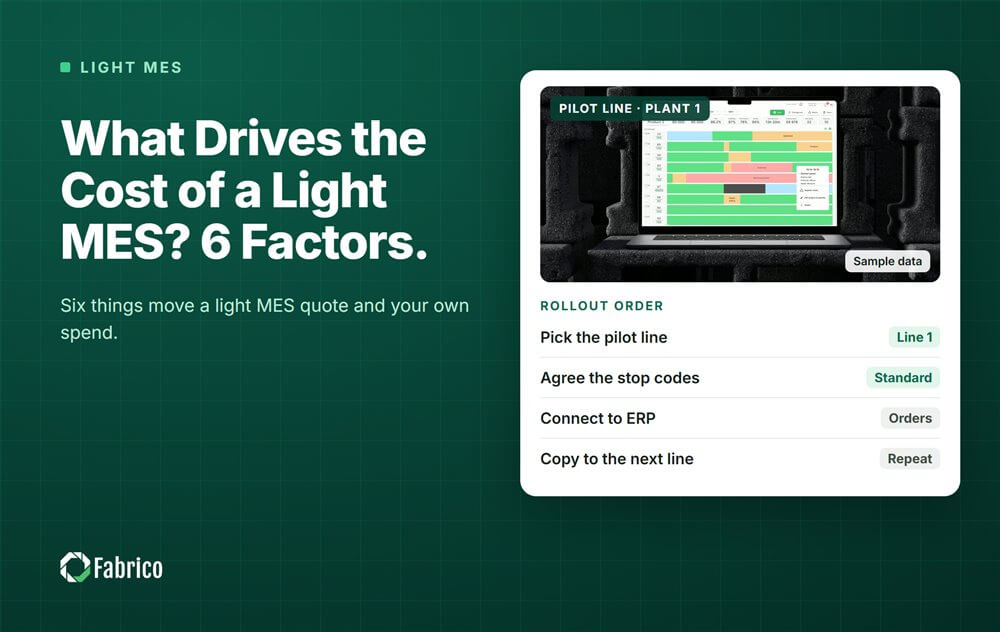
What Drives the Cost of a Light MES? 6 Factors

Key takeaways
- Six factors drive the cost of a light MES, from the machines you connect to the change on the shop floor.
- The first four shape the vendor's quote. The last two are your own spend.
- Old machines with no usable signal need an add-on device or a camera, which changes the scope.
- Change on the floor, such as training each shift and running daily reviews, is where rollouts stall.
- Count your drivers and hours before you ask for a quote, so quotes compare.
The short answer: six factors drive what a light MES costs. Four shape the vendor's quote: the lines and machines you connect, how each machine connects, the modules and the number of sites. Two are your own spend: your team's hours and the change on the shop floor. This guide explains each one, with no prices.
Two plants ask for a quote in the same week. One has three lines of new machines with PLCs. The other has twelve lines, and half its machines are old fillers and wrappers with no signal. Their quotes will not look alike, and neither will the work their own teams face.
A light MES is the part of an MES (manufacturing execution system) that watches the machines. It logs stops, shows OEE (overall equipment effectiveness) by line and shift, and prices the losses. This guide is for plant managers and finance leads planning one. It comes from Fabrico, a vendor of OEE and light MES software with computer vision on stops.
How do lines and machines change the cost?
The number of machines you connect is the first driver. Each one needs a signal, a setup and a place in the OEE model.
- Count machines, not only lines. A line with a filler, capper, labeller and case packer is four connections.
- Decide which lines go first. The bottleneck line, or the one that represents most others, is usually the best start.
- Ask whether every machine needs its own connection, or only the machines that set the pace and the ones that stop most.
Why does the way each machine connects matter?
Because each connection type brings different hardware and different work.
- PLC (programmable logic controller): often no extra hardware, but a controls engineer must find and map the signals.
- IoT device: a small add-on sensor for a machine with no usable signal. Someone buys it, fits it and replaces it.
- Camera: a mount, power and network. In Germany, the works council has a say on equipment that can monitor behaviour or performance.
- Manual entry: no hardware, but operator time every shift.
A plant of new PLC machines and a plant of old ones can have the same line count and very different scopes.
Which modules drive the quote?
Modules are the parts of the software you switch on. Start with the one that prices your biggest loss.
- OEE and downtime: the core of a light MES.
- Loss costing: each loss priced in money, so the Pareto is in dollars or euros, not minutes.
- Work orders for technicians, when a stop is a breakdown. Useful, but a side purchase for most OEE buyers.
Ask whether modules can be added later without a new contract. Our comparison of OEE software pricing models shows how vendors package them.
How do extra sites change the cost?
A second site adds machines, and also a second set of shift patterns, stop lists and people to train.
- Agree one set of OEE definitions for all sites before the second one starts, or the group view compares different numbers.
- Ask whether a view across plants is part of the quote or extra.
- Ask how support works for each site: one contact, or one per plant.
How many internal hours should I plan for?
Plan hours by role, because the vendor's quote covers only the vendor's work.
- IT: the security review, network access and user accounts.
- Controls engineers: finding and mapping PLC signals.
- Maintenance: fitting IoT devices and cameras.
- Continuous improvement lead: OEE definitions, ideal cycle times and the stop list.
Our guide to MES cost, time and team lists the roles a rollout needs.
Why is change on the shop floor a cost?
Because software only helps if people use it each shift. That takes time the quote never shows.
- Training on every shift, including nights and weekends.
- A short stop reason list that operators agree with.
- A daily review of the top losses, run by the shift lead.
- Trust: OEE by line and shift, never by named person, so stops get logged honestly.
Rollouts that skip this cost the most, because the system ends up unused. Our article on why MES implementations fail shows how that happens.
Sample: how do two plants compare on the 6 drivers?
Sample line (illustrative numbers, not a customer): two food plants plan a light MES. Plant A is one site with new machines. Plant B is a group of three sites with many older machines.
| Driver | Plant A | Plant B |
|---|---|---|
| Lines connected | 3 | 12 |
| Machines via PLC | 18 | 38 |
| Machines via IoT device | 0 | 24 |
| Machines via camera | 0 | 8 |
| Modules | OEE and downtime | OEE and downtime, loss costing, work orders |
| Sites | 1 | 3 |
| Internal hours planned | 180 | 900 |
| Operators to train | 30 | 160 |
- Machines at Plant A: 18 + 0 + 0 = 18.
- Machines at Plant B: 38 + 24 + 8 = 70, so 70 / 18 = 3.9 times as many as Plant A.
- Machines at Plant B without a usable PLC signal: (24 + 8) / 70 = 45.7%.
- Internal hours per line: 180 / 3 = 60 at Plant A, and 900 / 12 = 75 at Plant B.
- Operator training at 2 hours each: 30 x 2 = 60 hours, against 160 x 2 = 320 hours.
Plant B's quote and its own effort grow faster than its line count. Almost half its machines need a device or a camera. Its best first line is one with old machines, so the hardest case is tested before the other 11 lines are planned.
Mistakes plants make with light MES costs
- Counting lines instead of machines.
- Assuming every old machine has a usable signal.
- Buying every module before the first loss is measured.
- Leaving internal hours and training out of the plan.
- Adding a second site before the OEE definitions are agreed.
Where Fabrico fits
Fabrico is a computer vision enabled Manufacturing Performance Platform. OEE and light MES come first, and each plant's quote is built from the modules, the lines and machines, and the sites.
- Automatic downtime logging: a machine connects through a PLC, a Fabrico IoT device or an AI camera.
- Every loss priced in money, so the losses sit next to the quote.
- One view across plants for groups with more than one site.
- A pilot on one line, so the first scope and your first internal hours stay small.
Devices are connected in about one month, and the full rollout takes 3 to 4 months. You start on one line, with a baseline and a decision date agreed in advance. There is no free plan and there are no tiers: each plant gets a quote. Our light MES guide explains what the scope covers.
Frequently asked questions
How much does a light MES cost?
It depends on the plant, so most vendors quote per plant rather than publish a price. The quote follows the lines and machines you connect, how each one connects, the modules and the sites. Add your own team's hours and the time for training on the floor to see the full cost.
Is a light MES cheaper than a full MES?
A light MES starts with a narrower scope: the machines, stops, OEE and losses, on one line first. Whether the total is lower depends on what you need. Compare both on the same lines and the same goals, and include the internal hours each one needs from your team.
Do old machines make a light MES more expensive?
They can change the scope. A machine with no usable signal needs an add-on IoT device, a camera or manual entry, and each brings hardware or operator time. Count those machines before you ask for a quote, and test the oldest one first on the first line.
What internal costs should I plan for?
Plan hours for IT, controls engineers, maintenance, the continuous improvement lead, shift leads and operators. IT runs the security review, controls map the signals, maintenance fits devices, and the continuous improvement lead sets definitions and the stop list. Training on every shift is often the largest single block.
Can I start small and add lines later?
Yes, and it is the usual way. Start on one line with a baseline and a decision date. Add lines and modules once the first line shows its losses in money. Ask the vendor up front how adding lines and sites changes the quote.
Price your light MES on your own line
Bring your machine list and how each machine can connect. We will show what drives your quote and what your team would need to do.
Latest from our blog


Real Fabrico tiles, sample data.