


 Login
 Blog
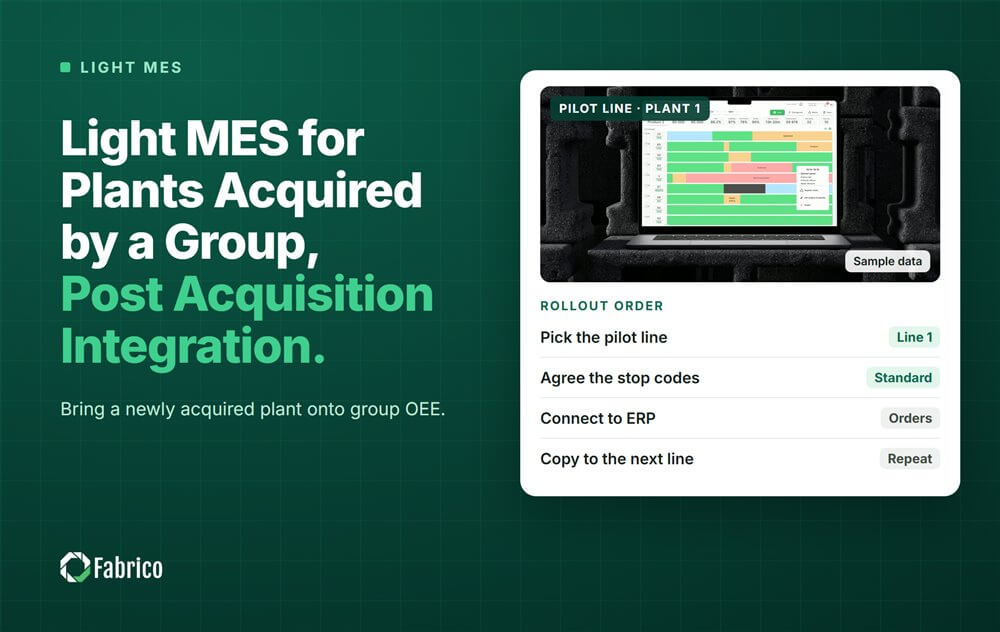
Light MES for Plants Acquired by a Group: Post-Acquisition Integration

Key takeaways
- Bring an acquired plant onto group OEE (overall equipment effectiveness) by measuring a baseline from its machines and starting on one line.
- Keep the plant's own ERP (enterprise resource planning system) for orders and costing.
- The plant's own OEE often looks higher than the group's because the rules differ, not because anyone cheated.
- Machines connect through the PLC (programmable logic controller), an IoT (internet of things) device or an AI (artificial intelligence) camera.
- Treat the first line as the test, with a decision date, then extend line by line.
Post-acquisition plant integration for OEE starts with a baseline measured from the plant's own machines, not from its reports. Keep the plant's ERP. Connect one line, agree the group's definitions with the plant team, and compare the plant's number with the group's number side by side. Then extend line by line.
A few weeks after closing, the acquired plant's monthly pack shows its sauce line above the group average. One shift at the capper tells another story: a long changeover, a chuck fault, dozens of short stops. Both numbers are honest; the rules differ.
This guide is for chief operating officers, group operational excellence leads and the plant managers who join a group through an acquisition. It covers the baseline, the ERP question, the group rules and the first line. This guide comes from Fabrico, a platform for OEE and light MES (manufacturing execution system) with computer vision on stops.
What changes for a plant when a group acquires it?
The products and the people stay. What changes is how the plant's numbers are read. The group wants an OEE it can compare with its other plants, and a loss list in money.
- Stays local: the ERP, orders, costing, the plant's own reports and its language.
- Becomes shared: the OEE definitions, the loss codes and one view across plants.
- Comes first: a measured baseline, so nobody argues about the old numbers.
Checking the plant before the deal is a separate job, covered in our guide to technical due diligence for manufacturing acquisitions.
Why measure a baseline from the machine first?
Because the plant's past numbers were built on its own rules and its own memory. A baseline from the machine gives both sides one set of facts before anything changes.
- Shift sheets miss short stops, so the reported downtime looks smaller than it is.
- Local habits decide what counts as planned time, and they are rarely written down.
- The ideal rate often comes from the ERP routing, which was set for planning, not for OEE.
Machines connect through the PLC, a small IoT device on the machine's signals, or an AI camera watching the product flow. Our guide to OEE monitoring without a PLC covers older machines.
Run the baseline next to the plant's own report for a few weeks, and change nothing yet. Our OEE baseline guide has a checklist.
Should the acquired plant change its ERP first?
No, not for OEE. OEE comes from machine time and counts, which a light MES collects at Level 2 to 3. The ERP stays at Level 4 for orders and costing. An ERP migration is a long project with its own business case, so keep the two apart.
A light MES is the Level 3 layer in a different order: OEE and downtime first, one line first. Our guide to light MES explains the idea, and lightweight MES for smaller plants shows the fit for a small team.
Which group rules does the plant adopt?
The plant takes the group's OEE definitions and loss codes as they are, with local labels on the same codes. Our guide to the OEE report for head office lists the definitions.
Some groups keep the whole changeover inside planned time; pick one rule, write it down, and use it in every plant. Our guide to group OEE standards across sites covers how groups keep the rules aligned.
How do you start, and which line goes first?
Start with the line that matters most to the group: usually the highest volume line, or one with a machine model the group runs elsewhere.
- Name the owners on both sides before anything is connected.
- Connect the machines, then the operator screen for stop reasons.
- Run the plant's report and the group's OEE side by side, and explain the gap item by item.
- Agree in advance what result moves the rollout to the next line, and by when.
- Extend line by line, each with the same definitions and codes.
On Fabrico's own figures, devices are connected in about one month, and the full rollout takes 3 to 4 months. Our guide to light MES vs spreadsheets helps decide which old tabs to keep during the switch.
A worked example: the plant's paper log vs the machine baseline
Sample line (illustrative numbers, not a customer): an acquired plant's sauce jar line, with the capper rated at 120 jars a minute. One shift has 440 planned minutes after breaks. The group's standard changeover is 25 minutes, and this one took 45. The counter shows 37,200 good jars, the same figure in both columns.
| Loss in the shift | Plant's paper log, own rules | Machine baseline, group rules |
|---|---|---|
| Changeover over the 25 minute standard | Not a loss (whole changeover planned) | 20 min |
| Capper chuck fault | 18 min | 18 min |
| Short stops: cap feed jams, tipped jars | Not logged | 34 min |
| Slow running | Not logged | 26 min |
| Underfilled jars rejected at the checkweigher | 7 min | 7 min |
| Planned time | 440 minus 45 = 395 min | 440 minus 25 = 415 min |
| OEE | 78.5% | 74.7% |
- Plant's rules: 37,200 / 120 / 395 = 310 / 395 = 78.5%.
- Group rules: 37,200 / 120 / 415 = 310 / 415 = 74.7%. The 3.8 point gap is the changeover rule alone.
- Lost minutes on group rules: 415 minus 310 = 105, which is 20 + 18 + 34 + 26 + 7.
- The paper log explains 18 + 7 = 25 of them. The machine baseline names the other 80.
- Short stops and slow running: 34 + 26 = 60 minutes, or 60 x 120 = 7,200 jars.
- At a contribution of $0.09 a jar: 7,200 x $0.09 = $648 a shift, or €648 in a euro plant at €0.09 a jar. Over 680 shifts a year: $440,640, or €440,640.
The plant's number was close and its formula was right. Its loss list was not: the log showed the chuck fault as the only real problem.
So the first integration step is the report itself: the machine baseline replaces the paper log in the monthly pack. Then the first project goes after the short stops and slow running at the capper.
Mistakes groups make with an acquired plant's OEE
- Taking the plant's reported OEE as the baseline.
- Replacing the plant's ERP before measuring a single line.
- Comparing the plant with its sisters before the rules are agreed.
- Choosing the first project from the old paper log.
- Treating the gap as a failing of the plant team. It is a difference in rules.
Where Fabrico fits
Fabrico is a computer vision enabled Manufacturing Performance Platform. OEE and light MES come first, so an acquired plant gets group numbers without waiting for a new ERP.
- Automatic downtime logging from the machine signal. A machine connects through a PLC, a Fabrico IoT device or an AI camera, and the machine itself needs no PLC.
- OEE live by line and shift, on the group's definitions.
- One view across plants, so the new plant sits next to its sisters.
- A pilot on one line, the first line of the side by side test.
You start on one line, with a baseline and a decision date agreed in advance. There is no free plan and there are no tiers: each plant gets a quote. Read more about the approach in our guide to light MES.
Frequently asked questions
How do you integrate an acquired plant into group OEE?
Measure a baseline from the plant's machines first, then agree the group definitions with the plant team. Run the plant's own report and the group's OEE side by side on one line, explain the gap, and set a decision date. Extend line by line once the first line's numbers are trusted. The ERP can stay as it is.
Who should own the integration on each side?
On the group side, one operational excellence lead owns the definitions, the loss codes and the plant comparison. On the plant side, the plant manager owns the line data, and the controller owns the price per unit. IT (information technology) and OT (operational technology) own the connection on both sides.
Why is the acquired plant's OEE higher than ours?
Usually because the rules differ, not because the plant is better. Common reasons are changeovers counted as planned time, an ideal rate taken from the ERP routing, and reworked units counted as good. Recompute the plant's number on group rules from machine data before you compare it with your other plants.
Can old machines without a usable PLC be connected?
Yes. A machine can be connected through a small IoT device on its signals, or through an AI camera that watches the product flow. The machine itself needs no PLC. That matters in acquired plants, which often run older equipment than the rest of the group.
See an acquired plant's line on group rules
Bring one line from the plant you acquired and its last monthly report. We will show its stops, its OEE on group rules and what each loss costs.
Latest from our blog



Real Fabrico tiles, sample data.