


 Login
 Blog
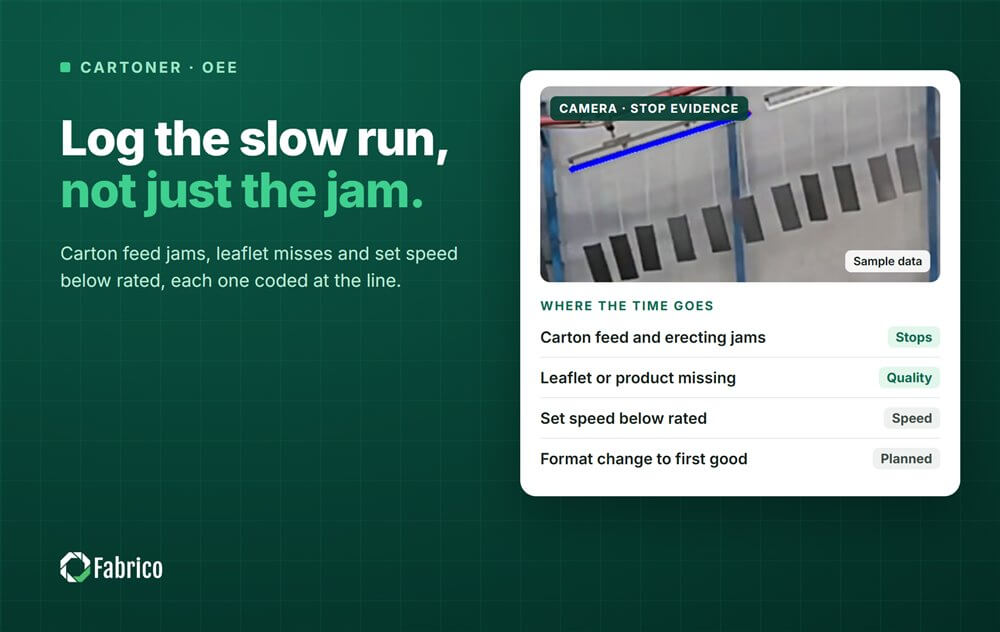
Cartoner OEE: Carton Feed Jams, Leaflet Misses and Speed Loss

Key takeaways
- Carton feed and erecting jams are the cartoner's most frequent stops, and carton board quality is often the cause.
- A carton rejected for a missing leaflet, product or code is a Quality loss, even though the machine was right to reject it.
- Speed loss is the cartoner's hidden loss: a set speed below rated never shows as a stop.
- Format changes need a standard time per format pair and a clear end point: the first good carton at rated speed.
- Code glue and tuck closure faults apart from feed jams, so the Pareto shows which one costs most.
The cartoner on the blister line runs a little below its rated speed. Nobody decided that on paper: a while ago a batch of cartons kept failing to open, an operator turned the speed down, and it stayed down. The OEE report shows a small Performance loss and no stop to explain it.
Cartoners lose time in three ways: stops at the carton feed and erecting station, rejects for missing leaflets, products or codes, and quiet speed loss that nobody logs. This guide covers each one, how to measure OEE on a cartoner, how to handle format changes, and what a camera adds where the PLC says only stopped.
How a cartoner works and where it stops
Most packaging lines use end-load cartoners: horizontal machines, intermittent or continuous motion, that push product into the end of an erected carton. The main stations are the carton magazine, pick and erect, the product infeed and bucket chain, the loading pusher, the leaflet feeder, end closing by tuck or glue, coding and inspection, and the outfeed.
| Station | Typical stops | Typical cause |
|---|---|---|
| Carton magazine | Magazine empty, cartons stuck together | Refill timing, carton board, humidity |
| Pick and erect | Carton not opened, opened out of square, dropped carton | Suction cup wear, vacuum loss, weak side seam on the blank |
| Product infeed | Empty bucket, product jam at loading | Upstream gaps, product out of position |
| Leaflet feeder | Leaflet missing, double leaflet, misfold | Leaflet stack, folder settings, paper quality |
| End closing | Tuck flap not closed, glue skip, open end | Flap scoring, clogged glue nozzle, glue temperature |
| Coding and inspection | Code missing or unreadable | Coder fault, ribbon or ink out |
Carton board quality drives many stops in the first two rows. Cartons that are warped, damp or have a weak side seam fail to open or open out of square. Give carton quality its own reason code, so a supplier or storage problem does not land on the machine crew.

How to measure Availability, Performance and Quality on a cartoner
- Availability = run time / planned production time. Jams, faults, starved time and format change overruns reduce it.
- Performance = cartons produced / (run time x rated cartons a minute). Use the rated speed for the format, from the nameplate or the maximum demonstrated speed.
- Quality = good cartons / cartons produced. Cartons rejected for a missing leaflet, missing product, open end or missing code count against it.
One detail matters: count the rejects the machine throws out itself. A cartoner that detects a missing leaflet and rejects the carton is working as designed, but the carton is still a loss. If the count comes only from the outfeed, those rejects disappear from Quality.
Speed loss: the loss nobody logs
A cartoner set to run below its rated speed never shows a stop. The run clock ticks, the counter counts, and the loss sits inside Performance with no reason attached. It usually starts for a good reason: a carton batch that kept failing to open, a new leaflet that fed badly, a format that jammed at full speed. The speed goes down and stays down after the reason has gone.
Two habits keep it visible. Log the set speed with the count, so the report shows how long the cartoner ran below rated and on which format. And treat a reduced speed as a temporary setting with an owner, not as the new normal. Our guide to diagnosing rate loss on high-speed lines covers the method.
Leaflet misses and closure faults
On pharmaceutical, cosmetics and some food lines the leaflet is a required part of the pack, so a carton without one is a reject. Leaflet misses come from the stack running low, a misfold in the folder, double feeds and paper that curls or sticks. Code them apart from product misses: the fix for a leaflet folder is not the fix for a product infeed. Our guide to OEE for pharmaceutical manufacturing covers how regulated lines treat these losses.
Closure faults are the other big group. A tuck flap that does not close cleanly points to carton scoring or folding plate settings; a glue skip or an open glued end points to a clogged nozzle or glue temperature. Both produce rejects and short stops, and both deserve their own codes.
Format changes on a cartoner
A format change can mean new magazine guides, bucket chain or pusher settings, folding plates, leaflet folder settings, glue gun positions and a new coder layout. Some cartoners use tool-less adjustments with position indicators; others need change parts. On pharmaceutical lines a line clearance comes before the new batch, so no cartons, leaflets or product from the last batch remain.
Measure from the last good carton of the old format to the first good carton of the new one at rated speed, ramp-up included. Set a standard per format pair, code each minute over it, and record the settings that worked so the next change starts from a known position. Our guide on how to reduce changeover time gives the steps.
A worked shift on a cartoner
Sample line (illustrative numbers, not a customer): a cartoner rated at 120 cartons a minute is the constraint on its line, with 450 minutes of planned production time on the shift.
- Format change 35 minutes, own jams and faults 25 minutes, starved 15 minutes: 75 minutes lost. Run time = 375 minutes. Availability = 375 / 450 = 83.3%.
- At rated speed, 375 minutes would make 375 x 120 = 45,000 cartons. The cartoner made 39,600. Performance = 39,600 / 45,000 = 88.0%.
- Rejects for missing leaflets, open ends and codes: 396. Good cartons = 39,204. Quality = 39,204 / 39,600 = 99.0%.
- OEE = 0.833 x 0.880 x 0.990 = 72.6%. Check: 39,204 / 120 = 326.7 minutes of ideal time, and 326.7 / 450 = 72.6%.
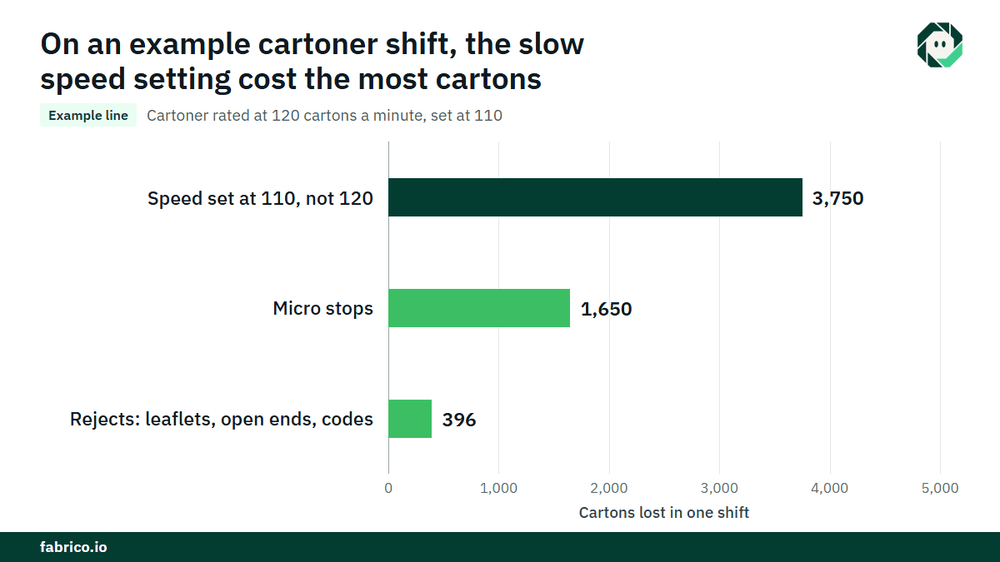
Now split the 5,400 cartons lost to Performance (45,000 minus 39,600). The set speed was 110 for the whole run, which costs 375 x 10 = 3,750 cartons. The other 1,650 are micro stops: 15 minutes at 110 a minute.
Price the speed loss alone. At a contribution of $0.25 a carton, 3,750 cartons are $937.50 a shift, or €937.50 in a euro plant at €0.25 a carton. Over 500 shifts a year (two shifts on 250 production days) that is $468,750, or €468,750, from a speed setting nobody wrote down.
What a camera adds on a cartoner
The cartoner PLC knows its faults and its reject counts, but on many machines it reports several different jams under one code. Where a camera watches the magazine and the erecting station, the clip shows whether a carton failed to open, opened out of square or dropped, and the operator confirms the reason in one tap. The same clips settle whether a run of stops came from one carton batch.
Mistakes plants make with cartoner OEE
- Letting a reduced set speed become permanent without a reason or an owner.
- Counting cartons at the outfeed only, so machine rejects vanish from Quality.
- One reason code for all jams, so carton quality, leaflet and closure faults blur together.
- No standard time for format changes, so overruns never show.
- Blaming the machine for carton board problems that start in storage or at the supplier.
Where Fabrico fits
Fabrico is a computer vision enabled Manufacturing Performance Platform. OEE and light MES come first: automatic downtime logging at the cartoner, OEE live by line and shift, and speed loss that shows up as a loss instead of hiding inside Performance.
- The operator confirms the reason in one tap, so carton, leaflet and closure faults get their own codes.
- A camera clip as evidence for a stop, where a camera watches the magazine or the erecting station.
- Losses priced in money and ranked, so a quiet speed loss can outrank a noisy jam.
- One view across plants for cartoners on different sites.
- A work order with its cost to the right technician when a stop is a breakdown.
You start on one line, with a baseline and a decision date agreed in advance. Each plant gets a quote after a review of its lines. See how a stop gets its evidence on our computer vision for OEE page.
Frequently asked questions
How do you calculate OEE on a cartoner?
Availability is run time over planned production time, Performance is cartons produced over what the cartoner could make at its rated speed for that format, and Quality is good cartons over cartons produced. Multiply the three.
Why does my cartoner fail to open cartons?
Common causes are carton board quality (warp, humidity, a weak side seam), worn suction cups or vacuum loss, and magazine settings. If the problem follows one carton batch, it is the material; if it follows the machine, check pick and erect.
Is a carton rejected for a missing leaflet a Quality loss?
Yes. The machine was right to reject it, but the carton, the product and the time are lost. Count machine rejects in Quality, not only cartons at the outfeed.
What speed should a cartoner run at?
At the rated speed for the format. If it has to run slower, record the reduced speed with a reason and an owner, so it is a decision and not a habit.
How long should a cartoner format change take?
There is no general figure; it depends on the machine and the formats. Measure your own changes to the first good carton at rated speed and set a standard per format pair.
See your cartoner's losses in a demo
Bring one line and its current downtime log. We will show its jams, rejects and speed loss, logged automatically and priced in money.
Related articles












Real Fabrico tiles, sample data.