


 Login
 Blog
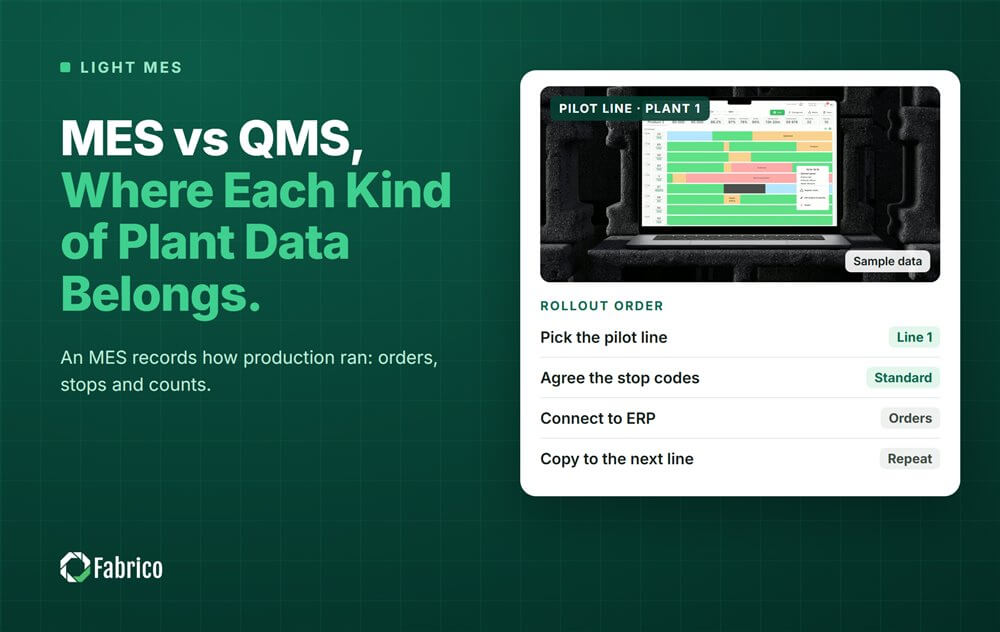
MES vs QMS: Where Each Kind of Plant Data Belongs

Key takeaways
- An MES is about execution: what ran, when, how fast and what stopped.
- A QMS is about the quality system: specs, inspections, deviations, corrective actions, documents and audits.
- In ISA-95, quality operations sit at Level 3, right next to production.
- A light MES starts with OEE and downtime. Specs, corrective actions and audits stay in the QMS.
- Link the two by line, time and lot code, instead of typing the same event twice.
An MES and a QMS answer different questions. The MES says how production ran. The QMS says whether the product met its standard, and what was done when it did not. A food plant usually needs both, connected at the events they share.
Fabrico, OEE and light MES software with AI cameras, covers the OEE and downtime part of an MES. It is not a QMS, and it makes no claim to manage specs, deviations or audits.
What does an MES do?
MES stands for manufacturing execution system. In the ISA-95 model it sits at Level 3, between ERP at Level 4 and the machines and their control at Levels 0 to 2. It works in shifts, hours, minutes and seconds.
The classic MESA-11 model, from MESA White Paper 6 in 1997, lists 11 MES functions. Among them are data collection, performance analysis and maintenance management. In a food plant, the MES side typically holds:
- The order and SKU running on each line.
- Machine states, stops and their reasons.
- Counts of total and good units, and rejects.
- OEE by line and shift.
What does a QMS do?
QMS stands for quality management system. It manages how the plant defines, checks and improves quality. Typical contents:
- Specifications for products and materials.
- Inspection and test results from the lab and the line.
- Nonconformances, each with its investigation.
- Corrective and preventive actions, and checks that they worked.
- Document control, training records, supplier quality, complaints and audits.
In food plants, the QMS often works next to a food safety management system such as ISO 22000:2018. That standard wraps HACCP in a plan, do, check, act cycle.
Where do MES and QMS overlap?
ISA-95 Part 3 splits Level 3 into four kinds of operations: production, quality, logistics and maintenance. So quality work happens at the same level as production, and the two systems meet at the same events.
| Data | MES side | QMS side |
|---|---|---|
| A reject | Counted, by machine, time and reason | Part of a nonconformance, if it crosses a limit |
| A hold | Units not yet good count | The release decision and its record |
| A deviation | A stop and its minutes | The investigation and corrective action |
| A spec | The target the line runs to | The approved document and its version |
The MES records that something happened on the line. The QMS decides what it means for quality and what to change.
Worked example: one seal failure in both systems
Sample line (illustrative numbers, not a customer). A tray sealer runs at 80 trays a minute. At 09:10 a check finds leaking seals. The crew stops the line to adjust the seal bar and restarts at 09:35.
| Field | MES and OEE | QMS |
|---|---|---|
| Event | Stop 09:10 to 09:35, 25 minutes | Nonconformance opened at 09:10 |
| Cause | Reason: seal bar temperature | Root cause investigation |
| Product | 1,100 trays rejected, Quality loss | Disposition of the rejected trays |
| Follow-up | Stop minutes and rejects tracked per shift | Corrective action and an effectiveness check |
The stop cost 25 x 80 = 2,000 trays of output. At a margin of USD 0.20 a tray, that is USD 400 (about EUR 370). The 1,100 rejected trays add USD 220 of margin, plus their materials.
The MES shows what the failure cost and how often it comes back. The QMS shows why it happened and what was changed. Each team reads its own system, about the same 25 minutes.
What is a light MES, and where does it stop?
A light MES is the part of an MES that watches the machines. It covers the Level 3 work in a different order: OEE and downtime first, on one line, then more lines. It shows three of the MESA functions: data collection, performance analysis and maintenance management.
Some things stay outside it. Lot tracking and full electronic production records belong to a full MES or another system your plant already runs. Specs, corrective actions, documents and audits belong to the QMS. Our guide to the light MES explains the scope, and MES for food manufacturing covers the full MES side.
How should MES and QMS be connected?
- Use one clock for the line, the MES and the lab, so 09:10 means the same in both.
- Share the keys: plant, line, product and the lot code your plant already uses.
- Link, do not copy. A nonconformance points to the stop; it does not retype it.
- Agree who owns what. Quality owns specs and nonconformances; production owns stop reasons.
- Ask each vendor how its data can be linked to the other system before you sign.
For record integrity in regulated plants, see our guide to GMP data integrity. For the business layer above both, read ERP vs MES, and for the levels, ISA-95.
Where does Fabrico fit?
Fabrico is a computer vision enabled Manufacturing Performance Platform. OEE and light MES come first: it is the execution side, not the quality system.
- Automatic downtime logging, with each stop timed by the machine.
- The operator confirms the reason in one tap, so stops and rejects carry a cause.
- Every loss priced in money, so a quality problem has a cost next to its record.
- OEE live by line and shift, and one view across plants.
Fabrico is not a QMS and does not replace one. You start on one line, with a baseline and a decision date agreed in advance. There is no free plan and there are no tiers: each plant gets a quote.
Frequently asked questions
What is the difference between an MES and a QMS?
An MES records how production ran: orders, machine states, stops, counts and OEE. A QMS manages quality: specifications, inspection results, nonconformances, corrective actions, documents and audits. The MES says what happened on the line. The QMS decides what it means and what to change.
Does an MES include quality management?
Some full MES suites include quality functions, such as in-line checks and sample results. In ISA-95, quality operations sit at Level 3 next to production. But specs, corrective actions, document control and audits usually live in a dedicated QMS.
Do food plants need a QMS if they have an MES?
Usually, yes. Food plants must manage specs, deviations, corrective actions and audits, often next to a food safety system such as ISO 22000. An MES does not do that job. It supplies the line data that the QMS can link to.
Where should reject data live, in the MES or the QMS?
Count rejects in the MES, by machine, time and reason, because that is where OEE and the Pareto come from. When a reject crosses a quality limit, the QMS opens a nonconformance and points to that data by line and time.
Can a light MES replace a QMS?
No. A light MES covers OEE, downtime and losses on the line. It does not manage specs, corrective actions, documents or audits. Run it next to your QMS, linked by line, time and lot code.
See the line side of your quality events
Bring one month of stops and rejects. We will show which ones cost most and how often they return.
Latest from our blog


Real Fabrico tiles, sample data.