


 Login
 Blog
AVEVA vs Ignition: System Platform, MES Modules and OEE Compared

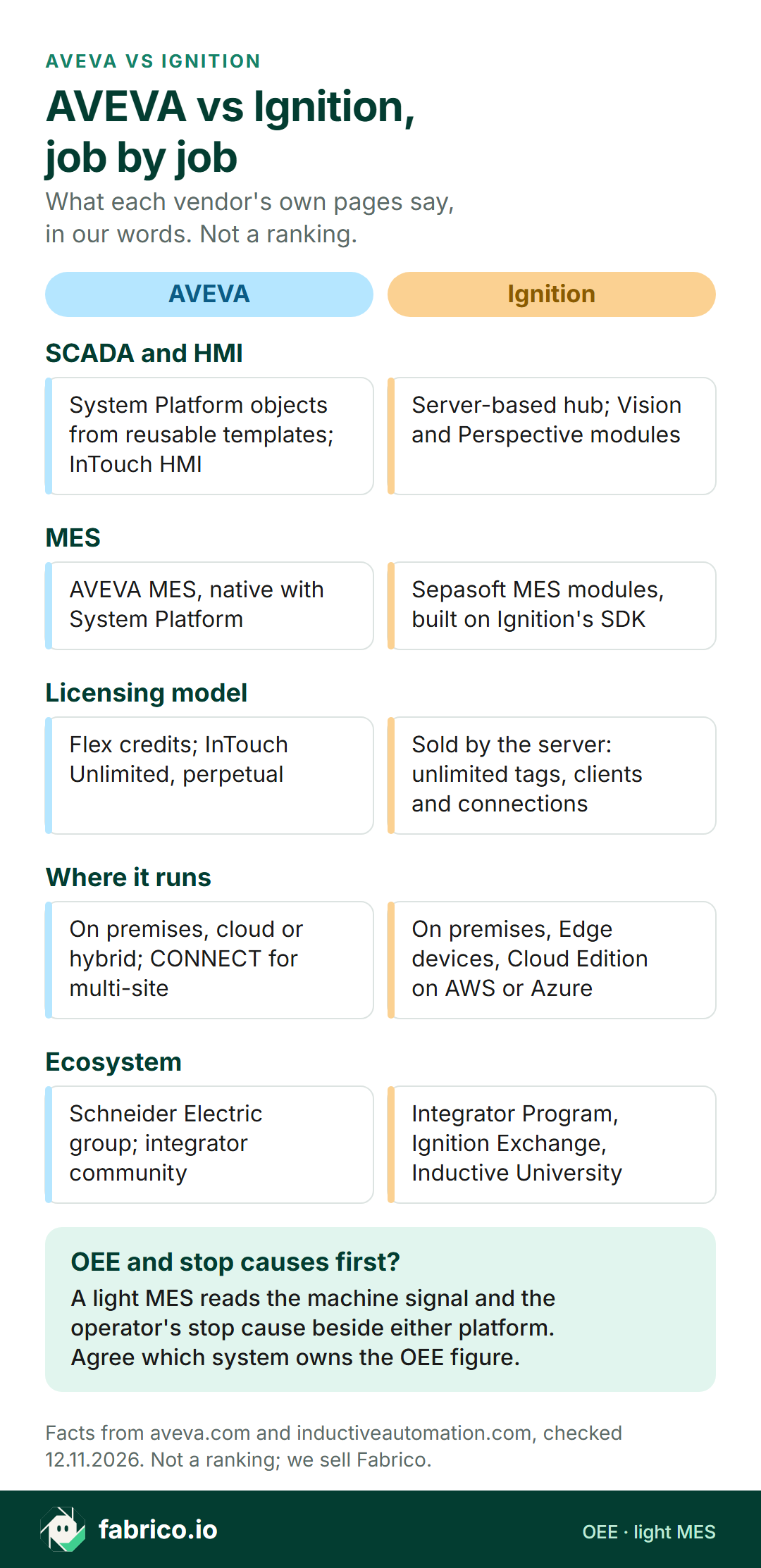
In short: AVEVA vs Ignition is mostly a choice of SCADA platform and of how MES gets added. AVEVA System Platform models assets as reusable objects for SCADA, MES and IIoT applications, with AVEVA MES as its MES. Ignition is server software sold by the server, with unlimited tags and clients, and for MES its maker points to Sepasoft's modules for Ignition. If the job is OEE and stop causes, a light MES such as Fabrico can measure that beside either.
- Both vendors name SCADA, HMI, MES and IIoT applications on their own pages.
- AVEVA's MES page describes native integration with System Platform; Inductive Automation lists Sepasoft's MES modules, built with Ignition's module SDK.
- Both name on-premises and cloud options: AVEVA a hybrid cloud with CONNECT, Ignition its Edge and Cloud Edition products.
- Facts come from each vendor's own pages, as of 12.11.2026, linked in place. No prices, no verdicts.
An engineering team has to replace an ageing HMI, and the plant manager wants OEE from the same budget. AVEVA and Ignition both come up, and the two decisions get mixed. Separate them: first pick the platform that supervises and steers the machines, then decide where OEE and stop causes should live.
This page compares the two by job, from each vendor's own pages. Fabrico wrote it and does not sell SCADA. We sell Fabrico, so it is not ranked; it has a separate section on where OEE fits. For other options around AVEVA, see our AVEVA alternatives page.
AVEVA vs Ignition at a glance
As of 12.11.2026, per each vendor's own pages, linked in the sections below. This is what each vendor's own site says, in our words. It is not a ranking, and a gap means only that we did not find it on the pages we read, so ask each vendor directly.
| Job | AVEVA | Ignition |
|---|---|---|
| Platform | System Platform: assets as objects from reusable templates | Server software, the hub for plant-floor data |
| SCADA and HMI | System Platform; InTouch HMI with an HTML5 web client | Vision and Perspective modules, web-deployed clients |
| MES | AVEVA MES, native with System Platform | Sepasoft MES modules for Ignition |
| Licensing model | Flex credits; InTouch Unlimited as a perpetual license | Sold by the server: unlimited tags, clients, connections |
| Where it runs | On premises, cloud or hybrid | On premises, Edge devices, Cloud Edition |
| Ecosystem | Schneider Electric group; integrator community | Integrator Program, Ignition Exchange |
What AVEVA offers for SCADA, HMI and MES
AVEVA's site says it is a member of the Schneider Electric group. As of 12.11.2026, three of its product pages matter here:
- AVEVA System Platform is described as a unified platform for SCADA, MES and IIoT. It models real-world assets as objects built from reusable templates, and template changes reach the derived objects automatically. It runs on premises, in the cloud or in hybrid setups, exchanges data through MQTT, and uses Python and C# for runtime logic. Plug-in extensions include MES, Quality and Batch.
- AVEVA InTouch HMI is HMI visualization software. Its page names an HTML5 web client for tablets and phones, an industrial graphics library for situational awareness, and the AVEVA Historian included.
- AVEVA Manufacturing Execution System runs on premises or as a hybrid cloud, with multi-site operations management on CONNECT. Its FAQ describes native integration with System Platform for execution tracking and data collection on automated processes. It measures OEE KPIs in real time and tracks genealogy.
- Licensing, as published. The MES page describes the AVEVA Flex subscription program as a credits-based system across cloud, hybrid and on-premises products. The InTouch page describes InTouch Unlimited as a traditional perpetual license, and InTouch Unlimited Premier as part of the Flex subscription.
Customer results on AVEVA's pages are its own claims, so we don't repeat them.
Ask in the demo: which parts need System Platform, which need InTouch alone, and who builds and maintains the templates.
What Ignition offers for SCADA, HMI and MES
Ignition is made by Inductive Automation, based in Folsom, California, per its homepage. As of 12.11.2026, its pages say:
- The platform. Ignition is server software that acts as the hub for plant-floor equipment, built on SQL, Python, OPC UA and MQTT (Ignition overview). It connects to SQL databases and to PLCs through OPC UA, and runs on Windows, Linux and macOS.
- Licensing, as published. Ignition is sold by the server: one license covers an unlimited number of clients, tags and connections, and designers are unlimited too. The unlimited licensing page notes that the hardware sets the practical ceiling.
- Modules. The Vision module launches web-deployed clients for plant-floor and desktop screens; the Perspective module builds mobile-responsive HTML5 applications. The modules page also lists OPC UA, SQL Bridge, historian, reporting and alarm notification modules, and says modules can be added or removed as needs change.
- MES through Sepasoft. Inductive Automation lists Sepasoft as a premier technology provider whose MES modules are built with Ignition's module SDK (Sepasoft page). The modules include OEE Downtime, Track and Trace, Batch Procedure, SPC, Settings and Changeover, and an Interface for SAP ERP.
- Edge and cloud. Ignition Edge comes as Edge IIoT and Edge Panel, installs on devices on the plant floor or in the field, and syncs data to a central Ignition system. Ignition Cloud Edition runs on AWS or Microsoft Azure, is paid by hourly use, and its users handle configuration, backup and upgrades.
- Ecosystem. Inductive Automation runs an Integrator Program, the Ignition Exchange for community-made resources, and free online courses at Inductive University.
Ask in the demo: which modules the first phase needs, which come from Sepasoft or another provider, and who builds the screens.
AVEVA vs Ignition, job by job
SCADA and HMI. Both build operator screens for desktops and phones. AVEVA's System Platform page centres on object templates reused across sites; Ignition's pages centre on one server with unlimited clients and two visualization modules. Ask each how a template change reaches 20 similar machines.
MES. AVEVA sells its own MES with native System Platform integration. Inductive Automation's MES menu points to Sepasoft, whose modules are bought from the technology provider and run on Ignition. Either way, MES is a scope of its own, next to the SCADA.
Licensing model. As published: AVEVA describes Flex credits across cloud, hybrid and on-premises products, plus a perpetual InTouch Unlimited license. Inductive Automation sells Ignition by the server, with modules added as needed, and Cloud Edition by hourly use. We don't compare prices; ask both for a quote on the same scope.
Where it runs. AVEVA names on-premises, cloud and hybrid deployments for System Platform, and a hybrid cloud with CONNECT for AVEVA MES. Inductive Automation names on-premises servers, Ignition Edge on devices, and Cloud Edition on AWS or Azure.
Ecosystem. AVEVA is part of Schneider Electric and hosts a technical community for integrators and customers. Inductive Automation runs an integrator program, a third-party module showcase and the Ignition Exchange. With either, ask which certified integrators work near your plants.
Where OEE fits: SCADA screens, an MES module or a light MES
Both platforms can carry OEE: Ignition's homepage lists calculating OEE under MES, and AVEVA's MES page lists OEE KPIs. The real question is who keeps the stop-cause list, the screens and the reports up to date.
| Your situation | Route to look at first |
|---|---|
| SCADA is being replaced anyway, and the team writes scripts | A: OEE screens in the new SCADA project |
| Orders, genealogy or batch records are needed too | B: an MES module, such as AVEVA MES or Sepasoft |
| The pain is lost time, and SCADA work is booked for a year | C: a light MES next to the SCADA |
| Older machines with no SCADA tags | C: PLC, IoT sensors or a camera add-on |
Our SCADA vs MES guide explains the split, and OEE software vs SCADA covers the overlap.
Where Fabrico fits, beside or instead
Fabrico wrote this page. It is a cloud-based OEE and light MES platform, not SCADA: process control stays in SCADA, as our light MES guide says. Per our MES and OEE overview:
- Machine data. Fabrico reads cycles, stops and output from the PLC on automated lines, fits an IoT device with external sensors to older machines, and offers the camera add-on to count output at manual steps (how the camera add-on works). Protocols on our connectivity page include OPC UA, Modbus, PROFINET, MQTT and EtherNet/IP.
- Stops with causes. Stops on connected machines are recorded with their start and length, micro-stops included, and operators tag the cause on a tablet or phone.
- OEE and losses in money by machine, line and shift, on the web and in iOS and Android apps.
- Data out. A REST API, webhooks, and Excel or CSV export; a connection to SAP or another ERP can be scoped per customer.
- Rollout. Devices connected in about a month; full rollout in 3 to 4 months.
- Not Fabrico: supervisory control and process control, job dispatching, BOMs, routings and genealogy.
Beside AVEVA or Ignition: the SCADA keeps supervising and steering the process, and Fabrico measures OEE and stop causes by line. Instead of an OEE build: if the job you planned to script in SCADA is OEE and stop reasons, a light MES is built for that job. Either way, agree which system holds the official OEE figure.
Ask in the demo: how each machine on a pilot line would report run, stop and count, and how operators tag a stop.
Want to see the light MES side on a line like yours? Book a demo and bring one week's downtime log.
Worked example: SCADA has the stop, the operator has the cause
Sample data for one shift on a machining line, not a customer's line or a product screen. The shift is 480 minutes with a 30 minute break, so planned time is 450 minutes. At an ideal 20 parts a minute, the line could make 9,000 parts.
The SCADA tags show 74 minutes stopped, so run time is 376 minutes and availability is 83.6%. In 376 minutes the ideal is 7,520 parts; the line made 6,768, so performance is 90.0%. Of those, 135 failed inspection, leaving 6,633 good, so quality is 98.0%. OEE is 83.6% x 90.0% x 98.0% = 73.7%, the same as 6,633 good of 9,000 possible (OEE calculation).
The tags give the 74 minutes. They don't give the cause. Once operators tag it, the minutes split into changeover 30, waiting for material 22, tool jams 14, and 8 with no reason given. That ranking is what the morning meeting acts on, whichever system stores it.
Questions to ask before you choose
- Which job comes first: supervising machines, running orders, or measuring lost time?
- Who builds and maintains it? Your automation team, an integrator or the vendor, for screens, scripts and templates.
- Which modules are in scope, and who sells and supports each one?
- How does an operator tag a stop cause at the line, and how long does it take?
- Which parts must run on site for the line to keep running?
- How does the price change from one line to the whole plant? Fabrico is quoted per plant; start with a one-line pilot.
For the layers behind this, read PLC vs SCADA vs MES and ISA-95. For packaged goods plants, our FMCG guide shows where the camera add-on fits next to machine signals.
What people ask next
Is Ignition SCADA or MES?
Both, per Inductive Automation's site: Ignition is a platform for SCADA, IIoT, MES and other industrial applications, extended with modules. Its MES menu points to Sepasoft, whose MES modules are built with Ignition's module SDK.
Does AVEVA System Platform include MES?
AVEVA describes System Platform as a platform for SCADA, MES and IIoT applications, with plug-in extensions such as MES and Batch. AVEVA Manufacturing Execution System is its MES product, with native integration for System Platform.
How is Ignition licensed compared with AVEVA?
As each publishes it: Ignition is sold by the server, with unlimited clients, tags and connections, and modules added as needed. AVEVA describes Flex, a credits-based subscription across cloud, hybrid and on-premises products, and a perpetual license for InTouch Unlimited. Ask both for a quote on the same scope.
Can AVEVA and Ignition run in the cloud?
Yes, per their pages. AVEVA System Platform runs on premises, in the cloud or in hybrid setups, and AVEVA MES combines on-premises execution with cloud services on CONNECT. Ignition Cloud Edition is bought through AWS or Microsoft Azure and paid by hourly use.
Do I need SCADA to measure OEE?
No. An OEE system can read the PLC or a sensor directly. Fabrico reads automated lines from the PLC and fits an IoT device with external sensors to older machines.
Can Fabrico run next to AVEVA or Ignition?
Yes, as a separate layer. Fabrico takes machine data from the PLC, an IoT device or the camera add-on, and its data leaves through a REST API, webhooks, and Excel or CSV export. Agree first which system holds the official OEE figure.
Want to see OEE and stop causes on a line like yours? Book a demo or contact us.
Related articles






Real Fabrico tiles, sample data.