


 Login
 Blog
FactoryLogix Alternatives: Electronics MES or OEE First for SMT Lines

In short: the right FactoryLogix alternative depends on the job you need first. For unit-level traceability, NPI and enforced revisions in electronics assembly, compare it with Critical Manufacturing, Siemens Opcenter Execution Electronics, Cogiscan or Tulip. If your first question is why SMT lines stop and what it costs, a light MES with OEE, such as Fabrico, measures that next to your ERP.
- FactoryLogix is the MES platform of Aegis Software, founded in 1996; Aegis released FactoryLogix in 2013.
- Its electronics page covers NPI from CAD and BOM data, enforced revisions, dynamic line routing, Level-4 component traceability and SPI and AOI data on a board view.
- On connectivity, a PLC Gateway reads PLCs over OPC UA and converts tags into IPC CFX events. OEE appears in its multi-site reporting.
- Vendor facts come from each vendor's own site, as of 12.11.2026, linked in place. No prices, no verdicts, no ranking.
An EMS plant runs six SMT lines, a box build area and many short runs. Some customers ask for a record of every component on each board. The plant manager asks something else: why did line 3 build far fewer boards last week than its placement rate allows?
FactoryLogix is built for the first question. Below: what it is, per Aegis Software's own pages, whether it covers connectivity and OEE, and five alternatives grouped by job. Fabrico wrote this page and is one of the five. We sell Fabrico, so it is not ranked. For which MES an EMS plant needs, see MES for electronics and EMS manufacturing.
What FactoryLogix is (as of 12.11.2026, per Aegis Software's site)
Aegis Software was founded in 1996 by two manufacturing engineers and incorporated in Pennsylvania, according to its about page. Its timeline says FactoryLogix was released in 2013 as a total rewrite of earlier tools into a single MES platform, that Peak Rock Capital acquired Aegis in 2025, and that Aegis completed its acquisition of Simio in 2026, adding digital twin simulation and advanced planning and scheduling. What its electronics page says:
- Who it is for. OEMs, EMS providers and contract manufacturers, with high-mix, high-volume and low-volume production on the same platform.
- NPI. CAD, BOM and engineering data become process plans, visual work instructions, inspection plans and machine programs.
- Revisions. Operators are guided to the current approved version at the station, and outdated instructions are blocked.
- Routing. Jobs are rerouted to an available, compatible line or machine when equipment is down or material is short.
- Traceability. Level-4 component traceability, tracked to a single unit rather than a lot.
- Quality. SPI, AOI and test results on a visual of the board, with native integration to SPI, AOI and AXI systems, including Omron's.
- Planning. Simio simulation and scheduling model capacity and changeover sequencing across lines.
Defect and traceability results in its customer story are vendor-reported, so we don't repeat them.
Does FactoryLogix support machine connectivity and OEE?
Per Aegis's pages, as of 12.11.2026:
- Its connectivity and IIoT page says FactoryLogix connects machines, PLCs and industrial systems, standardizes production events and adds manufacturing context.
- The Aegis PLC Gateway connects to PLCs over OPC UA, with Kepware and Matrikon support for legacy controllers, and converts raw tags into IPC CFX events through configuration. It also runs independently of FactoryLogix.
- Its manufacturing intelligence page lists drag-and-drop dashboards, built-in SPC charts, and comparing throughput, yield and OEE across facilities from one view. Data can also reach Power BI or Tableau.
- Its architecture page lists four deployment models on one code base: on premises, private cloud, hybrid cloud or edge, and SaaS.
Ask in the demo: how FactoryLogix calculates OEE for an SMT line, which machine sets the ideal rate, and where stop reasons come from.
When FactoryLogix is the right pick
- Customers ask for component traceability per board, below lot level.
- NPI is frequent, and work instructions and machine programs should come from CAD and BOM data.
- Revisions change often, and outdated instructions must be blocked at the station.
- You want planning and simulation from the same vendor, which Aegis now offers through Simio.
If most are true, an electronics MES is built for your plant. If your first question is line time, read on.
Comparison table: FactoryLogix and five alternatives
This is what each vendor's own site says, in our words, as of 12.11.2026, linked in each section below. It is not a ranking, and a gap means only that we did not find it on the pages we read, so ask each vendor directly. Fabrico comes first because we wrote this page.
| Tool | Main job, per its site | Electronics focus, per its site | Ask in the demo |
|---|---|---|---|
| FactoryLogix (for reference) | Electronics MES: NPI, execution, quality | Level-4 traceability, SPI and AOI data | How is OEE calculated? |
| 1. Fabrico | OEE and light MES | Changeovers timed per board | How is rework counted? |
| 2. Critical Manufacturing | MES for complex discrete products | Component traceability per IPC-1782 | Which modules come first? |
| 3. Siemens Opcenter Execution Electronics | MES for PCB and box build | Machine connectivity, OEE, traceability | Which other Opcenter products? |
| 4. Cogiscan | SMT connectivity, traceability, analytics | Adapters for many machine brands | Alone or next to an MES? |
| 5. Tulip | Composable frontline apps | Revision-driven instructions, genealogy | Who builds the apps? |
Want to see the OEE side of an SMT line like yours? Book a demo and bring one week's changeover and downtime log.
Fabrico: OEE and light MES next to your ERP and traceability
Fabrico wrote this page. It is a cloud-based OEE and light MES platform. Where FactoryLogix runs the build of each board, Fabrico measures the line: when it stopped, for how long, why, and what it cost. Per our MES and OEE overview:
- Machine data. From the PLC, from a Fabrico IoT device with external sensors on older machines, or from AI cameras, an add-on, where there is no machine signal. Protocols: OPC UA, Modbus, PROFIBUS, PROFINET, MQTT, EtherNet/IP, EtherCAT, IO-Link and HTTP (machine connectivity).
- Stops and reasons. Connected machines report their own stops, including short stops too brief to log by hand. Operators tag the reason, such as a feeder, a nozzle or a missing reel, on a tablet or phone.
- SMT line view. OEE by line and by product, measured against the bottleneck machine, with each changeover timed per board and rework counted as lost good output.
- Losses in money, per line and shift, on the web, iOS and Android.
- The camera add-on can count output at manual stations such as rework benches and hand assembly. In the standard setup, video from the camera add-on is streamed on request, not stored in Fabrico (how the camera add-on works).
- Data out. REST API, webhooks and Excel or CSV export. A connection to SAP or another ERP can be scoped per customer.
- Rollout. Devices connected in about a month; full rollout in 3 to 4 months.
- Stays in your ERP or traceability system: routings, BOMs, dispatching and component genealogy. Roadmap, not live: production planning and scheduling, and a camera add-on that detects stops and offers a likely reason.
Ask in the demo: how a placement line is measured as one constraint, and how rework reaches the quality factor.
Fits plants that keep genealogy in the ERP or the placement machines' own records, and want to know where line time goes across many short runs. EU customers are hosted on AWS in Frankfurt. Quoted per plant. Start with a one-line pilot. See our OEE software for electronics comparison.
Critical Manufacturing: MES for electronics, semiconductor and medical devices
Critical Manufacturing describes an MES-powered industrial operations platform for discrete products, focused on semiconductor, electronics, medical devices and industrial equipment (criticalmanufacturing.com). It has been a subsidiary of ASMPT, a supplier of semiconductor assembly and SMT solutions, since 2018 (who we are). Its electronics page says, as of 12.11.2026:
- Traceability goes down to the component level, aligned with IPC-1782, as component lots go into each PCBA and PCBAs into each final unit.
- Connect IoT handles protocols from IPC-CFX to vendor-specific ones such as ASMPT OIB, so SMT lines, manual assembly and test stations report into one system.
- Access can be set per product, so each OEM customer's data stays separate on shared lines.
- Material management delivers kitted materials by pull signal and enforces FIFO and FEFO rules.
Compared with FactoryLogix: both describe component-level traceability and multi-vendor machine connectivity. Critical Manufacturing's page stresses per-product data separation for contract manufacturers; Aegis's stresses NPI from CAD data and Simio planning. Ask both to trace one defect back to its component lot.
Fits plants that build for several OEMs on shared lines and need genealogy from component lot to final unit.
Siemens Opcenter Execution Electronics
Siemens describes Opcenter as a manufacturing operations management portfolio covering MES, quality, planning and scheduling, and intelligence (Opcenter). Its Opcenter Execution Electronics page says, as of 12.11.2026:
- It offers out-of-the-box machine connectivity, automation and operator guidance for PCB and box-build production.
- It manages production workflows, specifications and advanced electronic work instructions, with closed-loop feedback to the PLM system during NPI.
- It shows trends, OEE and other KPIs online, and works with Opcenter Scheduling Electronics to balance demand and capacity across SMT and assembly lines.
- It provides full traceability of PCB and box-build production, with access to as-built data.
Compared with FactoryLogix: both cover NPI, work instructions, traceability and planning for electronics. Siemens' page ties the MES to PLM and other Opcenter products; Aegis's ties planning to Simio.
Fits plants that already run Siemens software and want electronics MES from the same portfolio.
Cogiscan: SMT connectivity, traceability and factory analytics
Cogiscan was founded in Canada in 1999 and became part of Dürr Systems AG, via iTAC Software AG, in 2021, according to its about page. As of 12.11.2026, its pages say:
- Co-NECT is a standalone, neutral connectivity interface for SMT machines such as placement machines, AOI, SPI, printers and reflow ovens, with over 250 adapters per Cogiscan (connectivity).
- It reads IPC-CAMX, IPC-CFX and SECS/GEM, plus MQTT and AMQP brokers, and runs alone or with ERP, MES, IIoT or AI systems.
- Traceability goes up to IPC-1782 Level 4 (traceability), and PFC halts a board when it finds a wrong material, a wrong program, expired parts or a skipped step (cogiscan.com).
- Factory Insights shows data from site OEE down to machine KPIs (analytics).
Compared with FactoryLogix: both connect multi-vendor SMT lines and trace to the unit. Cogiscan's pages describe a layer that can sit next to an MES; FactoryLogix describes a full MES.
Fits plants that want SMT connectivity and board-level traceability first, next to the MES or ERP they already run.
Tulip: composable apps for electronics assembly
Tulip describes a composable frontline operations platform that some manufacturers use to implement a composable MES, often starting with one use case on one line (Tulip for electronics). As of 12.11.2026, its pages say:
- Workflows can branch by configuration or revision, and each change is approved before operators see it.
- It connects through REST APIs, database connectors, and OPC UA, MQTT and Modbus for machines, with 700+ supported devices; the ERP and PLM stay the systems of record.
- Its OEE app combines machine and PLC data with operator reason codes, by line and shift (OEE tracking).
Compared with FactoryLogix: FactoryLogix describes electronics MES functions that are configured, not coded; Tulip describes apps your engineers compose. See our Tulip alternatives.
Fits plants that want to start with one use case, such as guided box build, and grow from there.
Which FactoryLogix alternative fits your plant
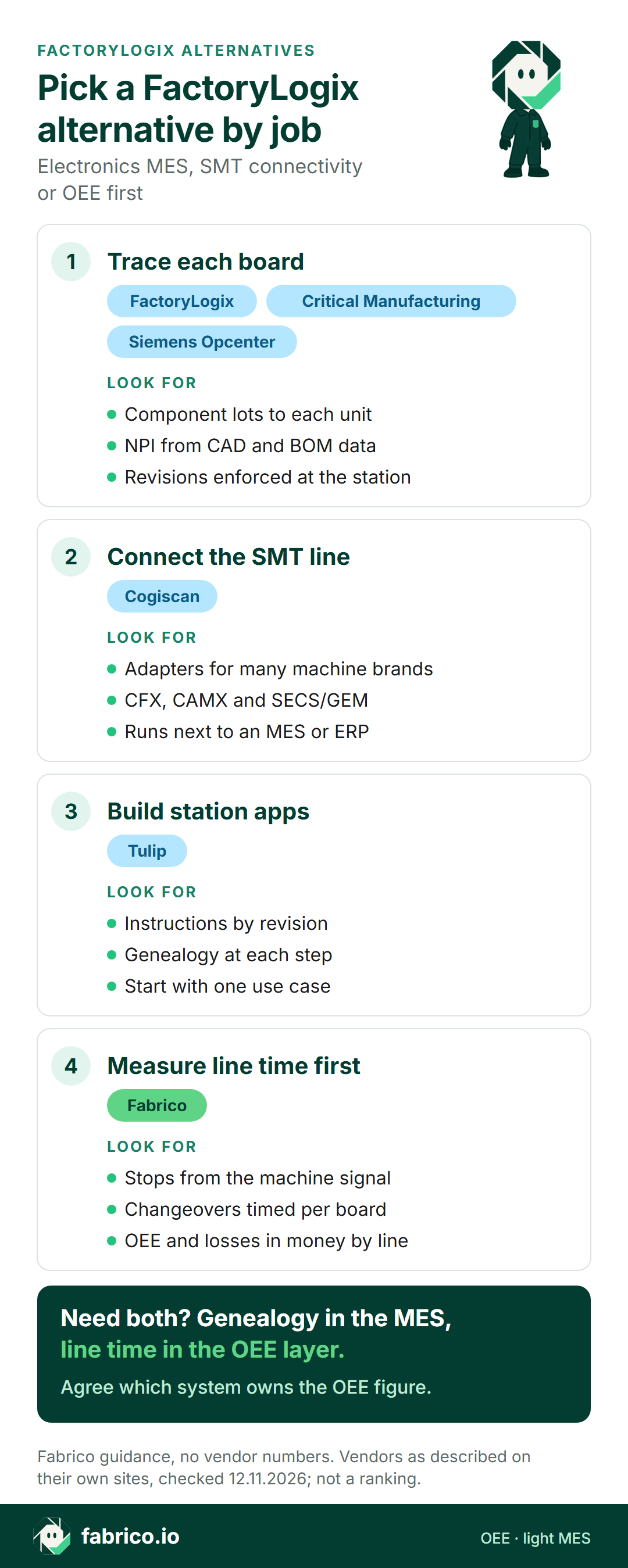
- NPI from CAD and BOM data, enforced revisions and Level-4 traceability in one electronics MES: FactoryLogix.
- Component genealogy for several OEMs on shared lines, plus semiconductor or medical device work: Critical Manufacturing.
- Electronics MES inside a wider Siemens portfolio: Siemens Opcenter Execution Electronics.
- SMT connectivity and board traceability first, next to an existing MES or ERP: Cogiscan.
- Station apps built one use case at a time: Tulip.
- Line time, changeovers and OEE by line and product first, with genealogy left where it is: Fabrico.
An electronics MES and an OEE layer can run together if one system owns each record. See OEE on high-mix electronics lines and IPC-CFX and Hermes.
Worked example: one SMT line, one shift
Sample data for one 8 hour shift on a high-mix SMT line, not a customer's line or a product screen. Planned production time is 450 minutes. The placement machine is the bottleneck, with an ideal cycle of 45 seconds a panel.
Six changeovers took 60 minutes, and other stops 30. Run time is 360 minutes, so availability is 80.0%. At 45 seconds a panel, 360 minutes allow 480 panels. The line built 432, so performance is 90.0%.
Eighteen panels failed first pass and went to rework, leaving 414 good: quality is 95.8%. OEE is 80.0% x 90.0% x 95.8% = 69.0%, the same as 414 good panels x 0.75 minutes over 450.
The electronics MES record is 432 panels, each with its components, programs and inspection results. The OEE record is the 139.5 minutes the line lost. Timed per board family, the changeover minutes show which products cost the most line time; see SMT changeover time and first pass yield on SMT lines.
Questions to ask any vendor on this list
Put the same questions to every vendor, us included, for one representative line.
- Which job is it for? Tracing each board, measuring line time, or both.
- How does each machine report? CFX, a vendor interface, a PLC or a sensor, including manual stations.
- How is OEE calculated on an SMT line? Which machine sets the ideal rate, and how changeovers and rework count.
- Where does genealogy live? In the MES, the ERP or the placement machines' own records.
- Who changes a work instruction or a program? An engineer, the vendor or an integrator.
- What drives the quote? Lines, machines, sites, integration and training. Give every vendor the same list.
What people ask next
Does FactoryLogix support IoT machine connectivity and real-time OEE monitoring?
Per Aegis's pages, FactoryLogix connects machines, PLCs and industrial systems, and its PLC Gateway reads PLCs over OPC UA and converts tags into IPC CFX events. Its manufacturing intelligence page lists real-time dashboards and comparing throughput, yield and OEE across facilities. Ask Aegis how OEE is calculated for a line and where stop reasons come from.
Is FactoryLogix cloud or on premises?
Aegis's architecture page lists four models on one code base with full feature parity: on premises, private cloud, hybrid cloud or edge, and SaaS managed by Aegis.
What are the main FactoryLogix alternatives for electronics manufacturing?
For a full electronics MES, Critical Manufacturing and Siemens Opcenter Execution Electronics. For SMT connectivity and traceability next to an MES, Cogiscan. For composable station apps, Tulip. For line time and OEE first, a light MES such as Fabrico.
How is Fabrico different from FactoryLogix?
FactoryLogix runs the build, per Aegis's site: NPI, revisions, routing, traceability and quality. Fabrico measures the line: stops from the machine signal, reasons from the operator, changeovers timed per board, and OEE and losses in money by line and shift.
Does Fabrico track component genealogy per board?
No. Component genealogy stays in your ERP, a traceability system or the placement machines' own records. Fabrico works next to them and adds line performance.
Can an OEE layer run next to FactoryLogix?
Yes, if each record has one owner. The MES keeps genealogy, revisions and quality data; the OEE layer keeps stops, reasons and line time. Agree which system publishes the OEE figure.
Want to see the OEE side of an SMT line like yours? Book a demo or contact us.
Related articles









Real Fabrico tiles, sample data.