


 Login
 Blog
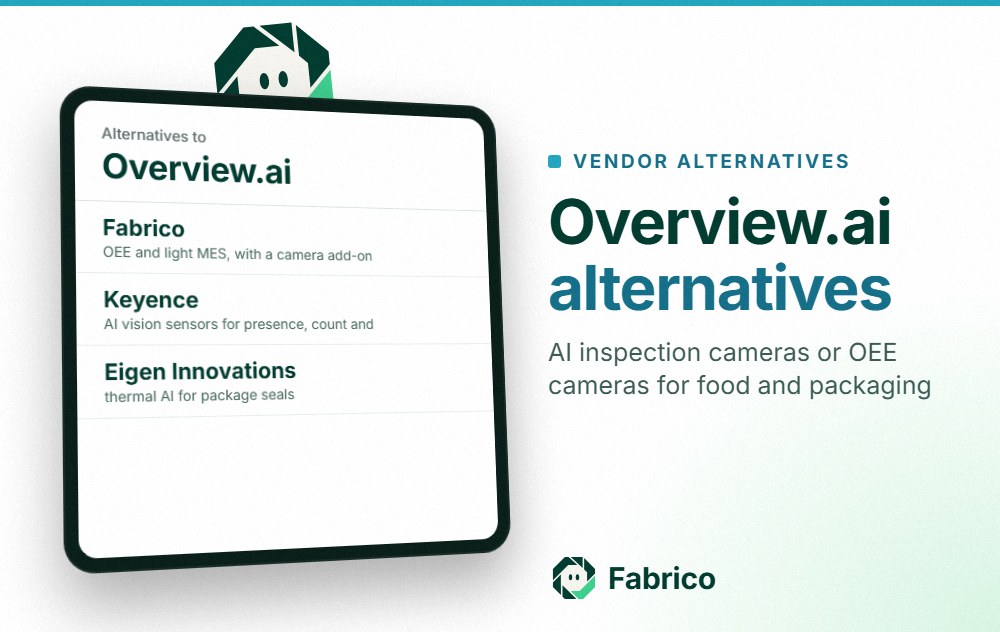
Overview.ai Alternatives: AI Inspection or OEE Cameras for Food Lines

In short: pick an Overview.ai alternative by the question the camera has to answer. Overview.ai sells AI inspection cameras that train and run their models on the device, for checks such as seals, date codes and fill level. Other ways to inspect include Keyence's AI vision sensors and Eigen Innovations' thermal seal inspection. If you need to know why the line stopped and what the lost time cost, compare OEE software such as Fabrico, whose camera add-on counts output on request.
- Overview.ai's range runs from the new OV Spark camera, with an onboard AI agent called Sparky, to the OV10i, OV20i and OV80i and the OVX platform.
- Its food and beverage page covers seal and package integrity, foreign material, date and lot code reading, and fill level.
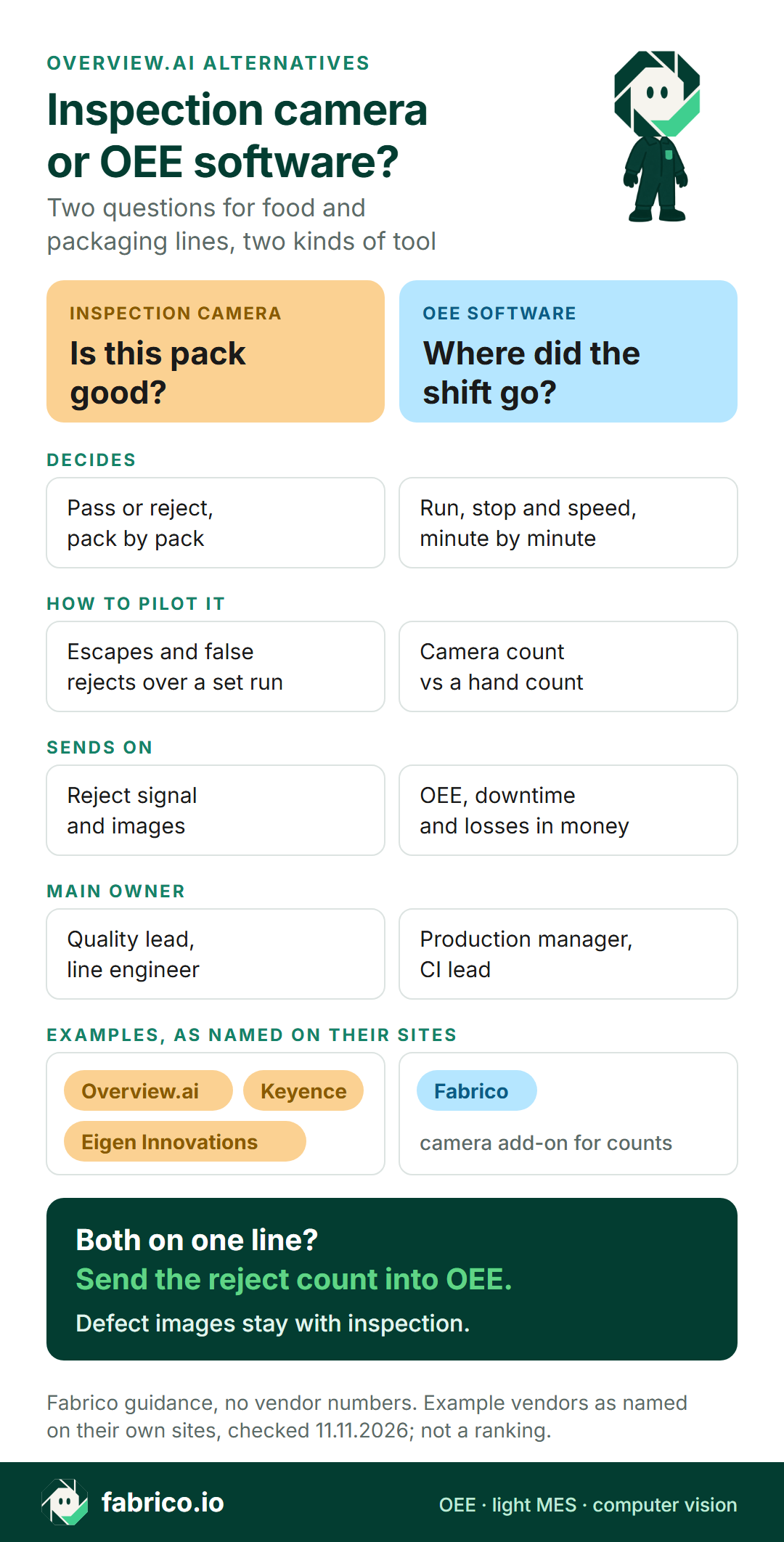
- An inspection camera answers "is this pack good?" in the moment. OEE answers "where did the shift go?" over hours. A food plant can need both answers.
- We checked every vendor claim on that vendor's site on 11.11.2026 and link the page next to it. There are no prices or scores here.
At 4 a.m. a pouch line has two problems that look alike from the office. Some pouches leave with a weak seal. And the bagger keeps stopping for a few minutes at a time. The first is a pass or fail decision on each pouch. The second is lost time.
Overview.ai's site leads with the first problem. If that is yours, compare other ways to inspect. If your problem is the second, compare OEE software too; this page shows where the two meet.
We are Fabrico, one of the options below, so read this as a vendor's page and test it. Fabrico comes first below because we wrote this page, not as a ranking. The wider inspection market is mapped in our visual quality control software guide.
Overview.ai's range, per its own site (as of 11.11.2026)
Overview, a San Francisco company that joined Y Combinator in 2019, combines camera hardware, inspection software and application engineering, according to its company page. Its products, per the same site:
- OV Spark and Spark Pro. Marked "Just released" on the site: a 1.2 MP camera and a 5 MP Pro version, with an onboard AI agent, Sparky, that helps choose inspection tools, build recipes and design operator screens. Its ten AI and rules-based tools include AI counting, OCR and OCV, barcode reading and anomaly detection (OV Spark).
- OV10i, OV20i and OV80i. AI vision sensors and a higher-performance vision system, sold with the software pre-loaded (overview.ai). The OVX platform adds 65 MP, thermal or your own GigE Vision camera.
- Edge first. Per the homepage, models are trained and run on the camera itself, production data stays on the factory floor, and setup happens in a browser.
- Connections. The homepage lists EtherNet/IP, Profinet, Modbus, OPC-UA, MQTT and discrete I/O, among others.
- Food and beverage. Its food and beverage page lists seal and package integrity, foreign material such as glass or metal, label checks with date and lot code reading, and fill level and product shape. It says the system can be retrained for new product lines without calling an integrator.
- Packaging. Its packaging and logistics page adds package damage, carton seals and shipping labels, and describes counting packages and logging throughput per hour, day and week on a dashboard the camera serves itself.
Overview's pages also quote accuracy and customer outcomes; they are vendor-reported, so we leave them out.
Ask in the demo: which camera your seal or code check needs, and how a result reaches the PLC, the reject gate and your reports.
When Overview.ai fits
Per its product pages, Overview.ai fits plants that want to:
- judge each pack pass or fail, whether that is a seal, a cap, a date code or a fill level;
- keep images inside the plant, with the model living on the camera;
- retrain checks in-house when products change, rather than calling an integrator;
- send results to a PLC over a common industrial protocol.
Inspection camera or OEE camera: what each one needs from you
The two jobs ask different things of the line, the team and the pilot. For codes and labels in particular, read how code-reading vision differs from an OEE camera.
| Plan for | AI inspection camera | OEE camera |
|---|---|---|
| When it fires | Each pack, in position | Counts units as they pass |
| Pilot pass mark | Escapes and false rejects | Count vs a hand count |
| View and light | Close up, controlled light | Enough to see each unit |
| Main owner | Quality lead, line engineer | Production manager, CI lead |
| Sends on | Reject signal, images | Counts into OEE |
Side by side: Overview.ai, Keyence, Eigen and Fabrico
Sources for every cell sit in each vendor's section below, checked on 11.11.2026.
| Vendor | What its site leads with | Hardware | Food or packaging pages |
|---|---|---|---|
| Overview.ai (for reference) | Inspection cameras with on-device AI | Own AI cameras; OVX for other cameras | Food and beverage; packaging and logistics |
| Fabrico | Line OEE and downtime, in money | Machine data; camera add-on for counts | Food and FMCG guides |
| Keyence | Vision sensors and systems, with AI tools | IV4 AI vision sensor; smart cameras, controllers | Food and medicine examples |
| Eigen Innovations | AI thermal inspection and monitoring | Thermal sensors, cameras, 3D profilers | Package sealing, bakery, oven and freezer lines |
Want to see stops priced in money next to a reject count? Book a demo on our demonstration line.
Fabrico: OEE and light MES, with a camera add-on that counts
Our own entry. Fabrico is cloud software for OEE and light MES, and it covers the time side of a line: running or stopped, why it stopped, how fast it ran and how much good product came off it.
- Data in: a PLC, sensor or counter reports run, stop and count, and the operator picks the stop reason on a tablet or phone.
- What you see: each line's and shift's OEE and downtime, with losses priced in money, in the browser or the iOS and Android apps.
- Camera add-on, on request: AI cameras count output where no machine gives a usable count, for example at a hand-pack table. Pick a point on the shift timeline and the matching video plays; by default it is streamed, not kept in Fabrico.
- Data out: REST API, webhooks, Excel and CSV.
- On the roadmap, not in the product today: stops spotted by the camera itself, jam zones drawn on its view, and a suggested stop reason for the operator to accept or change.
- Outside Fabrico: checking seals, labels, codes or fill. An inspection system does that; when its rejects arrive as a signal or counter, they go into the quality figure.
Proof, and a conflict to declare. The proof comes from Ficosota, a Bulgarian maker of hygiene, tissue and household products. Ficosota is also a Fabrico investor. Our investment announcement has the details. Between June and September 2026, OEE on its 16 lines in Fabrico rose from 53.11% to 59.62%, and good output from 10.49 million to 12.92 million units a month. Unclassified time fell from 3.20% to 0.40% of production time. These are OEE results across those 16 lines at an FMCG maker; the approved figures make no claim about cameras. Read the Ficosota story.
Compared with Overview.ai: Overview.ai's camera decides whether each pack passes. Fabrico records what happened to the line's time. Overview's packaging page also describes counting packages and tracking flow rate and belt uptime on the camera's own dashboard, so ask both vendors how a count reaches the OEE calculation and how stops get their reasons.
Fits plants that rank their downtime by what it costs, line by line and shift by shift, and have some stations no PLC can count (Fabrico computer vision). Our OEE solution overview shows the rest of the platform.
Keyence: AI vision sensors for presence, count and code checks
Keyence sells vision sensors and systems among many other automation products. Overview's company page names Keyence, with Cognex, among its competitors. As of 11.11.2026, Keyence's IV4 series page says:
- The IV4 is a vision sensor with built-in AI. With one click, its AI imaging tests over 10,000 image conditions and recommends the optimal images for detection.
- AI OCR reads characters, dates and numbers against a built-in dictionary, and can learn characters it cannot read yet.
- In AI Through Count mode, the sensor counts targets passing inline. An AI trigger removes the need for a separate trigger sensor.
- The lineup includes models with PoE, a compact head, a high-flex robotic cable or an IP67 enclosure rating.
Its vision systems page adds smart cameras and controllers, and gives food and medicine examples, among them reading lot codes and checking food trays, shrink wrap and cans.
Compared with Overview.ai: both sell AI cameras set up on the device, with counting, OCR and trigger tools. Keyence's IV4 page leads with one-click image setup on a compact sensor. Overview's Spark page leads with an onboard AI agent that helps build recipes and operator screens.
Ask in the demo: which model and lens suit your pack size and line speed, and who on site adds a new date code format.
Fits plants that want a compact AI vision sensor for presence, count and date code checks, per its IV4 page. For Cognex In-Sight, see the Cognex In-Sight review.
Eigen Innovations: thermal AI for package seals
As of 11.11.2026, Eigen Innovations' site describes AI thermal vision for quality inspection and condition monitoring (eigen.io). Its package sealing page says thermal cameras inspect each seal right after sealing, and that detections can reject packages or stop the line. Its homepage also lists food lines such as bread baking and cooling, and oven and freezer lines, and its hardware page lists hardware from high-resolution cameras to thermal sensors and 3D profilers.
Which option fits which plant
- Overview.ai fits plants that want a model living on each inspection camera and no production images leaving the site (its homepage).
- Keyence fits plants that want a compact AI vision sensor for presence, count and code checks (its IV4 page).
- Eigen Innovations fits plants that want seal checks from thermal imaging right after sealing (its sealing page).
- Fabrico fits plants that need the shift's lost time explained and priced, with a camera count at stations that have no machine signal (Fabrico's camera add-on page).
Comparing more inspection vendors? Our Elementary alternatives and Landing AI alternatives pages cover others. The OEE camera side has its own roundup: camera-based OEE software compared.
Worked example: what each system reports for the same shift
Picture a snack pouch line on a 7 hour shift. The numbers are invented for this page, not taken from a customer or a product screen: 420 planned minutes, an ideal 80 pouches a minute, so 33,600 pouches is the ceiling.
Three things stopped the bagger for 42 minutes in all: a film splice (12), cleaning the sealing jaws (18) and waiting on the weigher (12). With 378 of 420 minutes running, availability comes to 90.0%.
Running flat out, those 378 minutes would give 30,240 pouches. The bagger turned out 28,350, a performance of 93.8%.
All 28,350 went past the seal camera, which kicked out 567: a 2.0% reject rate and 27,783 good pouches, so quality is 98.0%. Together that is 90.0% x 93.8% x 98.0% = 82.7% OEE, which matches 27,783 out of 33,600.
Both reports are right. The camera says 2.0% of pouches failed. The OEE report says stops cost 3,360 pouches, about six times the rejects, and slow running another 1,890. In this sample the jaw cleaning links them: weak seals in one report, 18 minutes of stops in the other. That is the case for sharing one reject count between the two systems.
Before a camera count goes into OEE, hand-count the same station for a shift and compare; this guide on camera count accuracy explains how. For bagger stop modes, see VFFS bagger stops and cameras.
Before you sign: a seven step pilot plan
Use it for every vendor you shortlist.
- Write down the one question. "Is this seal good?" or "Why did the bagger stop?" The question picks the type of vendor.
- Collect the bad examples. For inspection, keep real failed packs and note what was wrong. For OEE, keep last month's stop log, however rough.
- Fix the station. Agree camera position, lighting, mounting and the network point before the vendor arrives.
- Set the pass mark. For inspection: escapes and false rejects over a set number of packs. For OEE: the camera count within an agreed gap of a hand count, and stop reasons filled in.
- Test a changeover. Run at least one SKU change in the pilot and time how long the check takes to be ready.
- Settle where pictures are kept. Camera, plant server or vendor cloud; the retention period; the people with access. Bring the works council in early; see cameras without surveillance.
- Ask for the same quote basis. Stations, cameras, lenses, lighting, mounting, integration and training, from every vendor.
Running the OEE half? The computer vision OEE pilot plan has the week-by-week detail. Food plants can also read the food plant camera guide, and packaging and household lines the FMCG buyer's guide.
Questions buyers ask next
Is Overview.ai OEE software?
Overview describes itself as an AI vision systems company for detecting defects and verifying assembly. Its packaging page also describes counting packages and tracking flow rate and belt uptime on the camera's own dashboard. For OEE with stop reasons by line and shift, ask how its results would reach the system that calculates OEE.
Does Overview.ai need the cloud?
Its homepage says training and inference run on the camera and that production data never leaves the factory floor. The OV Spark page says no cloud connection is needed for production inspection; the optional Defect Studio uses the cloud to make synthetic training images.
What can Overview.ai inspect on a food line?
Its food and beverage page lists seal and package integrity, foreign material on the product or in containers, label presence and date or lot code reading, and fill level and product shape. Test your own packs and defects in a pilot.
Can an Overview.ai camera count output for OEE?
Its Spark AI Count tool checks how many items are in a region against a minimum and maximum, as a pass or fail. Its packaging page also describes counting packages over time. Whether that count can feed your OEE depends on how it reaches your PLC or OEE software, so test it against a hand count.
Does Fabrico inspect packs like Overview.ai?
No. Overview.ai's cameras judge each pack. Fabrico is OEE software: it tracks when the line runs and stops, records the stop reasons operators enter, and prices the lost time. Its camera add-on counts output at stations without a machine signal; it does not check seals, labels or codes.
How does an Overview.ai result reach the PLC or reject gate?
Its homepage lists EtherNet/IP, Profinet, Modbus, OPC-UA, MQTT and discrete I/O, and the OV Spark page lists native EtherNet/IP, PROFINET, Modbus TCP, MQTT and OPC UA. Ask how the pass or fail result maps to the PLC and reject gate, and test it in the pilot.
Want one line's shift laid out as stops, speed and rejects? Book a demo or write to us.
Related articles


Real Fabrico tiles, sample data.