


 Login
 Blog
Cogniac Alternatives: AI Vision Platforms, Inspection Kits or OEE

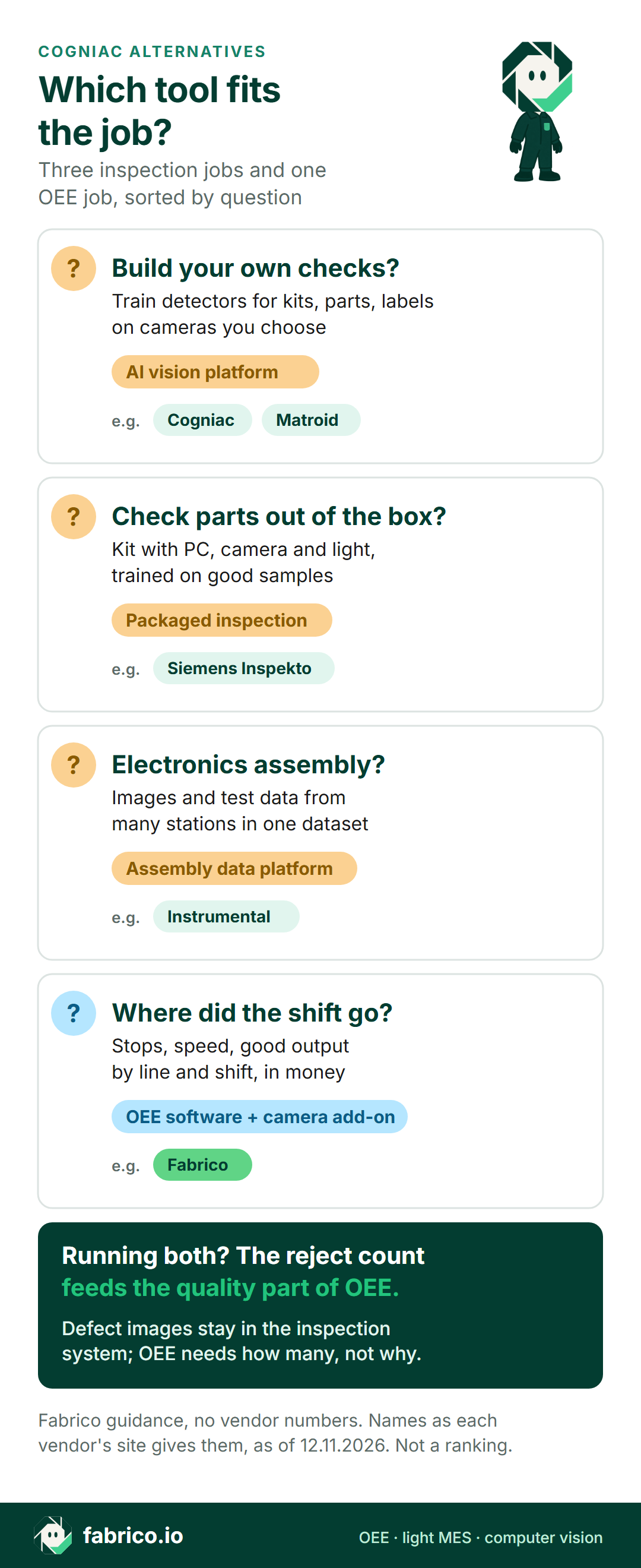
In short: choose a Cogniac alternative by the job the camera has to do. Cogniac sells a low-code AI vision platform for defect checks and kit or label verification that runs in the cloud, on-prem or at the edge. Other ways to do that job include Matroid's no-code detectors on existing cameras, the Siemens Inspekto inspection kit and, for electronics assembly, Instrumental. If you need to know why the line stopped and what the lost time cost, compare OEE software such as Fabrico, whose camera add-on, available on request, counts output.
- Cogniac's own pages describe manufacturing quality checks, packaging and kitting verification, and a partnership with Cisco Meraki cameras.
- An inspection platform answers "is this part, kit or label right?" OEE answers "where did the shift go?" Many plants need both answers.
- The alternatives here are grouped by job, not ranked.
- We checked every vendor claim on that vendor's own site on 12.11.2026 and link the page next to it. There are no prices or scores here.
Picture a packing room after a night shift. One supervisor worries about kits that left with a wrong part. Another worries that the kitting bench sat idle for most of an hour, in short gaps nobody wrote down. Both are camera questions, but not the same question.
Cogniac's industry pages describe the first: is this kit, part or label right? If that is your problem, compare other inspection platforms. If it is the second, compare OEE software too. This page covers both and where they meet.
We are Fabrico, one of the options below, so read this as a vendor's page and test it. Fabrico's section comes first among the alternatives because we wrote the page, not as a ranking. For a wider map of inspection tools, see our visual quality control software guide.
Cogniac, per its own site (as of 12.11.2026)
Cogniac was founded in late 2015 and is headquartered in San Jose, California, according to its company page. It calls itself an enterprise computer vision platform. Per its own pages:
- A low-code platform. Its product page describes a low-code platform built on artificial intelligence and convolutional neural networks, and says it can identify defects from as few as 100 labelled images.
- Where it runs. The manufacturing and industrial page says the platform can run in the cloud, on-prem or on the edge, using Cogniac's own EdgeFlow system. The product page describes deployment across the cloud, on-prem, or both.
- Manufacturing quality. The same manufacturing page describes a quality assurance standard that stays consistent across shifts and sites, and a wood mill case where the platform evaluates the quality of incoming wood, including its curvature.
- Packaging and kitting. Its packaging and kitting page describes analysing an image of a prepared kit to check that the parts match the SKU, with a human expert notified, and says the platform can be retrained with a few labelled images when a new label or parts kit arrives.
- Cameras. A Cisco Meraki partnership page pairs Cogniac's custom computer vision with Meraki MV cameras, for inspection, order accuracy and process observation.
- Industries. The homepage lists automotive, railway, manufacturing, safety and security, government, logistics, and packaging.
Cogniac's pages also quote accuracy figures and savings from client projects. These are vendor-reported, so we leave them out.
Ask in the demo: which deployment mode fits your network, who on site retrains a model when a SKU changes, and how a pass or fail reaches the PLC and your reports.
When Cogniac fits
Per its own pages, Cogniac fits plants that want to:
- check kits, parts or labels against a SKU, with a person told when something looks wrong;
- choose where the AI runs, in the cloud, on-prem, at the edge or in a mix;
- run several visual tasks on one platform across sites, not one camera at a time;
- use Meraki MV cameras they already own for vision tasks.
Inspection platform or OEE camera: what each one needs from you
The two jobs ask different things of the station, the team and the pilot. For label and code checks in particular, read how code-reading vision differs from an OEE camera.
| Plan for | Inspection platform | OEE camera |
|---|---|---|
| Question | Is this item right? | Where did the shift go? |
| Training data | Labelled good and bad images | What one unit looks like |
| Pilot pass mark | Escapes and false rejects | Count vs a hand count |
| Main owner | Quality lead | Production or CI lead |
| Sends on | Pass or fail, images | Counts into OEE |
Side by side: Cogniac, Fabrico, Matroid, Siemens Inspekto and Instrumental
Sources for every cell sit in each vendor's section, checked on 12.11.2026.
| Vendor | What its site leads with | Where it runs, per its site | Cameras, per its site |
|---|---|---|---|
| Cogniac (for reference) | Low-code AI vision platform | Cloud, on-prem, edge (EdgeFlow) | Meraki MV partnership |
| Fabrico | Line OEE and downtime, in money | Cloud; web, iOS, Android | Camera add-on for counts |
| Matroid | No-code vision for inspection | Cloud, on premises, edge | Existing cameras and streams |
| Siemens Inspekto | Out-of-the-box visual inspection | Siemens Industrial PC in the kit | Camera and light in the kit |
| Instrumental | Assembly data for electronics | Managed cloud or own environment | Existing AOI and cobot cameras |
Want to see lost time priced in money next to a reject count? Book a demo and bring your station list.
Fabrico: OEE and light MES, with a camera add-on that counts
Our own entry. Fabrico is cloud software for OEE and light MES. It covers the time side of a line: running or stopped, why it stopped, how fast it ran and how much good product came off it.
- Data in: a PLC, sensor or counter reports run, stop and count, and the operator picks the stop reason on a tablet or phone.
- What you see: OEE and downtime by line and shift, with losses priced in money, in the browser or the iOS and Android apps.
- Camera add-on, on request: AI cameras count output where no machine gives a usable count, for example at a kitting bench or hand-pack table. Pick a moment on the shift timeline and the matching video plays; in the standard setup it is streamed on request, not stored in Fabrico.
- Data out: REST API, webhooks, Excel and CSV.
- Roadmap, not in the product today: stops detected by the camera add-on itself, jam zones drawn on its view, and a suggested stop reason for the operator to accept or change.
- Not something Fabrico sells: checking parts, kits, labels or codes. An inspection system does that; when its rejects arrive as a signal or counter, they feed the quality figure.
Compared with Cogniac: Cogniac's platform decides whether a kit, part or label is right. Fabrico records what happened to the station's time. A packing room can run both: the kit check sends its reject count, and Fabrico turns it into the quality part of OEE.
Fits plants that rank downtime by what it costs, line by line and shift by shift, and have stations no PLC can count (Fabrico computer vision). The OEE solution overview shows the rest of the platform.
Matroid: no-code detectors on cameras you already have
As of 12.11.2026, Matroid's homepage leads with no-code computer vision for industrial inspection. Its why Matroid page says:
- The no-code platform lets a team without programmers build computer vision themselves.
- It deploys in the cloud, on premises or at the edge.
- It analyses images, videos and live streams from existing cameras, smart devices, drones and more.
- It helps manufacturers deploy computer vision at scale for quality inspection, safety and compliance.
Its manufacturing page says detectors can be trained to find surface flaws, missing parts, incorrect assembly and other product irregularities, and that alerts can go to dashboards, mobile devices or factory systems. Its deployment page describes running models on live streams from new or old security and manufacturing cameras.
Compared with Cogniac: both sell a platform for building your own visual checks rather than a fixed sensor. Matroid's pages lead with no-code detector building on any existing camera; Cogniac's lead with low-code training and its own EdgeFlow edge system.
Siemens Inspekto: a boxed inspection kit trained on good parts
Siemens sells Inspekto. As of 12.11.2026, its Siemens product page says:
- It enables out-of-the-box visual quality inspection and needs no expertise in vision systems or AI to implement, deploy and maintain.
- Commissioning needs 20 good samples; bad samples are optional.
- Use cases on the page include plastic injection moulding, metal casting, PCB components and end-of-line assembly, plus incoming goods and final product checks.
A Siemens insights article says the kit contains a Siemens Industrial PC, a camera, a light and the cables, and that Inspekto can be fully integrated with PLC or MES and ERP systems.
Compared with Cogniac: Inspekto arrives as a station with its own camera, light and PC, trained mainly on good parts. Cogniac is a platform that runs many tasks across cameras and sites, trained on labelled images.
Instrumental: assembly data for electronics lines
As of 12.11.2026, Instrumental's homepage leads with manufacturing acceleration for complex electronics, and says it turns assembly data into knowledge and action that improve yield, throughput and ramp. It works with existing AOI and cobot cameras. Its industry pages cover AI compute infrastructure, consumer, enterprise, and aerospace and defense electronics.
Its platform page says it can take in images and data from existing equipment such as AOI and X-ray, add drop-in stations for images and visual tests, and run in a managed cloud or inside your own environment.
Compared with Cogniac: both look for defects with AI. Instrumental's pages centre on electronics assembly data across stations and factories; Cogniac's span manufacturing, packaging, logistics and more.
Which option fits which plant
- Cogniac fits plants that want one vision platform for kit, part and label checks, with a choice of cloud, on-prem or edge (its packaging page).
- Matroid fits plants that want staff to build detectors on cameras they already run (its why Matroid page).
- Siemens Inspekto fits plants that want a boxed inspection station trained mainly on good parts (its product page).
- Instrumental fits electronics plants that want assembly images and test data in one place (its homepage).
- Fabrico fits plants that need the shift's lost time explained and priced, with a camera add-on count at stations that have no machine signal (the camera add-on page).
Comparing more inspection vendors? The Landing AI alternatives page covers model-building platforms, and the Elementary alternatives page covers AI inspection cameras. For OEE cameras, see camera-based OEE software compared.
Worked example: what each system reports for the same shift
Picture a hand-pack kitting station on a 450 minute shift. The numbers are invented for this page, not taken from a customer or a product screen. The ideal rate is 4 kits a minute, so 1,800 kits is the ceiling.
Three things stopped the bench for 45 minutes in all: waiting for parts (20), a label printer jam (15) and a SKU changeover (10). With 405 of 450 minutes running, availability is 90.0%.
At the ideal rate, 405 minutes would give 1,620 kits. The team packed 1,458, so performance is 90.0%.
All 1,458 kits went past the kit check, which flagged 29 as wrong. That leaves 1,429 good kits, so quality is 98.0%. Together: 90.0% x 90.0% x 98.0% = 79.4% OEE, which matches 1,429 out of 1,800.
Both reports are right. The kit check says 2.0% of kits were wrong. The OEE report says stops cost 180 kits, about six times the wrong kits, and slow packing another 162. If some of the 29 wrong kits carried misprinted labels, the label printer links the two reports: rejects in one, 15 minutes of stops in the other. That is the case for sharing one reject count between the two systems.
A bench like this has no PLC, which is where a camera count earns its place. Before that count goes into OEE, hand-count the same station for a shift and compare; this guide on camera count accuracy explains how. Co-packers running many kits and SKUs can read computer vision for co-packers.
Before you sign: a seven step pilot plan
Use it for every vendor you shortlist.
- Write down the one question. "Is this kit right?" or "Why did the bench stop?" The question picks the type of vendor.
- Collect real examples. For inspection, keep real wrong kits, bad parts and misprinted labels, and note what was wrong. For OEE, keep last month's stop log, however rough.
- Fix the station. Agree camera position, lighting, mounting and the network point before the vendor arrives.
- Set the pass mark. For inspection: escapes and false rejects over a set number of items. For OEE: the camera count within an agreed gap of a hand count, and stop reasons filled in.
- Test a changeover. Run at least one SKU or label change in the pilot and note who retrains the check and how.
- Settle where pictures are kept. Camera, plant server or vendor cloud; the retention period; who has access. Bring the works council in early; see cameras without surveillance.
- Ask for the same quote basis. Stations, cameras, lenses, lighting, mounting, network, integration and training, from every vendor.
Running the OEE half? The computer vision OEE pilot plan has the detail. Packaging and household lines can read the FMCG buyer's guide to computer vision.
Questions buyers ask next
Is Cogniac OEE software?
Cogniac describes itself as an enterprise computer vision platform. Its pages describe inspection, defect detection and kit checks. For OEE with stop reasons by line and shift, ask how its results would reach the system that calculates OEE.
Where does Cogniac run?
Its manufacturing page says the platform can run in the cloud, on-prem or on the edge, using Cogniac's own EdgeFlow system. Its packaging page also names hybrid workflows. Ask which mode suits your network and where images are kept.
Can Cogniac check labels and kits on a packing line?
Its packaging and kitting page describes checking an image of a prepared kit against the parts a SKU needs, and retraining with a few labelled images when a new label or parts kit arrives. Test your own labels and kits in a pilot.
Which Cogniac alternative works with existing cameras?
Matroid's site says it analyses images, video and live streams from existing cameras, and Instrumental's homepage says it works with existing AOI and cobot cameras. Siemens Inspekto ships its own camera and light in the kit. Ask each vendor to test on your camera feeds.
Does Fabrico inspect products like Cogniac?
No. Cogniac and the other inspection vendors here judge parts, kits or labels. Fabrico is OEE software: it tracks when the line runs and stops, records the stop reasons operators enter, and prices the lost time. Its camera add-on counts output at stations without a machine signal.
Can an inspection platform and Fabrico run on the same line?
Yes. They answer different questions. If the inspection system sends its reject count to the PLC or a counter, that count can feed the quality part of OEE in Fabrico. Defect images and classes stay in the inspection system.
Want one station's shift laid out as stops, speed and rejects? Book a demo or write to us.
Related articles





Real Fabrico tiles, sample data.