


 Login
 Blog

Matics Alternatives: OEE, Frontline Apps and Light MES Compared

In short: Matics alternatives are easiest to compare by who in the plant will use them each day and where the numbers come from. Matics describes itself as a real-time operational intelligence platform with apps for operators, planners, QC managers, technicians and managers. The options here are Redzone, Shoplogix, Intouch Monitoring and Fabrico, grouped by the job each one describes.
- Matics collects data through an external PLC connection, smart sensors or OPC, per its FAQ page.
- Its pages add planning with a dynamic Gantt, digital QC tests with SPC, alerts and in-context chat.
- The practical split between vendors: role apps and communication, machine signals with modules, or OEE by cause with losses in money.
- Every vendor line below links the page it came from, read on 13.11.2026.
Picture a plastics packaging plant with fourteen extrusion blow moulders, a trimmer and a leak tester on each line, and a hand packing area at the end of the hall. Shift sheets are on paper. Last week ran at about three quarters of the plan, and nobody can say which machine, shift or cause took the rest.
Matics is on the shortlist because its pages speak to plastics, packaging and CPG, and to each role on the floor. The sections below set out what Matics publishes about itself, then Redzone, Shoplogix, Intouch Monitoring and our own product, Fabrico, each by the job it describes.
What Matics is (as of 13.11.2026, per matics.live)
Matics calls itself the manufacturing intelligence platform that aggregates, analyses and streamlines production data (Matics home page). Its about page describes a new generation of MES that runs in the cloud, operating in 25 countries. The company name in its footer is Matics Manufacturing Analytics Ltd, and the site comes in English, Italian and Hebrew. As of 13.11.2026, its pages say:
- Data collection. The Matics FAQ lists three ways to collect machine data: an external PLC with a non-disruptive connection, smart sensors, and a software route such as OPC. The same FAQ names plastic and rubber, and packaging and CPG, among its key verticals, and says Matics is not an ERP system.
- Technology. The technology page says the platform turns data from old and new machines, people, IoT sensors and environments into information on any device, through a proprietary InCloudFactory connection to the cloud.
- Operators. The operators page describes a shift dashboard, automatic alerts, stop reasons entered in real time, and the next job prepared and activated digitally.
- Planners. The planners page covers production rates, machine downtime, cycles and planned stops, and a dynamic Gantt for delivery dates.
- QC managers. The QC managers page describes digital test results, quality triggers based on quantity, timing and events, and SPC support.
- Communication. The home page lists rules that send messages, service calls and tasks on set events, and the solution overview adds machine-connected group chats and task management.
Worth asking Matics: which of the role apps the first line needs on day one, and how orders and part data flow from the ERP to the operator tablet.
When a role-based platform like Matics makes sense
- Several roles want their own view of the same machines.
- Calls to the technician or the shift lead get lost on radios and paper.
- QC tests are on paper and should be triggered by quantity or time.
- The planner wants a Gantt that moves with live counts.
If most of those fit, a broad platform is a sound route. If the first question is why the blow moulders lose a quarter of the shift and what that costs, compare how each option records the stop cause and prices it.
Five roles, five answers
Role-based software is easier to compare once you write down who asks what. Some answers come straight from the machine; others need a person at the line. Our article on MES vs machine monitoring sorts those questions by layer.
Matics and four alternatives at a glance
The table condenses what each vendor's site said on 13.11.2026; the sources are linked in the vendor sections. Matics sits on top as the page subject and Fabrico second as the page owner; the rows are not in order of merit.
| Vendor | How machine data comes in | Other areas on its site | Question to ask |
|---|---|---|---|
| Matics (reference) | External PLC link, smart sensors or OPC | Role apps, Gantt planning, QC tests, alerts | Which apps does the first line need? |
| Fabrico | PLC, IoT device, or camera add-on at packing | Tablet stop causes, losses in money | Which reason codes fit our blow moulders? |
| Redzone | Links to ERP, data historian and MES | Coaching AI, scheduling, CMMS, QMS | Which teams start first? |
| Shoplogix | Any machine on the floor | Team messaging, quality modules, Pulse AI | Which module comes first in packaging? |
| Intouch Monitoring | One relay or encoder input per machine | Scheduling board, dashboards, energy | How does a blow moulder connect? |
Curious how fourteen blow moulders look on one screen? Walk through a sample hall in a demo.
Fabrico: stop causes and losses in money for a moulding hall
This section is ours, and each claim in it can be checked on our MES and OEE overview or our light MES guide. The bottle plant in the opening does not need five role apps on day one. It needs to know where a quarter of the shift goes on fourteen blow moulders, which causes are behind it, and what each one costs.
Fourteen machines, three kinds of signal. Newer blow moulders with a usable controller send cycles, stops and output from the PLC, using a protocol from our machine connectivity page. The older ones are fitted with a Fabrico IoT device and external sensors. No controller watches the hand packing tables, so the camera add-on counts packed output there. When a supervisor opens the video for a moment at the packing table, it is streamed while open and, in the standard setup, not stored in Fabrico (camera add-on page). The three sources land in one OEE figure per line.
A cause for the lost quarter. Fabrico logs when a connected blow moulder stopped and for how long, and picks up micro-stops from the signal that no shift sheet would show. The operator chooses the cause on a tablet or phone from reason codes the plant writes itself, such as parison sag, mould change or trimmer jam. Leak tester rejects and purge bottles can be keyed in on a tablet where no sensor counts them, so they reduce the quality factor instead of vanishing.
Getting the right person to the machine. Shift leads, technicians and managers still need to hear about a problem. Notification rules decide who is told about what, by push, in-app message or email. A QR code on a blow moulder opens its record and repair history, and a technician can raise a repair work order from the stop itself. Plants with more than one hall can set them side by side on a multi-plant view.
Where Fabrico stops. Fabrico is a light MES: machine data collection, production monitoring, OEE and downtime analytics. Production planning and scheduling are on our roadmap and not part of Fabrico yet, so the Gantt stays wherever the plant plans today. Job dispatching, BOMs, routings and genealogy remain in the ERP; an SAP or other ERP link is scoped per customer over REST APIs, and webhooks plus Excel or CSV export carry data out. In the five levels of the ISA-95 model that is operations work, and IEC 62264-1 places operations management at Level 3, below the enterprise systems at Level 4. EU customers are hosted on AWS in Frankfurt.
Worked example: one blow moulder shift, counted and explained
Sample data: a two-cavity blow moulder on a 480 minute shift. Take off the 30 minute break and 450 minutes are planned. At the ideal rate the machine makes 30 bottles a minute.
Availability. The machine stopped for 65 minutes: a 40 minute mould and colour change, a 14 minute trimmer jam, and nine short stops adding up to 11 minutes when the packing conveyor backed up. Run time is 450 minus 65, or 385 minutes, so availability is 385 / 450 = 85.6%.
Performance. At 30 bottles a minute, 385 minutes allow 11,550 bottles. The machine made 10,400, so performance is 10,400 / 11,550 = 90.0%.
Quality. The leak tester rejected 260 bottles, most of them start-up bottles after the colour change, leaving 10,140 good. Quality is 10,140 / 10,400 = 97.5%.
OEE. 85.6% x 90.0% x 97.5% = 75.1%. As a check, 10,140 good bottles at 30 a minute need 338 minutes, and 338 / 450 = 75.1%. The definitions follow the OEE KPI in ISO 22400-2; our OEE calculation guide shows the same steps.
The signal alone shows 65 lost minutes and a slow rate. The causes a person tagged turn a weekly 75% into a list of fixes.
Redzone: frontline teams with coaching AI
Redzone describes AI manufacturing software for frontline teams. The Redzone home page says, as of 13.11.2026:
- Its ChampionAI gives frontline teams the next best action, often before problems occur.
- Frontline teams see their numbers in real time and get AI-guided coaching when they start to slip.
- Other areas on the page: scheduling of people to lines, maintenance alerts, work instructions for compliance, and learning for new hires.
- It plugs into an existing ERP, data historian and MES stack, and its industry list includes plastics and packaging, CPG, and food and beverage.
Compared with Matics: both lead with the people on the floor. Redzone frames it as coaching a connected workforce; Matics as role apps on one platform.
Shoplogix: a smart factory platform with team messaging
Shoplogix calls its product a smart factory platform. The Shoplogix home page says, as of 13.11.2026:
- Its platform links to any machine on the floor and points production teams at bottlenecks and savings they can act on.
- Pulse AI, the assistant built into Shoplogix, takes plain questions on OEE, downtime, quality, shifts or jobs and answers from live production data.
- A team communication module connects operators, engineers and supervisors with real-time alerts and messaging.
- Other add-on modules cover quality management, production and labour efficiency, sensors and machine health; packaging has its own industry page.
Compared with Matics: both pair machine data with alerts and messaging between teams. Shoplogix sells the extra areas as add-on modules; Matics presents them as apps per role. Our Shoplogix alternatives page goes further.
Intouch Monitoring: a cycle signal per machine
Intouch Monitoring is a UK production monitoring company. Its XTX016C hardware page says, as of 13.11.2026:
- The XTX016C has 16 digital inputs and can monitor up to 16 machines.
- On discrete machines such as injection moulders it counts a relay that closes once a cycle, and on continuous lines such as extruders it reads a rotary encoder.
- From those pulses its cloud software works out cycle time, active time and trailing time and shows output live.
The Intouch home page adds a scheduling board built to work with ERP systems, plus dashboards. Compared with Matics: both connect older machines without replacing controls. Intouch starts from one relay per machine cycle; Matics lists PLC, sensor and OPC routes. More on our Intouch Monitoring alternatives page.
Which Matics alternative fits which job
- Apps per role for operators, planners, QC and technicians on one platform: Matics.
- Coaching, scheduling of people and live numbers for frontline teams: Redzone.
- Machine data first, then modules for team messaging, quality or labour as the plant grows: Shoplogix.
- A relay cycle signal per machine, with a scheduling board alongside: Intouch Monitoring.
- Blow moulder stops coded by cause on a tablet and priced in money, with repairs raised from the stop: Fabrico.
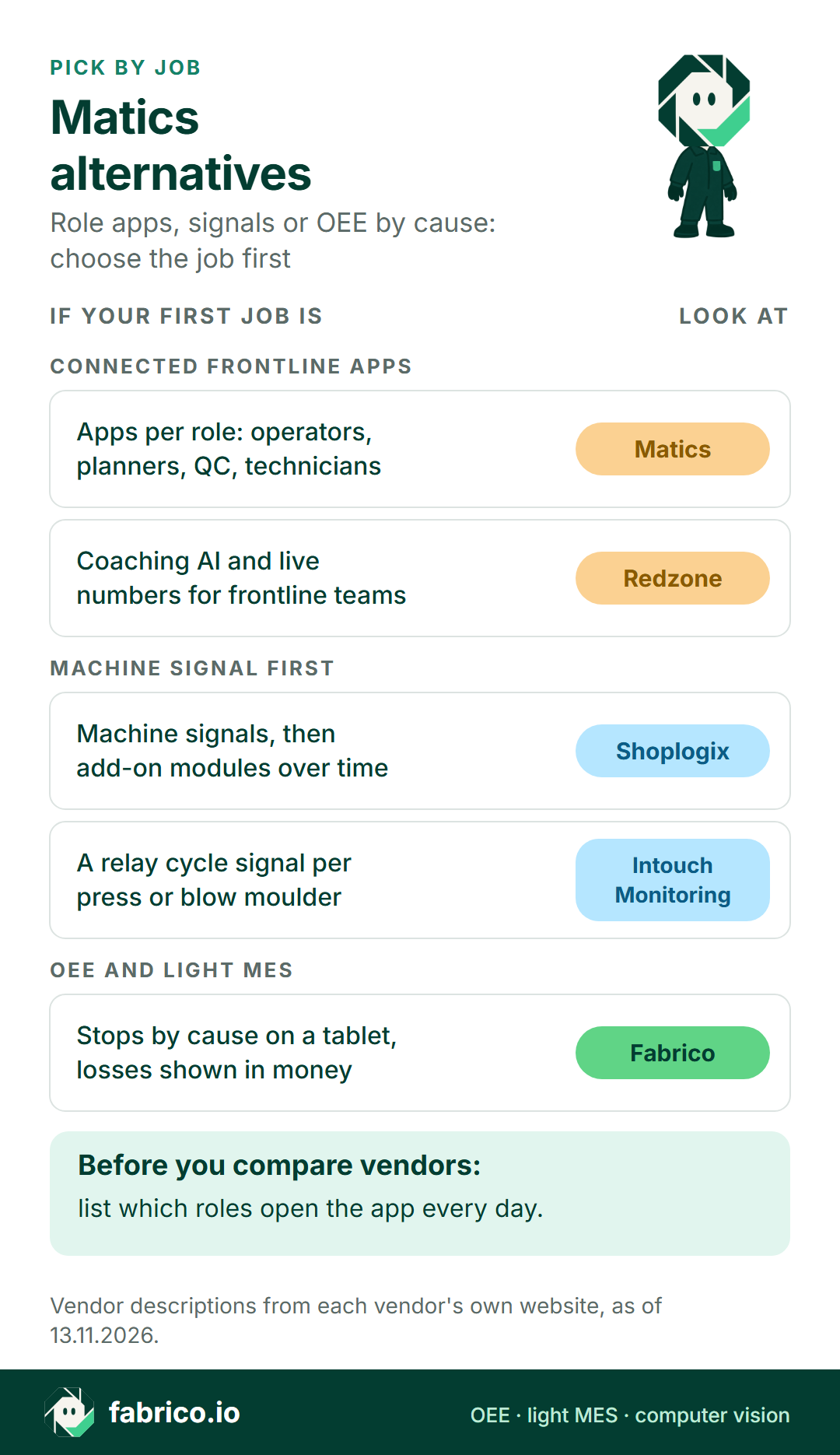
Text version of this infographic
- Pick by job: Matics alternatives. Role apps, signals or OEE by cause: choose the job first.
- Connected frontline apps: apps per role for operators, planners, QC and technicians (Matics); coaching AI and live numbers for frontline teams (Redzone).
- Machine signal first: machine signals, then add-on modules over time (Shoplogix); a relay cycle signal per press or blow moulder (Intouch Monitoring).
- OEE and light MES: stops by cause on a tablet, losses shown in money (Fabrico).
- Before you compare vendors: list which roles open the app every day.
- Vendor descriptions from each vendor's own website, as of 13.11.2026.
If the packing area or other hand stations matter, read computer vision for packaging converters for where a camera add-on earns its place.
Five questions for the whole shortlist
Ask all five the same, Fabrico included.
- Which roles use it daily, and which screen does each open first?
- Where does the count come from on an older blow moulder, and on a hand packing table with no signal?
- Who enters the stop cause, on which device, and what happens to minutes nobody explains?
- How are rejects counted? From the leak tester signal, a tablet entry, or the ERP after the shift.
- What stays in the ERP, and how do orders and counts move between the two?
If planning and execution are both on your list, our light MES vs full MES article and our OEE software guide help set the scope.
What people ask next
What is Matics, and is it an MES?
Matics describes itself as a real-time operational intelligence platform with a web platform, a mobile app and a tablet interface. Its about page calls it a new generation of MES that runs in the cloud, and its FAQ says it is not an ERP system.
How does Matics collect machine data?
Its FAQ lists an external PLC with a non-disruptive connection, smart sensors, and a software route such as OPC. The technology page adds data from people, IoT sensors and other systems.
How is Fabrico different from Matics?
Matics presents apps per role on one platform, with planning and QC tests among them. Fabrico is a cloud OEE and light MES platform built around stop causes: counts come from the blow moulder's PLC, a Fabrico IoT device or the camera add-on, operators pick the cause on a tablet or phone, and the lost minutes are priced in money. Planning is on our roadmap, and orders, BOMs and routings stay in the ERP.
Why can a blow moulder look busy and still score 75% OEE?
Because OEE multiplies three factors. In the sample shift on this page, 65 stopped minutes, a slower rate and leak tester rejects each take a share, and together they leave 75.1%.
Ask for a Fabrico demo to watch a sample blow moulding hall sorted into stop causes and lost money; other questions can go through our contact page.
Related articles

Latest from our blog




Real Fabrico tiles, sample data.