


 Login
 Blog
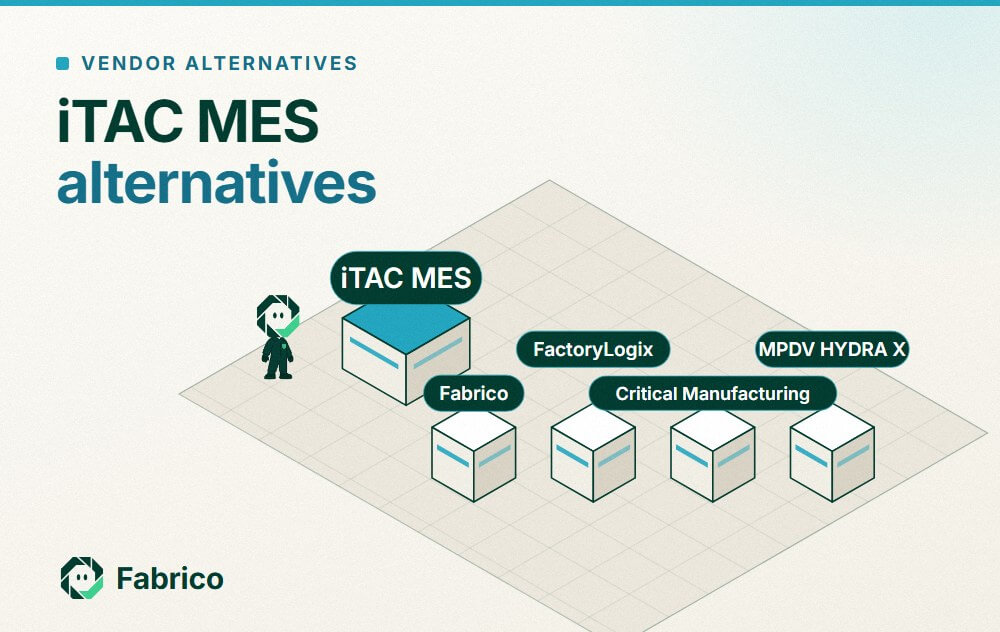
iTAC MES Alternatives: MOM Suites, Electronics MES or OEE First

In short: the right iTAC MES alternative depends on how much of the plant you want one system to run. iTAC's current site names its suite iTAC.MOM.Suite and says it covers production control, quality, traceability, planning and maintenance. Other full suites include MPDV HYDRA X; electronics MES options include FactoryLogix and Critical Manufacturing. If the open question is why the line stops, Fabrico, an OEE and light MES platform, measures it and leaves orders in your ERP.
- iTAC Software AG is an independent company of Dürr, and its current pages call the core product iTAC.MOM.Suite.
- Its home page names automotive, e-mobility, electronics/EMS and telecommunications among the industries it addresses.
- This page sorts the alternatives by scope: whole MOM suite, electronics MES, or a line performance layer.
- Every vendor fact below is linked to that vendor's own page and dated 13.11.2026; we show no prices and rank no one.
An automotive electronics plant builds control units on four SMT lines that feed a shared end-of-line test area. Its MES project has been on the table for two years. One camp wants a full suite that runs orders, traceability, quality and maintenance. The other wants to know, this quarter, why the test area builds fewer boards than its cycle time allows.
Both camps can end up looking at iTAC. Below: what iTAC offers today, per its own pages, and four alternatives sorted by scope. Fabrico is one of the four and wrote this page, so nothing here is ranked. If you are weighing an electronics MES to run the build of each board, our FactoryLogix alternatives page goes deeper on that choice; this page is about scope.
What iTAC MES is today (as of 13.11.2026, per iTAC's site)
If you know the product as iTAC MES or iTAC.MES.Suite: the iTAC pages we read on 13.11.2026 use neither name. On iTAC's current site, itacsoftware.com, the company calls itself a leading MES/MOM provider and an independent company of Dürr, and the core product is the iTAC.MOM.Suite. The home page also lists DUALIS, Cogiscan and Accevo as iTAC group companies. Highlights from its pages on 13.11.2026:
- One platform. The home page describes an integrated MES/MOM platform for production control, quality, traceability, planning and maintenance, used by companies in discrete manufacturing.
- Architecture. The iTAC.MOM.Suite page describes a modular suite on an open, service-oriented architecture, integrated with existing ERP, PLM and automation systems, which tracks material and machine status.
- Deployment. The same page lists on-premises, cloud or hybrid operation.
- Traceability. iTAC.TR.Service, the traceability solution within the suite, gives each component a unique serialized identifier for single-part traceability (traceability page).
- Machines and analytics. iTAC.SMT.Edge connects machines from different manufacturers and of different ages (SMT.Edge page). The iTAC.MA.Suite page says the analytics suite combines SMT.Edge, IIoT.Edge and the Asset.Analyzer, and names electronics manufacturing, SMT and THT among its uses.
- Electronics. Its electronics and telecommunication page addresses electronics manufacturers, EMS providers and telecom companies, with traceability and compliance requirements in view.
Ask in the demo: which modules a first phase needs, and how the suite works out OEE when a test station is the bottleneck.
When iTAC is the right pick
Keep iTAC on your shortlist if most of these are true:
- You want one suite for production control, quality, traceability, planning and maintenance, rather than several tools.
- Customers or regulators ask for single-part traceability.
- You run several plants and want the same platform in each, on premises, in the cloud or hybrid.
- Your SMT lines mix machine brands and ages, and machine integration should come from the MES vendor.
If most are true, a full suite fits the plan; see when a light MES is not enough. If you mainly need to know where line time goes, keep reading.
Three scopes: MOM suite, electronics MES or line performance
Most iTAC shortlists mix tools that do different jobs. Sort them by scope first, then compare within a scope. Our light MES vs full MES guide covers the split in general; for electronics plants, our electronics and EMS MES guide goes further.
Comparison table: iTAC and four alternatives
Each row paraphrases the vendor's own pages as read on 13.11.2026; the sections below link them. Order is not rank: Fabrico sits first only because we wrote the page. A short cell means the pages we read said little on that point, so put the question to the vendor.
| Tool | Scope, per its site | Electronics angle, per its site | Question for the demo |
|---|---|---|---|
| iTAC.MOM.Suite (for reference) | MES/MOM: control, quality, traceability, planning, maintenance | Electronics/EMS among its named industries; SMT.Edge | Which modules come first? |
| Fabrico | OEE and light MES | Stops and counts from the machine signal | How is the test station read? |
| FactoryLogix (Aegis) | Electronics MES from NPI to quality | Level-4 component tracking; SPI, AOI and test data on a board view | Where does its OEE come from? |
| Critical Manufacturing | MES for electronics plants, among other industries | Component UIDs per board, IPC-CFX driver | Which drivers are off the shelf? |
| MPDV HYDRA X | Modular MES for all production areas | Discrete and process plants | Which apps cover electronics? |
To see the line performance side, book a demo; a week of downtime notes from the test area makes it concrete.
Fabrico: line performance next to any MES or ERP
Fabrico wrote this page. It is a cloud-based OEE and light MES platform. Where a MOM suite runs orders, quality and traceability, Fabrico measures the line: when it stopped, for how long, why, and what it cost. Per our MES and OEE overview:
- Machine data, three ways. From the PLC, from a Fabrico IoT device with external sensors on older machines, or from AI cameras, an add-on, at manual steps. Protocols include OPC UA, Modbus, PROFINET, MQTT and EtherNet/IP (machine connectivity).
- Stops with reasons. Connected machines report when a stop started and how long it lasted, and short stops are detected from the signal. Operators tag the cause on a tablet or phone from your own list of reason codes.
- OEE by machine, line and shift, with losses measured in money, on the web, iOS and Android.
- The camera add-on counts output at manual stations, such as rework benches and hand assembly. In the standard setup, video from the camera add-on is streamed on request, not stored in Fabrico (how the camera add-on works).
- Maintenance built in. When a stop needs a repair, a technician opens a work order from the stop, on the same machine record.
- Data out. REST API, webhooks and Excel or CSV export. A connection to SAP or another ERP can be scoped per customer.
- Rollout. Devices connected in about a month; full rollout in 3 to 4 months.
- Stays in your ERP or MES: job dispatching, BOMs, routings and genealogy. Roadmap, not live: production planning and scheduling.
Ask in the demo: how a test station is read when its tester reports through its own software, and which data goes back to the ERP.
Fits plants that want downtime ranked by cause and priced by line and shift before, or instead of, a full MOM project. EU customers are hosted on AWS in Frankfurt. Quoted per plant. Start with a one-line pilot. See our OEE software guide.
FactoryLogix: electronics MES from Aegis Software
Aegis Software's electronics page says FactoryLogix helps OEMs, EMS providers and contract manufacturers. As of 13.11.2026, its pages say:
- It turns CAD, BOM and engineering data into controlled manufacturing processes.
- Each component is tracked to a single unit, not just a lot or batch, and the system moves jobs automatically to another available, compatible line or machine.
- SPI, AOI and test results are captured on a visual of the board, and pull-based material replenishment feeds high-mix lines.
- Its connectivity page describes a PLC Gateway that reads PLCs over OPC UA and turns raw tags into IPC CFX messages, and runs independently of FactoryLogix.
Compared with iTAC: both trace to the single unit and connect SMT equipment. Aegis's pages center on electronics; iTAC's name electronics next to automotive, e-mobility, medical technology and metal plants. Our FactoryLogix alternatives page covers it in depth.
Fits plants that build electronics for several customers and want NPI, routing and unit traceability in one electronics MES.
Critical Manufacturing: one MES baseline for electronics sites
Critical Manufacturing's electronics manufacturing page describes an MES for electronics plants. As of 13.11.2026, it says:
- Traceability tracks individual component unique identifiers at the board or panel level.
- Its Connect IoT drivers include MQTT, IPC-CFX, Fuji Nexim, OPC-UA and SECS/GEM.
- Kitted materials reach the line based on real-time pull signals from machines, and FIFO or FEFO rules apply to time-sensitive and MSD material.
- NPI loads an ODB++ ECAD file and a product BOM, and the page cites live OEE visualization of quality and performance.
- A single baseline MES can be deployed across multiple sites.
Compared with iTAC: both trace components to the unit and plan for many sites. Critical Manufacturing's electronics page lists named machine drivers; iTAC's pages put SMT connectivity in iTAC.SMT.Edge.
Fits plants that want one MES baseline across electronics sites, with material flow and NPI in the same system.
MPDV HYDRA X: modular MES for discrete and process plants
MPDV's HYDRA X page calls it the modular Manufacturing Execution System for all production areas. As of 13.11.2026, the page says:
- It runs from operational and machine data acquisition to quality and material management, maintenance, human resources and energy management, in one central system.
- Its functions are grouped as order, resource, material, assembly, quality, HR and information management, plus an AI suite.
- It serves discrete manufacturing and the process industry, and lists ensuring traceability among its benefits.
- Openness comes from MPDV's integration platform, MIP.
Compared with iTAC: both are modular suites that reach well beyond the line, into quality, material and maintenance. HYDRA X's page adds HR and energy management; iTAC's adds SMT machine integration and traceability by serial number.
Fits plants that want one MES across many production areas and both discrete and process work.
Which iTAC alternative fits your plant
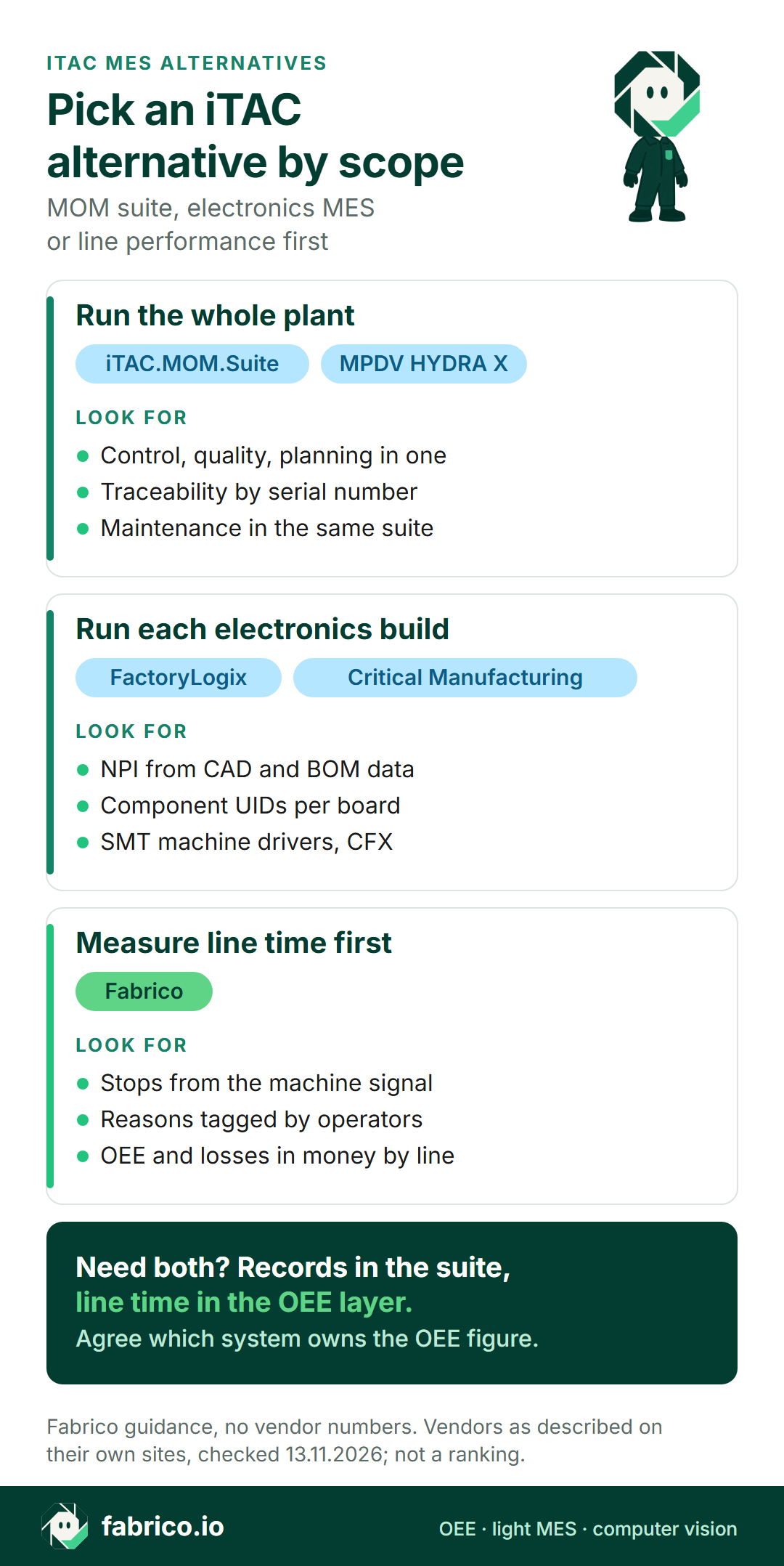
- One MOM suite for control, quality, traceability, planning and maintenance, across automotive and electronics plants: iTAC.
- A modular MES across discrete and process areas, including HR and energy: MPDV HYDRA X.
- Electronics MES with NPI from CAD and BOM and Level-4 traceability: FactoryLogix.
- One MES baseline across electronics sites, with material pull and named machine drivers: Critical Manufacturing.
- Downtime ranked by cause, with OEE per line and shift, next to whatever MES or ERP you keep: Fabrico.
See MES for automotive suppliers and OEE vs MES.
Worked example: a test station sets the pace
Illustrative sample numbers, not from a customer or a Fabrico screen: one 8 hour shift with 450 planned minutes on an automotive electronics line. The SMT lines run fast; the end-of-line tester sets the pace at an ideal 0.8 minutes a board.
Stops took 66 minutes, so run time was 384 minutes and availability 85.3%. In 384 minutes the ideal is 480 boards. The station tested 444, so performance is 92.5%.
Twelve boards failed test, leaving 432 good: quality is 97.3%. OEE is 85.3% x 92.5% x 97.3% = 76.8%, the same as 432 good boards x 0.8 minutes over 450 minutes.
A MOM suite holds the 444 test records, with serial numbers, results and the components behind each board. A line performance layer holds the 66 minutes by cause: fixture, waiting boards, changeover. The formula is in our OEE calculation guide; for the quality side, read about SMT first pass yield.
Five questions for every vendor
Use one representative line and ask each vendor, Fabrico too, the same five things.
- What is in phase one? Which modules, which lines, and what the plant can see at the end of it.
- How does each station report? Over CFX, a machine maker's interface, a PLC, the tester's own software or manual entry.
- How is OEE calculated? Which station sets the ideal cycle, how changeovers count, and where stop reasons come from.
- Where is genealogy kept? MES, ERP, or the machines' own records.
- Which records go back to the ERP, and who maintains that link.
What people ask next
Is iTAC.MES.Suite the same as iTAC.MOM.Suite?
The iTAC pages we read on 13.11.2026 do not use the name iTAC.MES.Suite. They name the core product iTAC.MOM.Suite and describe iTAC as an MES/MOM provider, so the MES functions sit inside the MOM suite. Ask iTAC how its current modules map to the MES functions you need.
Who owns iTAC Software?
iTAC's site describes iTAC Software AG as an independent company of Dürr, and says the iTAC group includes DUALIS, Cogiscan and Accevo.
What are the main iTAC MES alternatives for electronics plants?
For a full suite, MPDV HYDRA X. For an electronics MES, FactoryLogix from Aegis Software and Critical Manufacturing. If line time and OEE come first, Fabrico, a light MES that runs next to whatever MES or ERP you keep.
Can iTAC run in the cloud?
Its iTAC.MOM.Suite page lists on-premises, cloud or hybrid operation. Ask iTAC which modules run in each model.
How is Fabrico different from iTAC?
iTAC describes a MOM suite for production control, quality, traceability, planning and maintenance. Fabrico measures the line itself: the machine signal gives stops and counts, operators add the reason, and OEE and the cost of each loss show per line and shift, with orders and genealogy left in the ERP or MES.
Can a line performance layer run next to iTAC or another MOM suite?
Yes. Give each record one owner: the suite holds orders, serial records and quality data, and the OEE layer holds stops, reasons and line time. Decide up front which system publishes OEE.
Want Fabrico's view of line time? Book a demo, or write to us with your questions.
Related articles




Latest from our blog





Real Fabrico tiles, sample data.