


 Login
 Blog

Litmus Edge Alternatives: Edge Data Layer or OEE Layer

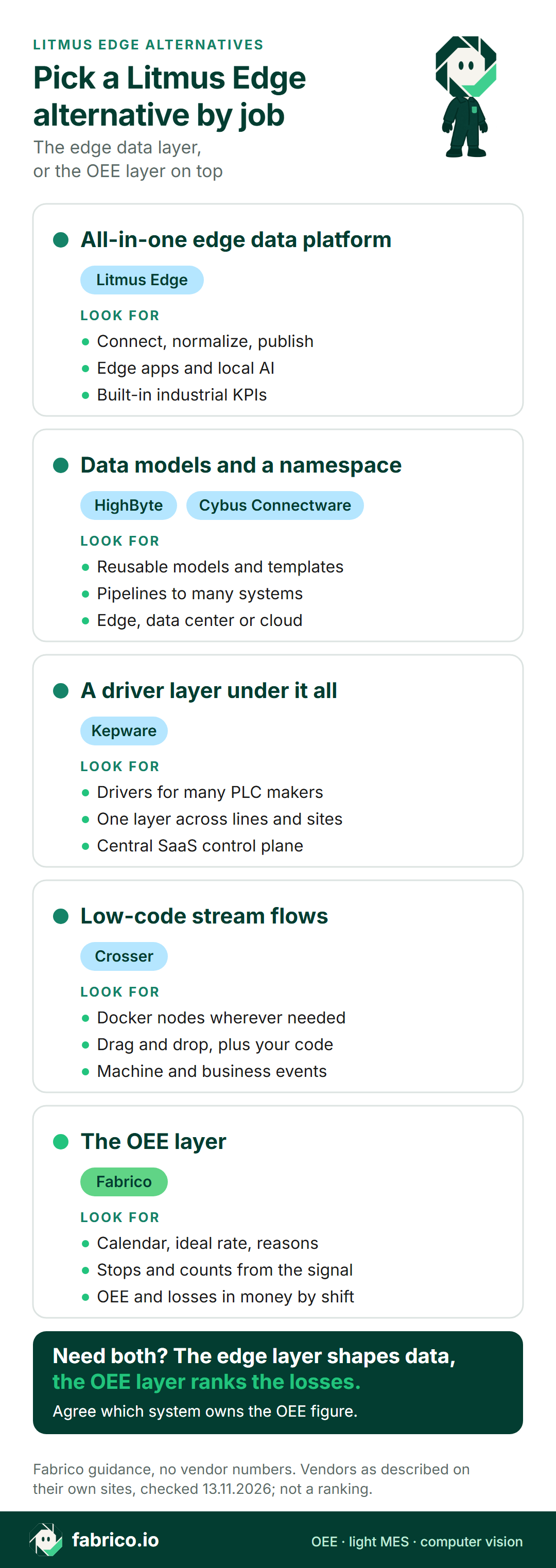
In short: Litmus Edge is an industrial edge data platform, so its alternatives fall into two groups. If you want the data layer itself (connect machines, structure the data, send it on), compare it with HighByte Intelligence Hub, Kepware, Crosser and Cybus Connectware. If what you really want is OEE, the downtime reasons and what the losses cost, you need an OEE application on top of, or instead of, an edge layer, such as Fabrico.
- Litmus calls Litmus Edge an industrial edge data platform that sits between machines and enterprise systems.
- Its pages cover connectivity, data operations, analytics with built-in industrial KPIs, edge apps and local AI.
- Litmus lists built-in industrial KPIs and says its line models suit OEE. Any OEE figure, on an edge platform or in an OEE app, still needs a planned-time calendar, ideal rates and stop reasons.
- Each vendor is described from its own pages, read on 13.11.2026 and linked next to the claim. No prices and no ranking.
A plant has forty machines from twelve makers, three generations of PLCs and a historian that nobody fully trusts. IT wants one clean data layer before anything else. Operations wants to know, by next quarter, which line loses the most time and why.
An edge data platform answers the first ask. An OEE application answers the second. They are often bought by different teams, and sometimes confused. Below: what Litmus Edge is, per Litmus's own pages, four data-layer alternatives, and where an OEE application fits. Fabrico is our product and one of the routes on this page; read that section as a vendor's case and check it.
What Litmus Edge is today, per litmus.io (13.11.2026)
Litmus's Litmus Edge page calls it an industrial edge data platform. It sits at the operational boundary between machines and enterprise systems: it connects industrial assets, structures data at the edge, runs analytics and applications locally, and publishes data to enterprise and AI systems. Its feature list, read on 13.11.2026:
- Connect. Native connectors for industrial devices and control systems, multi-protocol collection across legacy and modern equipment, and automated device and tag discovery.
- Structure. Data normalization, context from assets and metadata, local time-series storage, and reusable machine and line data models.
- Analyze. Streaming flows, a visual no-code workflow builder, built-in industrial KPIs, statistical analysis and anomaly detection.
- Run apps. A Docker-based runtime at the edge with a marketplace catalog.
- Local AI. ML and AI inference at the edge, including LLM and SLM support.
- Publish. Managed connectors to cloud platforms, enterprise applications, databases and message brokers.
- Across plants. Litmus Edge is designed to standardize industrial data architecture across plants.
On OEE, a Litmus blog post on data models says its process models, which represent a production line, are well suited to OEE calculations that aggregate availability, performance and quality across the assets on one line. The savings figures on the product page are vendor-reported, so they are left out here.
Ask in the demo: which KPIs come built in, and who builds the OEE model, the planned-time calendar and the stop reason input.
The data layer and the OEE layer are different jobs
An edge data layer moves and shapes machine data: connect, normalize, add context, publish. An OEE layer turns that data into a decision: how much planned time became good output, where the rest went, and what it cost. The two jobs can sit in one product or in two. Litmus Edge lists built-in KPIs, so a team can build OEE on it; Fabrico reads machines with or without an edge layer. You can buy one, the other, or both. Our guide to edge computing for OEE covers the trade-offs.
Comparison table: Litmus Edge and five alternatives
Each row restates the vendor's own pages in plain words, as read on 13.11.2026; the source links are in the sections further down. The rows are not ranked; Fabrico sits first because this is our page. Anything not in a row is simply something we did not see on those pages, so put it to the vendor.
| Tool | What it is, per its site | Runs where, per its site | Worth asking |
|---|---|---|---|
| Litmus Edge (for reference) | Edge data platform: connect, structure, analyze, apps | At the edge, between machines and enterprise | Which KPIs come built in? |
| Fabrico | OEE and light MES application | Cloud; EU customers are hosted on AWS in Frankfurt | How is a machine without a PLC read? |
| HighByte Intelligence Hub | Industrial DataOps: modeling, orchestration, governance | Edge, on-premises data center or cloud | Which models are templates? |
| Kepware | Industrial connectivity layer, now part of Velotic | Server, plus a containerized edition | Which drivers cover your PLCs? |
| Crosser | Low-code stream analytics and integration | Docker node at the edge, on-premises or cloud | Who builds and owns the flows? |
| Cybus Connectware | Factory Data Hub connecting OT and IT | Across your factories | How is a new site added? |
Want to see the OEE layer on a line like yours? Book a demo and bring a downtime log from one line.
Fabrico: the OEE layer, with or without an edge platform
Fabrico is our own product, a cloud-based OEE and light MES platform. Where Litmus Edge prepares the data for many uses, Fabrico does one job with it: OEE, the reasons for downtime and what the losses cost, by line and shift. Per our MES and OEE overview:
- Machine data, three ways. From the PLC, from a Fabrico IoT device with external sensors on older machines, or AI cameras (an add-on) where a station gives no signal.
- Open protocols. OPC UA, Modbus, PROFIBUS, PROFINET, MQTT, EtherNet/IP, EtherCAT, IO-Link and HTTP (machine connectivity). If you already run an edge layer, ask us how it would connect.
- Stops with reasons. Run and stop times come straight from connected machines. The reason comes from the operator on a tablet or phone, which builds a downtime history by cause over the shifts.
- OEE and losses in money. Availability, performance and quality by machine, line and shift, and what the losses cost in money, in the browser or the iOS and Android apps.
- The camera add-on counts output at manual stations, and its video opens for any moment on the shift timeline. In the standard setup, video from the camera add-on is streamed on request, not stored in Fabrico (how the camera add-on works).
- Maintenance built in. A stop that needs a fix becomes a work order for a technician, tied to the machine it happened on.
- Data out. REST API and webhooks, Excel or CSV export.
- Rollout. Devices connected in about a month; full rollout in 3 to 4 months.
- Left to other systems: BOMs, routings, genealogy and job dispatching remain in the ERP. Roadmap items, not released: planning and scheduling, and a camera add-on that would spot stops and suggest a probable reason.
Fits plants that want the loss list first, whether or not an edge data layer is in place. Most plants begin with a one-line pilot; the OEE software guide covers what to compare.
HighByte Intelligence Hub: industrial DataOps
HighByte's Intelligence Hub page calls it an Industrial DataOps software solution for industrial data modeling, orchestration and governance. Read on 13.11.2026, the page says:
- It connects devices, files, databases and systems through open standards and native connections, and models streaming data in real time.
- Reusable models and templates replicate common datasets across assets.
- It runs at the edge on hardware from single-board computers to servers, or in on-premises data centers or the cloud.
- An embedded MQTT broker and Namespaces help build a unified namespace (UNS), and an Industrial MCP Server gives AI agents access to connected systems.
Compared with Litmus Edge: both model and contextualize data at the edge. HighByte's pages center on modeling, pipelines and the namespace; Litmus's also cover edge apps and local AI execution.
Fits teams that want a modeling and pipeline layer that feeds many existing systems.
Kepware: connectivity, now part of Velotic
Velotic's Kepware page calls Kepware an industry standard for industrial connectivity, now part of Velotic alongside Proficy and ThingWorx. Read on 13.11.2026, the page says:
- It gives ready-to-use connectivity across a wide range of devices and protocols.
- It provides a common connectivity layer for PLCs, controllers, devices and industrial systems across equipment, lines and sites.
- Offerings include the flagship Kepware, a containerized edition, and a SaaS control plane to view and configure Kepware centrally.
Compared with Litmus Edge: both connect devices across makers. Kepware's pages focus on the connectivity layer; Litmus's add data operations, analytics and edge apps on the same platform.
Fits teams that need a driver layer under SCADA, historians or apps they already run.
Crosser: low-code stream analytics
Crosser's platform page describes low-code stream analytics, integration and automation. Read on 13.11.2026, the page says:
- The Crosser Node runs in a Docker container at the edge, on the shop floor, in a data center or in any cloud.
- Crosser Control Center is where flows are designed, deployed and monitored, as a hosted SaaS or on-premises.
- Pre-built modules and drag-and-drop build flows, with your own Python, C# or JavaScript code when needed.
Compared with Litmus Edge: both run processing at the edge with low-code flows. Crosser's pages span IoT data, databases and SaaS events; Litmus's are built around industrial assets.
Fits teams that want to build event-driven flows across machine data and business systems.
Cybus Connectware: a factory data hub
Cybus's Connectware page calls it the Factory Data Hub to connect OT and IT company wide. Read on 13.11.2026, the page says:
- It collects, standardizes, processes and distributes data for industrial IoT use cases.
- It uses a composable architecture with code-based configurations.
- It describes itself as a technology-neutral layer for a vendor-independent data pipeline.
Compared with Litmus Edge: both aim at one data layer across factories. Cybus's pages stress code-based configuration and vendor independence.
Fits groups that want a central data hub run by an IT or platform team.
Which Litmus Edge alternative fits your plant
- Connectivity, data operations, analytics and edge apps in one platform: Litmus Edge.
- Data modeling, pipelines and a unified namespace: HighByte Intelligence Hub.
- A driver layer under the systems you already run: Kepware.
- Low-code stream flows across machine and business data: Crosser.
- A central factory data hub with code-based configuration: Cybus Connectware.
- OEE and ranked losses in money, with or without an edge layer: Fabrico.
An edge layer and an OEE layer work well together when each has one job. See IoT gateway vs edge device, edge vs cloud for shop floor data and our data contextualization platforms review. Running food or consumer goods lines? See computer vision for FMCG manufacturing.
Worked example: from clean tags to an OEE figure
Here is what an edge layer hands over, and what an OEE layer still has to add. Sample data for one hour on a packing machine, invented for this page, not taken from a customer or a product screen. The edge layer delivers three clean tags: run state, a unit count and a reject count.
The two stops took 12 minutes, so run time is 48 minutes and availability is 80.0%. At 40 units a minute, 48 minutes allow 1,920 units. The machine made 1,800, so performance is 93.8%. 40 rejects leave 1,760 good units: quality is 97.8%.
OEE is 80.0% x 93.8% x 97.8% = 73.3%, the same as 1,760 good units at 1.5 seconds each over 3,600 seconds. The tags alone could not say that the hour was planned time, what the ideal rate is, or that the film jam was the bigger loss. Those three inputs are the OEE layer's job, whoever builds it. On an edge platform with KPI tools, such as Litmus Edge, your team could set them up there; in an OEE application they are part of the setup. For the formula itself, see OEE calculation.
Questions for every vendor in this comparison
Ask all of them, us too, about the same representative line.
- Data layer or answer? Does the product end at clean tags, or at OEE and a ranked loss list?
- Who builds the OEE model? Calendar, ideal rates, changeover rules and stop reasons: configured, templated or built by your team.
- How do operators add reasons? Screen at the line, reason tree, or fault codes from the PLC.
- Which drivers and protocols cover your machines, including the oldest ones and stations with no signal.
- Which systems receive the data? MQTT broker, historian, data lake, ERP or OEE app, and in which format.
- Who runs it at each site? OT, IT, a platform team or the vendor, and how a new site is added.
What people ask next
What is Litmus Edge?
Litmus describes Litmus Edge as an industrial edge data platform that sits between machines and enterprise systems. It connects industrial assets, structures data at the edge, runs analytics and applications locally, and publishes data to enterprise and AI systems.
Is Litmus Edge an OEE software?
Litmus describes it as an industrial edge data platform. Its page lists built-in industrial KPIs, and a Litmus blog post says its process models suit OEE calculations across the assets on a line. Ask who sets up the calendar, ideal rates and stop reason input.
What are the main alternatives to Litmus Edge?
For the data layer, buyers often compare HighByte Intelligence Hub, Kepware, Crosser and Cybus Connectware. When the target is OEE with downtime reasons, Fabrico, an OEE application, can run with or without an edge layer.
Do I need an edge data platform before OEE software?
Not always. An edge layer helps when many systems need the same clean machine data. An OEE application can also read machines directly through PLCs, IoT devices or a camera add-on. Many plants start with OEE on a few lines and add a data layer as use cases grow.
How is Fabrico different from Litmus Edge?
Litmus Edge prepares industrial data for many uses, per its site. Fabrico uses machine data for one job: it turns signal-based stops and counts, plus operator reasons, into OEE and money losses per line and shift.
Can Fabrico run next to Litmus Edge?
Yes, if each layer has one job. The edge layer connects and models data for many systems; Fabrico tracks line time, stops and their reasons. Decide which one publishes the OEE figure, and ask us how your edge layer would connect.
Want to see the OEE layer on a line like yours? Book a demo or ask us how it connects.
Related articles


Latest from our blog




Real Fabrico tiles, sample data.