


 Login
 Blog

PAS-X MES Alternatives: Pharma MES, eBR or an OEE Layer Beside It

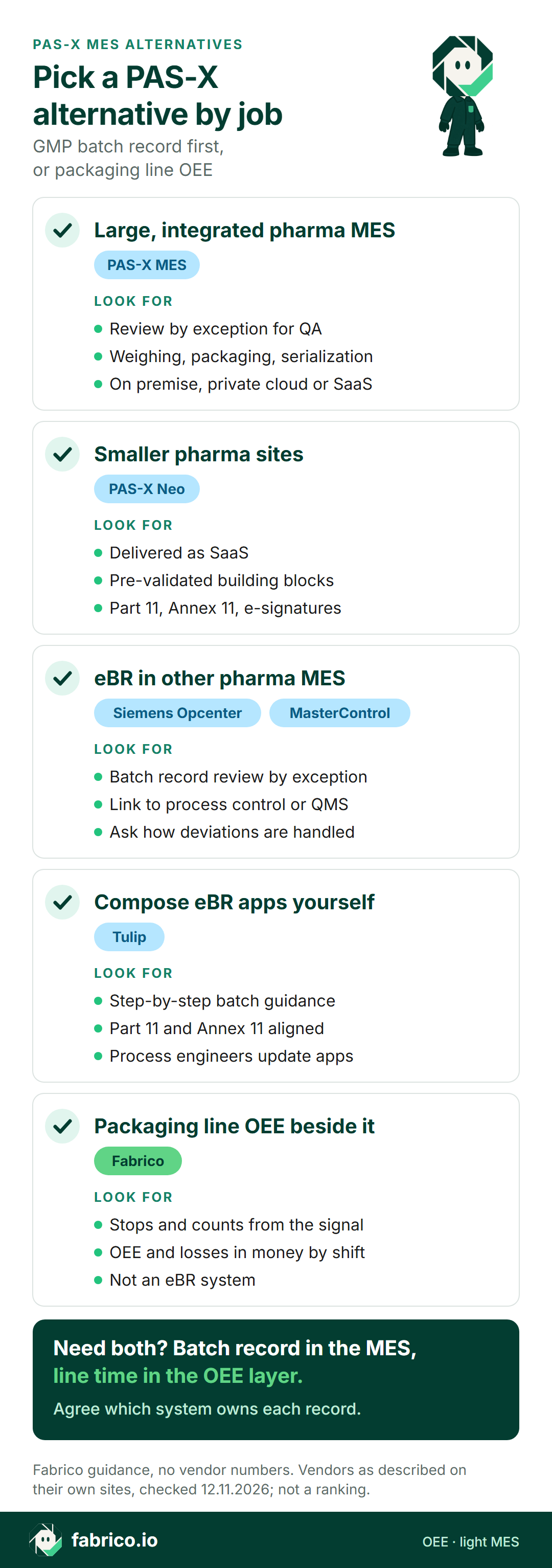
In short: if you need GMP electronic batch records, the PAS-X MES alternatives are other pharma MES and eBR vendors, such as Siemens Opcenter Execution Pharma, MasterControl Manufacturing Excellence and Tulip, or Körber's own PAS-X Neo for smaller sites. If the plant mainly wants OEE and downtime on its packaging lines, an OEE and light MES layer such as Fabrico can sit beside the MES or come before it. Fabrico is not an electronic batch record system and does not replace a GMP MES.
- PAS-X MES is Körber's MES for pharmaceutical, biotech and cell and gene therapy production, offered on premise, in a private cloud or as SaaS.
- Körber's own PAS-X Neo, announced in May 2026, is a SaaS MES for small and mid-sized pharma companies and sites.
- The batch record and the line's lost minutes are different jobs, and they can live in different systems.
- Vendor facts come from each vendor's own site, as of 12.11.2026, linked in place. No prices, no verdicts, no ranking.
A mid-size generics plant runs granulation, tablet presses and four blister lines. Batch records are on paper, and QA wants them electronic. Operations has a different worry: the blister lines lose time to changeovers, line clearance and feeder jams, and nobody can say how much.
Both are real problems, and they lead to different tools. Below: what PAS-X is, per Körber's own pages, the pharma MES alternatives if you need GMP batch records, and where an OEE layer fits if you mainly need line performance. Fabrico wrote this page and appears in it as the OEE option only. We sell Fabrico, so nothing here is ranked. For a wider list of batch record tools, see our electronic batch record software guide.
What PAS-X MES is (as of 12.11.2026, per Körber's site)
PAS-X MES comes from Körber, and many buyers still know it by its former Werum name. Körber's life sciences MES page offers to "digitalize and orchestrate your pharmaceutical, biotech, and cell & gene therapy production". What Körber's pages say, as of 12.11.2026:
- Positioning. Körber calls PAS-X MES its flagship and "the solution of choice for large-scale, highly integrated manufacturing environments", purpose-built for pharma and life sciences.
- Batch records and review. Automated data capture speeds up batch record generation, and Quality Assurance can focus on flagged exceptions instead of checking the entire batch execution record. The page names FDA 21 CFR Part 11 and EU GMP Annex 11.
- On the floor. Its digital manufacturing page covers weighing and dispensing, paperless records with integrated equipment, planning for faster batch release, and packaging and serialization workflows.
- Deployment. Its deployment page lists three options: in your own data centre, in a private cloud on platforms like AWS or Azure, or as a fully managed SaaS operated by Körber.
- Analytics. PAS-X Savvy is Körber's analytics platform for process and batch data from sources including MES, LIMS and SCADA.
- Current release. Körber announced PAS-X MES 3.4.2 on 26 August 2026, available for on-premise, private cloud and fully managed SaaS environments.
Performance and time-saving figures on Körber's pages are vendor-reported, so we don't repeat them.
Ask in the demo: which deployment model fits your validation approach, and how packaging lines report into the batch record.
First question: do you need a GMP batch record?
This decides the whole list. A GMP MES or eBR system holds the master batch record, guides each step, records signatures and supports batch release. An OEE layer holds line time: when the line ran, when it stopped, why, and what it cost. Our light MES guide puts electronic batch records in full MES territory, and light MES vs full MES covers the split.
When PAS-X is the right pick
Keep PAS-X on your shortlist if most of these are true:
- You run large-scale, highly integrated production, which is how Körber positions its flagship.
- You make pharmaceuticals, biologics or cell and gene therapies and need GMP batch records with review by exception.
- Weighing, dispensing, packaging and serialization should run in one MES.
- You want a choice of deployment: your own data centre, a private cloud or Körber-run SaaS.
If your site is smaller with standard processes, look at PAS-X Neo below. If your question is about line speed and stops, the OEE section is the one to read.
Comparison table: PAS-X and the alternatives
This is what each vendor's own site says, in our words, as of 12.11.2026, linked in each section below. It is not a ranking. If a topic is not in a row, we did not find it on the pages we read, so ask the vendor. Fabrico is listed last because it does a different job.
| Tool | Built around, per its site | Batch record, per its site | Ask in the demo |
|---|---|---|---|
| PAS-X MES (for reference) | Large-scale, integrated pharma MES | Review by exception for QA | Which deployment model? |
| PAS-X Neo | SaaS MES for smaller pharma sites | Part 11, Annex 11, e-signatures | What moves to full PAS-X later? |
| Siemens Opcenter Execution Pharma | Compliant, documented pharma production | eBR with review by exception | How does it link to process control? |
| MasterControl Mx | No-code digital manufacturing platform | eBR and eDHR, review by exception | How does it tie to the QMS? |
| Tulip | Composable apps for frontline work | Composable eBR, Part 11 aligned | Who builds and validates the apps? |
| Fabrico (OEE layer) | Machine signal and operator stop reasons | Not an eBR system; runs beside one | Which records stay in the MES? |
Want to see the OEE side of a packaging line like yours? Book a demo and bring one week's downtime log.
PAS-X Neo: Körber's own lighter MES
If PAS-X looks too large, the first alternative may come from Körber. Its PAS-X Neo announcement of 18 May 2026 describes a purpose-built MES for small and mid-sized companies and sites. As of 12.11.2026, Körber says:
- It is designed so that small and mid-sized pharmaceutical companies and sites can digitalize shop floor operations quickly.
- It is delivered as SaaS, which Körber says reduces effort and total cost of ownership.
- Compliance is built in, including ALCOA+, FDA 21 CFR Part 11, EU Annex 11, audit trails and electronic signatures, with pre-validated building blocks to reduce validation effort.
Körber's MES page positions Neo for "more standardized processes and lower complexity".
Compared with PAS-X MES: same vendor, different scale. Ask Körber what a later move from Neo to the flagship would involve.
Fits sites that are smaller, run standard processes and prefer SaaS with no local infrastructure.
Siemens Opcenter Execution Pharma: eBR inside a Siemens stack
Siemens says Opcenter Execution Pharma provides electronic batch records for the pharmaceutical industry. As of 12.11.2026, its page says:
- It is built to ensure fully compliant, fully documented pharmaceutical production.
- Batch manufacturing processes are designed to comply with FDA and GMP regulations.
- It supports a review of the batch record by exception, for faster product releases, and native integration with the production control system.
Compared with PAS-X: both are pharma MES products with electronic batch records and review by exception. Ask both how they connect to your process control system and your ERP.
Fits plants that want the batch record tied closely to the production control layer.
MasterControl Manufacturing Excellence: eBR next to the QMS
MasterControl calls Manufacturing Excellence (Mx) "a next-generation digital manufacturing platform". As of 12.11.2026, its page says:
- Manufacturing processes and procedures are digitized with no-code workflows.
- It covers fully digital, compliant batch records and digitally managed device history records.
- It supports real-time review by exception, and puts GMP work instructions, operator guidance and training in the flow.
Compared with PAS-X: both cover batch records and review by exception. MasterControl's page names integration with systems like ERP, LIMS and QMS, and points to MasterControl's own QMS; Körber positions PAS-X for large, integrated production. Ask both how deviations reach the quality system.
Fits plants that want no-code batch record workflows and a quality system from the same vendor.
Tulip: composable eBR apps
Tulip's homepage says it is GxP-ready, and its electronic batch record page describes composable eBR apps with step-by-step guidance, automated data capture and real-time alerts. As of 12.11.2026, it says:
- The platform aligns with FDA 21 CFR Part 11 and EudraLex Annex 11 requirements for electronic records and signatures.
- Complete, in-spec batches flag as ready automatically, and Tulip supports a Computer Software Assurance approach to validation.
- It integrates the execution layer with your ERP, QMS and LIMS, with clear system-of-record boundaries.
Compared with PAS-X: Körber offers a packaged MES; Tulip offers apps your team composes. Ask both who validates a change to a step. See our Tulip alternatives.
Fits plants that want to digitize batch records one process at a time, with their process engineers updating the apps within set guardrails.
Fabrico: OEE beside the MES, not an eBR system
Fabrico wrote this page, so here is what it is and what it is not. Fabrico is a cloud-based MES and OEE platform, a light MES in the performance-first sense. It is not an electronic batch record system. It does not hold master batch records, collect GMP signatures or release batches. Those stay in your MES or eBR system. Per our MES and OEE overview, what it does on a packaging line:
- Machine data, three ways. From the PLC, from a Fabrico IoT device with external sensors on older machines, or from AI cameras, an add-on, where there is no machine signal (machine connectivity).
- Stops with reasons. Connected machines report their own stops, including short stops too brief to log by hand. Operators add the reason on a tablet or phone.
- OEE and losses in money. The OEE dashboard updates while the line runs, with losses shown in money, on the web, iOS and Android.
- The camera add-on counts output at manual steps, and its video opens for any moment on the shift timeline. In the standard setup, video from the camera add-on is streamed on request, not stored in Fabrico (how the camera add-on works).
- Maintenance built in. When a stop needs a repair, a technician opens a work order from the stop.
- Data out. REST API and webhooks, Excel or CSV export. A connection to SAP or another ERP can be scoped per customer.
- Rollout. Devices connected in about a month; full rollout in 3 to 4 months.
- Roadmap, not live: production planning and scheduling, and a camera add-on that detects stops and offers a likely reason.
Where it fits: beside a pharma MES, to rank packaging line losses by cause and shift, or before an MES project, to measure where the time goes while the eBR decision is still open. EU customers are hosted on AWS in Frankfurt. For packaging detail, see OEE for blister packaging lines and our OEE software guide.
Who owns which record on a packaging line
If both systems run, write down which one owns each record before anything is connected. A typical split, as a starting point for your own validation team:
| Record | Pharma MES or eBR | OEE layer |
|---|---|---|
| Master and executed batch record | Owns it | Not held |
| Line clearance sign-off | Owns it | Times it as a stop |
| Stop reasons and short stops | Ask your vendor | Owns them |
| OEE by line and shift | Agree one owner | Agree one owner |
| Good and reject counts | For the batch | For OEE quality |
Worked example: one shift on a blister line
Sample data for one 8 hour shift on a blister packaging line, not a customer's line or a product screen. Planned production time is 450 minutes after a 30 minute break, and the ideal rate at the cartoner is 120 cartons a minute.
Stops took 72 minutes, so run time was 378 minutes and availability 84.0%. In 378 minutes the ideal is 45,360 cartons. The line made 40,800, so performance is 89.9%.
The line rejected 600 cartons, leaving 40,200 good: quality is 98.5%. OEE is 84.0% x 89.9% x 98.5% = 74.4%, the same as 40,200 good cartons over the 54,000 possible in 450 minutes. See OEE calculation for the formula.
The batch record holds what GMP needs: materials, line clearance sign-off, in-process checks and the reconciliation. The OEE layer holds the 72 minutes by cause and the 38 minutes of slow running. On this sample, changeover and line clearance is the biggest loss, and feeder jams are next; the short ones are covered in micro-stops.
Questions to ask any vendor on this list
Put the same questions to every vendor, us included, for one representative line.
- Which job is it for? The GMP batch record, line performance, or both.
- What is validated, and by whom? Ask how a change to a step or a report is validated.
- How do packaging machines report? PLC, edge device or operator entry, including older machines.
- How is OEE calculated? How line clearance and changeovers count, and where stop reasons come from.
- Which deployment models exist: on premise, private cloud or SaaS.
- Which records stay in the ERP and the QMS, and which data flows back.
What people ask next
Who makes PAS-X MES?
Körber. Many buyers still know it by the Werum name. Körber's page describes PAS-X MES for pharmaceutical, biotech and cell and gene therapy production, and calls it its flagship for large-scale, highly integrated manufacturing.
Is PAS-X available as SaaS?
Yes, per Körber's deployment page: PAS-X MES runs in your own data centre, in a private cloud on platforms like AWS or Azure, or as a fully managed SaaS operated by Körber.
What is PAS-X Neo?
A purpose-built MES from Körber for small and mid-sized pharma companies and sites, announced on 18 May 2026. Körber delivers it as SaaS, with pre-validated building blocks and support for 21 CFR Part 11 and EU Annex 11.
Can Fabrico replace PAS-X?
No. Fabrico is not an electronic batch record system and does not hold master batch records, GMP signatures or batch release. It measures line performance: stops, reasons, OEE and losses in money, and can run beside a pharma MES.
Can an OEE layer run beside PAS-X or another pharma MES?
Yes, if each record has one owner. The MES keeps the batch record and line clearance sign-off; the OEE layer keeps stops, reasons and line time. Agree with your validation team which system publishes the OEE figure.
How does Siemens Opcenter Execution Pharma compare with PAS-X?
Per their own sites, both are pharma MES products with electronic batch records and review by exception. Siemens names native integration with the production control system; Körber names three deployment models and a smaller PAS-X Neo option.
Want to see packaging line OEE on a line like yours? Book a demo or contact us.
Related articles


Latest from our blog



Real Fabrico tiles, sample data.