


 Login
 Blog
What Drives the Cost of Computer Vision on a Production Line

In short: the cost of computer vision on a production line is set by how many stations need a camera, and by everything around the camera: mounting, lighting, network, compute, integration, model training, change on the floor and support.
- Count stations, not lines. Stations with a usable PLC signal often need no camera at all.
- The camera is rarely the biggest line in the budget. Installation, integration and your own team's hours add up.
- Ask how each new SKU or pack format is handled. Retraining can be a yearly cost.
- Send every vendor the same station list, so the quotes can be compared line for line.
- Work out payback from minutes recovered at the constraint, not from minutes anywhere on the line.
This guide is for teams budgeting a camera project. It has no prices, because no honest number fits every line. The same logic for software without cameras is in what drives the cost of a light MES. To make the case to finance, start with the business case questions for line cameras.
What drives the cost of computer vision on a production line?
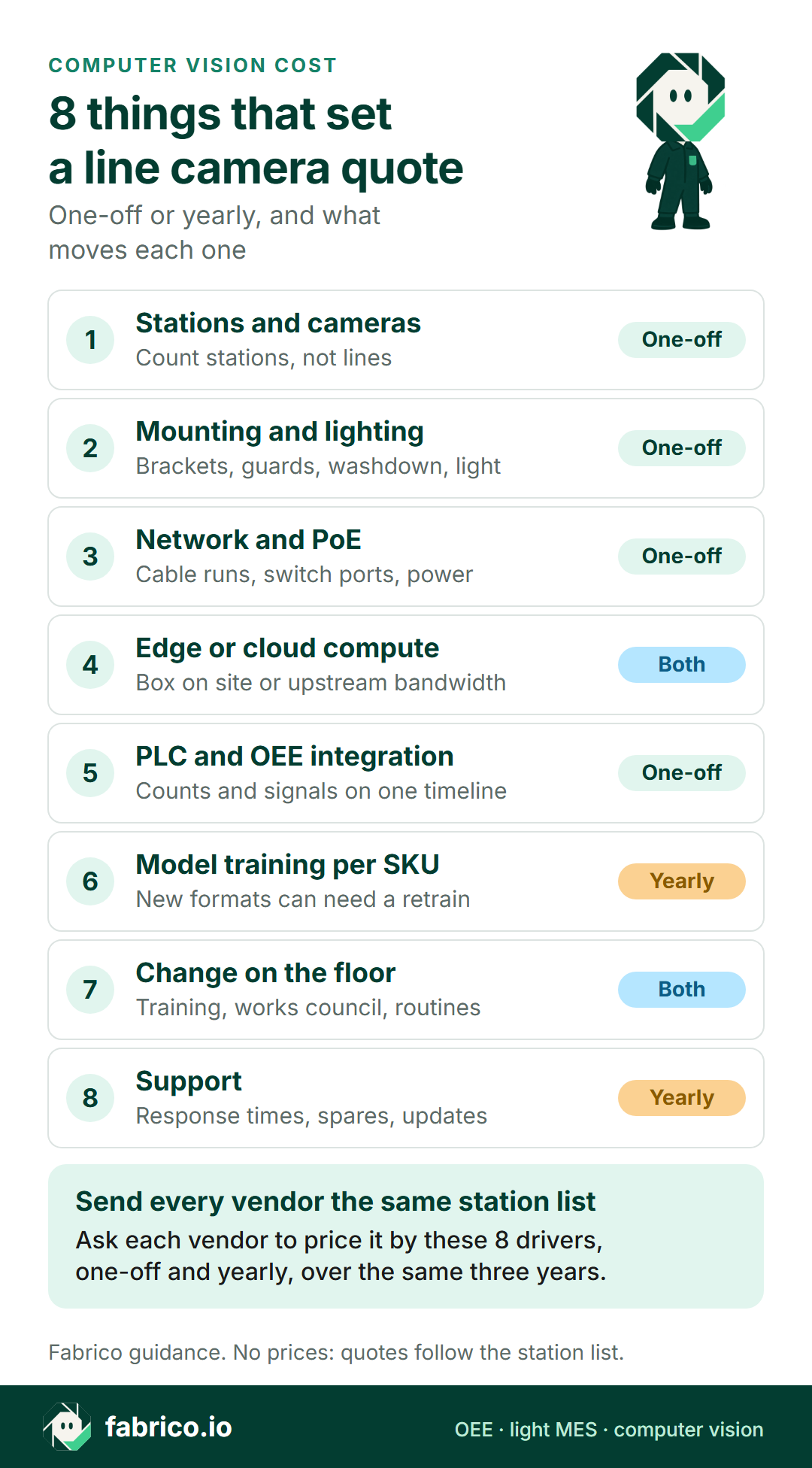
Eight things move the quote. Some are paid once, some every year. The table shows what pushes each one up, what keeps it down and when you pay it.
| Driver | Cost goes up when | Cost stays down when | Paid |
|---|---|---|---|
| 1. Stations and cameras | Many stations, wide views, fast lines | Cameras only where no signal exists | Once |
| 2. Mounting and lighting | Washdown, guards, changing daylight | Stable light, existing frames | Once |
| 3. Network and PoE | New cable runs, full switches | Spare ports and PoE power nearby | Once |
| 4. Edge or cloud compute | Many streams, video kept long | Counts sent, video only on request | Both |
| 5. PLC and OEE integration | Custom signal work per machine | Standard protocols, one timeline | Once |
| 6. Model training | Many SKUs, frequent new formats | Formats agreed up front, with a set retrain turnaround | Yearly |
| 7. Change on the floor | No owner, no routine for the data | Shift meeting uses the data from the start | Both |
| 8. Support | Unclear response times, spares not covered | Support, updates and spares in scope | Yearly |
Stations and cameras: count stations, not lines
A line is not one camera. A filler with a good PLC signal may need none. A hand-pack table or an old machine with no signal usually needs one, and so do transfers where short stops hide.
Fast or wide stations can need a second view. The method is in how many cameras a line needs for OEE, and the trade-off per machine is in camera or sensor by machine.
Mounting, lighting and the line environment
Brackets and guards cost little alone, but they multiply by station. Washdown areas need rated housings. Changing daylight can need added lighting so counts stay stable across shifts.
Ask who mounts, whether it is in the quote and whether the line must stop. See camera placement and lighting on a production line.
Network, PoE and where the video goes
Most line cameras take power and data over one Ethernet cable (PoE), so the switch is part of the cost: free ports, total power and the cable run. The Ethernet Alliance overview of the PoE standards notes that the first standard, 802.3af, could provide 13 W to a device; later standards, 802.3at and 802.3bt, provide more. A camera with a heater or its own light may need more than an older switch gives, so check before you order.
Bandwidth is the other line. Counts use little; streamed video uses capacity only while someone watches. Ask for the measured bandwidth per camera on a running pilot line. IT's questions are in line camera network requirements.
Edge compute or cloud: where the model runs
The model that turns pixels into counts runs on a box near the line (edge) or in the cloud. Edge needs hardware on site that someone powers and patches. Cloud needs reliable upstream bandwidth, and the compute runs on the vendor's side, so ask where it appears in the quote. The bigger question is video retention: keeping video costs storage and privacy work, streaming it on request keeps both down. See line video storage, edge vs cloud.
Integration with the PLC and the OEE software
A camera count is useful when it lands on the same timeline as the machine signals, stop reasons and OEE. Ask whether the vendor connects to your PLCs through standard protocols, whether camera counts and PLC counts feed one OEE, and who maps the signals. Custom work per machine is where integration budgets grow. If your HMIs already hold the data, see HMI data collection for OEE.
Model training per SKU and pack format
A new label colour, pack size or promotion pack can need new examples and a retrain. With ten SKUs this stays small; with hundreds of formats a year it can become the largest yearly cost. See computer vision for co-packers for that case.
Ask what happens to the counts until a retrain is done. On a pilot, compare the camera count with a hand count or a checkweigher for the same shift, as in how accurate camera OEE is.
Change on the shop floor and support
The camera is the easy part. Operators tag stop reasons, shift leads run a meeting on the data, and the works council may review where each camera points. Those hours rarely appear in a vendor quote. Plan them anyway. The privacy side is in GDPR and production line cameras.
Support is the last driver: response times, who replaces a broken camera, software updates, and whether spares sit on site. A low first year followed by costly support is not a low cost.
Hidden costs that show up after the quote
- Line stops for installation outside planned downtime.
- A new switch or network segment for IT to maintain.
- Moving cameras when the layout changes.
- Storage, if someone later asks to keep footage.
How to compare camera quotes like for like
Quotes differ because they price different things: cameras only, cameras with mounting and network, or a bundle with software. To compare them, price everything against one station list.
- List each station on the line: name, machine, whether a usable signal exists, speed and the SKUs that run on it.
- Mark which stations you expect to need a camera, and why.
- Ask each vendor to price the same list, split by the 8 drivers, one-off and yearly.
- Ask for the same horizon, for example the first three years, so yearly costs are visible.
- Put the answers in one table. Blank cells are costs you will pay later.
If you are also comparing vendors, see computer vision for manufacturing OEE, compared, and for FMCG lines in general, computer vision for FMCG manufacturing.
Pilot quote, plant quote or both?
Pick a pilot quote if you have not measured the losses on one line yet, or if the stations are unusual, such as manual steps or many formats. You learn the real station count and accuracy before you scale.
Pick a plant quote if the losses are measured, the lines share the same machines and SKUs, and a pilot has already shown that the counts hold up.
Do both if the lines differ: price the pilot line now and ask for a price per line type for the rest.
How a pilot runs is in the computer vision OEE pilot guide.
Want to see what a station review looks like? Book a demo and bring your station list.
Payback: what recovered minutes are worth
Payback in months is the one-off cost from the quote divided by the monthly value minus the monthly running cost. Three rules from OEE practice keep the value side honest:
- Value minutes at the constraint, the station that sets the line's output. A minute saved elsewhere adds no output.
- Count a loss once. If the camera and the PLC see the same stop, it is one stop.
- Whether a minute is extra product or avoided labour depends on whether the line is sold out; the business case questions show how to price it.
Illustrative, sample data. A line runs two shifts a day, 21 days a month: 42 shifts. The filler is the constraint, at an ideal rate of 120 units a minute. The team plans to recover 10 minutes a shift there.
- Recovered time: 10 min x 42 shifts = 420 min, or 7 hours a month.
- Sold out: 420 min x 120 units = 50,400 extra units. At a sample contribution of EUR 0.05 a unit, that is EUR 2,520 a month.
- Not sold out: 7 hours x a crew of 4 x EUR 34.9 an hour = about EUR 977 a month, if those hours are really cut.
- OEE: on 450 planned minutes a shift, 10 minutes recovered at ideal rate and full quality add at most 10 / 450 = 2.2 points.
The EUR 34.9 is the EU average hourly labour cost for the whole economy in 2025, from Eurostat. National figures range from EUR 12.0 in Bulgaria to EUR 56.8 in Luxembourg, so use your own rate. Then halve the recovered minutes and check the case still holds.
For scale, the Siemens True Cost of Downtime 2024 report says an average large plant still loses 27 hours a month to unplanned downtime. It rests on 181 interviews at large companies in four sectors, with results from April 2019 to March 2023, and for FMCG it says hours lost are similar to 2019, so treat it as context, not as your number. On video replay, see computer vision for OEE with video replay.
Questions to put to any vendor
- Which stations on the station list need a camera, and which can use a PLC signal or a sensor instead?
- What is in the hardware line: camera, housing, bracket, lighting, cable?
- What PoE class and measured bandwidth does each camera need?
- Where does the model run, and what hardware on site must we buy, power and patch?
- Is video kept by default, and who pays for the storage?
- How many SKUs and formats are included, and what does a new format take in time and cost?
- How do camera counts and PLC data reach one OEE calculation?
- What does support cover after year one: response time, spares and updates?
Where Fabrico fits
Fabrico is a cloud OEE and light MES platform. Stops and counts come from the machine signal through the PLC or an IoT device with a sensor, and the operator adds the stop reason on a tablet or phone. OEE and losses show by line and shift. See OEE software and light MES.
The computer vision add-on counts output at stations with no usable signal, such as hand-pack tables. With the camera add-on you open the video for a stop on the timeline, streamed on request and not kept in Fabrico in the standard setup. Cameras are an add-on to Fabrico OEE, quoted per plant once the line review shows how many stations need one, so a station list is the starting point. Details are on the computer vision feature page.
Roadmap, not live today: stop-reason suggestions from the camera add-on that the operator confirms, and jam zones on the camera view. Fabrico does not sell quality inspection: checking labels, caps or fill level is a different job, done by inspection vision systems. Where the model runs and how new formats are handled: ask in the demo. Devices connected in about a month; full rollout in 3 to 4 months. Test these claims like any vendor's.
What people ask next
How much does computer vision on a production line cost?
There is no fair single number. It depends on how many stations need a camera and on seven more drivers, from mounting and network to model training and support. Send every vendor the same station list and ask for a price split by those drivers.
Is a camera cheaper than connecting the PLC?
Not as a rule. Where a machine has a usable PLC signal, connecting it is usually the simpler route. A camera earns its cost where there is no signal, such as manual stations and old machines, or where a running signal hides a stop.
Do we pay again for each new SKU or pack format?
It depends on the vendor and the contract. Before you sign, ask how many SKUs and formats are covered, who collects and labels the images, how long a retrain takes and how a new format shows in the quote.
Is edge or cloud processing cheaper to run?
Edge needs hardware on site that someone must power and patch. Cloud needs upstream bandwidth, and the compute runs on the vendor's side, so ask where it appears in the quote. The larger difference is usually video retention: streaming video only when someone opens it costs less than keeping it.
How do I compare two camera quotes fairly?
Give both vendors the same station list, ask for one-off and yearly costs split by the eight drivers, and use the same horizon, such as three years. Any blank cell is a cost you will meet later.
How long does a line camera take to pay back?
Divide the one-off cost from the quote by the monthly value of minutes recovered at the constraint, minus the monthly running cost. Then halve the recovered minutes and check the case still holds.
Want to compare quotes on a line like yours? Book a demo and bring your station list.
Related articles

Latest from our blog


Real Fabrico tiles, sample data.