


 Login
 Blog

Computer Vision for Tobacco Manufacturing: Cigars, Pouches and Case Counts

In short: computer vision for tobacco manufacturing pays off as an output counter and a witness where no usable machine signal exists: hand and semi-manual work such as cigars, rolling tobacco pouches and display packs, rework and repacking, older lines, and case counts at the end of the line.
- Primary processing, filter makers, cigarette makers and packers already have PLCs and their own inspection. Read their signals first.
- Tipping, print, tear tape and pack quality checks are inspection. Unique identifiers on packs are track and trace. Both are separate systems, and Fabrico does neither.
- Tobacco losses hide in brand changes, linked maker and packer stops, short stops at the packer and material waits.
- Fabrico's camera add-on counts output and lets you open the video for any moment on the shift timeline. The operator adds the stop reason.
Your makers and packers came with PLCs, counters and inspection built in. Your primary processing runs on its own control system. Yet the cigar room, the pouch packing table, the display pack station and the rework area are still counted by hand.
This page is for plant managers and CI leads choosing how to put cameras on tobacco lines to count output and get OEE. It shows where a camera earns its place and what to ask each vendor.
Computer vision for tobacco manufacturing: three different jobs
Three kinds of camera system end up in a tobacco factory. Inspection checks the product and pack. Track and trace prints and reads codes. OEE cameras count output and show what happened at a stop.
| Job in a tobacco factory | Inspection or track and trace | OEE camera |
|---|---|---|
| Tipping, filter, rod checks | Yes, often built into the maker | No |
| Pack print, tear tape, foil, lid | Yes, on the packer | No |
| Unique identifiers on packs and cases | Yes, track and trace | No |
| Count packs, cartons, cases or cigars | Counts what it checks or codes | Yes, also at manual steps |
| Video of a stop | Reject images, not stop video | Open the video for that minute |
| Feeds OEE through | Its reject count | The output count |
Inspection is already part of the high-speed machines. On the Coesia group's cigarette making page, one listed Molins maker comes with an in-built inspection system. Your maker and packer rejects belong in the quality part of OEE, read from the machine's own reject count, so they are counted once.
Track and trace is a separate system with its own rules. In the EU, Article 15 of the Tobacco Products Directive 2014/40/EU requires that all unit packets of tobacco products are marked with a unique identifier. It has applied to cigarettes and roll-your-own tobacco since 20 May 2019, and to other tobacco products since 20 May 2024. Article 15 also lets the recording be done through aggregated packaging such as cartons, mastercases or pallets. The technical rules in Implementing Regulation (EU) 2018/574 set out the unique identifiers, including the one for aggregated packaging, meaning any packaging that holds more than one unit packet.
An OEE camera does none of that. For where the line sits between the two jobs, read label and code vision vs an OEE camera.
Where the losses hide in a tobacco factory
A tobacco factory has two halves: continuous process at the front, very fast machines and hand work at the back.
Primary processing runs on signals
Primary processing conditions, blends, cuts and dries the tobacco, then feeds cut tobacco to silos for the makers. It runs continuously, and belt weighers and the process control system already know the flow and the state of each section.
Measure it by throughput against the planned rate, from those signals. A camera adds little there. Its loss shows up downstream, as makers waiting for the right blend.
Linked maker and packer stops
Makers and packers run fast and are usually linked. Coesia says its G.D cigarette making solutions process up to 20,000 cigarettes per minute. Focke lists one hinge lid packer at 600 packs per minute, to link up to a filter cigarette maker of up to 12,000 cigarettes per minute. Those are the vendors' own figures (vendor pages, checked 13.11.2026). Your rated speeds will differ.
At those speeds, a one-minute stop costs thousands of cigarettes. And because the two machines are linked through a buffer, a stop in one becomes a stop in the other once the buffer runs full or empty.
Pick one rule for the pair. Many plants treat maker and packer as one line, count at the packer, and give maker, packer and buffer stops their own codes. The PLCs already know which machine stopped first. Read them. For the method, see finding the real constraint on linked lines.
Short stops at the packer
The packer is where many short stops sit: blank feed, inner frame, foil, the collation of cigarettes into the pack, tax stamps where a market uses them, and the overwrapper with its film and tear tape.
A 30-second stop rarely gets written down. Forty of them are 20 minutes. The packer PLC counts them, but often gives a fault number, not a reason.
A camera adds video here, not a count: open the minutes when short stops jumped. Camera-detected stops and jam zones are Roadmap, so today the stop time comes from the PLC. See micro stops.
Brand changes
A brand change touches almost everything: blend, cigarette and tipping paper, filter rods, pack blanks, inner frames, film, tax stamps and market codes. Each one brings a stop, a start-up and often a batch of rejects.
Book brand changes inside planned time, with their own code and a standard time for each type of change: blend only, pack only, or full change. Then compare actual minutes against standard. For the method, see changeover time.
Material waits
A maker waits for cut tobacco, filter rods, paper bobbins or tipping. A packer waits for blanks, foil or stamps. A cartoner waits for cartons.
These are not breakdowns, but often get booked as one. Give each material its own wait code, so the report points at the right department, not at maintenance. See waiting for material in OEE.
Filter making
Filter makers turn tow into filter rods for the cigarette makers. They have their own PLC and count, so read the signal. The loss to watch is the cigarette maker waiting for rods.
Secondary packing and the end of the line
After the packer come cartoners, case packers and palletizing. Newer ones give a count. On older lines, or where the PLC is closed, the case count arrives only after the shift.
A camera at the case packer outfeed counts cases as they leave, and you can open the video when the case packer stalls. Compare that count with the packer's pack count, and the gap tells you where packs went. See case packer downtime and cameras.
Hand and semi-manual work
Not all tobacco work is high speed. Premium cigars are often rolled, banded and boxed by hand. Pouches may come off a filler and then be packed by hand. Display packs are often assembled at manual stations.
Then there is rework and repacking: packs reworked after a code or stamp problem, stock repacked for another market, rejects opened to reclaim the tobacco. That is real output, often with no counter at all.
This is where a camera earns its place most clearly. The camera add-on counts the cigars, boxes, pouches, cartons or display packs that leave each station, so output by hour stops being a guess. Stop reasons still come from the people at the table. See OEE at a manual packing station and computer vision for co-packers, which covers the same counting problem at display and repack stations. See also computer vision for FMCG manufacturing.
Dust and climate
Makers throw off fine tobacco dust, and dust on a housing window can make a count drift. Mount cameras outside the guarding, away from dust extraction points, in a housing you can wipe, and agree a cleaning routine with the line team.
For the maintenance side of makers, cutting heads and packers, see maintenance software for tobacco manufacturing.
Where a camera goes in a tobacco factory
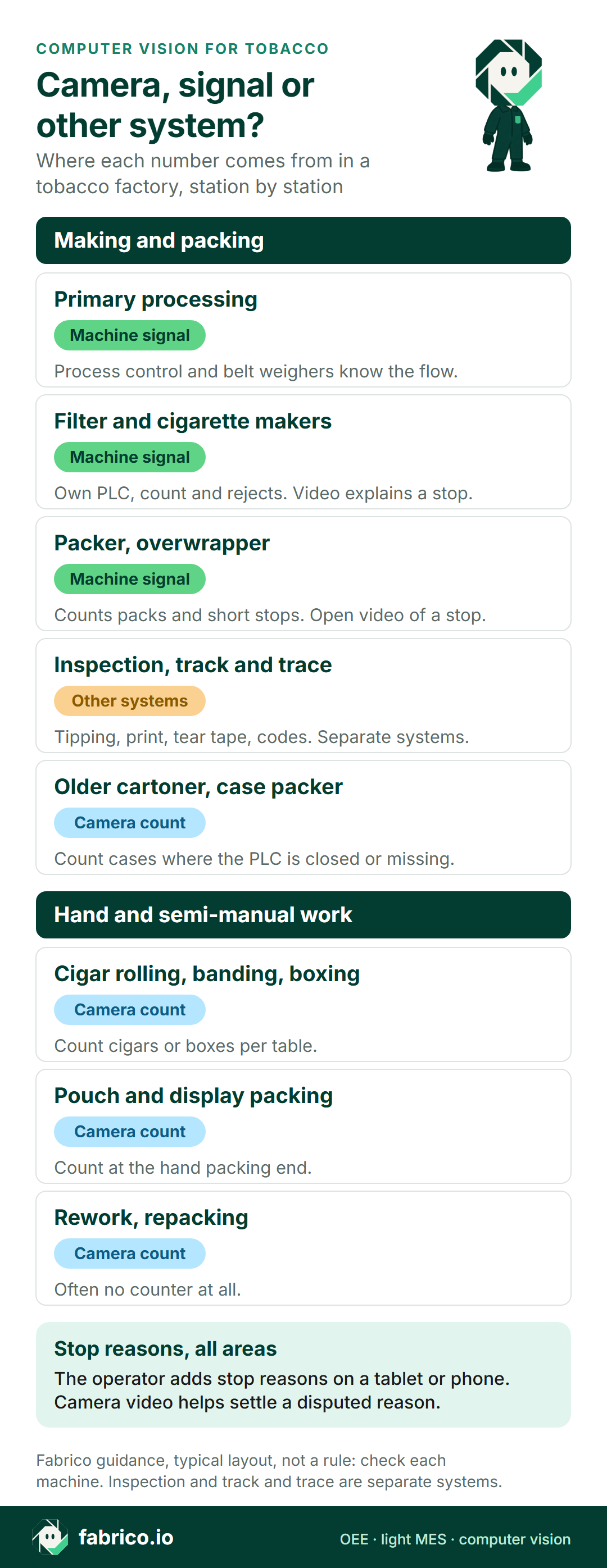
Here is one example: a cigarette making and packing line, and the hand and semi-manual areas.
For how many cameras a station needs, see how many cameras per line for OEE.
Camera, sensor or operator: station by station
This is typical for a tobacco factory, not a rule. Check each machine.
| Station | Count and stops from | What a camera adds |
|---|---|---|
| Primary processing | Process control, belt weighers | Little. Use the signal. |
| Filter maker | Filter maker PLC | Little |
| Cigarette maker | Maker PLC, its own rejects | Video of what led up to a stop |
| Packer, overwrapper | Packer PLC, its own rejects | Video of short stops |
| Inspection, track and trace | Their own counts | Nothing. Feed rejects to quality. |
| Cartoner, case packer | PLC, if you can reach it | Case count if you cannot |
| Cigar rolling, banding, boxing | Usually nothing | Count of cigars or boxes |
| Pouch and display packing | Filler PLC, then hands | Count at the hand packing end |
| Rework, repacking | Usually nothing | Count of reworked packs or cases |
| Stop reasons, all areas | The operator, on a tablet or phone | Video to check a disputed reason |
You rarely need a camera on a modern maker or packer.
Bring your station list and one week of stop sheets to a demo, and we will go through it station by station.
Worked example: one shift on a pouch line
These are example numbers, and they describe no real plant. A semi-automatic rolling tobacco pouch line with an ideal rate of 40 pouches a minute runs one 480-minute shift. The pouches are packed into cartons by hand at the end.
The filler PLC gives the run state and counts the pouches filled. A camera at the hand packing table counts the pouches packed into cartons, after people set faulty ones aside. Pouches set aside for weight or seal faults make up the difference.
Stops took 120 minutes: a brand change 40, material waits 35, short stops 30 and one breakdown 15. Run time is 360 of 480 minutes, so availability is 75%.
At 40 pouches a minute, 360 minutes could make 14,400 pouches. The filler counted 12,960, so performance is 90%. The gap is 36 minutes of slow running.
The camera counted 12,640 pouches packed at the table. That leaves 320 rejects, so quality is 97.5%. Those 320 pouches are 8 minutes of line time.
OEE is 75% x 90% x 97.5% = 65.8%. Check it the short way: 12,640 good pouches of 19,200 possible is also 65.8%.
Look at the material waits: more than double the breakdown. Without their own code they would hide as "other", and the fix sits with supply, not with the fitters.
Eight checks for any tobacco camera or OEE vendor
Run these with every vendor, and with us. Bring one real shift from last week as the test case.
| Ask | How to test the answer |
|---|---|
| How do you book a brand change? | Ask for a code inside planned time, and minutes over standard for each type of change. |
| How is a linked maker and packer counted? | Ask to see a packer stop that starves the maker, and where each minute lands. |
| How do maker and packer rejects get in? | Ask if the machine's own reject count feeds quality, so rejects count once. |
| What exactly does the camera count? | Cigars, boxes, pouches, cartons or cases? Run it next to a hand count for one shift. |
| How do material waits show? | Ask for wait codes by material, apart from breakdowns. |
| Does the count hold in tobacco dust? | Ask what happens to the count when the lens window gets dusty, and how it is cleaned. |
| Where does each camera mount? | Ask for each position on a drawing, outside guarding, with safety sign-off first. |
| Is video kept, and who can open it? | Ask where it lives, for how long, and who sees it. |
Before you roll out across the site, test on one area first. See the guide to a computer vision OEE pilot.
Cameras, privacy and the works council
Cigar rooms, packing tables and rework areas are full of people. Tell staff before any camera goes up. In many European countries, talk to the works council first.
Frame the camera on the product, the box or the carton, not the crew. Report by station and shift, not by person. Ask each vendor, us included, what privacy masking is live today and what is still roadmap.
Fabrico's camera add-on counts product, not people. For a fuller checklist, read production line cameras without surveillance.
Where Fabrico fits
Fabrico is a cloud OEE and light MES platform. Here is what it does in a tobacco factory today.
- Stops and counts: from the machine signal, through a maker, packer or case packer PLC, a sensor or a counter.
- Stop reasons: the operator adds them at the line, on a tablet or phone.
- OEE and losses: OEE, downtime and losses by line and shift, with losses shown in money. On the web, iOS and Android.
- Cameras, an add-on on request: the camera add-on counts output, including at cigar tables, hand packing, rework and machines with no usable signal. You can open the camera video for any moment on the shift timeline. In the standard setup, video is streamed on request, not stored in Fabrico.
- Your data: it leaves through a REST API, webhooks and Excel or CSV export.
Roadmap, not live today: stops detected by the camera, jam zones on the video, and a camera suggesting a stop reason.
What Fabrico does not do: inspection of tipping, print, tear tape or pack quality, which stays with the inspection on your makers and packers. Track and trace, including unique identifiers on packs and aggregated packaging, stays with your track and trace system. Fabrico does not control primary processing or the machines. For planning and scheduling, ask us in the demo.
For the full product, see Fabrico computer vision for OEE. If you are still comparing platforms, read the guide to OEE software. All eight checks above apply to us too.
Bring one shift's stop sheet and your station list to a demo, and ask us to show which numbers we can fill and which we cannot.
What people ask next
Which tobacco station should get the first camera?
Usually the one with the weakest count: a cigar banding and boxing table, hand packing of pouches or display packs, a rework area, or an older case packer whose count you cannot reach. Makers and packers with a PLC count you trust come last.
Can a camera check tipping, print and tear tape on cigarette packs?
Yes, but that is an inspection system, usually built into the maker or packer or added by an inspection vendor. Fabrico does not do inspection. The inspection system's reject count can feed the quality part of OEE.
Does Fabrico handle EU unique identifiers or track and trace?
No. Printing, reading and reporting unique identifiers on packs and aggregated packaging is the job of your track and trace system and its service providers. Fabrico counts output and records stops for OEE.
How do you measure OEE on a linked maker and packer?
Pick one rule and keep it. Many plants treat the maker and packer as one line with the packer as the counting point, and give stops their own codes for maker, packer and buffer. Then a stop in one machine is not booked twice.
Is the camera video stored?
Not in Fabrico. In the standard setup, video is streamed on request, and you can open it for any moment on the shift timeline. Ask every vendor the same question, and where their video lives.
What drives the cost of computer vision in a tobacco factory?
Pricing is set per quote. The drivers are the number of lines and cameras, mounting and housings for dusty areas, the network to the hall, and training. Give each vendor the same station list so the quotes compare.
Want to see it on a line like yours? Book a demo and bring one shift from a tobacco line.
Related articles











Real Fabrico tiles, sample data.