







 Login
 Blog
OEE for a Manual Packing Station: Count Output With a Camera

Key takeaways
- Hand-packing, kitting and rework stations rarely have a PLC (programmable logic controller), so they are often missing from the line's OEE.
- Count the finished unit at one fixed spot, such as the outfeed belt or a full tray, not the hands.
- A stop is a gap with no finished unit past a threshold your plant sets. The operator confirms the reason in one tap.
- Split waiting for material, starved and blocked time from the station's own stops.
- On the sample station, slow running cost 186 trays a shift, more than any single stop.
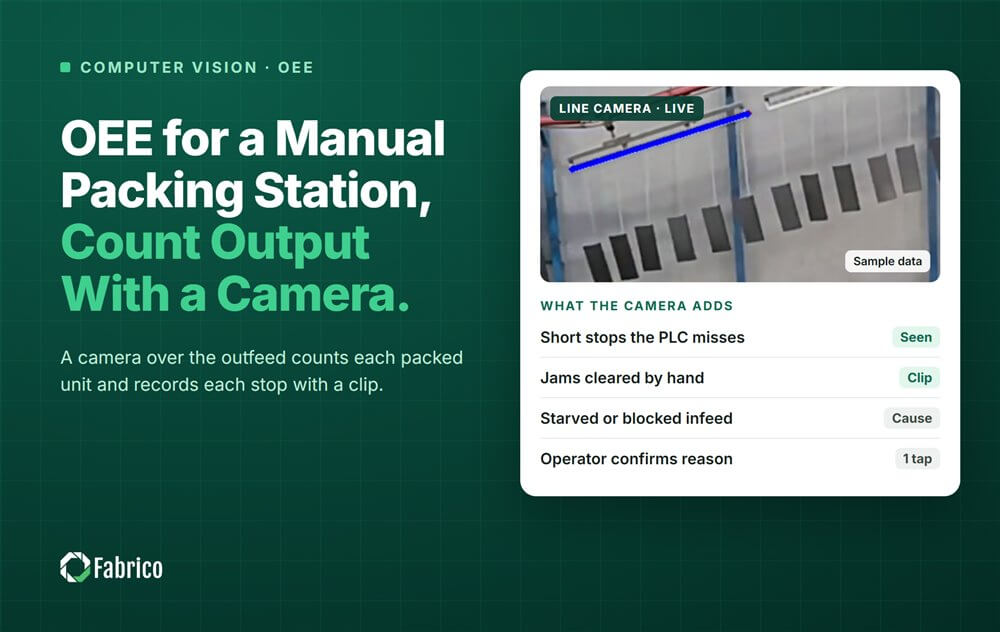
To get OEE (overall equipment effectiveness) at a manual packing station, put a camera over the spot where finished units leave it. It logs every pack that passes and every gap where nothing does. The station then gets Availability, Performance and Quality, like the machines around it.
Fabrico is OEE and light MES (manufacturing execution system) software for fast-moving consumer goods (FMCG) plants. Its AI cameras are an add-on that count output and record stops on manual and packing stations, so one OEE covers the whole line.
Which manual stations in an FMCG plant need OEE?
Most FMCG lines run on machines from filler to case packer. The hand work sits at the edges: promotion packs, display trays, kits and rework. These stations rarely have a PLC, so their minutes live on a paper tally or nowhere.
That matters when the manual station is the slowest step, as a hand-packing bench often is during a promotion. Its lost minutes are then the line's lost minutes.
| Station | What to count | Common stops |
|---|---|---|
| Hand-packing: multipacks, gift packs, display trays | Closed packs or full trays on the outfeed | No trays or cartons, no product from upstream, outfeed full |
| Kitting: sample kits, bundles | Finished kits in the take-away tote | A part missing, wrong leaflet, format change |
| Rework: relabelling, repacking | Units leaving rework, kept apart from line output | Waiting for held stock or a quality decision |
What should the camera count at a packing station?
Count the product, not the person. Pick one spot where every finished unit passes once and the view stays clear.
- Count the unit the line counts. If the filler counts jars and the bench makes trays, record trays and convert with the pack count.
- Keep the frame on the done spot. The outfeed is easier to see than the bench, and it keeps people out of the picture.
- Take rejects from where they are found. Good count is the camera count minus the bad packs the operator or a checkweigher records.
- Tell the system what is running. Two promotion packs can look alike, so the format comes from the order or the operator.
Before you trust the count, check it against a hand count for a few full shifts. Our guide to computer vision OEE for manual assembly covers that test and how to set an ideal cycle time on human work.
What counts as a stop at a manual station?
A stop is a gap with no finished unit at the done spot that lasts longer than a threshold. No standard sets it. A minor stop is usually a minute or two, so pick a cutoff that fits the pack and keep it on every shift.
Shorter pauses show up as slow running inside Performance. Longer gaps are recorded as stops, each with a short clip.
The camera sees that output stopped, but not always why. Waiting for cartons and waiting for a supervisor can look the same. So the camera suggests a reason, and the operator confirms it in one tap from a short list:
- Waiting for material: no trays, cartons, leaflets or labels at the bench.
- Starved: no product from the machine upstream.
- Blocked: the outfeed is full because the next step is down.
- Format change: a new promotion pack or kit.
A planned break comes out of planned time, and so does a station with nobody planned on it. But a packer pulled away to cover another line is a stop, coded as staffing.
How does a manual station join the line's OEE?
The same three factors apply as on any machine. Our OEE calculation guide has the full math.
- Availability = run time / planned production time.
- Performance = ideal cycle time x units counted / run time. Set the ideal per pack format for the station, never per person.
- Quality = good units / units counted.
Then put the station on the same timeline as the filler and the wrapper. Starved minutes go to the machine upstream that stopped first, and blocked minutes to the one downstream. Our guide to case packer OEE shows the same split on an automatic machine.
How do you keep the camera on the process, not the person?
This decides whether the station gets a camera at all. In Germany, the works council co-determines any equipment that can monitor behaviour or performance, even when nobody intends to. In France, the CSE (the works council) is consulted before installation.
- Aim the camera at the outfeed and the material, not at faces.
- Report OEE by station, line and shift, never by named operator.
- Use the clip to show the cause: an empty tray rack, a late pallet of cartons.
- Agree in writing who sees clips and why, before the first camera goes up.
A one-person station needs extra care, because its numbers can point at one person. Our guide to production line cameras without surveillance covers the policy and the setup.
Worked example: what does one shift at a hand-packing station lose?
Sample line (illustrative numbers, not a customer): a hand-packing bench at the end of a sauce line. Two packers put 6 jars into a display tray for a retail promotion. The ideal cycle time is 20 seconds a tray, so 3 trays a minute, over 450 planned minutes.
| State | Minutes | Charged to |
|---|---|---|
| Packing, trays leaving the outfeed | 372 | None |
| Starved, no jars from the labeller | 30 | Labeller |
| Waiting for empty trays, 6 x 4 minutes | 24 | Material supply |
| Format change to a new promotion tray | 15 | Changeover |
| Blocked, outfeed full, palletiser down | 9 | Palletiser |
| Total | 450 |
The camera counted 930 trays. The checkweigher rejected 12 for a missing jar, so 918 were good.
- Availability = 372 / 450 = 82.7%.
- Performance = 930 x 20 seconds = 310 minutes, and 310 / 372 = 83.3%.
- Quality = 918 / 930 = 98.7%.
- OEE = 0.827 x 0.833 x 0.987 = 68.0%. Check: 918 x 20 seconds = 306 minutes, and 306 / 450 = 68.0%.
- Availability, own causes only = (450 minus 39) / 450 = 91.3%. The labeller and palletiser own 39 of the 78 stop minutes.
Now turn minutes into trays. In 450 minutes the bench could have made 1,350 trays. It made 918 good ones, so it lost 432:
- Slow running, 372 minus 310 = 62 minutes: 186 trays.
- Starved by the labeller, 30 minutes: 90 trays.
- Waiting for empty trays, 24 minutes: 72 trays.
- Format change, 15 minutes: 45 trays.
- Blocked by the palletiser, 9 minutes: 27 trays.
- Rejects: 12 trays.
At a contribution of $1.20 a tray (or €1.20 in a euro plant), 432 trays are $518.40 a shift. Over a promotion of 120 shifts, that is $62,208. It counts as cash only if the promotion is sold out or the lost trays cost overtime.
The biggest loss is not a stop. It is 62 minutes of slow running that no paper tally shows. At a bench, that usually comes from long reaches and walks for material, so start with the layout.
The largest stop the bench can fix is waiting for trays. The clip shows an empty tray rack, not a slow packer.
Where Fabrico fits
Fabrico is a computer vision enabled Manufacturing Performance Platform. It runs with OEE and light MES first. There is no free plan and there are no tiers: each plant gets a quote.
- Automatic downtime logging from machine signals, and from AI cameras on stations with no PLC.
- A camera clip as evidence for a stop, and the operator confirms the reason in one tap.
- Losses ranked by money, so slow running at the bench sits next to the filler's stops.
- OEE live by line and shift, with the manual station inside the line.
Cameras are an add-on to Fabrico OEE, and devices are connected in about a month, and the full rollout takes 3 to 4 months. You start on one line, with a baseline and a decision date agreed in advance. See the computer vision OEE and MES page.
Frequently asked questions
Can you measure OEE at a manual packing station without a PLC?
Yes. A camera over the outfeed counts finished units and records the gaps where nothing leaves the station. Add the planned time, the ideal cycle time per format and the rejects, and you get the same three factors as on a machine.
What should the camera count at a hand-packing station?
The finished unit, at one spot where each one passes once. A closed pack on the outfeed, a full tray in a fixed place or a closed case on the belt all work. Count the unit the line uses, or convert with the pack count.
How long does a pause have to be to count as a stop?
No standard sets it, so pick one threshold for the station and keep it on every shift. Shorter pauses show up as slow running in Performance. Longer gaps become stops with a clip, and the operator confirms the reason in one tap.
Should a rework station count in the line's OEE?
Give rework its own station and its own OEE. Count the bad units as a quality loss on the line that made them. Never add reworked units to the line's output a second time, or the line will look better than it ran.
Does the camera measure how fast each operator packs?
No. Fabrico's camera counts the station's output and records its stops, but it does not measure manual cycle time per operator. OEE is reported by station, line and shift, so agree that in writing with employee representatives before the first camera goes up.
See your manual stations in a demo
Bring one line with a manual station and its last shift tally. We will show where the station's minutes went and what each loss cost.
Latest from our blog



Real Fabrico tiles, sample data.