


 Login
 Blog

Computer Vision for Tea Packing: Tea Bag Machines, Cartons and Cases

In short: computer vision for tea packing pays off where nothing else counts and where stops are too quick to explain: cartons and cases on machines you cannot read, gift packs packed by hand, and video of the tag, string and cartoner stops on a fast tea bag line.
- Checking bag weight, tags, strings, seals and carton codes is inspection, a separate purchase: dosing control, checkweighers and vision systems from firms such as Cognex, Keyence or Mettler-Toledo.
- A tea line loses time to blend changes, reel changes, tag and string stops, and a cartoner that backs up the bag machine.
- Read the bag machine's PLC for bags and stops. Add a camera where a cartoner or case packer gives no count you can reach, at the gift-pack tables, and over the tag and string station.
- With Fabrico's camera add-on, a tea packer gets carton and pack counts from stations with no signal, plus the video behind any minute on the shift timeline. Operators still pick the stop reason.
A tea bag machine makes bags faster than anyone on the floor can watch. The cartoner turns them into boxes of 20, 40 or 80, and at the end of the hall a crew packs gift tins and sample boxes by hand.
This guide is for engineers and managers at tea blending and packing plants who are picking cameras and OEE software: string and tag bags, pyramids, envelopes, loose tea and the end of the line. The estate side, from withering to drying, is out of scope.
You will see which tea stations earn a camera, which ones the bag machine's signal already covers, and eight questions for vendors. Fabrico is one of those vendors, so hold this page to the same test.
Computer vision for tea packing: two different jobs
Ask for vision at a tea packer and you may be offered two different systems. One inspects: it checks bags or cartons and rejects the bad ones. The other is an OEE camera: it counts what leaves a station and lets you replay a stop. Tea packers often buy them from different suppliers, so write two specs.
| Job on a tea line | Inspection system | OEE camera |
|---|---|---|
| Bag weight | Dosing checks or a checkweigher | No |
| Tag, string and seal | Checks on the bag machine, or a vision system | No |
| Carton code and label | Code reader or vision system | No |
| Cartons, cases and gift packs counted | Counts what it inspects | Yes, including hand tables |
| A stop on the bag machine | Images of rejected items | Video of the minute it stopped |
| Reaches OEE as | Rejects, through quality | The good count |
Searching for machine vision for tea and finding only inspection kit? This guide covers the counting side.
On one line the two sit side by side. Feed the checkweigher's or code reader's reject signal into the quality figure, and a rejected carton is counted once, not twice. Where one job ends and the other begins: label and code vision vs an OEE camera.
Where a camera helps on a tea packing line, and where it does not
In the UK, almost all tea is drunk from a tea bag: the UK Tea and Infusions Association FAQ puts the share at 97.5%. That is one country, and the FAQ gives no date or source, so check your own mix. Where your mix looks like that, most of your output, and most of your losses, run through the bag machine.
Those machines are fast. IMA rates its C2002 string and tag machine at up to 600 bags a minute, on its own product page. At that rate, a 30-second stop costs 300 bags, and nobody writes down a 30-second stop.
For a sense of scale, Siemens' 2024 True Cost of Downtime report puts an hour of unplanned downtime in fast moving consumer goods at $36,000, the bottom of its four sectors, for large manufacturers, and says the figure has been relatively stable since 2019. A tea packer's hour will differ, so price your own.
Blend changes and dust
A blend change means clearing dust and the last blend out of the hopper and the dosing unit. Run strongly flavoured and scented teas last, before a full clean, and time each change against a standard.
The camera has little to add here. The bag machine's own signal marks the stop and the restart, and the operator picks the change type.
Tag, string and reel stops
Why tag, string and reel stops happen, and how to code them, is on our page on OEE for tea packing lines. The camera question is narrower.
The PLC logs that the machine stopped, sometimes with one fault code for several causes. A camera over the tag and string station lets you open the video for those seconds and see what jammed. The operator still adds the reason. To keep stops this short in the data, see micro stops.
The cartoner and the case packer
When the cartoner jams, the bag machine backs up and stops. On the bag machine's own log, that can look like its own stop. The time belongs to the cartoner, and on a paper log it often lands on the wrong crew.
If you can read the cartoner's PLC, do. Some older cartoners and case packers have no count you can reach, and that is where a camera at the outfeed pays off: it counts cartons or cases, and its video shows which machine stopped first. See cartoner OEE and case packer downtime on camera.
Bags, cartons and cases
A tea line makes bags, sells cartons and ships cases, and a carton of 80 bags is not a carton of 20. Count bags at the bag machine, count cartons or cases where the money is, and convert per SKU. Our page on OEE units: bottles, cases and pallets shows how to keep the units straight.
Gift tins and sample boxes
Gift tins, sample boxes and promotion multipacks usually end at a table, not a machine. Nothing counts them, so output per hour is a guess.
That table is where a camera pays off most. Today it gives the table a count per hour on the shift timeline, so a slow hour shows up the same shift, and the people at the table say why. Stops detected by the camera itself are on the roadmap. See OEE at a manual packing station. Plants that pack coffee as well will find the same pattern in computer vision for coffee manufacturing.
Loose tea and pouches
For loose tea and larger pouches on a VFFS bagger, where the camera goes is covered in VFFS bagger stops on camera.
Dusty halls
Tea dust settles on everything near the hopper and the dosing unit, lenses included, and a dusty lens blurs the image and can throw off the count. Keep cameras away from the hopper, in a housing your hygiene team accepts, put lens cleaning on the shift's cleaning list, and agree each position with QA before anyone drills. Angles and light for a dusty hall are in our guide to camera placement and lighting.
Where a camera goes on a tea packing line
One example line: string and tag bags into an old cartoner whose PLC nobody can reach, then cases, plus a gift-pack table.
Not every machine on your line is here. Our page on camera or sensor for OEE, machine by machine covers the rest.
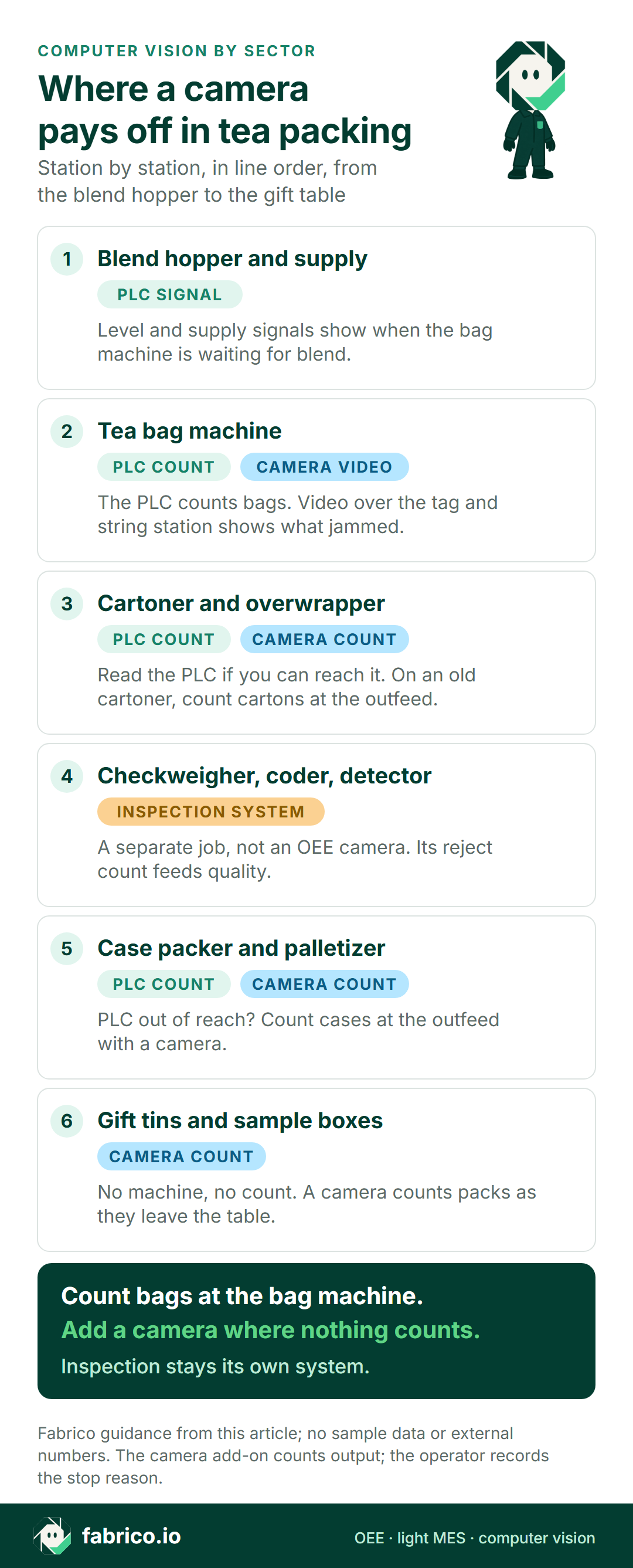
Camera, sensor or operator: station by station
A typical split for a tea packing site. Machines differ, so check each one.
| Station | Count and stops from | What a camera adds |
|---|---|---|
| Blend silos and hopper | Level and supply signals | Little. Use the signal. |
| Tea bag machine (string and tag, pyramid or envelope) | Bag machine PLC | Video of tag, string and reel stops |
| Cartoner | Cartoner PLC, if you can reach it | Carton count at the outfeed if you cannot, and which machine stopped first |
| Overwrapper | Overwrapper PLC | Video of film stops that block the cartoner |
| Checkweigher, metal detector, code check | Its own reject count | Nothing. Feed rejects to quality. |
| Case packer and palletizer | PLC, if you can reach it | Case count at the outfeed if you cannot |
| Gift tins and sample boxes | Nothing at a hand table | A count of packs where nothing counts |
| Stop reasons, all lines | The operator, on a tablet or phone | Video to settle a disputed reason |
In the example line above, that comes to three cameras, not one per machine: the old cartoner, the gift-pack table and the tag station.
Book a demo and bring your station list and one week of stop sheets; we will go through it station by station.
Worked example: the rejects a bag machine count hides
Count good output at the bag machine, and whatever the cartoner rejects never reaches the report. Here is one shift with example numbers that describe no real plant.
A pyramid bag machine with an ideal rate of 120 bags a minute for this SKU feeds an old cartoner that packs 15 bags a carton. Nobody can reach the cartoner's PLC, so a camera counts cartons at its outfeed. Planned production time is 450 minutes.
Stops over the 2-minute cutoff took 72 minutes, most of it one blend change, so availability is 378 of 450, or 84.0%. At 120 a minute, 378 minutes could make 45,360 bags. The bag machine counted 39,000, so performance is 86.0%.
The camera counted 2,520 cartons, or 37,800 bags. The other 1,200 bags were rejected at the cartoner, for torn mesh and wrong counts, so quality is 96.9%. OEE is 84.0% x 86.0% x 96.9% = 70.0%, the same as 37,800 good bags of 54,000 possible.
Count at the bag machine instead and quality reads 100%, OEE 72.2%. The 1,200 bags, 80 cartons a shift, drop out of the numbers, and so does the question of why the cartoner rejects them.
Eight checks for any tea packing camera or OEE vendor
Put the same eight questions to every vendor, Fabrico included, and use one real tea shift from last week as the test.
| Ask | How to test the answer |
|---|---|
| What exactly does the camera count? | Bags, cartons or cases? Ask how cartons of 15, 20 or 80 convert to bags for each SKU, and run it beside a hand count. |
| Can you tell bag machine stops from cartoner blocks? | Ask to see blocked and starved time on the shift timeline, apart from the bag machine's own stops. |
| Do 20-second stops stay in the data? | Ask what cutoff the system uses, and where the stops under it land. |
| What does dust do to the count? | Ask for the lens cleaning routine, and test the count on your finest blend. |
| Does the ideal rate change with the bag type? | String and tag, envelope and pyramid bags run at different rates. Ask to see each SKU's ideal. |
| How do inspection rejects get in? | Ask whether checkweigher and code reader rejects reach quality, so no carton is counted twice. |
| Where does the video live? | Ask who in the plant can open tag station video, from where, and for how long. |
| How does a gift-pack table get an OEE? | Ask to see a hand table on the same report as a machine line. |
Prove it on one tea line before the rest of the site. Our guide to a computer vision OEE pilot sets one up, and how accurate a camera count is shows how to test the count.
Cameras, privacy and the works council
At a gift-pack table, a camera aimed at the table will have hands in view. At the bag machine and the cartoner, operators walk through the frame. Tell the crew what the camera is for before it goes up, and in many European countries, bring in the works council first.
Point each camera at the product: the tag station, the cartoner outfeed, the packing surface. Keep reports at line and shift level, never per person. And ask every vendor, Fabrico too, which privacy masking works today and which is still on the roadmap.
Fabrico's camera add-on counts product, not people. Our checklist for production line cameras without surveillance covers the rest.
Where Fabrico fits
Fabrico is a cloud OEE and light MES platform. On a tea packing line, today, that means:
- Stops and counts: taken from the bag machine, cartoner or case packer PLC, a sensor or a counter.
- Stop reasons: picked by the operator at the line, on a tablet or phone, so tag, string and reel stops each get a code.
- OEE and losses: by line and shift, with losses in money, on web, iOS and Android.
- Camera add-on, on request: AI cameras count cartons, cases and gift packs where no machine signal can, and you can open the video behind any moment on the shift timeline. In the standard setup, that video is streamed when someone opens it and is not stored in Fabrico.
- Your data: out through a REST API, webhooks, or Excel and CSV export.
Roadmap, not live today: the camera detecting stops itself, jam zones drawn on the video, and the camera suggesting a stop reason.
Not Fabrico's job: inspection, dosing and bag weight control. Those stay with your inspection systems and the bag machine, and their rejects reach Fabrico's quality figure through the line's reject signal or counter. Production planning is on our roadmap, with no release date. Today Fabrico does not build or schedule your plan: it shows what the lines can do.
Product detail is on Fabrico's computer vision add-on for OEE. For food and FMCG plants in general, see computer vision for food manufacturing and computer vision for FMCG manufacturing. Comparing platforms more broadly? Start with our guide to OEE software, and hold us to the eight checks above.
Bring one shift's stop sheet from a tea bag line to a demo. We will show which of its numbers Fabrico can fill, and which it cannot.
What people ask next
Which tea packing station should get the first camera?
The station with the weakest count. That is usually the gift-pack table, an old cartoner, or a case packer whose PLC nobody can reach. A bag machine whose bag count you trust can wait.
Can a camera check tea bag weight or missing tags?
Not an OEE camera. Bag weight belongs to dosing checks and checkweighers, and tags, strings, seals and carton codes to the bag machine's own checks or a vision system. Fabrico does not sell inspection, but those reject counts can feed the quality part of OEE.
Does computer vision work in a dusty tea hall?
It can. Keep the camera away from the hopper and the dosing unit, use a housing your hygiene team accepts, and clean the lens on a schedule. Then test it: run the count on your finest blend and compare it with a hand count.
Should a tea line count bags or cartons?
Both. Count bags at the bag machine for OEE, because it sets the pace, and count cartons or cases where the money is. Convert per SKU, because a carton of 80 is not a carton of 20. See OEE for tea packing lines.
How many cameras does a tea packing line need?
One over each station with no usable signal, or where you want to see what stops it. With a readable bag machine, that often means the cartoner or case packer outfeed, the tag station and the gift-pack table. The number is agreed after a review of your stations.
What does computer vision on a tea packing line cost?
Each plant gets a quote. On a tea line it depends on how many outfeeds and tables need a camera, dust-tight housings near the hopper, the network out to the packing hall, and crew training. Send every vendor the same station list, so the quotes line up.
Want to see it on a tea line like yours? Book a demo and bring one shift from a tea bag line.
Related articles













Real Fabrico tiles, sample data.