


 Login
 Blog

Computer Vision for Packaging Converters: Where Cameras Pay Off

In short: computer vision for packaging converters is most useful where your machines can't give you a count you trust, or where you need to see what happened in a stop: hand packing at the folder gluer or pouch maker, the bundle and pallet end, and long make-readies. Print, glue and code checks are a separate job for inspection systems.
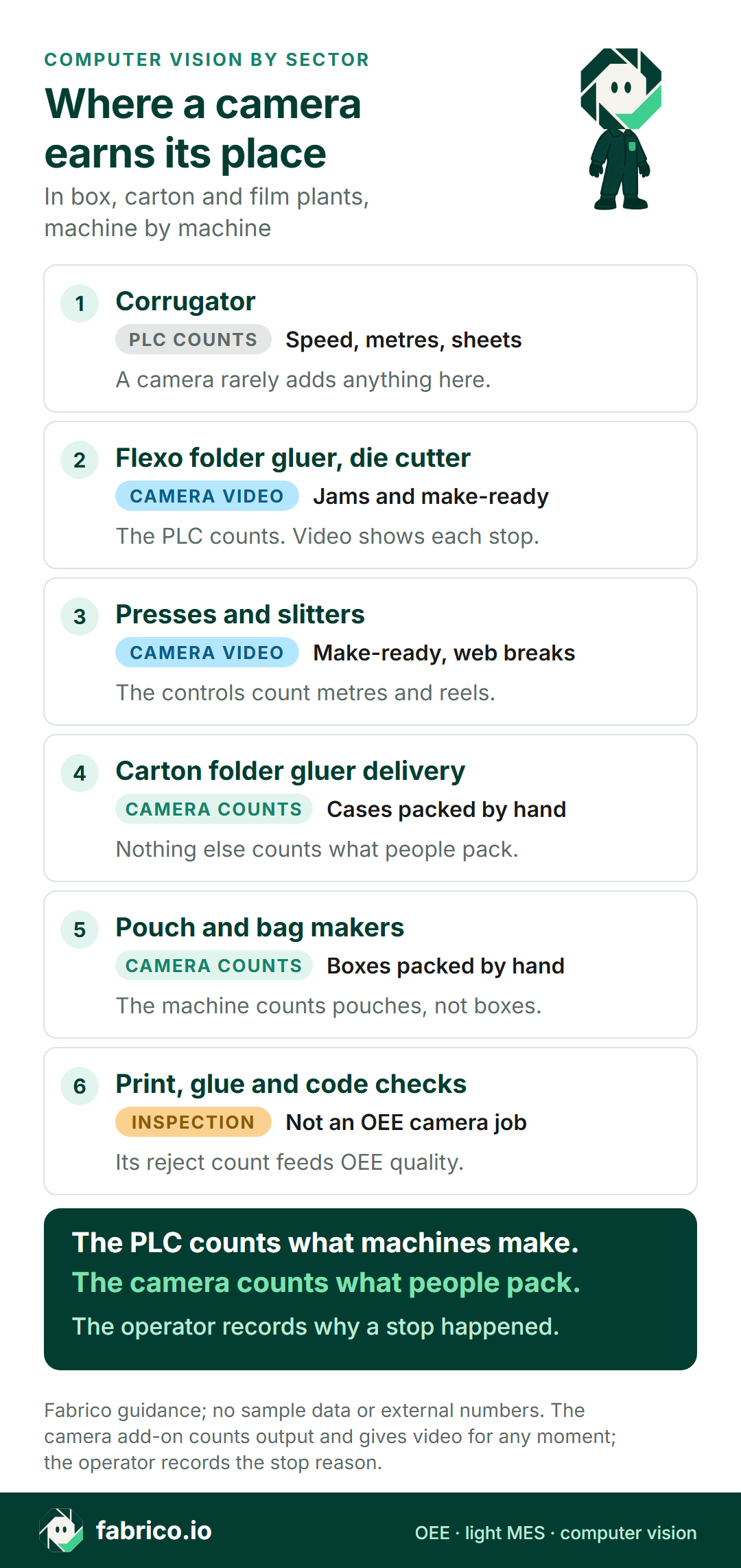
- Corrugators, flexo folder gluers, die cutters and presses usually count already, through their PLCs. A camera there adds video, not counts.
- Where people pack, stack or bundle by hand, a camera may be the only automatic count you can get.
- With short runs, make-ready is often the biggest loss. The machine signal times it, and video shows the steps.
- Fabrico measures OEE from machine signals plus operator stop reasons. AI cameras are an add-on that count output, with video for any moment on the shift timeline.
A converter makes the box, the carton or the film that an FMCG brand fills. The brand's filler may run one SKU for a week. Your folder gluer may change jobs four times in a shift.
So your losses sit in different places: in make-ready, at the feeder, and at the delivery end, where people pack and stack by hand.
If you are still comparing OEE software in general, start with our OEE software guide. For the wider map, from ERP to MES, see packaging manufacturing software.
We sell Fabrico, so test our claims like any vendor's.
What computer vision does in a converting plant, and what it doesn't
Two kinds of camera system get sold under one name, and many converters need both.
Inspection vision checks each sheet, carton or web against a standard and rejects the bad ones. An OEE camera counts output and gives you video for the minute a machine stopped.
| Job | Inspection vision | OEE camera |
|---|---|---|
| Check print, glue and codes, eject bad cartons | Yes, its main job | No |
| Count cases packed by hand | Not its job | Yes |
| Show the minute the feeder stopped | No | Video for that minute |
The two meet at the reject count. If your print or glue inspection gives a reject signal or counter, OEE software can use it for the quality part of OEE: how many rejects, not why. For the full split, read code and label vision vs an OEE camera.
Where the losses hide in corrugated, carton and flexible packaging plants
Your losses follow your customers. FEFCO, the European federation of corrugated board makers, says more than 40% of corrugated packaging is used to package food products.
So when a food brand adds a promo pack, a new language or a seasonal print, you get a new job, often a short one.
Make-ready: the loss that grows with every short run
A make-ready runs from the last good sheet of one job to the first good sheet of the next, at speed. Plates, inks, anilox rolls, dies, folding settings and glue guns all change in that window.
In a July 2026 article for Converter, Induvation, writing about its own assessments in box factories, describes a line with an average make-ready of about 24 minutes and 3,029 start-ups a year. By our arithmetic (24 minutes x 3,029), that is about 1,200 hours of make-ready a year on one line.
Its target for that line is 13 minutes, a 45% cut, by bringing work forward and changing how the line is served. At a machine cost of €400 an hour, Induvation puts the potential benefit at about €222,000 a year on that one line.
Corrugated: the corrugator, then the converting hall
The corrugator is a continuous process, and its PLC knows speed, metres and sheets. Its losses are failed splices, speed loss and warped board, which our corrugated OEE software review covers.
The converting hall is different. Flexo folder gluers and rotary or flatbed die cutters take short stops at the feeder: a warped sheet, a double feed, a jam at the slotter.
After the counter-ejector come the strapper and the palletizer. When either one stops, the bundles back up and the folder gluer stops too. Video for that minute shows which machine started it. Our page on palletizer downtime on camera shows where that camera goes.
Folding cartons: printing, die cutting, folder gluing, hand packing
A carton plant often prints sheet-fed, die cuts on a flatbed with stripping and blanking, and then folds and glues. Each step has its own make-ready, so one new job can mean a make-ready on every machine.
At the end of many folder gluers, people pack cartons into shipper cases by hand. No machine counts what they pack, so the good count often comes from a tally sheet. That table often sets the speed too: if the packers fall behind, the operator slows the machine.
A camera over the packing table can count cases as they leave, so here it adds a count, not only video. Our guide to AI visual counting explains how. For OEE at a hand packing station, see manual packing station OEE with a camera.
Test the count on your hardest job: varnished or foil board and metallised film throw glare, cartons leave the delivery shingled, and bundles touch on the belt. Our guide to camera placement and lighting covers what to check.
Flexible packaging: presses, slitters and pouch makers
On the press, web breaks and make-ready take the time: sleeves, anilox rolls, inks and register. On the slitter rewinder, it is set changes and knife setting. The press and slitter controls already count metres and reels, so a camera there adds video, not counts.
Pouch and bag makers are the exception. The machine counts what it makes, but people often stack, count and box the pouches by hand. That is a counting job for a camera. For web breaks and press make-ready, see OEE software for printing and converting.
Plant map: where a camera goes in a folding carton plant
Here is a folding carton plant, machine by machine, with the system that owns each job.
Two places get a camera: the packing table, where nothing else counts, and the die cutter, where make-ready runs long.
Camera, sensor or operator: machine by machine
Use this as a first pass for each machine.
| Machine | Counts and stops from | Where a camera helps |
|---|---|---|
| Corrugator | PLC: speed, metres, sheets | Rarely. The PLC does this job |
| Flexo folder gluer | PLC and counter-ejector | Video for feed jams and short stops |
| Rotary or flatbed die cutter | PLC sheet counter | Video for make-ready and jams |
| Sheet-fed, flexo or gravure press | Press control | Video for make-ready and web breaks |
| Slitter rewinder | PLC: metres and reels | Video for set changes |
| Carton folder gluer | PLC counter | Counts cases packed by hand |
| Pouch or bag maker | PLC counter | Counts boxes packed by hand |
| Strapper, palletizer | PLC run state | Video to check own stop or blocked |
| Print, glue, code checks | Inspection system | None. Its reject count feeds OEE |
In every row, the signal says when and for how long. The operator says why, with the video to check when it isn't obvious.
Want to map your own plant? Book a demo and bring a machine list, with what each machine can signal today.
Make-ready on die cutters and folder gluers: what video adds
Software that only times make-ready tells you it is long. To make it shorter, you need the steps.
A peer-reviewed study shows the method. Keyser, Severin and Geiger (2022) worked on a bottleneck rotary die cutter in a corrugated box plant. The crew agreed to be filmed during a typical setup. The video was then split into internal steps, which need the machine stopped, and external steps, which can be done while it runs.
Moving many internal steps outside the stop cut the average setup from 55 to 32 minutes, a 42% improvement.
OEE software helps in three ways after that.
- Time every make-ready from the signal. The operator codes the stop as a make-ready and picks the type, such as new plates only, or a new die and plates.
- Set a standard per type. Minutes over the standard become their own loss. The talk moves from "make-ready is slow" to which type runs over, on which machine and shift.
- Open the video for those minutes. With a camera on the machine, you can open the video for any moment on the shift timeline, including a long make-ready.
Count make-ready waste apart from running waste, as our guide to MES for packaging manufacturers explains. To turn one film into a step list, see changeover video analysis.
Worked example: what the camera at the packing table shows
This is sample data for one shift on a carton folder gluer. It is not a customer's line and not a product screen.
Planned production time is 450 minutes: an 8 hour shift minus a 30 minute break. The ideal rate for this carton is 250 a minute. Two people pack cartons into shipper cases of 250 at the delivery, and a camera over the packing table counts the cases.
The tally sheet for the shift says 252 cases, the same 63,000 cartons the machine counted. The camera counted 245. That gap is the first thing the camera changes: the good count is measured, not copied from the machine.
The machine stopped for 135 minutes, timed by the signal: 100 for four job changes, 20 for jams and glue faults, and 15 with the delivery full. That leaves 315 minutes of run time, so availability is 315 of 450, or 70.0%.
In 315 minutes at 250 a minute, the ideal is 78,750 cartons. The machine counted 63,000, so performance is 80.0%.
So the good count is 245 cases of 250, or 61,250 cartons, and quality is 61,250 of 63,000, or 97.2%. The gap of 1,750 is cartons the machine counted but nobody packed: ejected at the delivery, pulled out at the table or kept as samples.
OEE is 70.0% x 80.0% x 97.2% = 54.4%. On the tally sheet, quality would read 100% and OEE 56.0%. The OEE calculation guide has the method.
Slow running cost 63 minutes, or 15,750 cartons the machine could have made in its run time. In this example, the video at the packing table shows what happened: the packers were behind, so the operator held the speed down.
Add the 15 minutes with the delivery full, and the packing table cost 78 minutes, almost four times the jams. That is a business question with a number: add a packer on long runs, look at an automatic packer, or accept the pace.
On job changes, this shift had three same-size job changes, new artwork only, at 20 minutes and one size change at 40. Against standards of 15 and 35 minutes, that is 20 minutes over standard, and the first make-ready loss to chase.
For the same maths on a folder gluer without a camera, see the example in our packaging manufacturing software guide.
Questions to ask any vendor of computer vision for packaging converters
Run these with every vendor, us included. Bring a real shift from one of your machines.
| Ask | How to test the answer |
|---|---|
| Can it count our cases, bundles and stacks? | Film one run, count by hand, and compare. Ask how it handles different case sizes and stacks that touch. |
| How does it handle make-ready? | Ask to see one make-ready timed from the signal, coded by type and compared with a standard. |
| How does it handle hundreds of jobs a month? | Ask how ideal rates are set per job or carton size, and who keeps them current. |
| Where do inspection rejects go? | Ask how the reject signal from print or glue inspection reaches the quality part of OEE. |
| How does it tell own stops from blocked time? | Take one real strapper stop. Ask what marks the folder gluer as blocked: a signal, the operator, or both. |
| Is video stored, and who can see it? | Ask where it lives, for how long, and who can open it. |
| What does a pilot look like? | One machine, a fixed period, and a hand count to compare. Agree it before you sign. |
For a pilot plan you can reuse, read how to run a computer vision OEE pilot.
Privacy and the works council
A camera at a packing table will see hands, and often more. In many European plants, the works council or employee representatives will want to agree before anything goes up.
The die cutter study above is a good model: the crew agreed to be filmed, and the film was used to improve the setup.
Three things make the conversation easier:
- Aim at the product. Frame the cases, the delivery belt or the bundles, not faces.
- Say what happens to video. In Fabrico's standard setup, video is streamed on request and not stored in Fabrico.
- Say what it is for. Counting output and explaining stops, not timing people.
Roadmap: more automatic masking of people in the frame. Ask us what exists today.
How Fabrico does it
Fabrico is a cloud OEE and light MES platform. Here is what it does in a converting plant today, and what it doesn't.
- Stops and counts: from the machine signal, whether a PLC, a sensor or a counter. The operator adds the stop reason at the machine, on a tablet or phone.
- OEE and losses: OEE, downtime and losses by line and shift, with losses shown in money. On the web, iOS and Android.
- Computer vision add-on: AI cameras count output, including at manual steps like a packing table. You can open the camera video for any moment on the shift timeline. In the standard setup, video is streamed on request, not stored in Fabrico. Ask us in the demo how long after a shift you can open it, and where it sits until then.
- Your data: it leaves through the REST API, webhooks, or an Excel or CSV export.
- Roadmap: cameras that detect stops on their own, mark jam zones and suggest a likely reason for the operator to confirm. None of this is live today.
- Not Fabrico: print, glue and code inspection. Keep your inspection system and feed its reject count into OEE. Estimating, quoting and job costing stay with your packaging ERP or MIS. For planning and scheduling, ask us in the demo.
Put the seven questions above to us as well, with one of your own machines as the test case.
What people ask next
Can a camera count boxes at full folder gluer speed?
On a flexo folder gluer or a die cutter, the machine already counts at full speed, and that is the count to use. A camera is more useful where people pack, stack or bundle by hand.
If a vendor proposes a camera count at full speed, ask for accuracy data at your speed.
Does an OEE camera check print, glue or codes?
No. That is inspection, and it needs a dedicated inspection system. Its reject signal or counter can feed the quality part of OEE, so the two systems work side by side.
Can the camera tell us why the die cutter stopped?
Today the signal times the stop and the operator adds the reason, with the video for that minute to check. Roadmap: a camera suggesting a likely stop reason for the operator to confirm. It is not live today.
Is camera video stored?
In Fabrico's standard setup, video is streamed on request and not stored in Fabrico. Ask every vendor the same question, and get the answer in writing for your works council.
Where should the first camera go in a converting plant?
Usually at a station nothing counts today, like a hand packing table at a carton folder gluer or a pouch maker. The other good start is a machine where make-ready or blocked time runs long.
What drives the cost of computer vision in a converting plant?
The quote depends on the number of machines and cameras, mounting, network and training. Give every vendor the same machine and station list, so you compare like with like.
Want to see it on a machine like yours? Book a demo.
Related articles












Real Fabrico tiles, sample data.