


 Login
 Blog
GFOS MES Alternatives: Modular German MES or OEE First

In short: the GFOS MES alternative that fits depends on how much of the MES you need in the first phase. For a modular MES that covers machine and production data, planning, quality, traceability and energy, compare GFOS.Smart Manufacturing with MPDV HYDRA X and Cronetwork from Industrie Informatik. If the first need is machine downtime and OEE, cloud tools such as SYMESTIC and Fabrico start there.
- GFOS describes GFOS.Smart Manufacturing as modular manufacturing execution software that covers VDI guideline 5600.
- This page covers the GFOS MES product, not its workforce management software.
- Every vendor fact links to the vendor's own page, read on 13.11.2026.
Take a German plastics and metal parts maker with 40 machines over two halls: injection moulding presses with modern controllers, older stamping presses and a hand assembly area. The plant already runs GFOS software elsewhere, so the GFOS MES is a natural first call. The production manager's brief is shorter than an MES specification, though: show the real downtime per machine and shift, and an OEE figure the works council and the board both trust.
Below is what GFOS's pages say about its MES, then four alternatives grouped by the size of the first step. We make Fabrico, one of the four, so check our claims as closely as everyone else's.
What GFOS.Smart Manufacturing covers (as of 13.11.2026)
GFOS is a German software company that says it has been on the market for over 35 years, with solutions in 18 languages (GFOS home page). Its MES is sold as GFOS.Smart Manufacturing. The GFOS.Smart Manufacturing product page says:
- Scope. Modular manufacturing execution software that digitizes the manufacturing processes in a company and covers the requirements of VDI guideline 5600.
- Modules. Production data acquisition, process data, machine data acquisition, energy data, shopfloor management, maintenance, quality management, key figures, an MES dashboard, material management and manufacturing time tracking.
- Planning. Detailed planning to schedule employees, materials or machines for specific orders.
- Traceability. Product traceability that meets regulatory requirements in the field, per the page.
- Connections and hosting. Scalable connections to ERP and other systems and to machinery and equipment, and the ISO 27001-certified GFOS knownCloud.
The GFOS machine data acquisition page adds that the software derives logical machine statuses, that the control system provides data via the OPC server, and that digital system and sensor signals such as cycles, counters or faults can be received. Downtimes and reasons for faults can be analysed from that data, which forms the basis for KPIs such as the OEE calculation. The GFOS key figures page says its KPI calculation is based on VDMA standard sheet 66412 and ISO 22400-2.
Worth raising with GFOS: which modules a first phase needs, and how the older presses without OPC would send their signals.
Standards worth naming in the tender
GFOS cites VDI 5600 and ISO 22400-2, which gives every vendor a shared yardstick. Since GFOS names ISO 22400-2 for manufacturing KPIs, ask each vendor on this page to show its OEE calculation against that same text. For the layer an MES sits in, the ISA-95 enterprise-control model places MES at Level 3, between machine control and the ERP; its international edition is IEC 62264-1 at the IEC webstore.
Whole MES, or machine time first?
A modular MES lets a plant choose its first modules. The real question is whether the first phase must already run orders, materials and quality on the floor, or whether it should first measure machine time and losses and leave the rest in the ERP. Our guide to light MES vs full MES covers that choice in depth.
GFOS next to four alternatives
Each row restates the vendor's page as read on 13.11.2026; links are in the sections below. GFOS comes first as the subject and Fabrico second as the author of this page; the other rows follow no order.
| Tool | Built around, per its site | Machine data, per its site | Question to ask |
|---|---|---|---|
| GFOS.Smart Manufacturing (reference) | Modular MES to VDI 5600 | Statuses, cycles, counters, faults via OPC or signals | Which modules in phase one? |
| Fabrico | Light MES and OEE | Stops and counts from the PLC or an IoT device | How is hand assembly counted? |
| MPDV HYDRA X | Modular MES, discrete and process | Operational and machine data acquisition | Which apps make up a first phase? |
| Cronetwork | Modular real-time MES | OPC, fieldbus, SCADA, SQL | How does APS link to the ERP? |
| SYMESTIC | Cloud-native platform for mid-sized plants | OPC UA or an IoT box for signals | Which modules sit next to OEE? |
For the machine-time side, take one press's downtime notes from last month to a Fabrico demo.
Fabrico: downtime and OEE before the full MES
We make Fabrico, a cloud light MES and OEE platform. For the parts maker above, it takes on machine time in both halls and leaves orders, materials and routings in the ERP. This is how, per our MES and OEE overview:
- Injection moulding presses. Modern press controllers already hold cycles, output and stoppages; Fabrico reads them from the PLC (machine connectivity) and logs a stoppage with its start and length. Short interruptions at the gripper or sprue picker, which nobody writes on a shift sheet, show up in the signal and are reported apart from long stops.
- Older stamping presses. Where the press control cannot be read, a Fabrico IoT device with external sensors collects the production signal, and the press control stays as it is.
- Hand assembly area. Benches without a machine signal can get the camera add-on, which counts finished parts. In the standard setup the footage is streamed when a supervisor opens a moment of the shift and is not stored in Fabrico (how the camera add-on works).
- Reasons from the press operators. The setter or operator chooses the reason from the plant's own list on a tablet or phone, and when a stoppage needs maintenance, a technician opens a work order from it on the same machine record.
- One OEE rule for both halls. Availability, performance and quality are shown per line and shift, and the multi-plant view compares sites. German is one of the five interface languages, next to English, French, Polish and Bulgarian.
- Handing figures to the ERP. Excel or CSV export, webhooks and the REST API carry results out, and a link to SAP or another ERP can be scoped per customer. EU customers are hosted on AWS in Frankfurt.
Not in Fabrico: BOMs, routings, genealogy and job dispatching stay in the ERP or a full MES, and production planning and scheduling are still on Fabrico's roadmap. If phase one must already run detailed planning, material management and traceability, a modular MES such as GFOS.Smart Manufacturing covers that, and Fabrico can sit beside it.
Sample: one 8 hour shift on an injection moulding press
The press, the mould and every number here are invented for illustration, not taken from a customer or a product screen. The shift has 460 planned minutes after a 20 minute break. The mould's ideal cycle is 36 seconds a shot, so 0.6 minutes.
Stops took 58 minutes: a 35 minute mould change, a 14 minute dryer alarm and 10 short stops at the gripper that added up to 9 minutes. Run time is 402 minutes, so availability is 402 over 460, 87.4%. At 0.6 minutes a shot, 402 minutes allow 670 shots. The press made 630, so performance is 630 over 670, 94.0%, and the 40 missing shots are 24 minutes of slow cycles.
Quality control rejected 21 short shots, leaving 609 good: quality is 96.7%. OEE is 87.4% x 94.0% x 96.7% = 79.4%, the same as 609 good shots x 0.6 minutes over 460 minutes. As a check, 58 + 24 + 12.6 = 94.6 lost minutes, and 460 minus 94.6 is 365.4.
The mould change is the largest loss, but slow cycles come second and never appear as a stop. The 10 gripper stops are the kind a shift report rounds away. The formula is in OEE calculation.
MPDV HYDRA X: a modular MES across production areas
MPDV's HYDRA X product page calls HYDRA X the modular Manufacturing Execution System for all production areas. As of 13.11.2026, it says:
- It runs from operational and machine data acquisition to quality and material management and maintenance.
- It serves discrete manufacturing and has also been at home in the process industry for some time.
- Its integration platform is the basis for interoperability and openness.
Next to GFOS: both describe a modular German MES that grows from machine and production data. MPDV's page stresses its integration platform and process industry use. See MPDV HYDRA alternatives.
Cronetwork: a modular real-time MES with detailed scheduling
Industrie Informatik's Cronetwork home page leads with connected manufacturing and a real-time MES. As of 13.11.2026, its pages say:
- The Cronetwork MES overview says the modules can be implemented step by step.
- The machine and process data page lists collection via OPC, fieldbus, SCADA and SQL, and says piece counts, scrap quantities and disruption reasons are recorded automatically.
- The detailed scheduling APS page says it accepts production orders and planned orders from the ERP system.
Next to GFOS: both are modular MES suites from the German-speaking market with machine data and planning. Cronetwork's pages put detailed scheduling and an optimizer up front. See Cronetwork alternatives.
SYMESTIC: a cloud platform that starts with OEE
SYMESTIC calls itself the cloud-native manufacturing platform for mid-sized manufacturers. Its OEE software page says, as of 13.11.2026:
- It reads controller data via OPC UA, with an IoT box for digital signals on older machines.
- Stops are detected automatically and explained at the workstation using the plant's downtime reason catalog.
- It runs on Microsoft Azure with data stored in the EU.
Next to GFOS: both name OEE and machine data. SYMESTIC's OEE page says a plant starts with OEE and expands without a new project, with OEE as part of a cloud MES platform. See SYMESTIC alternatives.
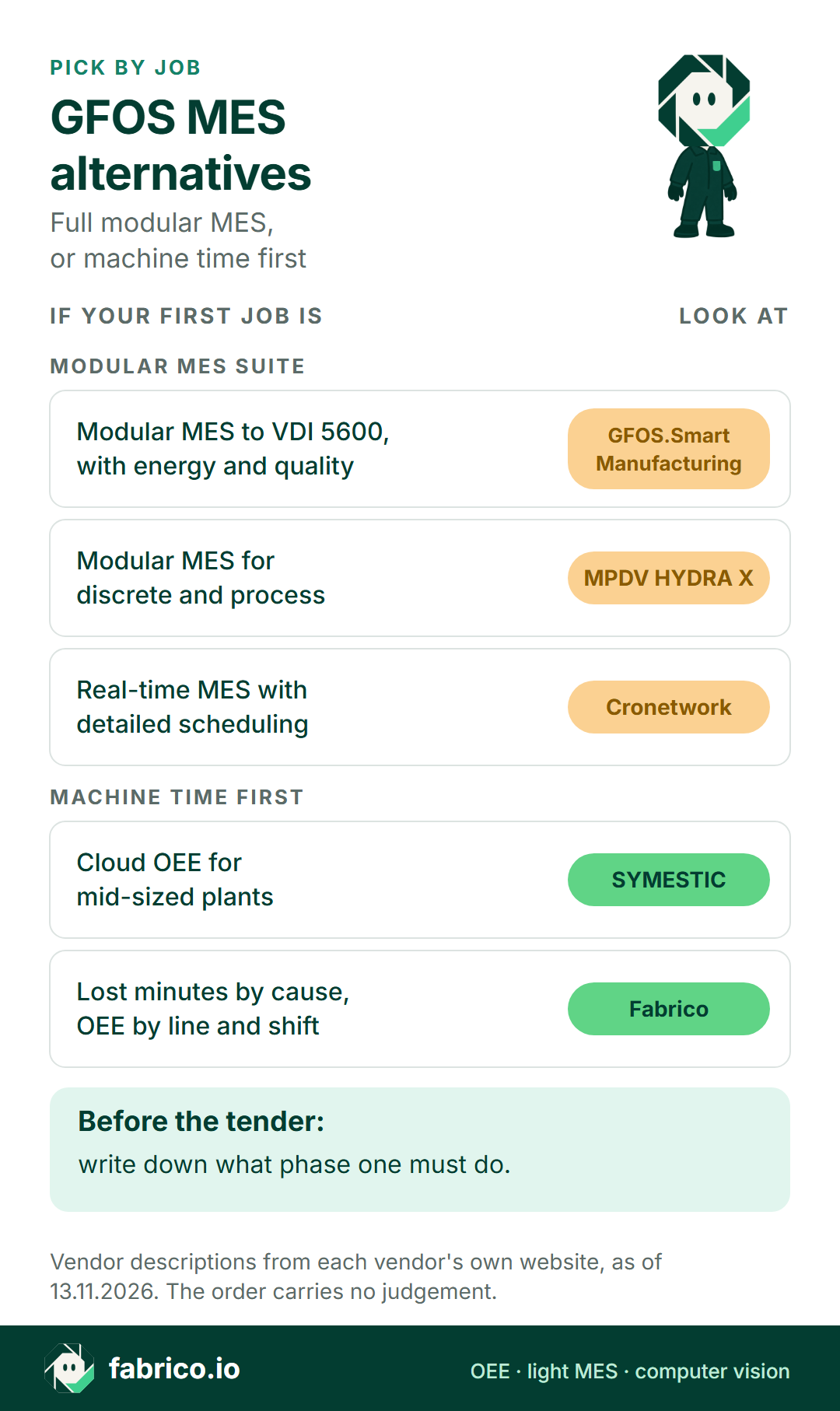
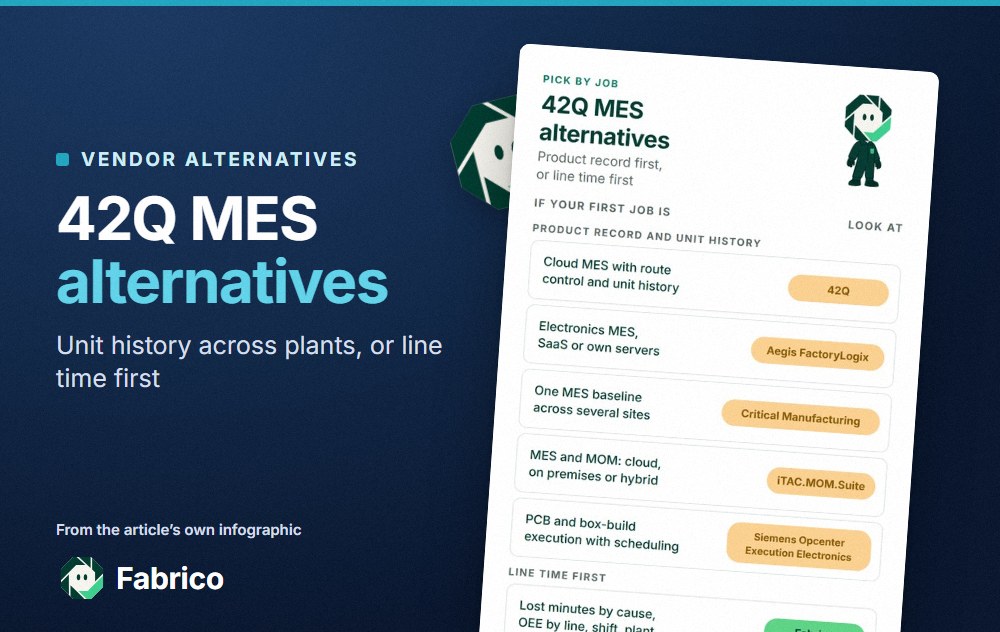
Five options on one card
The card sorts the five by the size of the first step, from each vendor's own pages.
Text version of this infographic
- Pick by job: GFOS MES alternatives. Full modular MES, or machine time first.
- Modular MES suite. Modular MES to VDI 5600, with energy and quality: GFOS.Smart Manufacturing.
- Modular MES for discrete and process: MPDV HYDRA X.
- Real-time MES with detailed scheduling: Cronetwork.
- Machine time first. Cloud OEE for mid-sized plants: SYMESTIC.
- Lost minutes by cause and OEE by line and shift: Fabrico.
- Before the tender: write down what phase one must do.
- Vendor descriptions from each vendor's own website, as of 13.11.2026. The order carries no judgement.
Questions to send GFOS and each alternative
Choose one modern press, one older press and the hand assembly area, and send every vendor, Fabrico included, the same list.
- How does each machine report? OPC, PLC signal, sensor device, camera or operator entry.
- Which OEE rule applies? Ask for the calculation against ISO 22400-2 in writing, short stops and slow cycles included.
- What does phase one include, and which records stay in the ERP?
- Who runs it after go-live? Who adds a machine, edits the reason list and checks the OEE rule.
What people ask next
What is GFOS.Smart Manufacturing?
It is the MES from GFOS, a German software company. Its product page describes modular manufacturing execution software that covers VDI guideline 5600, with modules for production, process, machine and energy data, quality, maintenance, key figures, material management and detailed planning.
Does GFOS calculate OEE?
Its machine data page says the data forms the basis for KPIs such as the OEE calculation, and its key figures page bases KPI calculation on VDMA standard sheet 66412 and ISO 22400-2.
Is this page about GFOS time and attendance?
No. GFOS also sells workforce management software, but this page compares its MES, GFOS.Smart Manufacturing, with other MES and OEE tools.
How is Fabrico different from GFOS.Smart Manufacturing?
GFOS, per its pages, offers a modular MES with planning, material management, quality and traceability. Fabrico is a light MES for machine time: press signals give stops and counts, operators give the reasons, and OEE comes out by line and shift, while orders and routings stay in the ERP.
Can Fabrico run next to GFOS?
Yes. Give orders, materials and quality records to the GFOS MES and press stoppages, reasons and shift minutes to Fabrico, which shares its results through the REST API and webhooks. Settle early which system the works council and the board read the OEE figure from.
Book a demo to see a moulding press shift split into mould changes, short stops and slow cycles.
Related articles
Latest from our blog


Real Fabrico tiles, sample data.