


 Login
 Blog
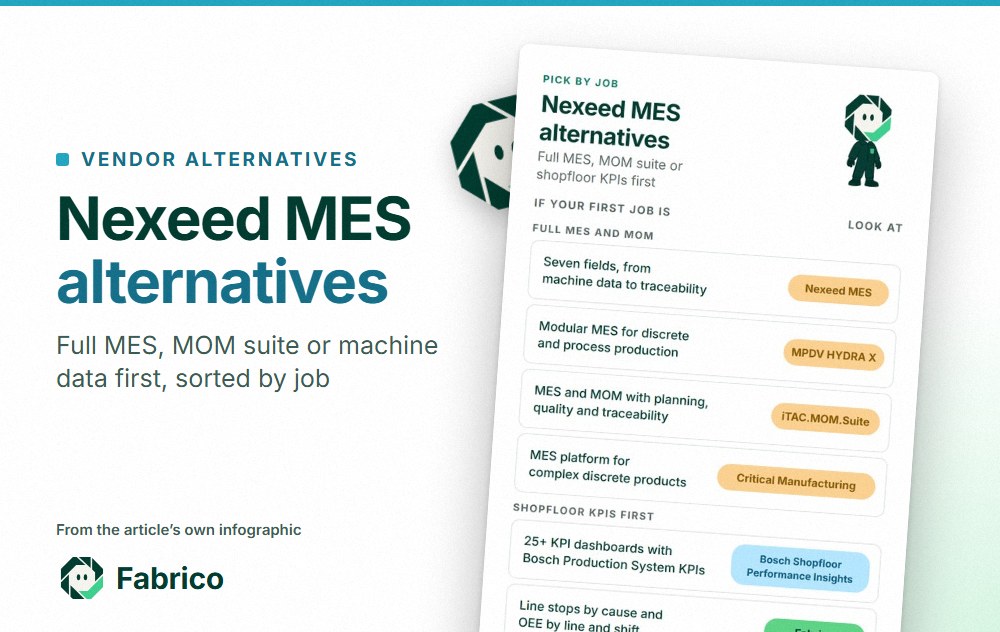
Nexeed MES Alternatives: Modular MES, MOM Suites or a Light MES

In short: the right Nexeed MES alternative depends on which module you need first. If you want Bosch's full scope, from machine data and materials to quality gates and component traceability, compare it with other modular MES and MOM suites such as MPDV HYDRA X, iTAC.MOM.Suite and Critical Manufacturing. If the first question is why lines stop and how much shift time is lost, a light MES with OEE, such as Fabrico, or Bosch's own Shopfloor Performance Insights starts there.
- Nexeed MES is "the MES from Bosch", with seven fields of application, sold as a modular system from a starter kit to a fully integrated MES.
- Every vendor fact links to the vendor's own page, read on 13.11.2026. Nothing on this page is priced or ordered by merit.
An automotive supplier runs welding and assembly lines with PLCs, a row of older presses and a manual rework bench. Group IT has a Nexeed MES proposal on the table: machine data, materials, quality gates and traceability, rolled out module by module. The plant manager asks a narrower question first: why did line 3 lose two hours last week, and which three causes cost the most?
The two questions can lead to different purchases. Below: what Bosch sells as Nexeed MES today, and five alternatives grouped by the first job each one is built for. We make Fabrico, one of the five, so test our section as hard as the rest.
What Bosch sells as Nexeed MES today (as of 13.11.2026)
Bosch's industrial software pages have moved. On 13.11.2026, bosch-connected-industry.com forwarded to Manufacturing Co-Intelligence, where Bosch Connected Industry leads with agentic AI and a Smart Operations Toolkit. The Nexeed MES product page we could read is on the site of Bosch Global Software Technologies: its Nexeed Manufacturing Execution System page calls it "the MES from Bosch". What that page says, as of 13.11.2026:
- Position. Vertical integration from the sensor to the cloud, as the link between the machine control system and the ERP systems.
- Machine and operating data. Its PDA/MDA module processes technical and organizational downtimes, operating periods, malfunctions and their causes, maintenance measures and produced quantities.
- Equipment and escalation. Tool management, maintenance and inventory functions, plus multi-layered escalation when something deviates.
- Materials and planning. Material management coordinates goods from receipt to use, and real-time process control keeps defined process sequences in order.
- Quality and traceability. Defined quality gates and archiving tools for long-term storage of production data, the basis for component traceability.
- Modular. From a starter kit to a fully integrated MES, with each company choosing the level of detail; the page lists independence from products and machines, and global service and training.
The same page links to other Nexeed products, among them Nexeed Production Performance Manager, Nexeed Track and Trace and Nexeed Intralogistics Execution.
Worth raising with Bosch: which Bosch unit delivers and supports Nexeed MES in your country, and which module a first project would start with.
Nexeed's page places it between machine control and ERP. That is Level 3 in ISA's ISA-95 model for linking plant and business systems, whose international edition is IEC 62264-1 from the IEC, and every option here works at that level. For OEE we use the OEE definition in ISO 22400-2, so ask each vendor to calculate it that way.
When Nexeed MES belongs on the shortlist
- You want one MES across the value stream, from machine data to material flow, quality gates and traceability.
- Components must be traceable from archived production data, for customers or audits.
- You plan module by module, starting small and growing to a fully integrated MES.
One module first, or the whole MES?
Bosch's own wording, a starter kit up to a fully integrated MES, frames the real choice. Some plants need material flow and traceability running on the floor from day one. Others need machine data and downtime first, and the rest can wait or stay in the ERP. Our guide to light MES vs full MES covers that split in depth.
Nexeed MES next to five alternatives, in one table
Each row restates what the vendor's own page said on 13.11.2026; the links sit in the sections below. Nexeed is the reference row, Fabrico sits next as the page author, and the order after that means nothing. Where a row looks thin, that is our reading, so confirm it with the vendor.
| Tool | Built around, per its site | First data it names | Worth asking |
|---|---|---|---|
| Nexeed MES (for reference) | Modular MES, seven fields | Downtimes, malfunctions, quantities | Which module comes first? |
| Fabrico | Light MES around shift time | Stops and counts from the signal | How is the rework bench counted? |
| MPDV HYDRA X | Modular MES, discrete and process | Operational and machine data | Which apps run in a first phase? |
| iTAC.MOM.Suite | MES plus MOM functions | Material and machine status | Cloud, on premises or hybrid? |
| Critical Manufacturing | MES platform for complex discrete | Equipment, IoT, ERP and PLM data | How is master data shared by site? |
| Bosch Shopfloor Performance Insights | 25+ KPI dashboards | Machine and line productivity | Which KPIs follow the Bosch Production System? |
Curious what the machine data side looks like? Take last month's downtime log for one line to a Fabrico demo.
Fabrico: the downtime question, without the MES project
We make Fabrico, a cloud light MES and OEE platform. For the supplier above, it covers the machine data part of an MES and leaves materials, routings and genealogy where they already run. Per our MES and OEE overview, this is how it would meet that plant:
The welding and assembly lines are read from their PLCs: cycles, stops and output (machine connectivity). Stops on a connected machine carry their start time and duration, and short stops too brief to write down are detected from the signal and reported apart from long ones. The older presses get a Fabrico IoT device with external sensors, so no new PLC is needed. The rework bench has no machine signal; there, the camera add-on counts output, and in the standard setup video from the camera add-on is streamed on request for a chosen moment of the shift, not stored in Fabrico (how the camera add-on works).
Operators tag the cause on a tablet or phone from the plant's reason list. OEE is split into availability, performance and quality per line and shift, and the OEE calculator on our site prices the gap between current OEE and the target. When a stop needs a repair, a technician opens a work order from it on the same machine record. Results leave through the REST API, webhooks and Excel or CSV export, and a connection to SAP or another ERP can be scoped per customer. The interface runs in English, German, French, Polish and Bulgarian, and the multi-plant view compares sites on one screen. EU customers are hosted on AWS in Frankfurt.
Not in Fabrico: job dispatching, BOMs, routings and genealogy stay in your ERP or MES, and production planning and scheduling are not part of Fabrico yet. If component traceability is the requirement, a full MES such as Nexeed does that job; Fabrico can run beside it.
Sample: one 12 hour shift on a welding and assembly line
The numbers are invented to show the method; no customer site or product screen sits behind them. The shift has 660 planned minutes after two 30 minute breaks. The slowest station sets an ideal cycle of 45 seconds, 0.75 minutes a unit.
Stops took 72 minutes: a 28 minute electrode and tool change over standard, 24 minutes waiting for parts, and 20 minutes of fixture faults that came as 9 short stops. Run time is 588 minutes, so availability is 588 over 660, 89.1%. In 588 minutes the ideal is 784 units. The line made 721, so performance is 92.0%.
The end-of-line test rejected 14 units, leaving 707 good: quality is 98.1%. OEE is 89.1% x 92.0% x 98.1% = 80.3%, the same as 707 good units x 0.75 minutes over 660 minutes.
The MES keeps the 707 component records and quality gate results. Fabrico keeps the lost minutes by cause: slow running, 47.3 minutes, outweighs the longest single stop, and the 9 fixture faults were short enough for a shift report to round away. A one-line pilot on the line with the most short stops is a fair test, and the formula is in OEE calculation.
MPDV HYDRA X: a modular MES from the MDC side
MPDV's HYDRA X page describes a modular Manufacturing Execution System for all production areas, as of 13.11.2026:
- It connects operational and machine data acquisition, quality and material management, maintenance, human resources and energy management in one central system.
- Its scope reaches into support processes such as intralogistics and operator guidance in complex assembly.
- It is platform-based, so functions can be added, and it serves discrete manufacturing and the process industry.
Compared with Nexeed MES: both describe a modular MES that starts from machine and operating data and adds materials, quality and maintenance. MPDV's page also names human resources, energy and process industry use. See our MPDV HYDRA alternatives.
Fits plants that want a modular MES standard across discrete and process areas, grown function by function.
iTAC.MOM.Suite: MES and MOM in one suite
iTAC's iTAC.MOM.Suite page describes a Manufacturing Operations Management solution that combines core MES functions with real-time control, planning and analysis. As of 13.11.2026, it says:
- Features include production planning, detailed scheduling and order execution, quality control, advanced planning and real-time monitoring.
- The system captures data in real time and tracks material and machine status, with quality assurance tools and traceability.
- It integrates with existing ERP, PLM and automation systems, on an open, service-oriented architecture, and the page calls the platform cloud-capable, with hybrid operation among its deployment options.
Compared with Nexeed MES: both span machine data, materials, quality and traceability. iTAC's page puts planning, detailed scheduling and supply chain integration in the same suite. See our iTAC MES alternatives.
Fits plants that want MES and wider operations management, including detailed scheduling, in one suite.
Critical Manufacturing: an MES platform for complex discrete products
Critical Manufacturing calls itself the MES-powered Industrial Operations Platform, for discrete products with a focus on semiconductor, electronics, medical devices and industrial equipment. Its home page says, as of 13.11.2026:
- Equipment, IoT, ERP, PLM and enterprise systems share a unified data layer.
- AI agents built on governed manufacturing data answer questions, build dashboards and write shift handover summaries from natural language prompts.
- A Global Data Orchestrator defines core master data centrally and distributes it to the sites that need it.
Compared with Nexeed MES: both aim at one MES across the floor. Critical Manufacturing's page leads with complex discrete industries, multisite master data and AI agents. See our Critical Manufacturing alternatives.
Fits groups that build complex discrete products across several sites and want one MES standard with shared master data.
Bosch Shopfloor Performance Insights: KPIs before a full MES
Bosch has a lighter option of its own. On Manufacturing Co-Intelligence, the Shopfloor Performance Insights page is part of the Smart Operations Toolkit. As of 13.11.2026, it says:
- More than 25 pre-configured KPI dashboards and a complete overview of machine and line productivity.
- KPI calculations from the Bosch Production System, built in as best practice.
- Users create their own dashboards and analyse data without complex configuration.
Compared with Nexeed MES: both come from Bosch. Nexeed MES's page leads with the full MES scope; the Shopfloor Performance Insights page leads with KPI dashboards on machine and line productivity.
Fits plants that want Bosch Production System KPIs on screen first and may stay with Bosch for later steps.
Which Nexeed MES alternative fits your plant
- Machine data, materials, quality gates and traceability, module by module, from Bosch: Nexeed MES.
- A modular MES across discrete and process areas, with HR and energy: MPDV HYDRA X.
- MES plus planning and detailed scheduling in one suite: iTAC.MOM.Suite.
- Complex discrete products across sites with shared master data: Critical Manufacturing.
- Bosch Production System KPIs on dashboards first: Bosch Shopfloor Performance Insights.
- Line stops by cause, short stops included, and OEE by line and shift, with orders left in the ERP: Fabrico.
Many discrete plants run two layers: an MES or ERP that owns the product record and a layer that owns shift time. Our page on MES for automotive suppliers walks through that split. If your plant also runs food or consumer goods packaging, our page on computer vision for FMCG manufacturing covers those lines.
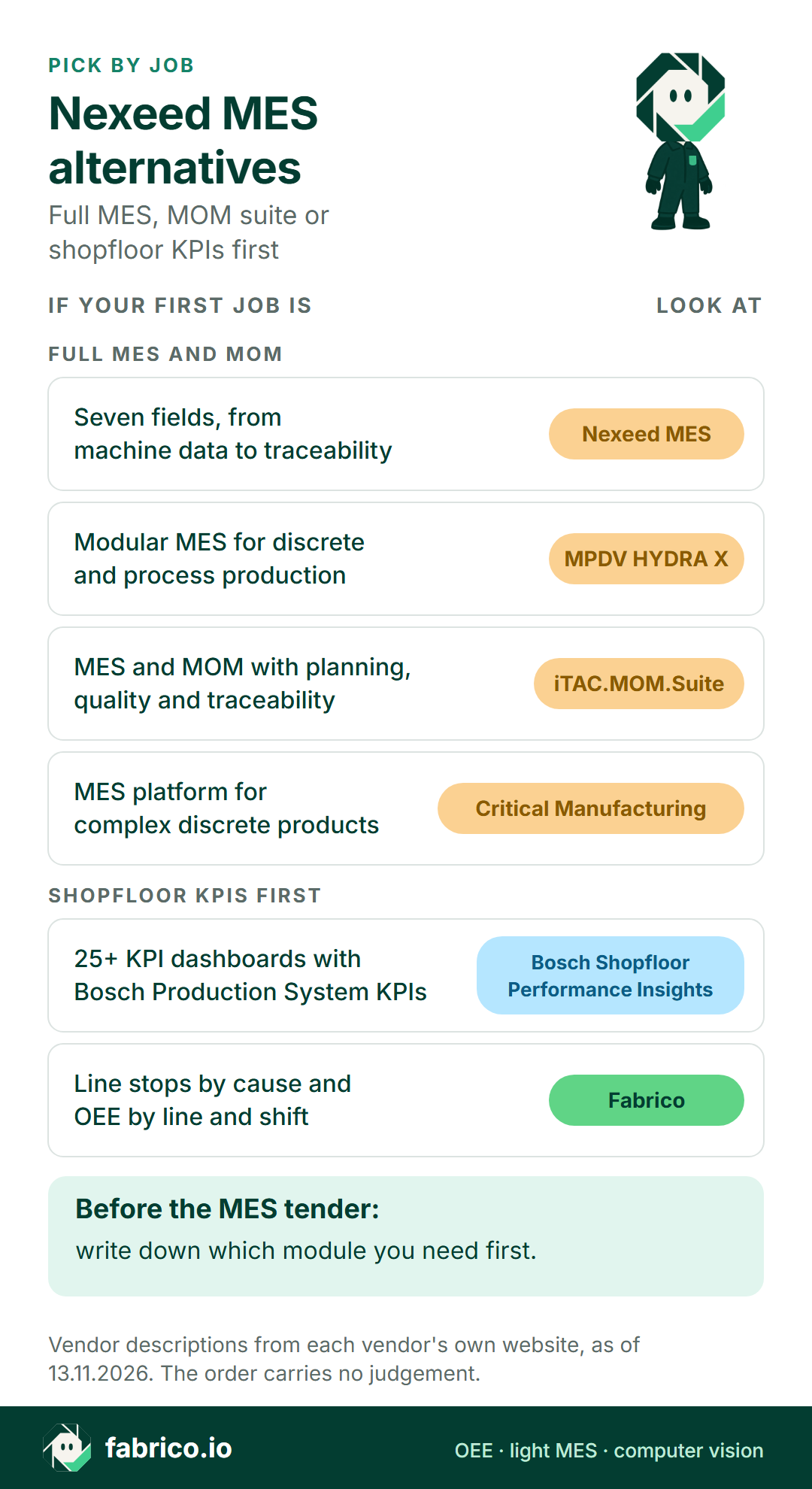
Text version of this infographic
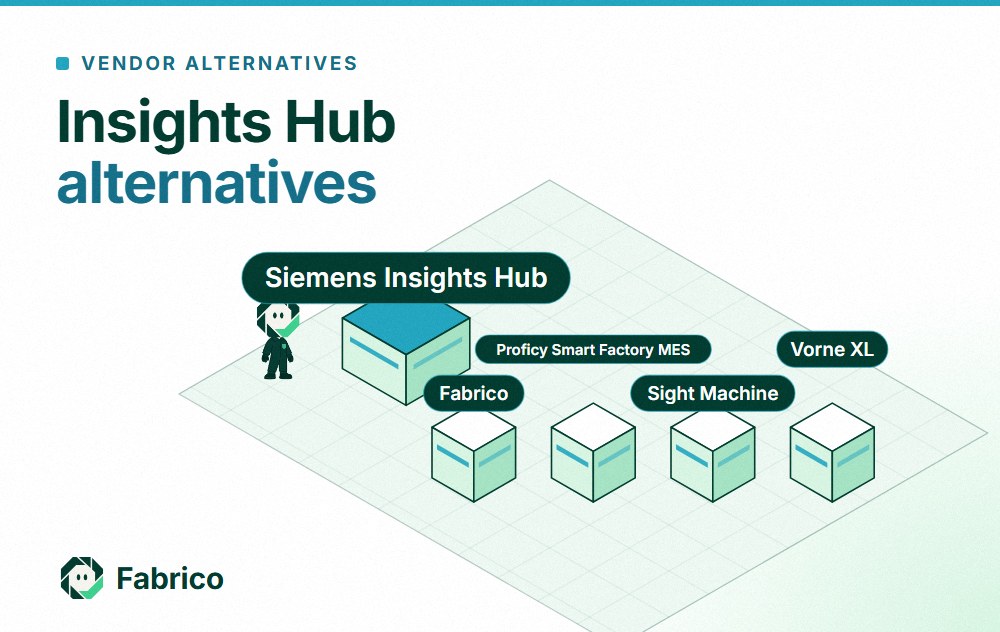
- Pick by job: Nexeed MES alternatives. Full MES, MOM suite or shopfloor KPIs first.
- Full MES and MOM. Seven fields, from machine data to traceability: Nexeed MES.
- Modular MES for discrete and process production: MPDV HYDRA X.
- MES and MOM with planning, quality and traceability: iTAC.MOM.Suite.
- MES platform for complex discrete products: Critical Manufacturing.
- Shopfloor KPIs first. 25+ KPI dashboards with Bosch Production System KPIs: Bosch Shopfloor Performance Insights.
- Line stops by cause and OEE by line and shift: Fabrico.
- Before the MES tender: write down which module you need first.
- Vendor descriptions from each vendor's own website, as of 13.11.2026. The order carries no judgement.
Questions to put to Bosch and every alternative
Use one representative line and give each vendor, Fabrico included, the same list.
- What is the first module? Machine data, materials, quality gates or traceability, and what it records without anyone typing.
- How does each machine report? PLC, sensor device, camera or operator entry, the older presses and the manual bench included.
- Where do short stops and slow running land in OEE? Ask for the counting rule in writing, not a screenshot.
- Which records stay in the ERP, and which data flows back.
- Who runs it after go-live? Ask who adds a machine, edits the reason list and checks the OEE rule, and how that person is trained.
What people ask next
Who sells Nexeed MES today?
Bosch. On 13.11.2026 the Nexeed MES product page we could read sits on the site of Bosch Global Software Technologies, which calls it the MES from Bosch. The old Bosch Connected Industry address now forwards to Manufacturing Co-Intelligence, which leads with agentic AI and a Smart Operations Toolkit. Ask Bosch which unit delivers and supports Nexeed MES in your region.
What does Nexeed MES cover?
Its product page lists seven fields of application: operating and machine data collection, operating equipment management, information management, material management, planning and process control, shopfloor integration, and quality management with traceability. It describes the system as modular, from a starter kit to a fully integrated MES.
Does Nexeed MES track downtime and OEE?
Its machine data module processes downtimes, operating periods, malfunctions and their causes, and produced quantities, and evaluates them. The same page links to Nexeed Production Performance Manager, so ask Bosch which product shows OEE by line and shift.
How is Fabrico different from Nexeed MES?
Nexeed MES, per its page, spans machine data, materials, planning, quality and traceability. Fabrico is a light MES: it takes stops and counts from the machine signal and causes from the operator, and shows OEE and losses by line and shift. Job dispatching, BOMs, routings and genealogy stay in your ERP.
Can Fabrico run next to Nexeed MES?
Yes, if each record has one owner. The MES keeps material flow, quality gates and traceability; Fabrico keeps stops, causes and shift time and sends results out through its REST API and webhooks. Agree early which system publishes the OEE figure of record.
Book a demo to see one welding line's shift split into long stops, short stops and slow running, or send us your questions.
Related articles


Real Fabrico tiles, sample data.