


 Login
 Blog
Nexus Integra Alternatives: IIoT Platforms or OEE Software

In short: a good Nexus Integra alternative depends on whether you are buying a data platform or an answer to why output falls short. To connect and unify plant data, compare it with other industrial data platforms such as Litmus Edge, Ignition and AVEVA PI System. To measure OEE and downtime by cause, look at an OEE application such as SYMESTIC or Fabrico, which can run beside a platform or without one.
- Nexus Integra is a Valencia-based Industrial IoT platform, part of Spain's Global Omnium group.
- Its pages describe three layers (connect, core, apps), SCADA-style views and room for MES applications that calculate OEE.
- Five alternatives below, split into data platforms and OEE tools. No ranking.
- Facts on each vendor come from that vendor's own site, read as of 13.11.2026 and linked where used.
A tile maker in eastern Spain runs presses, glazing lines and a kiln. The IT lead wants one place where every PLC tag, meter and database lands. The operations director is asking why the presses lost two hours on Tuesday and what that cost.
A data platform serves the first person well. The second needs stop reasons, ideal rates and planned time on top of the raw data. This page explains what Nexus Integra says it does, then sets out five alternatives grouped by that split. Fabrico published the page and appears among the five, so we rank none of them. For the bigger picture on execution systems, see the MES software overview.
What Nexus Integra is (as of 13.11.2026, per its own site)
The Nexus Integra about page calls the company a technology firm and a pioneer in implementing Industrial IoT, with more than 10 years of experience, and says it belongs to Global Omnium, one of Spain's largest corporate groups. Its homepage lists Smart Industry, Smart Building and Smart City, with headquarters at GoHub Valencia.
Its product page describes an open, standard platform for integrating industrial systems, in three layers:
- Nexus Connect takes in large volumes of data from many sources.
- Nexus Core holds that data once it is standardised and unified.
- Nexus Apps turns it into dashboards, alarms, reports and Smart SCADA views, and the page says no programming knowledge is needed.
The how it works page lists sensors, PLCs, SCADA and databases as sources, plus outside systems such as ERP, MES and CMMS, and offers a public REST API to Nexus Core. The industry page promises one operations centre to control, monitor and manage facilities, and names sectors from ceramics and agri-food to pharmaceuticals, chemicals and textiles.
On OEE, its OEE article says the platform allows MES applications for calculating and analysing OEE to be integrated, with the results fed to its own apps such as SCADA and reports.
A shared vocabulary helps when the tools differ this much: OEE here is the KPI defined in ISO 22400-2 (manufacturing operations KPIs), and MES means the operations level of the ISA-95 operations layer (internationally IEC 62264-1).
Data platform or OEE application: what each one owns
A data platform is plumbing plus views. It connects machines and systems, stores the values and lets a team build screens on top. An OEE application holds a model of production: planned time, ideal speed, what counts as a stop, and the reason someone gave for it. A platform can host that model, which is what Nexus Integra's OEE article describes, but someone still has to define and maintain it. See OEE vs MES for where OEE sits next to execution.
Nexus Integra and five alternatives compared
Our short reading of each vendor's website on 13.11.2026; the source links are in each section further down. Order is not rank. Fabrico comes first as the publisher.
| Tool | Built for, in its words | Data it names | Ask them |
|---|---|---|---|
| Nexus Integra (for reference) | Industrial system integration platform | Sensors, PLC, SCADA, ERP, MES | Which OEE app runs on it? |
| Fabrico | OEE, stop causes, losses in money | PLC, IoT device, camera add-on | How do manual stations report? |
| Litmus Edge | Edge layer between machines and enterprise | PLCs, SCADA, historians, MES | Which KPIs come built in? |
| Ignition | Server hub for plant floor integration | Plant floor systems, via modules | Which modules does OEE need? |
| AVEVA PI System | Operational data management suite | Vendor-neutral, many sources | How is context added to tags? |
| SYMESTIC | Cloud manufacturing platform with OEE | OPC UA, digital signals | How are reason lists set up? |
Curious how a raw stop log turns into OEE and losses in money? See it worked on a sample stop log in a demo.
Fabrico: the OEE model already built, beside a platform or without one
This page comes from Fabrico, so weigh this section with that in mind. Fabrico is cloud OEE software with light MES functions, on the application side of the split above. Go back to the tile maker. The IT lead may still want a platform for every tag; the operations director's question about Tuesday's two lost hours is the one Fabrico is built to answer, as the Fabrico MES and OEE overview sets out.
The presses report cycles, stops and output from their PLC. An older glazing machine with no usable PLC gets a Fabrico IoT device with external sensors, and at a manual sorting or packing step the camera add-on counts output. Protocols such as OPC UA, Modbus, PROFINET, MQTT and EtherNet/IP are listed on the machine connectivity page.
Take the press shift from the worked example further down. Fabrico logs the 38 minute die change with its start and duration, the operator tags it "die change" from the plant's own reason list on a tablet or phone, and the 22 minutes waiting for powder land under their own cause. Short halts are reported apart from long ones, and the 37 minutes of slow cycles count as performance loss. Live OEE by line and shift then shows those losses in money, so the director can see which part of the lost time cost most. If the press needs a repair, the technician opens a work order from that stop, on the same machine record.
Where a platform stays, the two sit side by side. Fabrico hands data on through its REST API and webhooks, any list exports to Excel or CSV, and an ERP link is scoped per customer. Historian storage across the plant and SCADA control remain the platform's work. A camera add-on that recognises stops and suggests the reason is on the Roadmap, not in the product today; the camera add-on opens video for a chosen moment as a stream on request, and Fabrico does not store it by default (computer vision add-on).
EU customers are hosted on AWS in Frankfurt. A single-line pilot is a common first step, and the OEE software buyer's guide covers the wider field.
Litmus Edge: a data layer at the edge
The Litmus Edge page places the product at the boundary between machines and enterprise systems. As of 13.11.2026 it says:
- It collects data over many protocols, from legacy and modern equipment.
- Analytics run at machine speed through configurable flows and no-code workflow design, and industrial KPIs are built in.
- It works with PLCs, SCADA platforms, historians, MES, cloud infrastructure and analytics tools, and publishes structured data to cloud platforms.
Compared with Nexus Integra: both collect and standardise plant data. Litmus frames itself around the edge, Nexus Integra around one operations centre with SCADA views. More in our Litmus Edge alternatives review.
Suits plants that want a standard edge layer feeding several cloud and analytics tools.
Ignition: a server hub for the plant floor
Inductive Automation calls Ignition server software that acts as the hub for everything on the plant floor. Its page, as of 13.11.2026, says:
- A full range of software modules lets teams build many kinds of industrial applications, mobile ones included.
- Deployment is server-centric and web based, and the software is cross-platform, from servers to embedded devices.
- It lists SCADA, IIoT and MES among its solution areas.
Compared with Nexus Integra: both give a plant one hub and SCADA-type screens. Ignition's page puts the weight on modules a team assembles; Nexus Integra's on configuring views without programming.
Suits plants that have controls engineers who want to build their own SCADA and MES screens on one server.
AVEVA PI System: operational data management
AVEVA describes the PI System as a suite of integrated operational data management software. As of 13.11.2026, the page says:
- It collects, stores, normalises, enriches and visualises real-time operations data.
- Vendor-neutral connectivity lets it handle operations data from almost any source.
- Data from several sites can be aggregated in the cloud through the CONNECT industrial intelligence platform.
Compared with Nexus Integra: both centre on unified operations data. AVEVA's page stresses time series storage and enrichment; Nexus Integra's stresses apps and SCADA views on top.
Suits plants that want a long-term record of process data across many sites.
SYMESTIC: OEE as a cloud application
On its homepage, SYMESTIC presents a cloud-native manufacturing platform aimed at mid-sized manufacturers. From its OEE software page, as of 13.11.2026:
- OEE is broken into availability, performance and quality, each shown on its own.
- Stop detection is automatic; operators give the cause at the workstation from a reason catalog.
- Machines connect through OPC UA or digital-signal hardware, with no PLC changes.
- The service runs on Microsoft Azure and keeps data in the EU.
Compared with Nexus Integra: SYMESTIC ships an OEE model ready to use. Nexus Integra offers a platform on which an OEE application can be integrated.
Suits plants that want cloud OEE across sites rather than a general data platform.
Choosing among the Nexus Integra alternatives
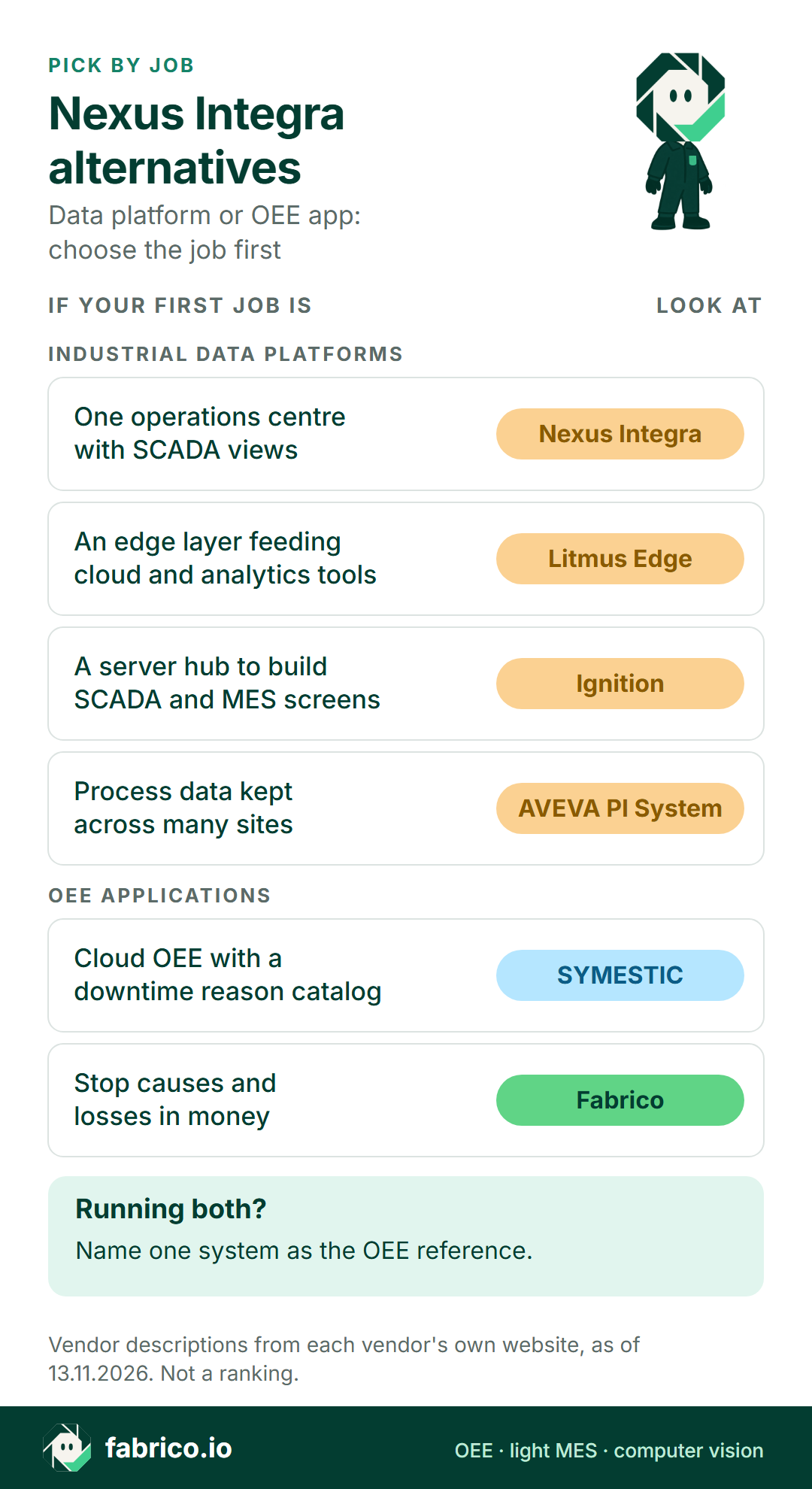
- One operations centre with SCADA views across industry, buildings or utilities: Nexus Integra.
- An edge layer that feeds many cloud and analytics tools: Litmus Edge.
- A server hub on which engineers build SCADA and MES screens: Ignition.
- A long-term store of process data across sites: AVEVA PI System.
- Cloud OEE with stop reasons, across several plants: SYMESTIC.
- OEE and losses in money per line and shift, without building a data model first: Fabrico.
Platforms and OEE tools often live together; agree which one is the reference for the OEE figure. Background reading: light MES vs full MES. Agri-food plants can also read computer vision in food manufacturing.
Text version of this infographic
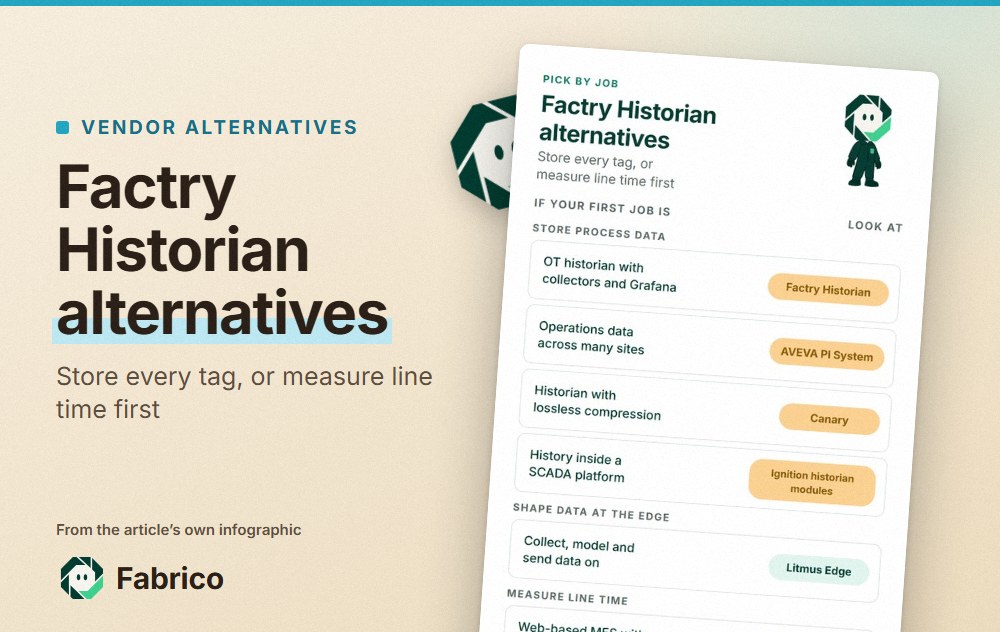
Pick-by-job card for Nexus Integra alternatives: one operations centre (Nexus Integra), edge data layer (Litmus Edge), server hub for SCADA and MES (Ignition), process data store (AVEVA PI System), cloud OEE (SYMESTIC), OEE and losses first (Fabrico).
Worked example: from press tags to an OEE figure
A made-up shift on one tile press, used only to show the arithmetic; it is not a customer plant or a product screen. The shift plans 465 minutes and the press's ideal speed is 12 tiles a minute.
A data platform will happily store the press state, the cycle counter and the reject count. To turn those tags into OEE you need the planned time and the ideal speed per product; to act on the result, you also need a reason for each halt.
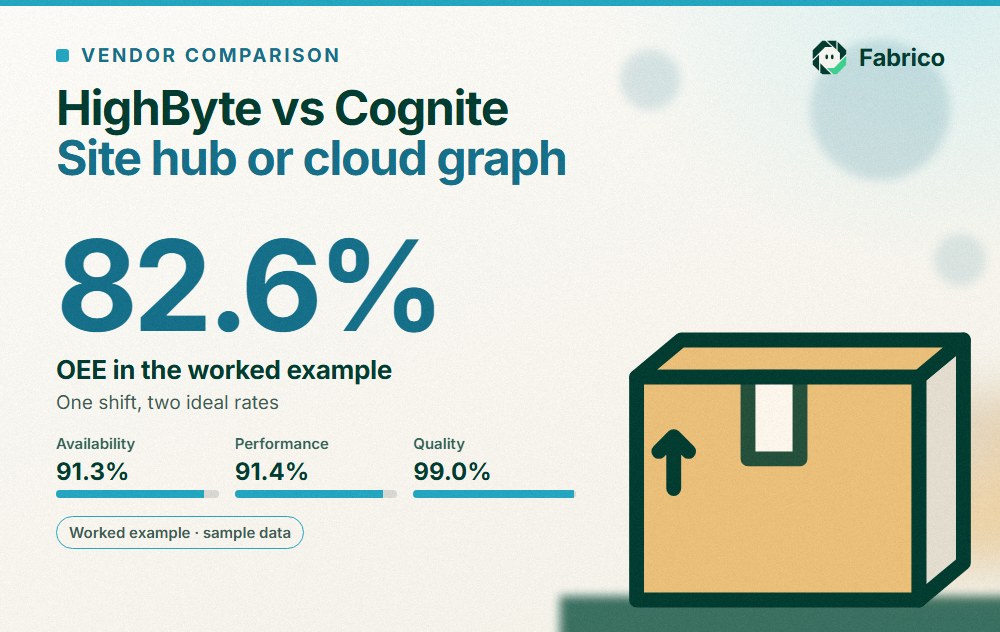
Here the press halted for 93 minutes, leaving 372 minutes of run time, so availability is 80.0%. Run at ideal speed, 372 minutes would make 4,464 tiles; the press made 4,018, a performance of 90.0%. Of those, 120 cracked or failed checks, so 3,898 were good: 97.0% quality. Multiplied before rounding, the three factors give 69.9%, the same as 3,898 good tiles over the 5,580 an ideal shift would make (the rounded figures multiply to 69.8%).
The biggest block is the 38 minute die change. Without a recorded reason, the data shows only that the press was not running. With it, the plant knows where to start. The OEE calculation guide walks through the formula.
What to ask Nexus Integra and every alternative
Take one real line to every vendor, Fabrico included, and ask the same things.
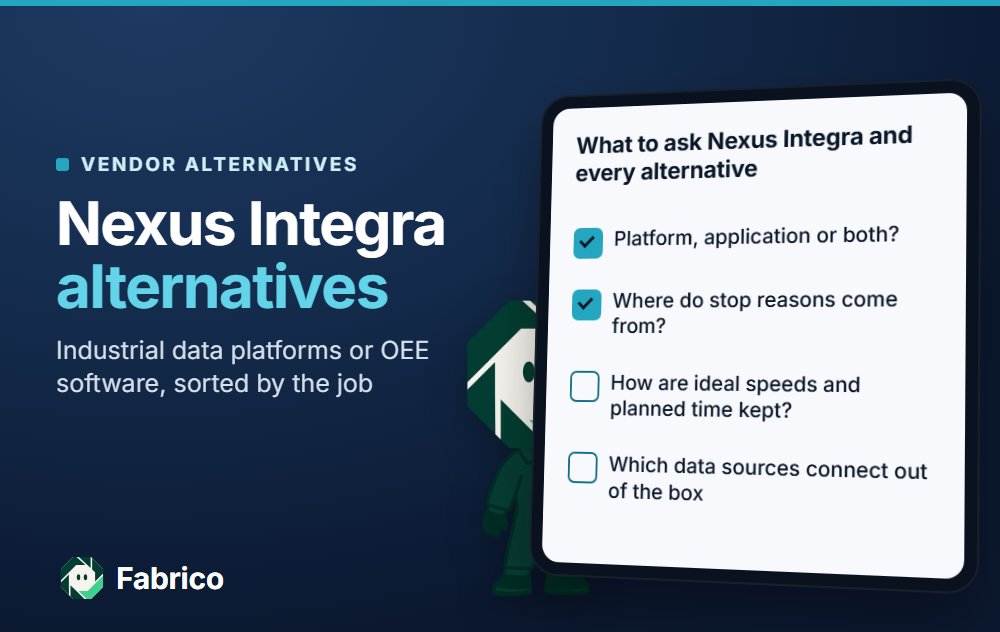
- Platform, application or both? Who builds the OEE model if the product is a platform.
- Where do stop reasons come from? Operator entry, rules on tags, or nowhere yet.
- How are ideal speeds and planned time kept? Per product, per machine, and who updates them.
- Which data sources connect out of the box, and which need custom work?
- Where does it run? Edge, plant server or cloud, and where the data is held.
- What goes into the quote? Hand all vendors the same list of machines, lines and sites.
What people ask next
What is Nexus Integra?
An Industrial IoT platform from Valencia, Spain, part of the Global Omnium group. Its site describes three layers, Nexus Connect, Nexus Core and Nexus Apps, for collecting, unifying and showing plant data through dashboards, alarms, reports and Smart SCADA views.
Does Nexus Integra calculate OEE?
Its OEE article says the platform allows MES applications for calculating and analysing OEE to be integrated, with results passed to its own apps such as SCADA and reports. Ask Nexus Integra which OEE application it would use for your plant and who sets it up.
Is Nexus Integra a SCADA or an MES?
Its pages call it an integration platform for industrial systems, with Smart SCADA among its views and MES applications integrated on top. It names sources from sensors and PLCs to ERP, MES and CMMS systems.
How is Fabrico different from Nexus Integra?
Nexus Integra is a data platform on which applications are built. Fabrico is an OEE application with light MES functions: stops come from the machine signal, causes from the operator, and OEE and losses in money are shown per line and shift.
Can an OEE tool run alongside an industrial data platform?
Yes. Many plants keep the platform as the store of raw data and use an OEE tool for stops, causes and losses. Decide which system is the reference for the OEE figure so reports agree.
What does Nexus Integra cost?
Ask Nexus Integra for a quote. To compare vendors fairly, give each of them the same list of machines, lines and sites.
Want to watch a press shift become OEE and stop causes? Book a demo, or write to us if a data platform is already in place.
Related articles



Real Fabrico tiles, sample data.