


 Login
 Blog
Computer Vision for Food Manufacturing: What It Counts, How to Choose

In short: computer vision for food manufacturing does two different jobs. Inspection cameras check each pack, and OEE cameras count trays, packs and cases where no machine signal exists, so output and OEE stop relying on a tally sheet.
- This page is about the counting job. Labels, date codes, seals and fill levels stay with your inspection systems.
- In a food plant the site is the hard part: high-pressure washdown, condensation in cold rooms and high-care hygiene rules.
- Settle how allergen clean-downs and food-safety holds count in OEE first. In our sample shift, the clean-down rule alone moves OEE by 6.6 points.
- Keep the PLC where it counts. Put cameras where people pack or where no usable count exists.
- Fabrico counts with AI cameras as an add-on, and you can open the video for any moment of the shift. Camera-detected stops are on our roadmap, not live.
Many food plants already have cameras on the line. They read date codes, check labels and look for bad seals. Ask what the line made last night, though, and the answer often still comes from a tally sheet at the hand-packing table.
This page is for the food plant managers, CI leads and engineers choosing cameras to fix that. Beverage, dairy, bakery, confectionery and meat plants each have their own quirks.
We sell Fabrico, a cloud OEE and light MES platform with a camera add-on.
What AI cameras on food production lines count, and what they don't
Two kinds of vision system share a food line. An inspection system decides whether one pack is good. An OEE camera tells you how many packs the line made, and lets you look back at what happened when output dropped.
| Job | Inspection camera | OEE camera |
|---|---|---|
| Count trays, packs or cases | Sometimes, as a side job | Its main job |
| Check labels, date codes, allergen text | Yes | No |
| Check seals, fill level, shape | Yes | No |
| Push a bad pack off the line | Yes, with a reject arm | No |
| Show a past moment of the shift | Rarely, beyond reject images | Yes, you open the video for that moment |
| Feed OEE | Through the line's reject count | Through the output count |
Inspection vision comes from vendors such as Cognex, Keyence and Mettler-Toledo. Fabrico does not sell it. The two sit side by side: inspection rejects reach the OEE Quality rate through the line's reject count or signal, the same way checkweigher rejects do.
The split matters in food. In Australia, undeclared allergens caused 38% of all food recalls in 2025, according to Food Standards Australia New Zealand. Its recall statistics name errors during packaging as the most common cause of undeclared allergen recalls from 2021 to 2025.
That job belongs to line clearance, label checks and inspection cameras. An OEE camera is not an allergen control. See label and code checks versus OEE cameras.
Where a food line loses time
Before you choose a camera, agree how each of these counts in your OEE. Otherwise every vendor's demo will show a different number for the same shift.
Allergen changeovers and clean-downs
Moving from a recipe with milk to one without means a full clean-down, a check and a sign-off. It is scheduled, but it is still lost time.
Some plants count it inside planned production time, as a stop with its own reason, so it shows in Availability. Others take it out of planned time. We recommend the first, as in our guide to CIP time in OEE: a clean-down you can see is one you can plan around, with fewer allergen switches in the run order and less waiting for swab results and sign-off. Never shorten the validated clean itself.
Washdown and sanitation
A washdown or clean during a production shift follows the same rule. A sanitation shift with no production planned sits outside OEE and shows in TEEP, as our guide to sanitation shifts in OEE and TEEP explains. The extra risk for a camera is the start-up after it: a wet lens, fog or a knocked mount can spoil the count for the first minutes of the run.
Food-safety holds
A foreign body found in a reject, or a failed metal detector test, usually stops the line until the food safety team releases it. Those minutes are unplanned. Held product counts in the total and only becomes good once released without rework, so a shift's Quality can change a day later. See food safety stops in OEE.
Short stops at the packer and wrapper
Flow wrappers, baggers and tray sealers stop for seconds at a time: a pack out of pitch, a missed pack, a jam at the infeed. Each is too short to write down, so paper records lose them.
They add up. The Siemens True Cost of Downtime 2024 survey of large manufacturers puts an hour of unplanned downtime in FMCG at $36,000, and FMCG is the only sector in it where downtime hours have not fallen since 2019. Your own line's hour will differ: the worked example below prices one.
The machine pages go deeper: VFFS bagger stops and bakery bagging line stops.
Hand packing and tray loading
Hand-packing tables, tray loading and hand case packing have no PLC and no counter, so output usually comes from a tally sheet. A camera counts trays or cases as they pass, and a slow hour shows up in the hour it happened. See OEE for a manual packing station.
Cold rooms and condensation
Cold product, warm air and cleaning steam fog lenses, and a fogged camera loses the count: see cameras in a frozen food packing hall.
High-care and low-care zones
Every new device in high-care is one more thing for the hygiene team to approve and clean. Fitting or servicing it means gowning up and following the zone's rules for tools, so choose mountings that need little work. The upside: a manager can open the video of a high-care stop from outside the zone.
Where computer vision for food manufacturing fits on the line
Ask three questions at each station, in this order.
A camera is not worth it when the station already has a usable count, when the loss sits in the process (ovens, fryers, cookers) rather than the packing, or when an inspection system already sends a reliable count.
Camera, sensor or operator: which source for each station
| Station | Count from | Why |
|---|---|---|
| Filler or depositor with a PLC | PLC | The signal is already there |
| Flow wrapper, bagger or tray sealer | PLC, or a camera if the count is not usable | Short stops need a timed signal |
| Tray loading or hand packing | Camera | No machine, no signal, only a tally sheet |
| Checkweigher, metal detector, inspection camera | Its reject signal | Feeds the Quality rate |
| Older case packer with no PLC access | Sensor or camera | A photo-eye at the case outfeed |
| Cold room or freezer packing | Sensor, or camera in an anti-fog housing | Lens fog decides it: test after sanitation |
| Why the line stopped | Operator, on a tablet | No signal knows the reason |
The rule of thumb: a signal you already have beats a camera, and a camera beats a tally sheet. For the full choice by machine, read camera or sensor for OEE.
Want to talk through your own line? Book a demo.
What the camera has to survive: washdown, cold and hygiene
In a food plant, half the decision is whether the camera, housing and mount survive your cleaning.
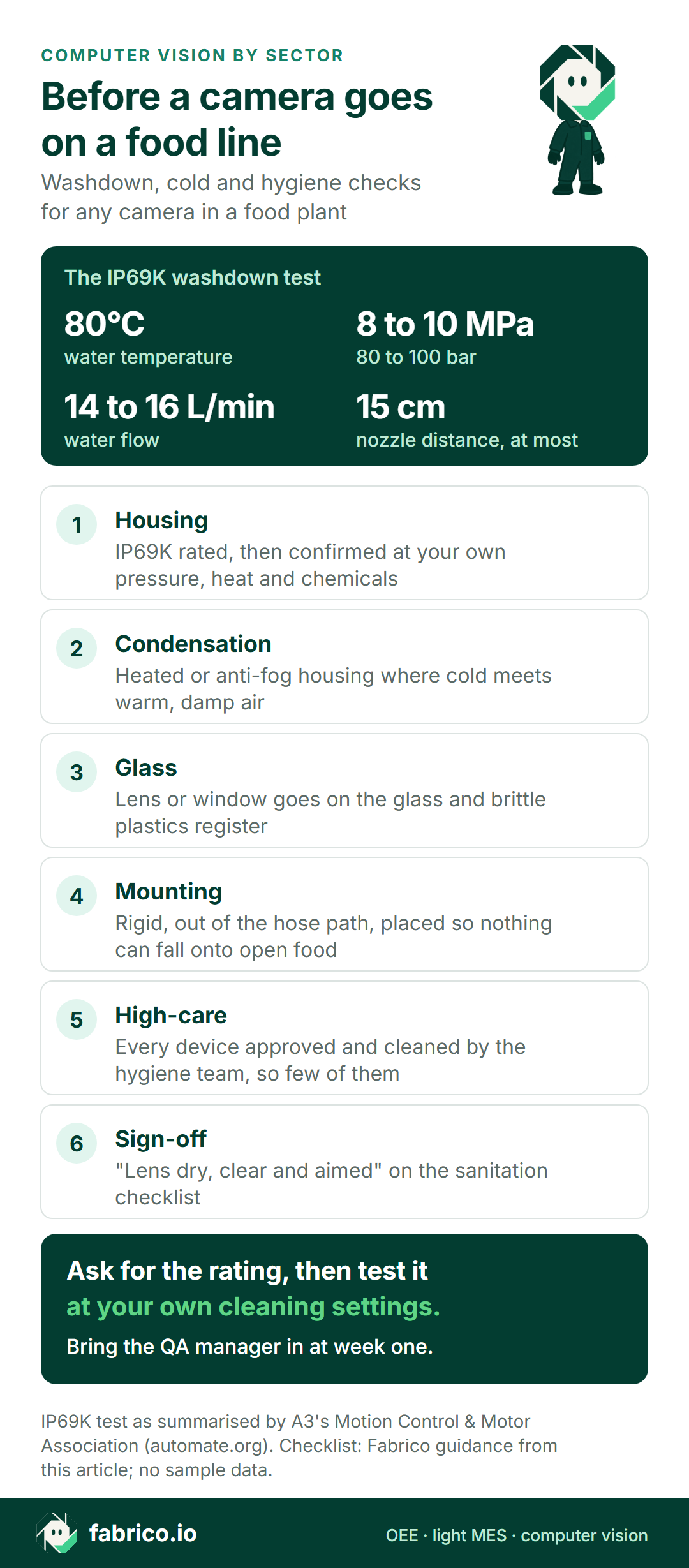
- Washdown rating. For hosed areas, ask for an IP69K housing. Its test sprays 14 to 16 litres a minute of 80°C water at 8 to 10 MPa (80 to 100 bar) from no more than 15 cm, as A3's Motion Control & Motor Association sums it up. Our IP69K guide covers the full test. Then have the supplier confirm it against your own pressure, temperature and chemicals.
- Materials. Stainless steel or food-grade plastic, smooth, with no gaps where water and dirt sit.
- Glass. If your site keeps a glass and brittle plastics register, the lens or window belongs on it.
- Mounting. Rigid, out of the hose path, and placed so nothing can fall from it onto open food.
- Sign-off. Add "lens dry, clear and aimed" to the sanitation checklist.
Worked example: one shift on a chilled tray line
Illustrative, sample data: one sample line, not a customer. People load trays by hand at a table in high-care, a sealer closes them, and a checkweigher and metal detector follow.
- Planned production time: 480 minutes. Ideal rate: 60 trays a minute, set by the sealer.
- The sealer's PLC gives run and stop signals, but its counter counts sealing cycles, not trays, so a cycle with an empty pocket still counts as full. Until now the plant reported output from the tally sheet.
- One allergen clean-down: 40 minutes. Other stops: 30 minutes, a film jam (18) and a wait for components (12).
- Camera count at tray loading: 21,300 trays. The tally sheet said 22,300.
- Rejects from the checkweigher and metal detector: 400 trays.
With the camera count and the clean-down as a stop inside planned production time:
- Run time: 480 minutes, less 70 minutes of stops, is 410 minutes.
- Availability: 410 / 480 = 85.4%.
- Performance: 21,300 / (410 x 60 = 24,600) = 86.6%.
- Quality: 20,900 good / 21,300 = 98.1%.
- OEE: 85.4% x 86.6% x 98.1% = 72.6%. Check: 20,900 good trays / (480 x 60 = 28,800) = 72.6%.
Now change only the rules. Take the clean-down out of planned time and planned time falls to 440 minutes: 20,900 / 26,400 = 79.2%. Use the tally sheet as well and good trays rise to 21,900: 21,900 / 26,400 = 83.0%.
Same shift, same trays, and a 10.4 point spread. The tally sheet added 1,000 trays that were never made. The clean-down rule moved OEE by 6.6 points.
The camera does not log stops by itself. It gives you a count you can check, so the 3,300 trays the line could have made in its run time (24,600 less 21,300) show up as 55 minutes of Performance loss: EUR 1,320 a shift at a sample margin of EUR 0.40 a tray. Open the video for the slow stretches to see why.
Why not count after the sealer, outside high-care? You can, and it keeps one device out of high-care. A camera at the loading table also shows why the table fell behind.
Who buys computer vision in a food plant
One person rarely buys it alone. The technical or QA manager can stop a project everyone else wants, so bring them in at week one.
| Role | What they ask | What settles it |
|---|---|---|
| Plant manager or operations director | Will the numbers I report change? | A pilot on one line, checked against a hand count |
| CI or OpEx lead | Can I trust the count and the loss list? | Stop reasons by line and shift, losses in money |
| Engineering manager | Mounting, power, network, washdown | Housing rating checked at your cleaning settings |
| Technical or QA manager | Hygiene, glass, high-care access | Materials, cleaning method and a sign-off step |
| IT or OT | Network, access, where video goes | A data and access diagram |
| HR or works council | Are we filming people? | Cameras aimed at product, written rules for video |
Eight questions to ask any camera vendor for a food plant
Ask every vendor these, and ask us too. Bring one real line and a week of tally sheets as the test case.
- Washdown: what IP rating does the housing carry, and was it checked against our cleaning pressure, temperature and chemicals?
- SKU changes: when a new tray or pack format arrives, does the camera need re-teaching, who does it, and does the ideal rate follow the SKU?
- Rules: how do allergen clean-downs and food-safety holds count in your OEE, and can we set one rule for every plant?
- Hand packing: can the camera count trays at a table where four people work, without tracking the people?
- Accuracy: how do we test the camera count against a hand count? See how accurate a camera count is.
- Joins: where a camera count meets PLC data on one line, how do you avoid counting a pack twice?
- Rejects: how do rejects from our checkweigher, metal detector and inspection cameras reach the Quality rate?
- Video: is video kept, where, for how long, and who can open it?
Cameras near people: privacy and works councils
Hand-packing stations are where the people are, so this comes up early. Aim the camera at the belt and the trays, and frame the view on the product. At a packing table, hands and arms will still pass through the frame, so say so to the team.
Agree in writing what the video is for and who opens it. In Germany and several other EU countries the works council has a say before cameras go in, so bring it in before the pilot. See our works council guide.
Automatic masking of people in the frame is on our roadmap. Today, privacy rests on where the camera points and who can open the video, so ask us in the demo what the current setup covers. See cameras on the production line without surveilling people.
How Fabrico does it
Here is what is live, what the camera add-on adds, and what is not.
- Stops and counts: from the machine signal, through a PLC, sensor or counter. The operator adds the stop reason at the line, on a tablet or phone.
- OEE and losses: OEE, downtime and losses by line and shift, with losses shown in money. On the web, iOS and Android.
- Camera add-on, on request: AI cameras count output, including at hand-packing stations and machines with no usable signal. You can open the camera video for any moment on the shift timeline. In the standard setup, video is streamed on request, not stored in Fabrico.
- Your data: out through the REST API, webhooks, or Excel and CSV export.
- Roadmap, not live: camera-detected stops, jam zones, and a camera that proposes a stop reason for the operator to confirm.
- Not what we do: inspection of labels, codes, seals or fill level, allergen or food safety compliance, and traceability. For production planning, ask us in the demo.
The camera add-on is on computer vision for OEE. For the wider choice, see OEE software and what a light MES covers.
Mapping every system in the plant? Start with food manufacturing software, then MES for food manufacturing and OEE in food and beverage. For food and non-food lines together, see OEE for FMCG plants.
Test these claims like any vendor's. Bring one line map and ask us which counts a camera would replace and which it would not.
What people ask next
Is computer vision in the food industry the same as vision inspection?
No. Inspection cameras check each pack: labels, codes, seals and fill level. OEE cameras count output and let you look back at a moment of the shift. Most food lines need both.
Do AI cameras work in cold rooms and chilled halls?
They can, but condensation is the risk where cold product meets warm, damp air. A heated or anti-fog housing helps. Test the count at a start-up after sanitation.
Should allergen changeovers count as planned or unplanned downtime?
Not as planned downtime. The clean-down is in the schedule, but it costs output, so most plants keep it inside planned production time as an Availability loss with its own reason code. Only a sanitation shift with no production planned sits outside OEE. Use one rule on every line.
Is the camera video kept?
Not in Fabrico. In the standard setup, video is streamed when someone opens a moment on the shift timeline, not stored in Fabrico. Ask us, and every vendor, where the video is held before it is streamed, for how long, and who can open it.
What drives the cost of computer vision for food processing?
Lines and cameras, washdown housings and mounting, network work and training. Our pricing is not public, so give every vendor the same line list and compare like with like.
Want to see a camera count on a line like yours? Book a demo.
Related articles




Latest from our blog



Real Fabrico tiles, sample data.