


 Login
 Blog
Computer Vision for HVAC Manufacturing: Coils, Assembly, Packing

In short: computer vision in HVAC manufacturing is worth buying where people, not machines, set the pace: a camera counts coils as they come off hand brazing, units leaving the fan and compressor cells, and crates at packing, where no machine gives a clean count. Fin presses, benders and test stands already have one.
- Braze leaks, missing parts and labels are found by leak testing and inspection systems. That is a different job from an OEE camera.
- HVAC losses hide in coil shortages from the brazing area, model changes on low-volume lines, waiting for the run test bay, crane and forklift waits, and units that loop back from leak test.
- Give each model family its own ideal cycle time. A rooftop unit and a small split unit should never share one number.
- Fabrico's camera add-on counts coils, units and crates; pick a minute on the shift timeline to stream that station's video, and the brazer or team leader records why the line stopped.
A fin press knows its strokes. A leak test stand logs each coil it tests, and a run test stand logs each unit by serial.
The brazer at the return bend station, the cell that fits fans and compressors, and the crew that crates a finished rooftop unit leave no count behind.
Fabrico wrote it and sells the camera add-on it describes, so check our claims against your own run test logs.
Computer vision in HVAC manufacturing: a counter, not an inspector
Two products share the name. One kind of vision system judges each part: a braze fillet, a fin pattern, a label. The other kind counts what leaves a station and lets you look back at a moment of the shift. Keep the two apart in your spec.
| Job in an HVAC plant | Done by | OEE camera? |
|---|---|---|
| Find coil and unit leaks | Helium or nitrogen leak test | No |
| Check fins, fillets, labels | Inspection system or inspector | No |
| Prove the unit runs | Run test stand | No |
| Count coils off hand brazing | Often nobody | Yes |
| Count units off manual cells | Paper sheet, if anything | Yes |
| Count crated units | Shipping scan, often late | Yes |
| Why the rooftop line waited | Memory and the shift log | Video of the position for that minute |
You need both. Leak and run test stands decide what passed, and their fail counts, from the stand log or a signal, set the quality figure. The camera count at brazing, cells and packing sets output.
Five areas of an HVAC plant, five data problems
This is a sizeable industry with very mixed lines. The IEA Heat Pump Monitor 2026 puts global heat pump manufacturing capacity at roughly 145 GW a year in 2024, led by China (around 35%), the United States (25%) and the European Union (20%). Heat pumps are only one part of HVAC.
The coil shop
Coils start on a fin press stamping aluminium fins, a hairpin bender forming copper hairpins, hairpins laced into the stacked fins, often by hand, and a tube expander locking the tubes into the fin pack. Each of these machines has a controller that knows its strokes or cycles. Read it, and watch for die changes when the fin pattern or coil size changes.
Then the return bends get brazed. On many lines that is still a person with a torch, coil after coil. Microchannel coils are different: they are brazed in a furnace, and the furnace line gives its own count. A 2019 US DOE Building Technologies Office peer review on braze joint quality, presented by an HVAC manufacturer with the University of Illinois, planned to autobraze test coils "to remove manual brazing variation", and points to "billions of U.S. braze joints". Leaks are the leak tester's job, and joint quality is checked by inspection and sectioning audits. Brazing output is not counted anywhere on many sites, and that is the station where the camera add-on pays off first.
After brazing, each coil goes through a leak test. The test stand logs pass and fail. A coil that fails goes back to the brazer, so count retests as their own number.
Sheet metal for cabinets and casings
Cabinets, base pans, panels and casings come off turret punches, laser cutters and press brakes. These have controllers with a part or program count. The losses are tool changes and waiting for material. A camera adds little here. See OEE for press brakes and, for a wider view of the shop, computer vision for metal fabrication.
Fan, compressor and electrical sub-assembly
Compressors are usually bought in, but they are fitted to base pans, along with fan motors, blower wheels, control boxes and wiring harnesses. Much of this work is done by hand at cells or benches that feed final assembly. A cell like that has no PLC and no counter. If it falls behind, final assembly waits. The camera add-on can count what leaves the cell. For the general method, read computer vision for OEE on manual assembly.
Final assembly: high volume and low volume
Split-unit indoor and outdoor units often run on a paced conveyor at high volume. That conveyor PLC gives run and stop, and the run test stand at the end gives a count by serial. Read both before you buy a camera.
Rooftop units, air handlers and chillers are different. They are large, built to order in many variants, moved by crane or on carts between fixed positions, and a single unit can take an hour or more at one position. There may be no conveyor and no line PLC at all. Here a camera at the last assembly position, or at the exit to the test bay, may be the only practical way to get a timed count.
On both kinds of line, brazers also join the compressor, the refrigerant piping and the coil connections on the unit itself. This system brazing is manual on most lines, and on a large unit it can hold a position longer than any other step. A camera add-on can count units leaving that position, and you can open the video for the moment the line waited. The leak test, not the camera, judges the joints.
Charging, leak and run test
Finished units are leak tested, evacuated and charged with refrigerant, then run tested, safety tested and sniffed for leaks. In the US, the EPA Technology Transitions table sets a GWP limit of 700 for residential and light commercial AC and heat pump systems such as mini-splits and unitary systems, from January 1, 2025, and EPA points to a later reconsideration rule for some dates. For a plant, a refrigerant change means new charge recipes and test settings, so book those changeovers as their own stops. The DOE review notes that "Systems leave manufacturing facilities having been proofed and leak checked". These stations are machines with their own data: charge weight, test result and serial. Their fail count goes to quality, and a unit that needed a leak repair or a second charge is not first-pass good, however it ships. More in rework and the good count in OEE.
The run test bay is also a common bottleneck. When all test positions are full, finished units cannot leave final assembly, and the line is blocked. Give that its own stop code.
Packing, crating and dispatch
Split units go into cartons. Rooftop units and air handlers are crated or skidded, stretch wrapped and moved by forklift. This step is often manual with no counter, and the shipping scan can come hours later. A camera add-on at the packing area counts what was packed, by the hour.
Where the cameras go
Here is one example: an HVAC plant with a coil shop, a sheet metal shop, sub-assembly cells and two kinds of final line.
White goods plants are a different case, with one paced line at high volume; see computer vision for appliance manufacturing.
Which HVAC stations already give a number
Use it as a starting point: an older fin press or bender may have no port you can read.
| HVAC station | Number comes from | Camera add-on gives |
|---|---|---|
| Fin press | Press controller | Little. Use the signal. |
| Hairpin bender, tube expander | Machine controller | Little. Use the signal. |
| Manual brazing | Often nothing | Coils brazed per hour |
| Coil leak test | Test stand: pass, fail, retest | Nothing. Feed fails to quality. |
| Punch, laser, press brake | Machine controller | Little. Use the signal. |
| Fan, compressor, control box cells | Often a paper sheet | Units off the cell |
| System brazing on the unit | Often nothing | Units leaving the brazing position |
| Paced split-unit line | Conveyor PLC and run test serials | Video of a short stop, if needed |
| Rooftop or air handler line | Often nothing | Units leaving the last position |
| Charging, leak and run test | Test stand data | Nothing. Feed fails to quality. |
| Packing, crating | Shipping scan, often late | Packed count by the hour |
| Why a position stood | Brazer or team leader, tablet or phone | The minute on video, if the reason is argued |
Before a demo, mark which coil shop and assembly machines can send a signal today; we will walk the plant from that sheet, coil shop first.
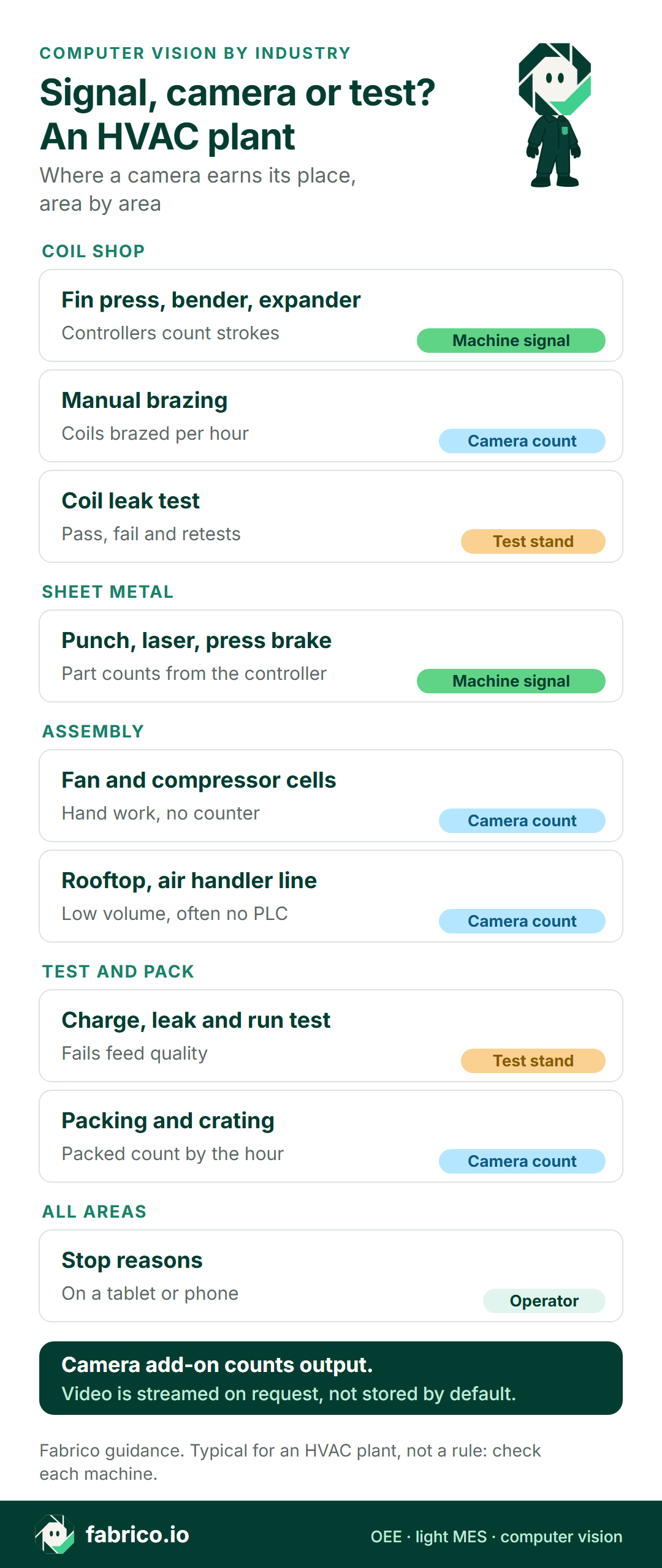
Text version of this infographic
- Fin presses
- Benders
- Expanders
- Punches and press brakes use the machine signal
- Coil leak test and charge
- Leak and run test use the test stand data
- Manual brazing
- Fan and compressor cells
- Rooftop and air handler lines and packing get a camera add-on count
- Stop reasons come from the operator
Worked example: a rooftop unit line, one shift
Example numbers, no real plant. A rooftop unit line builds two model families: a small unit with an ideal cycle of 12 minutes at its slowest position, and a large unit with an ideal of 20 minutes. The shift has 450 planned minutes after breaks.
The run test stand logs each unit by serial, so it gives both the output and the first-pass result. A camera add-on counts coils leaving the manual brazing stations, so the coil shortage has a cause you can see by the hour.
Availability. The line stopped for 100 minutes: waiting for coils from brazing 40, one model change 25, run test bay full 20 and waiting for the crane 15. Run time is 350 of 450 minutes, so availability is 77.8%.
Performance. The line built 14 small units and 6 large ones. At the ideal cycle, that is 14 x 12 + 6 x 20 = 288 minutes of work. It took 350, so performance is 82.3%.
Quality. One small and one large unit failed leak or run test the first time. That leaves 13 small and 5 large first-pass good units, worth 13 x 12 + 5 x 20 = 256 minutes. Quality is 256 of 288, or 88.9%.
OEE. 77.8% x 82.3% x 88.9% = 56.9%. The quick check gives the same: 256 good minutes of 450 planned is 56.9%.
The brazing camera count shows why the coil shortage happened: brazed coils per hour fell in the third hour, when one brazer moved to repair the coils that failed leak test. One rework loop in the coil shop became 40 minutes of stop in final assembly.
Now try the same shift with one ideal of 12 minutes for every unit, as some plants do. Performance falls to 240 of 350, or 68.6%, quality is 18 of 20, and OEE reads 48.0%. Nothing changed on the floor.
For more on setting ideals, read ideal cycle time and changeover time.
Six questions for any HVAC camera or OEE vendor
Put them to each supplier, and to us, with one week of run test serial logs and coil leak test results in hand.
| Question | What a good answer shows |
|---|---|
| What exactly does the camera count at a brazing station? | Coils, not torch movements. Ask how it handles a coil that comes back from leak test. |
| Can each model family have its own ideal? | An ideal per model or variant, and how it is set when a new variant arrives. |
| How does test stand data reach quality? | First-pass fails from leak and run test, read by serial or signal, so a unit repaired after leak test is never first-pass good. |
| How is a blocked line booked? | A separate stop code for a full run test bay, apart from faults. |
| Where does each camera go above a rooftop line? | A position on a drawing, clear of the crane path, forklift lanes and the brazing flame. |
| Where does brazing and assembly video go? | Whether any brazing video is kept, on whose servers, for how long, and whether a shift supervisor can replay it. |
Fin presses, benders and test stands already report, so even a large HVAC plant needs cameras only at a handful of manual positions. How many cameras a line needs for OEE and choosing camera or sensor for each machine are the tools to size a camera add-on rollout; start with the brazing area or one final line. If you are comparing vision-based OEE tools, the comparison of computer vision for manufacturing OEE covers that question.
Brazers, assemblers and the works council
A camera at a brazing station or an assembly cell will see people. Tell staff first, and in many European countries, the works council.
Aim the camera at the coil rack or the cell exit, not at the brazer's face, and report by station and shift only. Ask each supplier, and us, whether people can be masked out today at a brazing station, with torch flare in the picture, or only later.
The camera add-on is there to count coils, units and crates; who brazed them is not its business. A longer checklist is in production line cameras without surveillance.
How Fabrico handles an HVAC plant
Fabrico is cloud software for OEE and light MES. In an HVAC plant it ties the coil shop, the sub-assembly cells and the final lines into one record per shift.
- Coil shop and sheet metal: strokes, cycles and stops come from the fin press, hairpin bender, expander, punch and press brake controllers or the conveyor PLC, or from a sensor or counter on an older machine.
- Why a position stood: the brazer, assembler or team leader picks the reason on a tablet or phone, such as no coils from brazing or the run test bay full.
- Shift results: OEE, downtime and losses per line and shift, with lost units valued in money, on the web, iOS and Android.
- Camera add-on, on request: it counts coils at the manual brazing stations, units leaving sub-assembly cells and the last rooftop position, and crates at packing. A team leader can pick any minute on the shift timeline and have that brazing position's video streamed on request; the standard setup keeps none of it in Fabrico.
- Data out: stops, counts and reasons feed the ERP or a BI tool over the REST API and webhooks, and export to Excel or CSV for the weekly coil shop review.
Roadmap, not live today: jam zones drawn on the video, stops picked up by the camera add-on itself, and reasons it would suggest.
What Fabrico does not do: leak testing, charging, run testing, or any inspection of brazes, fins and labels. Those stay with your test stands and inspectors, and their fail counts can feed Fabrico's quality figure. Fabrico does not control the stands or set charge recipes.
Product details are on Fabrico computer vision for OEE. Coil and unit counts turn into OEE as shown in OEE with computer vision; if you are still choosing a platform, start with OEE software. Hold us to the six questions above.
What HVAC teams ask next
Which HVAC station should get the first camera?
In most plants, the manual brazing stations in the coil shop: a coil shortage stops final assembly, and nobody counts coils by the hour. Packing and crating come next if no count leaves the dock. Fin presses, benders and test stands already give you numbers.
Can a camera find braze leaks or missing parts?
Not an OEE camera. Leaks are found by helium or nitrogen leak testing, and visual checks for missing parts or labels are an inspection job. Fabrico does not sell inspection. Leak and run test stands can pass their fail count into the quality part of OEE through a signal or their log.
Do fin presses and hairpin benders need a camera?
Rarely. Their controllers already know their strokes or cycles, so read the signal first.
How should OEE work on a low-volume rooftop or air handler line?
Give each model family its own ideal cycle time, book model changes as stops with their own code, and count a unit as good only if it passed leak and run test the first time.
Want to try it on your own numbers? Bring one week of run test stand serial logs to a demo, and we will build the shift picture from them with you.














Real Fabrico tiles, sample data.