


 Login
 Blog
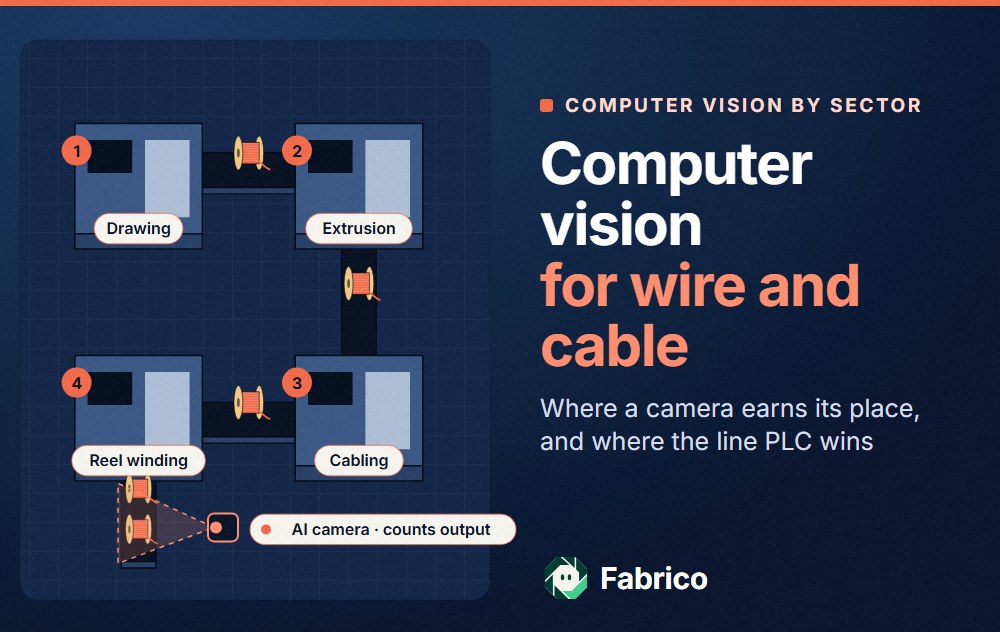
Computer Vision for Wire and Cable Manufacturing: Coilers, Reels and Harness Boards

In short: computer vision in cable manufacturing earns its place where no machine gives a usable count: at older coilers, reel and drum packing, and manual harness boards. On drawing, stranding and extrusion lines, the line PLC's length counter is the better count.
- Insulation faults and diameter are checked by the spark tester and the diameter gauge. That is inspection, a different job from an OEE camera.
- Cable losses hide in reel and drum changes, colour and size changes, extruder start-up scrap, waiting for reels, and short stops at the coiler.
- Harness assembly is mostly manual work on boards. The test table counts finished harnesses; a camera count shows output per board or station before test.
- Fabrico's camera add-on counts coils, reels, drums and harnesses where the line gives no count; the line operator books the stop reason, and video of a given minute is streamed only when someone asks for it.
Your extrusion line already knows its speed and how many metres it made. Your coiler may not. Your harness boards are people, clips and tape.
It is for the people who answer for output in wire, cable and harness plants: plant managers, extrusion and harness hall leads, and CI engineers who want a count of coils and harnesses they can trust.
It goes from drawing to the harness hall: where a camera count adds something, where the length counter is the better source, and what to ask a supplier.
Computer vision for wire and cable manufacturing: fault finding or counting
Cable plants get offered vision for two very different jobs. One finds faults in the insulation, the print or the lay. The other counts coils, reels and harnesses and lets you replay the minute a coiler stopped.
On a cable line, most inspection is not even a camera. It is a spark tester, a diameter gauge, a lump detector or an eccentricity gauge, running inline at full speed.
| Job in a cable plant | Inspection or test system | OEE camera |
|---|---|---|
| Insulation faults | Spark tester | No |
| Diameter and concentricity | Inline gauges | No |
| Print on the jacket | Print or code vision | No |
| Harness continuity | Electrical test table | No |
| Count coils, reels, harnesses | Rarely | Yes, at coilers, packing and boards |
| Why the take-up stopped | No | Video of the take-up for that minute |
| What it gives OEE | Spark faults, cut-out metres | Coils or harnesses per hour |
Keep both. The spark tester's fault count, or the metres cut out of a reel, belongs in quality, taken from the line's signal or a counter, so a bad length is not counted again at packing. Print checks on the jacket are code vision; that boundary is in label and code vision vs an OEE camera.
Start with the line: on continuous processes the length counter wins
Drawing machines, stranders, bunchers and extrusion lines are continuous. The line PLC knows the line speed in metres a minute, the length on the current reel, and when the line stops.
That is a better count than any camera. A camera looking at a moving conductor or a jacket sees a surface, not metres. Read the length counter, set an ideal speed for each product (conductor size and insulation), and you have availability and performance.
So on these lines a camera is a witness, not a counter. It can show what happened at the take-up in the minute before a stop, if the stop codes keep arguing.
It is a different story further down. Many cutting and coiling stations, reel and drum packing, and almost every harness board give no usable count at all. That is where the camera add-on pays off. Other machine types get the same treatment in which machines need a camera and which a sensor.
Where the losses hide in a cable plant
The IEA's 2023 grids report says that reaching national energy goals means adding or refurbishing over 80 million kilometres of grids by 2040, the equivalent of the entire existing global grid. That is a global scenario, not a forecast for any one plant, but it shows why hours on cable lines matter.
The industry is big, too. Europacable, the trade body, says its members employ over 80,000 people, more than half of them in Europe. Here is where line hours go in a typical cable plant.
Reel and drum changes
Every pay-off and take-up runs out or fills up. Lines with dual take-ups change on the fly. Lines with a single take-up stop: cut, lift the full drum out, load an empty one, thread and restart.
On stranders, cablers and armouring machines, loading the pay-off bobbins can take hours, longer than the run itself on a short order. Give reel and drum changes their own stop code, and split loading from threading, so the long ones show up.
Colour and size changes
A size change on an extrusion line means new tooling in the crosshead, often a new tip and die, and a new speed. A colour change means purging until the new colour is clean.
A size change stops the line, an availability loss. Many lines change colour on the fly by switching masterbatch, so that loss is scrap metres, not stop minutes. Plants that sequence light to dark colours and similar sizes together lose less. You only see that if the change is coded by type, not booked as one long "setup".
Extruder start-up scrap
After a start, the extruder heats up, the melt settles, and the operator centres the conductor until the gauges read in spec. Every metre made before that is scrap.
Those metres were made, so they count against quality. They are easy to miss when someone cuts them off the reel by hand. The worked example below shows one way to count them.
Waiting for reels and drums
Lines wait for wire from drawing, for stranded conductor, for empty drums, or for a crane or forklift. The line is ready and nothing feeds it.
Book this as its own code, not as "other". It is often a planning or logistics loss, and the fix sits outside the line.
Short stops at the coiler
Automatic coilers and spoolers stop for short faults: a coil that does not transfer, a tie or wrap fault, a bag that does not open. Each is a minute or less, so nobody writes it down.
Forty 45-second stops are half an hour. If the coiler gives no usable signal, a coil count from the camera add-on shows the coils per hour dropping, and you can open the video for those minutes. Having the camera add-on detect those stops itself is on the Roadmap; for now the coiler operator books them on the tablet. Our page on micro-stops shows how to treat them.
Manual harness boards
Wire harness assembly is labour intensive. A 2023 review in Procedia CIRP from Chalmers University and partners says that automotive wire harnesses are today usually assembled manually, which creates unergonomic and tedious working conditions for operators.
Leads are cut, stripped and crimped on machines that usually count their own output. Then people route them on boards, fit clips and connectors, and tape. A finished harness goes to the electrical test table. The test table logs every harness it tests, but there is often no count per board or station between the crimp machine and the test table, and many variants share one board.
For the OEE side of this, see OEE for wire harness assembly and computer vision OEE for manual assembly. For the cable side, read OEE for wire and cable manufacturing.
Where a camera goes in a cable plant
Here is one example: a cable plant from drawing to reel packing, and a harness hall. The spark tester and diameter gauge sit inline on the extrusion line; cabling and armouring apply to power cables, which go to drums rather than coilers.
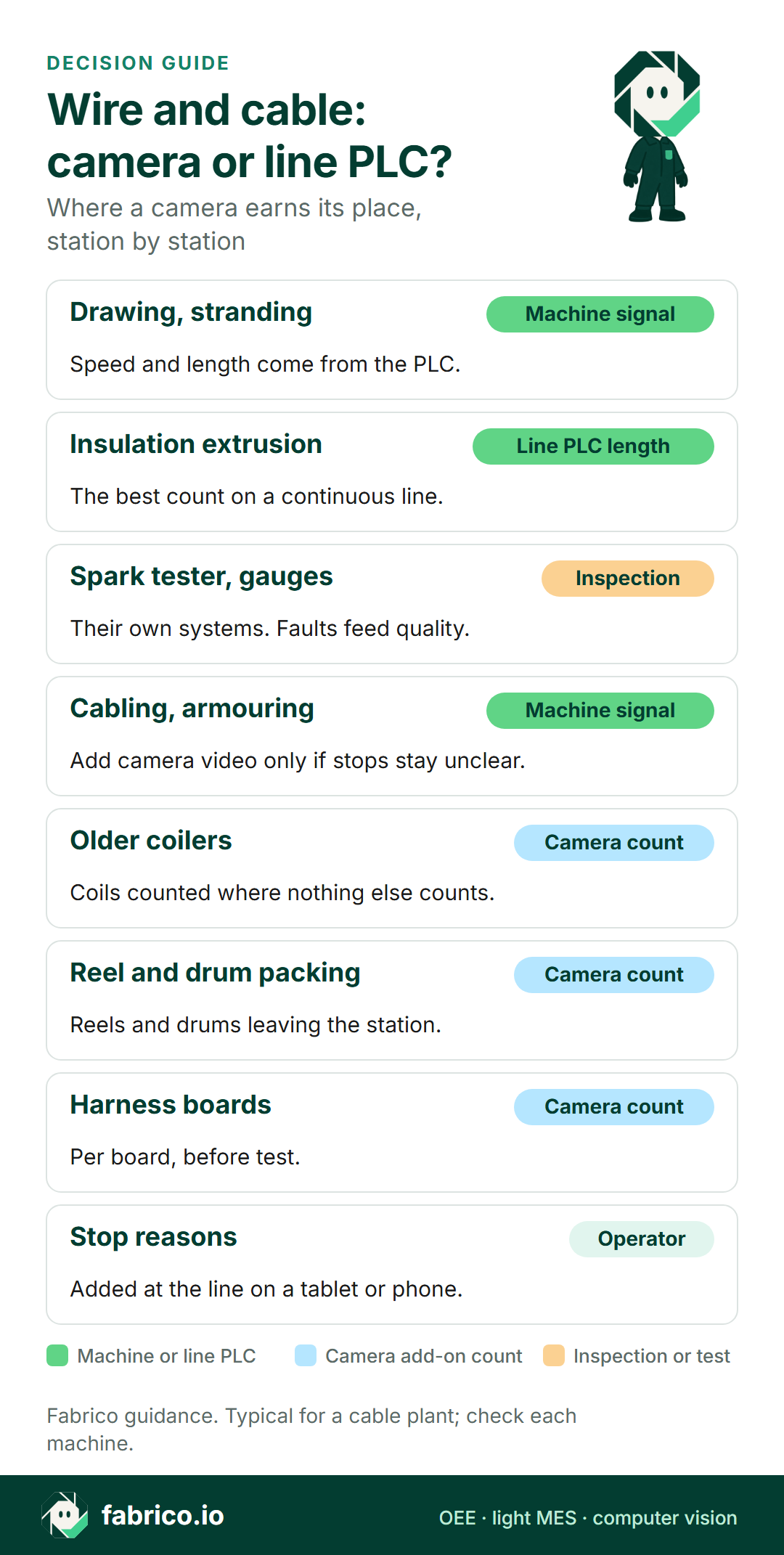
Notice how few blue boxes there are on the cable line. That is normal.
Camera, line PLC or operator: station by station
Most cable sites look roughly like this, but a 30-year-old strander may have no PLC you can reach, so walk the hall first.
| Cable or harness station | Metres, counts and stops from | Camera add-on's job |
|---|---|---|
| Wire drawing | Machine PLC: speed and length | Little. Use the signal. |
| Stranding, bunching | Machine PLC: length and run state | Video of a take-up or pay-off stop |
| Insulation extrusion | Line PLC: speed and length | Video of what led up to a stop |
| Spark tester, diameter gauge | Their own fault counts | Nothing. Feed faults to quality. |
| Cabling, armouring | Machine PLC, if you can reach it | Video at bobbin loading |
| Cutting and coiling | Coiler PLC on newer machines | Coil count where nothing counts |
| Reel and drum packing | ERP booking at labelling, often late or batched | Count of reels or drums leaving |
| Cut, strip, crimp | Machine counter | Little. Crimp force monitoring is inspection. |
| Harness boards, taping | Test table log for finished harnesses | Count per board or station before test |
| Why a line stood | Line operator or harness team lead, tablet or phone | Video of the minute, when the reason is argued |
On the cable side, expect cameras only at older coilers and at reel and drum packing; the harness hall needs more. The card below shows the split.
Before a demo, list the coilers and packing stations that give no count today; we will start the walk-through there.
Worked example: an extrusion line feeding an older coiler
The figures are invented for the example. A building wire extrusion line runs round the clock with three crews, so the example covers one full day: 1,440 minutes. Its ideal speed for this product is 400 metres a minute, and it feeds an older coiler that cuts 100-metre coils and gives no usable count.
The line PLC supplies run state and metres. A camera add-on over coil packing counts each good coil as it is bagged.
Across the three crews the line stood for 280 minutes: 120 on colour and size changes, 75 in short coiler stops, 45 heating up and threading after starts, and 40 waiting for empty reels. It ran 1,160 of 1,440 minutes, an availability of 80.6%.
In 1,160 running minutes at 400 metres a minute the line could have made 464,000 metres. The length counter shows 426,800, a performance of 92.0%. The missing 37,200 metres are 93 minutes of slow running, most of it the ramp back to speed after each change.
At packing the camera add-on counted 4,140 good coils, or 414,000 metres. The other 12,800 metres went to start-up scrap, purge and short ends: quality is 97.0%, and the scrap is 32 minutes of line time.
OEE: 80.6% x 92.0% x 97.0% = 71.9%. From the coil count alone: 414,000 good metres out of 576,000 possible in the day is also 71.9%.
Without the coil count, quality is whatever the night crew writes on the reel tag. With it, scrap metres show per crew and per product, and when coiler stops jump on one crew, the team lead can stream those minutes and see the tie fault for themselves.
Eight checks for any cable plant camera or OEE vendor
Ask them of each supplier, with last week's reel change log and one day's length counter export as the test case.
| Ask | How to test the answer |
|---|---|
| Do you read the length counter? | Ask to see output in metres, with an ideal speed for each product. |
| Does it count coils, drums or harnesses? | Run it at coil packing for a day and compare with the bagged coil tally per crew. |
| How do you book reel and drum changes? | Ask for their own code, and loading split from threading. |
| Where does start-up scrap go? | Ask how metres scrapped after a start or a colour change reach quality. |
| How do spark tester faults get in? | Ask how spark faults and cut-out metres reach quality, and that a cut length is not counted again as a good coil. |
| How does a harness board count? | Ask what triggers a count, and how it copes with many variants on one board. |
| Who can replay harness board video? | Ask whether video is kept at all, where, for how long, and whether a team lead can open footage of a named board. |
| Where do cameras go near take-ups and drum stands? | Ask for each position on a hall drawing, clear of rotating drums and crane lifts, with safety sign-off. |
Start at one coiler or one harness board, not the whole hall; the computer vision OEE pilot guide has the steps, and how accurate is camera OEE shows how to test the count against a hand tally over a full day.
Cameras, privacy and the works council
A harness hall can have dozens of people at boards, and a camera over a board will see their hands all shift. Explain the plan to the hall before anything is mounted, and where there is a works council, put it to them first.
Aim at the finished harness leaving the board, or the coil going into its bag, never at the assembler. Report by board, line and crew, not by person, and ask each supplier, and us, whether masking holds up today on a board where hands cover the product, or is still planned.
The add-on counts harnesses and coils; it has no interest in who taped them. The full set of steps is in production line cameras without surveillance.
Where Fabrico fits
Fabrico is a cloud system for OEE and light MES. In a cable plant it reads metres from the lines, takes coil and harness counts from the camera add-on where nothing else counts, and puts both on one timeline per crew.
- Drawing, stranding, extrusion: line speed, length and run state from the line PLC, or a sensor or counter on a machine you cannot reach.
- Reasons for a stand: the line operator or harness team lead books it on a tablet or phone, for example reel change, colour change or waiting for empty drums.
- Crew results: OEE, downtime and loss per line and shift, with lost metres turned into money, on the web, iOS and Android.
- Coilers, packing and boards (camera add-on, on request): the add-on counts coils, reels, drums and harnesses where no usable signal exists. Pick a minute on the timeline to have that station streamed to you; the standard setup keeps no copy of the video in Fabrico.
- Exports: metres, counts and stop codes leave through the REST API and webhooks, or as Excel and CSV files for the planners.
Roadmap, not live today: stop detection by the camera add-on, jam zones marked on the video, and the add-on proposing a stop reason.
What Fabrico does not do: inspection. Spark testers, diameter and eccentricity gauges and harness test tables keep that job, and their reject signal or counter can feed Fabrico's quality figure.
The product itself is on Fabrico computer vision for OEE, and a broader buyer's view is in our guide to OEE software. Test us on the same eight questions as anyone else.
Send us a hall layout with each line, coiler and harness board marked before a demo, and we will show which numbers come from the PLC and which the add-on would supply.
What people ask next
Do I need a camera on an extrusion line that already counts metres?
Usually not for the count. On drawing, stranding and insulation extrusion lines, the line PLC's length counter is the better source of output. A camera earns its place downstream, at a coiler or reel packing station with no usable count, or as video of what happened at a stop you cannot explain.
Can a camera find insulation faults or diameter errors?
Not an OEE camera. Insulation faults and diameter are checked inline by the spark tester and the diameter gauge, which are their own systems. Fabrico does not sell inspection. Their fault count, or the metres cut out, can feed the quality part of OEE.
Can a camera count harnesses on manual assembly boards?
Yes. Harness boards are one of the clearest cases for Fabrico's camera add-on: it counts harnesses leaving each board or station before test, while the assemblers still add the stop reasons. For finished output, use the electrical test table's log of first-pass harnesses, as our page on OEE for wire harness assembly explains.
How should reel changes and colour changes show up in OEE?
Size changes and reel changes as availability losses, each with its own stop code; a colour change made on the fly as scrap metres against quality. Then you can see minutes and metres per change by product and by shift. Book start-up scrap against quality too, not as a hidden extra.
Want the numbers for your own extrusion line? Bring one week of reel change logs and length counter exports to a demo, and we will work a day of them through with you.
Related articles












Real Fabrico tiles, sample data.