


 Login
 Blog
Computer Vision for Automotive Parts Manufacturing: Assembly Cells to Pack-Out

In short: computer vision in automotive parts manufacturing earns its place as a counter where no machine counts: manual assembly, sub-assembly cells, hand weld fixtures, rework benches and pack-out into returnable containers. Presses and CNC machines already give you a signal, so use it.
- Dimensional checks, surface defects, part presence and code reading are inspection, error proofing or traceability. Those are different systems.
- Supplier losses hide in changeovers, waiting for material, short pauses at manual stations, cycle time drifting past takt, and rework.
- A camera count by hour shows where a people-paced cell fell behind takt. The operator still adds the stop reason.
- Fabrico's camera add-on counts output and lets you open the video for any moment on the shift timeline.
Your press lines and machining centres already talk. Your assembly cells, rework bench and pack-out area mostly do not.
This page is for plant managers, operations and CI leads at Tier 1 and Tier 2 suppliers who are choosing how to put cameras on lines to count output and get OEE.
The stations matter because suppliers build most of the car. CLEPA, the European association of automotive suppliers, says on its facts page that European suppliers make 75% of each of the 18 million vehicles produced each year, and sustain 1.7 million direct jobs across the EU. The page carries no date, so read it as scale.
Computer vision in automotive parts manufacturing: count, do not inspect
Inspection systems measure parts and look for defects. Error proofing and traceability systems check that the right part went in and record which part went where. OEE cameras count output and let you see what happened when a cell stopped.
| Job in a parts plant | Inspection, error proofing, trace | OEE camera |
|---|---|---|
| Dimensions, surface defects | Yes, inspection system | No |
| Right part, step done | Yes, error proofing at the station | No |
| Part marking and genealogy | Yes, traceability system | No |
| Count parts at manual stations | Sometimes, as a side effect | Yes |
| Video of a stop | Reject images, not stop video | Open the video for that minute |
| Feeds OEE through | Its reject count | The output count |
If you searched for machine vision in automotive parts and found inspection, this page is about the other job. Fabrico does not do inspection, poka-yoke or traceability, and it does not replace the systems that do.
The two can work side by side. A test stand or vision system's reject count, read from its PLC or a counter signal, can feed the quality part of OEE, so rejects are counted once. For more on the difference at assembly stations, read computer vision for OEE in manual assembly.
Where the losses hide in a Tier 1 or Tier 2 plant
A supplier plant is two plants under one roof. One is machines: presses, CNC cells, robot weld cells, moulding machines. The other is people: assembly tables, sub-assembly cells, hand weld fixtures, rework benches and the pack-out area.
The machine side usually has data. The people side often has a paper sheet at the end of the shift. That is where the hours go missing.
The stakes run downstream. Siemens' 2024 True Cost of Downtime report puts the cost of an hour of unplanned downtime at large automotive manufacturers at $2.3 million. It comes from 181 online interviews at large industrial organizations in four sectors, with data from April 2019 to March 2023. It is not a figure for suppliers, so do not use it to price an hour at your plant.
Changeovers
Die changes on presses, fixture and program changes on CNC cells, and variant changes on assembly cells. Each one ends with a first-off part that has to be approved before the cell runs again.
On a press, the signal shows the stop. On a manual cell, nobody writes down the 25 minutes between the last part of one variant and the first approved part of the next. A camera count shows the gap in output, and the operator gives it a changeover code. For the press side, see quick die change in stamping.
Waiting for material
Assembly cells run on parts from other cells, other plants and other suppliers. When the kanban loop runs dry, the cell waits. When a sequenced part arrives late, the cell waits.
At a manual cell, waiting looks like people standing, and it rarely reaches a report with a reason. Booking it as its own code, separate from breakdowns, tells logistics where to look.
Short pauses at manual stations
A clip that will not seat, a label printer out of labels, a question to the team leader. Each pause is under two minutes. Twenty of them are more than half an hour.
At a station with no signal, those pauses show up as slow running: fewer parts in the hour than the cycle time allows. Camera-detected stops are Roadmap, not live today, so ask any vendor how stop time is captured at a station with no signal.
Cycle time drift against takt
Takt is set by the customer's call-offs. The cell is designed to a cycle time below it. Over a shift, the real cycle time creeps up: a new operator, a tired operator, a fixture that needs a tap to close.
A count by hour shows the drift while there is still time to act. A count at the end of the shift only tells you that Saturday is now an overtime shift. For takt and cycle time on supplier lines in depth, see OEE for automotive Tier 1 suppliers.
Rework loops
Parts that fail a check go to a rework bench, get repaired, and come back. If you count only at pack-out, repaired parts look like first-pass good parts and quality looks better than it is. If a repaired part goes back past the camera at the cell exit, it is counted twice.
Count first-pass output where it leaves the cell, and count rework separately. See how rework affects the good count in OEE.
Pack-out into returnable containers
Finished parts leave in returnable containers: small load carriers, racks, dunnage trays. The pack-out station is often the last place a part is handled, and often the only place it is counted, by hand, per container.
A camera over the pack-out area counts parts as they go into the container. That gives you output by hour instead of containers by shift.
Old machines with no usable signal
Most plants still run an older press, a manual lathe or a bought-in machine whose PLC nobody can reach. A camera can count its output without opening the control cabinet. For other options, see OEE on legacy machines.
Where a camera goes in an automotive parts plant
Here is one example: a supplier with presses, machining, a robot weld cell and manual assembly feeding one pack-out area.
Robot weld cells have their own signals. If yours is the bottleneck, see OEE for robotic welding cells. For a longer list by machine type, read camera or sensor for OEE, machine by machine.
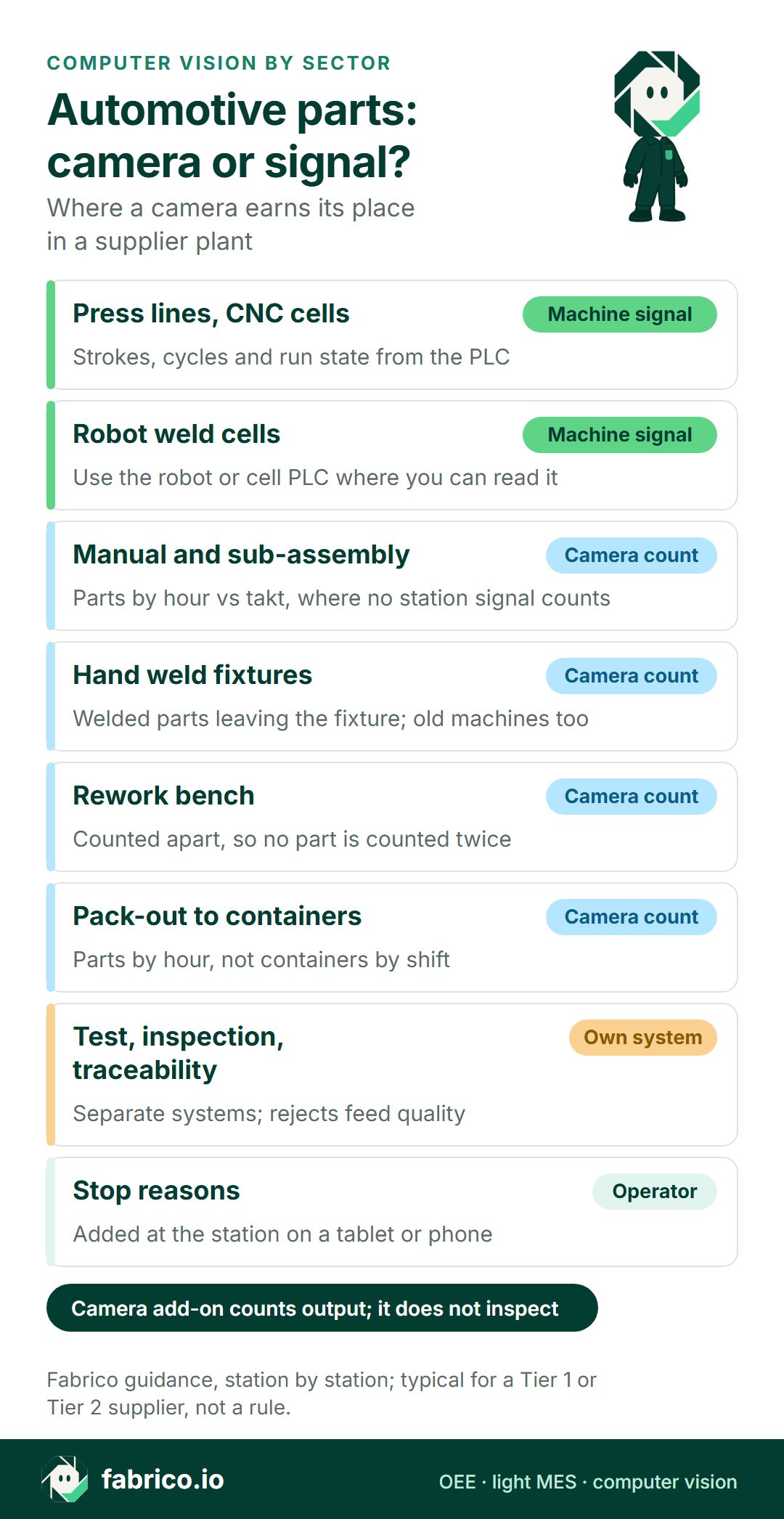
Camera, sensor or operator: station by station
This is typical for a parts supplier, not a rule. Check each station.
| Station | Count and stops from | What a camera adds |
|---|---|---|
| Press line | Press PLC: strokes x parts per stroke, and run state | Little. Use the signal. |
| CNC machining cell | Machine control: cycles and alarms | Little. Use the signal. |
| Robot weld cell | Robot or cell PLC | Count where the cell PLC is closed to you |
| Hand weld fixture | Welder arc-on signal, a clamp sensor, or nothing | Count of welded parts leaving the fixture |
| Sub-assembly and final assembly | Station PLC or nutrunner controller if fitted; often nothing | Count by hour against takt where no station signal gives a cycle-complete |
| Rework bench | Nothing | Rework count, kept apart from first-pass output |
| Pack-out into containers | Hand count per container | Count by hour as parts go in |
| Leak test, end-of-line test | Its own pass and fail count | Nothing. Feed rejects to quality. |
| Stop reasons, all stations | The operator, on a tablet or phone | Video to check a disputed reason |
If a station PLC already signals cycle complete, use it; the camera goes where nothing does. Start where the count is weakest, usually the assembly cell that sets the plant's output.
Bring your station list and one week of shift sheets to a demo, and we will go through it station by station.
Worked example: one manual sub-assembly cell against takt
These are example numbers, and they describe no real plant. A manual sub-assembly cell has an ideal cycle time of 60 seconds, so one minute of run time should make one part. The customer's call-offs need 420 parts a shift, so takt is about 68.6 seconds.
Planned production time is 480 minutes. A camera at the cell exit counts finished parts. The operator logs stops and reasons on a tablet. Parts sent to the rework bench are counted there.
Logged stops took 60 minutes: one changeover of 20, waiting for material 30, and a fixture fault 10. Run time is 420 of 480 minutes, so availability is 87.5%.
At 60 seconds a part, 420 minutes could make 420 parts. The camera counted 378, so performance is 90%. The missing 42 parts are short pauses and slow cycles that nobody logged.
Of the 378 parts, 14 went to the rework bench. That leaves 364 good first-pass parts, so quality is 96.3%.
OEE is 87.5% x 90% x 96.3% = 75.8%. Check it the short way: 364 good parts of 480 possible is also 75.8%.
Now compare with the call-off. The cell needed 420 good parts and made 364. The gap of 56 parts is the overtime, or the expedited freight, nobody planned.
The hourly view is what changes the shift. The three dips have reasons the operator logged. The slow running does not: the cell ran close to the ideal early on, then hours 5, 7 and 8 fell below takt pace with no stop logged. That is where a team leader can open the video for those minutes instead of guessing.
For how close a camera count gets to a hand count, read how accurate is camera OEE.
Eight checks for any automotive camera or OEE vendor
Run these with every vendor, and with us. Bring one real shift from last week as the test case.
| Ask | How to test the answer |
|---|---|
| What exactly does the camera count? | Parts, sub-assemblies or containers? Run it next to a hand count for one shift, per variant. |
| How does it handle variants? | Ask what happens when two similar variants run on one cell, and who retrains the count when a part changes. |
| How is stop time captured at a manual cell? | Ask what is live today and what is roadmap. Ask to see a manual station on the shift timeline. |
| Can the ideal cycle time change with the variant? | Ask to see two variants with different cycle times in one shift. |
| How are rework parts counted? | Ask how a repaired part is kept out of first-pass output, and how it avoids a second count if it passes the cell exit again. |
| Where does each camera mount? | Ask for each position on a drawing, clear of robot cells and safety guarding, and get sign-off from safety first. |
| Is video kept, and who can open it? | Ask where it lives, for how long, and who sees it. |
| How do test and inspection rejects get in? | Ask if the leak test or vision reject count feeds quality, so rejects count once. |
Before you roll out across the plant, test on one cell first. See our guide to a computer vision OEE pilot.
IATF 16949: what a camera count does and does not do
The IATF describes IATF 16949 as the automotive QMS standard that replaced ISO/TS 16949:2009, with a number of earlier customer specific requirements consolidated into it. Meeting it is the job of your quality system and your auditor.
A camera that counts output does not make a plant compliant, and it is not a traceability record. Fabrico does not do traceability, poka-yoke or inspection. Whether OEE and downtime records help your audit evidence is a question for your quality team.
For how an MES fits a supplier's quality system, read MES for automotive suppliers.
Cameras, privacy and the works council
Manual assembly is people work, and a camera at an assembly cell will see hands and arms. Tell staff before any camera goes up. In many European countries, talk to the works council first.
Frame the camera on the parts leaving the cell or going into the container, not on the operator. Report by cell and shift, not by person. Ask each vendor, us included, what privacy masking is live today and what is still roadmap.
The Fabrico camera add-on counts parts, not people. For a fuller checklist, read production line cameras without surveillance.
Where Fabrico fits
Fabrico is a cloud OEE and light MES platform. Here is what it does in a parts plant today.
- Stops and counts: from the machine signal, through the press or machine PLC, a sensor or a counter.
- Stop reasons: the operator adds them at the station, on a tablet or phone.
- OEE and losses: OEE, downtime and losses by line and shift, with losses shown in money. On the web, iOS and Android.
- Camera add-on, on request: AI cameras count output, including at manual assembly, hand weld fixtures, rework and pack-out, and on machines with no usable signal. With the add-on, you can open the camera video for any moment on the shift timeline. In the standard setup, video is streamed on request, not stored in Fabrico.
- Your data: it leaves through a REST API, webhooks and Excel or CSV export.
Roadmap, not live today: stops detected by the camera, jam zones on the video, and a camera suggesting a stop reason.
What Fabrico does not do: inspection, error proofing and traceability, which stay with the systems built for them. Test and inspection rejects can feed Fabrico's quality figure through the station's reject signal or counter.
For the full product, see Fabrico computer vision for OEE. If you are still comparing platforms, read our guide to OEE software and our list of OEE software for automotive manufacturing. All eight checks above apply to us too.
What people ask next
Which station in a parts plant should get the first camera?
Usually the manual assembly cell that sets the plant's output, or the pack-out area if it is the only place parts are counted. Presses and CNC cells with a signal you can read come last.
Can one camera count a cell that builds left-hand and right-hand variants?
Fabrico's camera add-on counts output at the cell exit. Look-alike variants are hard to tell apart on camera, so which variant is running comes from the operator or the order, not from the camera.
Does Fabrico replace our traceability system?
No. Fabrico does not do traceability, part genealogy or part marking. It measures OEE, downtime and losses. Keep your traceability system, and send its data and Fabrico's to the same reports through the REST API or exports.
Does a press line need a camera?
Usually not. A press PLC gives strokes and run state, which is a better count than a camera. A camera can still help on an old press with no usable signal.
What drives the cost of computer vision in a parts plant?
Pricing is set per quote. The drivers are the number of cells and cameras, mounting near robots and guarding, the network to the hall, and training. Give each vendor the same station list so the quotes compare.
Want to see it on a line like yours? Book a demo and bring one shift from an assembly cell.








Real Fabrico tiles, sample data.