


 Login
 Blog
Computer Vision for Battery Manufacturing: Module, Pack and End of Line

In short: computer vision in battery manufacturing pays back on the module and pack side: at hand pack stations, the rework bay and the hoist to the crate, where people do much of the work and nothing counts what leaves. On cell lines it adds little.
- Electrode coating, calendering, slitting, winding or stacking, filling and formation are highly automated. They already report through their PLCs and the plant MES.
- Electrode and cell inspection is a separate job for dedicated inspection systems. An OEE camera does not replace it.
- On module and pack lines, losses hide in changeovers between cell formats, waiting for cells and parts, short stops at stacking and welding cells, and rework after end-of-line test.
- Fabrico's camera add-on counts modules and packs where no serial scan does; the pack line operator records why it stopped, and a minute of station video can be streamed on request from the shift timeline.
A cell line is one of the most instrumented places in a factory. A pack line often is not: people place modules, route harnesses, plug connectors, torque covers and move finished packs to crates.
It follows the cell from coating to the crate: where a camera count adds something, where the PLC and the MES already have the number, and what to ask a supplier.
Computer vision for battery manufacturing: inspection or output count
Battery plants buy vision for two unrelated reasons. Surface, X-ray and weld systems decide whether an electrode, a cell or a busbar joint is good. An OEE camera decides nothing about the product; it counts modules and packs and lets you replay a minute at a stalled station.
They have different buyers, different specs and often different vendors. Keep them apart.
| Job in a battery plant | Inspection system | OEE camera |
|---|---|---|
| Coating defects on the electrode web | Yes, in-line surface inspection | No |
| Electrode alignment inside the cell | Yes, X-ray or CT | No |
| Weld and busbar checks | Yes, a dedicated weld check | No |
| Count modules or packs at manual stations | Counts only what it checks | Yes |
| Why the weld cell waited | Reject images only | Station video for that minute |
| What it gives OEE | Rejects per cell or weld | Modules and packs per hour |
Keep both. Rejects from surface, X-ray or weld inspection, taken from the station PLC or a counter signal, belong in the quality figure, and a rejected cell is not counted again downstream. An OEE camera makes no quality or safety call on a cell or pack. Fabrico does not sell inspection.
Where the cell line already has the data
Cell making is a chain of machines: mixing, electrode coating and drying, calendering, slitting, notching for stacked cells, then winding or stacking, tab welding, housing, electrolyte filling and sealing, then formation, ageing and grading.
These machines are fast, enclosed and costly, and many new plants connect them to an MES from the start. Each one already knows its run state, its count and its alarms. Many also carry their own inspection, such as thickness gauges and surface cameras on the coater, or X-ray after winding or stacking.
So an OEE camera adds little here. Read the machine signal or the MES instead. If your MES already gives OEE for the cell line, you may only need the module and pack side.
Formation and ageing need a word of their own. A 2019 paper in Joule by Wood, Li and An at Oak Ridge National Laboratory says wetting and formation may take 3 to 7 days, and ageing up to two more weeks. The authors add that these steps can take up to 25% of the floor space.
That is time in racks, not machine stops, and the formation system tracks it. Book it as process time, not as an OEE loss on the line that fed it. A camera has nothing to add there either. For OEE across electrode, cell and pack lines, see OEE for battery manufacturing.
Where the losses hide on module and pack lines
Volumes keep growing. The IEA's Global EV Outlook 2025 reports that battery demand in the energy sector, EV batteries and storage together, reached 1 TWh in 2024. It puts global cell manufacturing capacity at more than 3 TWh in the same year.
In the US, a 2025 Congressional Research Service report counts a record 54,400 people employed in battery manufacturing in 2024. It describes a downstream segment that assembles cells into modules and packs for each end use.
That downstream side is where many plants mix robots and people. The losses there look like this.
Changeovers between cell formats and variants
A module line may build for more than one cell format, pack variant or customer. Each switch means new fixtures, gripper fingers, weld programs and glue patterns, and often a first-off check before the line runs again.
The first-off check and the wait for sign-off are where the minutes hide. Give the changeover its own code, split it into stop, swap and restart, and see changeover time.
Waiting for cells and parts
Module lines wait for graded cells from formation or from a supplier. Pack lines wait for modules, trays, harnesses, BMS boards and covers. When one is late, a line that works perfectly stands still.
Code it as waiting for material, not as a breakdown, or maintenance chases the wrong problem. A station that starves or blocks the next one is covered in starvation and blocking.
Short stops at stacking and welding cells
Robot cells for stacking, busbar laser welding or wire bonding stop for short faults: a gripper misses a cell, a fixture does not clamp, or a weld cell waits for a part to be seated. Most clear in under a minute and never reach a stop sheet.
The cell PLC usually records these stops, if you can reach it. Read it first. Video helps when a short stop repeats and nobody can say what the robot was waiting for.
Manual and semi-manual pack stations
Pack assembly often has people at its core: placing modules in the tray, applying thermal material, routing harnesses, plugging connectors, fitting the BMS and torquing the cover. On a serialised EV pack line, the scan into the MES or traceability system already gives a count, so use it. Many stations still have no run state, and many storage, industrial and lower-volume pack lines have no reliable count at all.
Where no scan count exists, a camera pays off: it counts each module or pack as it is lifted off the station, so the hourly figure comes from the floor, not from memory. Our guide to computer vision OEE for manual assembly covers the method.
Rework after end-of-line test
Modules and packs that fail end-of-line test go to a rework bay, get fixed and come back. If the line counts them again when they pass, output looks better than it was.
Count good first time units for quality, and track rework on its own. See rework and the good count in OEE.
End-of-line handling, packing and older lines
Finished packs are heavy. They leave the line on a lift assist, a crane or a cart, and go into crates, racks or onto pallets, often with an operator on the hoist. That handling step rarely has a signal.
Lead-acid, industrial and some older lithium sites still run manual stations or machines with no usable PLC. A camera at the outfeed gives those lines a count.
Where a camera goes in a battery plant
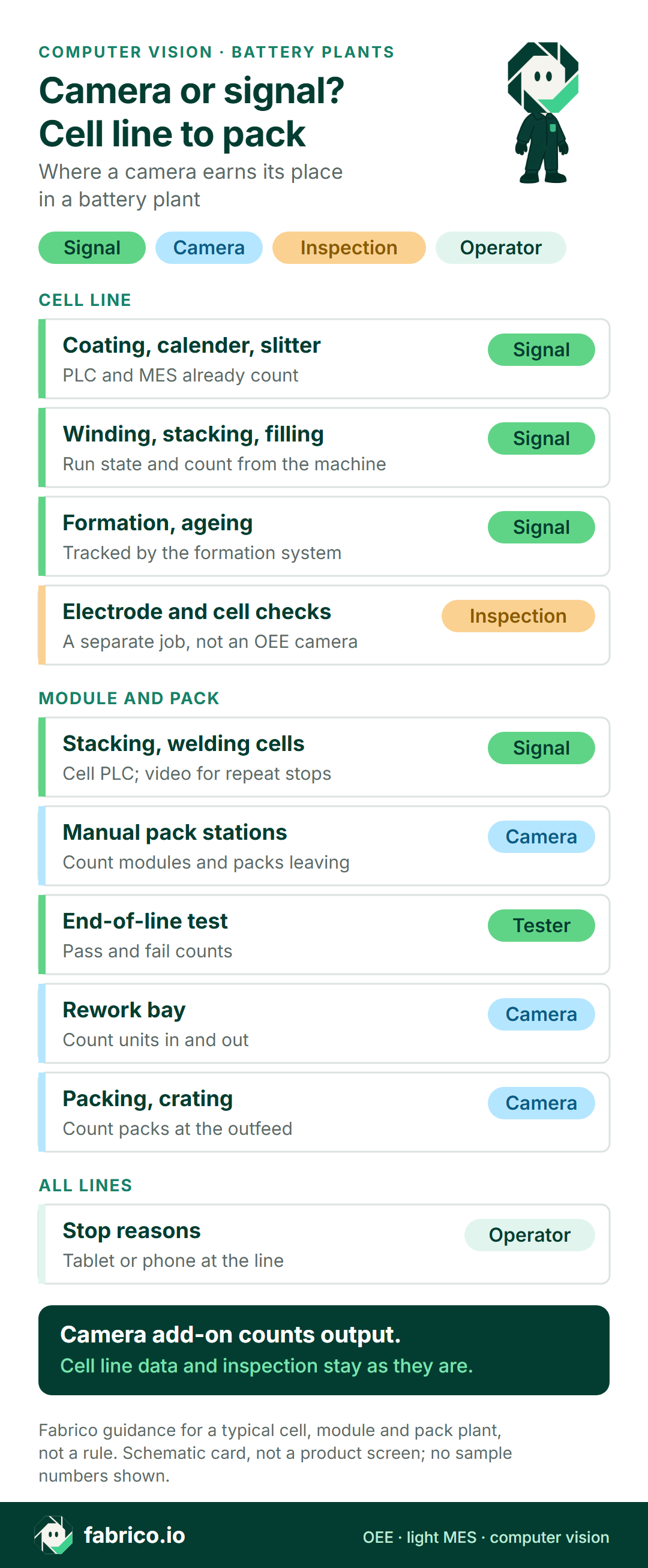
Here is one example: a cell line feeding a module and pack line.
For machines outside a battery plant, see camera or sensor, machine type by machine type.
Camera, signal or operator: station by station
Most battery sites look roughly like this, though a pack line bought from a smaller integrator may have stations with no reachable PLC at all. For other vehicle part lines, see computer vision for automotive parts manufacturing.
| Battery plant station | Count and stop data today | Camera add-on's part |
|---|---|---|
| Mixing, coating, drying | Machine PLC and MES | Little. Use the signal. |
| Calendering, slitting | Machine PLC and MES | Little. Use the signal. |
| Winding or stacking, tab welding | Machine PLC and MES | Little. Inspection is separate. |
| Filling, formation, ageing | Formation and process systems | Nothing for OEE. |
| Module stacking and welding cells | Cell PLC, if you can reach it | Video of repeat short stops; a count if the PLC is closed |
| Manual and semi-manual pack stations | Serial scans where every unit is scanned; often nothing else | Count of modules or packs leaving |
| End-of-line test | Tester pass and fail counts | None. Its fails set quality. |
| Rework bay | Paper or scans | Count of units in and out |
| Packing and crating | Usually nothing | Good count at the outfeed |
| Why a pack station stood | Pack line operator or team lead, tablet or phone | Station video for the minute in question |
The whole cell line can go without cameras; a pack line usually needs two to four, at the hand stations, the rework bay and the crate. How to size it is in how many cameras a line needs.
Before a demo, mark which pack stations scan every serial and which do not; we will start from the ones that do not.
Worked example: one module line, one shift
The figures are made up. A semi-manual module line works 12-hour shifts, as many battery plants do, and stops for two 30-minute breaks, so a shift has 660 planned minutes. Its ideal cycle is 60 seconds a module.
Run state comes from the welding cell PLC, passes and fails from the end-of-line tester. A camera add-on over the manual unload station counts each module lifted onto the outbound rack, so every hour of the shift has its own number.
The line stood for 160 minutes: 55 waiting for graded cells from formation, 45 on one switch of cell format, 40 in short stops at the welding cell and 20 on one gripper breakdown. It ran 500 of 660 minutes, an availability of 75.8%.
At one module a minute, 500 running minutes could make 500 modules. The camera add-on counted 455 off the line, the same total the tester saw: performance is 91.0%. The other 45 minutes are slow running, and the hourly count puts most of them in the two hours after the format change.
End-of-line test failed 13 modules, which went to the rework bay. Good first time is 442 of 455, a quality of 97.1%. When those 13 come back and pass, they are not counted as good a second time.
OEE: 75.8% x 91.0% x 97.1% = 67.0%. The short way agrees: 442 good modules out of 660 possible is 67.0%.
From the tester total alone, the 45 slow minutes would be one shortfall at shift end with no hour attached. And waiting for cells, the biggest stop here, is a formation and logistics problem; booked as a breakdown, it would send maintenance after the wrong thing.
Eight checks for any battery camera or OEE vendor
Use them with each supplier, and with us, and test the answers on last week's end-of-line test log and one shift of pack line stop notes.
| Ask | How to test the answer |
|---|---|
| What do you do with our cell line data? | Ask how coater, winder and formation data from the MES and the pack serial scans are used first, with cameras only at stations no scan covers. |
| Does it count modules, packs or crates? | Run it at the unload station for a shift and match it, module for module, against the end-of-line tester log. |
| How do cell formats and pack variants change the ideal? | Ask to see the ideal cycle switch with the variant, and a format change shown as its own stop on the shift timeline. |
| Where does waiting for material go? | Ask for its own code, and a weekly report of minutes lost waiting for graded cells, BMS boards or covers. |
| How do tester fails and rework count? | Ask how fails reach quality, and how a reworked unit stays out of the good count. |
| Where do cameras go around high-voltage pack stations? | Ask for each position on a drawing, outside the HV work zone and hoist path, signed off by plant engineering and EHS before anyone drills. |
| Who can replay pack station video? | Ask if any footage is retained, on whose servers, for how many days, and whether a team lead can pull up the assembly of one pack. |
| Can cameras stay off the cell line network? | Ask for bandwidth per camera and how the cameras are kept apart from the MES, formation and dry room systems under your OT rules. |
Begin with one pack line and its rework bay, not the whole site; the steps are in the computer vision OEE pilot guide.
Cameras, privacy and the works council
Pack stations are staffed all shift, and a camera over one will pick up arms, gloves and the odd face. Tell the pack crews what it is for before it is mounted, and if the plant has a works council, as many European battery sites do, take the plan to the council first.
Point it at the module or pack leaving the station, not at the person torquing the cover, with figures per line and shift only. Ask every supplier, Fabrico as well, which privacy masking already works on a pack station and which is still on a roadmap.
The add-on counts modules and packs; it has no use for who built them. The steps for briefing crews and the council are in production line cameras without surveillance.
Where Fabrico fits
Fabrico gives a battery plant cloud OEE and light MES for the module and pack side, next to the cell line MES rather than in place of it.
- Stacking, welding and test: run state, stops and counts from the cell PLC or the end-of-line tester, or from a sensor or counter where a station has no usable data.
- The reason a pack station stood: the pack line operator or team lead taps it in on a tablet or phone, such as no graded cells, BMS board missing or format change.
- Per shift: OEE, downtime and losses by line and shift, with lost modules priced in money, on the web, iOS and Android.
- Hand stations, rework and crating (camera add-on, on request): the add-on counts modules and packs at manual pack stations, units in and out of the rework bay, and packs going into crates. Choose a moment on the timeline and that station is streamed to you on request; the standard setup does not keep it in Fabrico.
- To the MES or ERP: counts, stops and reasons go out through the REST API or webhooks, or as Excel or CSV files.
Roadmap, not live today: the camera add-on spotting stops on its own, marking jam zones on the video, and offering a stop reason.
What Fabrico does not do: inspection of electrodes, cells or welds; that stays with your inspection systems, whose reject signal or counter can feed Fabrico's quality figure. Fabrico is not a cell line MES, does not run formation. For pack line planning, bring one week's build plan to the call and we will walk through the options.
The product page is Fabrico computer vision for OEE, an add-on to the OEE platform. For a wider comparison, see our guide to OEE software and our list of OEE software for EV battery manufacturing, and hold us to the eight checks above.
Send us the pack line layout, with each station marked scan or no scan, before a demo; we will show which numbers come from the tester and PLCs and which the add-on would add.
What people ask next
Which battery station should get the first camera?
A manual pack station with no serial scan, in most plants, then the rework bay and the crating area where finished packs leave on a hoist. Cell line machines with a PLC or MES count come last, if at all.
Can an OEE camera inspect electrodes, cells or welds?
No. That is inspection, done by dedicated systems such as in-line surface inspection, X-ray and weld checks. Fabrico does not sell inspection. The inspection station's reject count can feed the quality part of OEE.
Does the cell line need cameras?
Rarely for OEE. Coaters, calenders, slitters, winders, stackers and formation systems already report run state and counts through their PLCs and the MES. Read those signals and put cameras where no signal exists.
How should rework after end-of-line test count in OEE?
Count good first time units for quality. A unit that fails, gets reworked and passes later does not count as good a second time. Track rework time and units as their own figure. See rework and the good count in OEE.
Want to see your pack line's real OEE? Bring one week of end-of-line test logs to a demo, and we will rebuild a shift from them with you.
Related articles













Real Fabrico tiles, sample data.