


 Login
 Blog
Computer Vision for Switchgear and Electrical Equipment Manufacturing

In short: computer vision in switchgear and electrical equipment manufacturing earns its place at the hand-work stations that have no count: series board and wiring benches, manual end stations on breaker and contactor lines, high-volume core stacking, and packing and crating.
- Busbar CNCs, punching, winding machines and automated breaker lines already send a signal. Read it first.
- Engineer-to-order switchgear bays finish a few sections a week. Count them as milestones on a tablet, with the ideal from routing minutes.
- Hipot, routine tests and checks of wiring and nameplates belong to test and inspection systems. Their fail count can feed the quality part of OEE.
- Fabrico's camera add-on counts boards, doors and crates where no scan exists; from the shift timeline you can stream a bench's video for a given minute, and in the standard setup that video is not stored.
A busbar CNC knows how many bars it punched. A winding machine knows when it stopped. A routine test bench knows which section failed its power-frequency test.
The gaps sit between them: hand wiring benches, packing tables and crating bays with no count.
Fabrico sells the camera add-on discussed here, so check our claims against your own routine test records.
Computer vision for switchgear plants: count, check or test?
In this industry three systems end up under the label "vision" or "quality data". Only one of them is about OEE.
| Job in the plant | Who does it | OEE camera add-on |
|---|---|---|
| Wire presence, terminals, ferrules | Inspection vision or the wiring system | No |
| Nameplate, rating label, serial | Label or code verification | No |
| Hipot, insulation, secondary circuit checks | Routine test system | No |
| Count boards, doors or cartons with no scan | Often nobody | Yes |
| Video of the minute a bench stood still | Not a test system's job | Yes, streamed for that minute |
Every switchgear section and assembly gets routine tests before it ships: under IEC 62271-200 for metal-enclosed medium voltage switchgear, and as routine verification under IEC 61439 for low voltage assemblies. Their pass and fail records, read from the test system or a counter signal, belong in the quality part of OEE. Rating plates and serial labels are a code-reading job; the difference from counting is covered in label and code vision vs an OEE camera.
One industry, five kinds of shop floor
Electrical equipment is a large employer. Eurostat business statistics for electrical equipment manufacturing (NACE C27) count 42,468 enterprises and 1,507,915 persons employed across the EU in 2021, the latest year reported without estimates. In Germany, the trade body ZVEI puts employment in the German electrical and digital industry at about 873,000 people at the end of 2025, a wider group that also covers electronics.
Order books for grid equipment are full. In an IEA survey of leading grid industry players for Building the Future Transmission Grid, the International Energy Agency found that average lead times for cables and large power transformers have almost doubled since 2021, and that large power transformers can take up to four years to secure. With delivery slots that tight, an hour lost in an assembly bay moves a delivery date.
Sheet metal, enclosures and busbar
Enclosures come from punching, laser and press brake cells; busbar from CNC machines that cut, punch and bend copper or aluminum. Their controllers give part counts and run states, so read them. For the camera view of a sheet metal shop, see computer vision for metal fabrication.
Switchgear and switchboard bays
Medium voltage switchgear and large low voltage switchboards are built to order. Each line-up is configured for one project from type-tested designs, with some engineering on top, so plants call it engineer-to-order or configure-to-order. A crew builds sections in a fixed bay: frame, circuit breakers on withdrawable trucks or switch-disconnectors, busbar, then primary connections and secondary wiring. One section can take a day or more.
Wiring is a large share of that time. In a Rittal reference case on a Swiss switchgear builder's wire processing, Rittal writes that before that builder automated wire processing, almost half of its production time had been spent on wiring. Rittal sells the machine in that case, so treat it as one vendor-published example, not an industry average.
There is no PLC in a bay. The useful data is milestones: section started, busbar fitted, wiring done, ready for test. See make to order vs engineer to order.
Series boards, relay doors and looms
Distribution boards, meter cabinets and small control panels are often built in series at benches, tens a shift, with relay doors and looms wired at their own benches. Wire processing machines have counters; the hand wiring after them usually has none.
If each board is scanned at a station, that scan is your count. If it is not, put the camera add-on here: it counts boards, relay doors or looms as the wireman slides them off the bench. See OEE for wire harness assembly for the loom side.
Circuit breakers and contactors
Miniature breakers and contactors come off automated lines with a PLC per station and in-line test. Read them. The camera add-on fits manual stations for larger frames such as air circuit breakers, and hand packing tables.
Transformers
Coil winding machines have turn counters and a run state. Core cutting lines slit and cut the electrical steel and give a count. Stacking is often hand work, though some plants stack by machine and many distribution transformers use wound cores. Drying ovens or vapor-phase plants, tanking and oil filling each run on their own controller.
A large power transformer takes weeks, so OEE there is about milestones. Distribution transformer lines make tens of units a day, and a camera add-on can count stacked cores where nothing else does. The transformer test bay logs every routine test, so read it for quality.
Motors
Winding and coil insertion machines have signals, and VPI runs on a controller. The end-of-line test bench logs the motors it tests, so read it first. A camera add-on fits packing and manual stations with no bench data.
OEE when one section takes days
A switchgear bay makes a few different things slowly, so three habits from fast lines break.
- Units per hour mean little. A feeder and an incomer are different amounts of work. Set the ideal per section type from routing minutes, and measure performance as earned minutes against run time.
- A finished count comes once a day or less. Credit work at milestones, so a half-built incomer shows as work done, not slow running.
- Stops are long, few and rarely a machine fault. Waiting for parts, a drawing revision, the crane or the test bay. The bay lead logs them on a tablet as they start.
Be honest about the camera here. At a few sections a week, a tap on a tablet counts output as well as a camera does. In a bay, the camera add-on pays when you want the video for a moment on the timeline, such as a section left untouched for two hours. For the general method, read measuring OEE on manual and hybrid assembly lines and computer vision for OEE on manual assembly.
A plant map: signal, test record, tablet or camera
One example plant, from sheet metal to crating.
Area by area: what already counts, and what a camera adds
A starting point for a switchgear, panel, transformer or motor site. Check each machine and bench before you decide.
| Area | Output and stops come from | Camera add-on's part |
|---|---|---|
| Punching, press brake, busbar CNC | Machine controller | Little. Read the signal. |
| Engineer-to-order bay | Bay lead on a tablet: milestones and stops | Video of a long wait, if a camera is there. Not the count. |
| Series board, door and loom benches | Station scan, if fitted | Count where no scan exists |
| Breaker and contactor lines | Line PLC and in-line test | Little. Read the line. |
| Manual end stations, larger frames | Often nothing | Count off the station |
| Coil winding, coil insertion | Machine counters | Little. Read the signal. |
| Core cutting line | Machine controller | Little. Read the signal. |
| Core stacking, distribution transformers | Often a paper sheet | Stacked cores, where volume is high |
| Drying ovens, VPI, oil filling | Controller and batch records | Nothing. Read the controller. |
| Routine test, hipot | Test system: pass and fail per section | None. Test fails set quality. |
| Packing and crating | Often the shipping note | Packed count by the hour |
Before a demo, sketch one hall: bays, benches, CNCs and the test room, with what each reports today. We will mark which numbers come from signals, which from test records and which need a camera add-on.
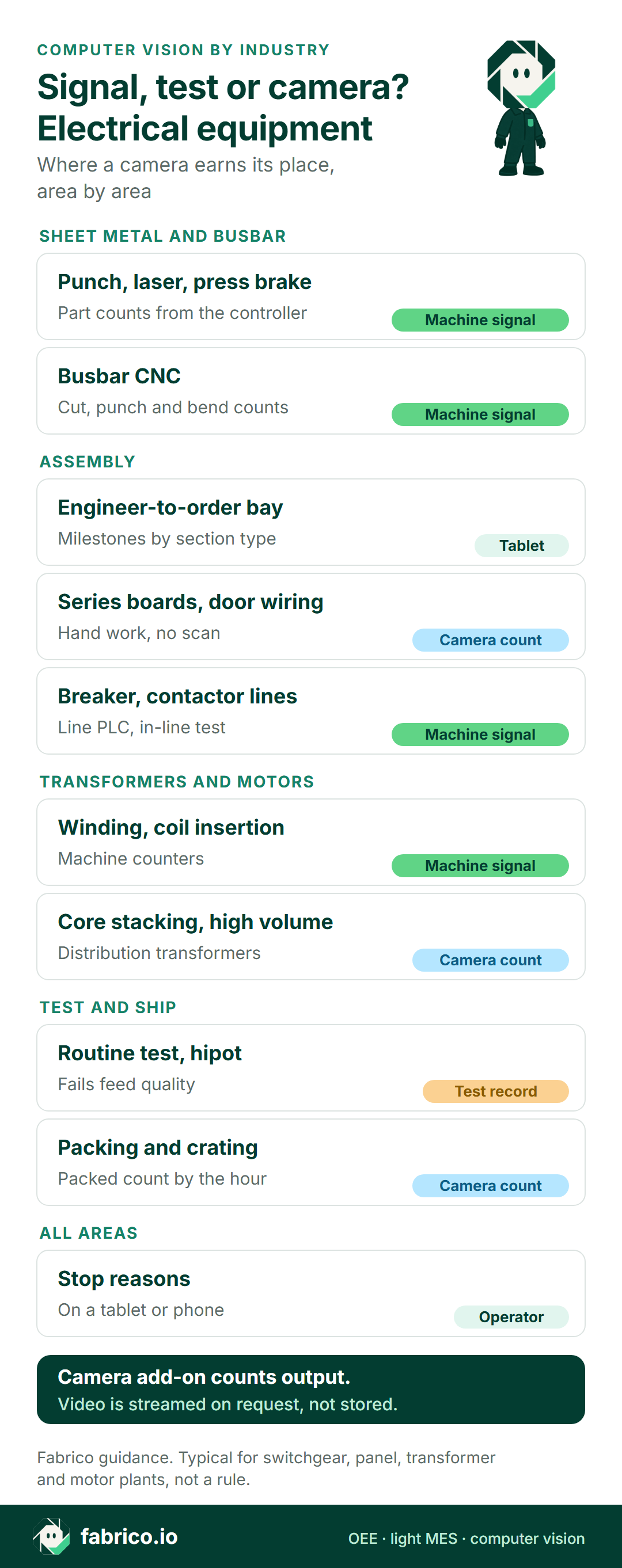
Text version of this infographic
- Machine signal: punch, laser, press brake; busbar CNC; breaker and contactor lines; winding and coil insertion.
- Tablet milestones: engineer-to-order bay.
- Camera count: series boards and door wiring; high-volume core stacking; packing and crating.
- Test record: routine test and hipot.
- Operator: stop reasons, on a tablet or phone.
- Camera add-on counts output; video is streamed on request, not stored.
Worked example: one medium voltage switchgear bay, one week
Example numbers, no real plant. One crew works a medium voltage bay on day shift, five days of 450 planned minutes: 2,250 minutes.
Routing gives standard minutes per section type: a feeder is 300 minutes of work, an incomer 390, a metering section 210. These are bay minutes for the whole crew: if routing is in labour hours, divide by crew size first. The bay lead taps milestones and stops on a tablet. The routine test system logs the result for each section. There is no camera in this example.
Availability. The bay stood still for 450 minutes: waiting for busbar from the CNC 180, a breaker late from the supplier 105, a drawing revision 120, waiting for the crane 45. Run time is 1,800 of 2,250 minutes, so availability is 80.0%.
Performance. The crew finished three feeders, one incomer and one metering section: 3 x 300 + 390 + 210 = 1,500 earned minutes. For simplicity, no section was half built at the start or end of the week; in a real week, credit those at their milestones. Performance is 1,500 of 1,800, or 83.3%. The 300-minute gap is work routing did not credit: hunting for parts, re-reading a revised drawing, one fitter waiting on another.
Quality. At routine test, one feeder failed the auxiliary and control circuit check and went back for rework. First-pass earned minutes are 1,200 of 1,500, so quality is 80.0%. Weighting by standard minutes matters: a failed feeder costs more than a failed metering section.
OEE. 80.0% x 83.3% x 80.0% = 53.3%. The short way agrees: 1,200 first-pass earned minutes of 2,250 planned is 53.3%.
The largest loss is waiting for parts: 285 minutes from busbar and the late breaker. No camera finds that; a stop code at the bay does, and it points at busbar scheduling and purchasing, not the crew. See rework and the good count in OEE for the quality side.
In this plant, a camera add-on would go on the bench that wires relay doors for these sections, and at the crating bay, where nothing is counted today. The bay runs on the tablet.
Six questions to put to any vendor selling cameras into an electrical plant
Put them to each supplier, and to us, using one real week of milestones and routine test results from one bay.
| Ask | How to test the answer |
|---|---|
| How do you measure a bay that finishes one section a day or less? | Ask for an ideal per section type and credit at milestones, not units per hour. |
| Where do stops in a bay come from? | Ask to see a bay lead log a waiting-for-material stop on a phone, with the part family. |
| How do routine test results reach quality? | Ask how hipot and wiring check fails from the test system reach the quality figure, weighted by section type. |
| What does the camera count on a wiring bench? | Boards, doors, cartons or crates? Ask how it tells apart two board types that look alike. |
| Where do the cameras go in a hall with cranes? | Ask for positions on a hall drawing, clear of cranes, forklifts and crate stacks. |
| Which areas of the plant would you leave without a camera? | Expect them to name the ETO bays, the busbar CNC and the breaker lines. A vendor who wants a camera everywhere is selling cameras. |
Start where counts are missing and volume is high: series board benches and crating, not the ETO bay. Sizing help is in how many cameras a line needs for OEE, and the machine-by-machine split in camera or sensor, by machine type.
Skilled hands on camera: privacy and the works council
Wiring is skilled work, and the people doing it will ask why a camera is there. Answer before anything is mounted, and in many European countries take the plan to the works council first. Point the camera at the bench outfeed or the crating table, not at the wireman, and report by bench and shift only. Ask each supplier, and us, whether masking works today on a bench where hands are in every frame, or only later.
The add-on counts boards and crates; who wired them is not its concern. More in production line cameras without surveillance, and for crating and packing, OEE cameras at manual packing stations.
How Fabrico does it
Fabrico is OEE and light MES software that runs in the cloud. In an electrical equipment plant it puts busbar, winding and breaker line signals, bay stops and camera add-on counts from the benches into one shift picture.
- Busbar, winding and breaker lines: run state, stops and counts come from the busbar CNC, the winding machine or the line PLC, or from a sensor or counter on a machine without a port.
- Why a bay or bench stood: the bay lead or wireman picks the reason on a tablet or phone, for example busbar not cut, breaker late or drawing revised.
- Shift results: OEE, downtime and losses by line and shift, with lost output in money, on the web, iOS and Android.
- Benches with no scan (camera add-on, on request): it counts series boards, relay doors, larger breaker frames off manual end stations, stacked cores and crates where nothing scans. Click a minute on the shift timeline and the add-on streams that bench's video on request; in the standard setup it is not stored in Fabrico. How those counts become OEE is in OEE with computer vision.
- Getting the numbers out: bay and line results can be pulled into the ERP through the REST API or webhooks, or exported to Excel or CSV for the weekly bay review.
Roadmap, not live today: stop detection and stop-reason suggestions by the camera add-on.
What Fabrico does not do: inspection, routine testing and hipot, which stay with your test systems; their fail signal or counter can feed Fabrico's quality figure. Sequencing engineer-to-order projects is its own topic; bring the project list to the call and we will go through what fits.
The product is described on Fabrico computer vision for OEE. If you are still comparing, see our guide to OEE software and the comparison of computer vision tools for manufacturing OEE.
Questions buyers ask about cameras in electrical plants
Does an engineer-to-order switchgear bay need a camera to measure OEE?
Usually not for the count. A bay finishes a few sections a week, and a milestone tap on a tablet counts them. A camera add-on helps when you want to open the video of a long wait in the bay.
Can a camera check wiring, terminals and nameplates?
That is inspection, a different system from an OEE camera. Wiring checks, label and nameplate verification belong to inspection vision and to the routine test. Fabrico does not sell inspection. The fail count from those systems can feed the quality part of OEE.
How should a failed routine test count in OEE?
Count a section as good only if it passed the first time. Read the result from the test system, and weight it by the section's standard minutes, so one failed incomer weighs more than one failed metering section.
Want to see what your bays lose in a week? Bring one week of bay stop notes and routine test reports to a demo, and we will show which numbers Fabrico can fill.









Real Fabrico tiles, sample data.