


 Login
 Blog
Computer Vision for Metal Fabrication: Welding Bays, Grinding and Pack-Out

In short: computer vision for metal fabrication earns its place at the manual stations: welding bays, grinding and deburring, older press brakes, assembly, powder coating hang and unload, and pack-out. There, cameras count parts or batches where nothing else counts, and let you open the video of a stop.
- Lasers, plasma tables, CNC press brakes and machining centers already have controllers. Read their signal first, through MTConnect or OPC UA where the machine offers it.
- Weld inspection is a different job, done by inspectors, NDT or dedicated weld inspection systems. An OEE camera does not inspect welds.
- In a high-mix, low-volume shop, count by part or batch against the routing, not by units per hour.
- Losses hide in setup and changeover, waiting for material or the crane, and waiting for first-off approval.
Your laser knows when it cuts. Your welding bay does not report anything. The parts on the outbound rack are the only proof of what the shift made.
This page is for plant managers, operations leads and CI engineers in job shops and contract fabricators who are choosing where to put cameras and how to get an honest OEE figure.
It shows where a camera earns its place, where the controller is enough, and what to ask each vendor.
Computer vision for metal fabrication: two different jobs
Two kinds of camera system get sold to fabricators under one name. Inspection systems judge the part. OEE cameras count the parts and show you what happened at a station.
They come from different vendors and answer different questions, so keep them apart in the spec.
| Job in the shop | Inspection | OEE camera |
|---|---|---|
| Weld quality | Inspector, NDT or weld vision | No |
| Dimensions, hole positions | Gauges, CMM, laser scan | No |
| Bend angle | Protractor, or the brake's own angle measuring | No |
| Count parts or batches | Rarely | Yes, also at manual stations |
| Video of a stop | No | Open the video for that minute |
| Feeds OEE through | Scrap and rework counts | The output count |
If you searched for machine vision in fabrication and found weld inspection, this page is about the other job.
The two work side by side. Your scrap and rework counts, booked by the inspector or the station, feed the quality part of OEE. The camera never decides whether a weld is good.
Where the losses hide in a fabrication shop
Fabrication is a big, labor-heavy trade. In the US, fabricated metal product manufacturing employed about 1.47 million people in October 2026, a preliminary figure from the Bureau of Labor Statistics. In the EU, Eurostat ranks fabricated metal products among the largest manufacturing divisions by employment, on 2023 data.
Much of that work is done by hand. The BLS Occupational Outlook Handbook counts about 437,700 welder, cutter, solderer and brazer jobs in 2025, and 63% of them in manufacturing.
That is why a shop can have connected lasers and still not know what half its stations made. Here is where the hours go.
Setup and changeover on lasers and brakes
High mix means many short jobs. On a laser, that is sheet loading, nest changes, nozzle and lens checks, and program call-up. On a press brake, it is tooling changes, backgauge setup and test bends on every new part.
Book setup as its own code, by job, so it does not hide inside run time. Our pages on OEE for laser cutting and OEE for press brakes go machine by machine, and changeover vs setup time sets out the terms.
Waiting for material, cranes and forklifts
Heavy parts move by overhead crane or forklift, and one crane often serves several bays. A welder with a fixture ready and no part in it is waiting, and that wait rarely gets written down.
Give waiting for material, waiting for the crane and waiting for the previous operation their own codes. They point at different owners: planning, the crane schedule, or the station upstream.
First-off approval
After a setup, the first part often waits for a quality sign-off before the batch can run. On a short job, that wait can be a large share of the whole run.
Track the time from first part to sign-off as its own stop. See first-off approval after changeover.
Manual welding bays
Welding time is only part of a welder's shift. Miller, a welding equipment maker, writes that average arc-on time in a semi-automatic welding operation is only 10-12%, and that the figure leaves out fit-up, preparation and post-weld grinding. That is a vendor's figure, not a study, so measure your own bays.
For OEE, arc-on time is not the point. The count of finished parts against their standard times is. A camera at the bay counts the parts that go onto the outbound rack, and the welder records which job they belong to, so output by hour stops being a guess.
Robotic welding cells are different: the robot controller knows when the cell runs. See OEE for robotic welding cells.
Grinding, deburring and assembly
Grinding and deburring are manual, dusty and noisy, and they have no signal to read. Neither does a bench where frames, brackets or kits get assembled.
A camera that counts parts leaving the station gives these steps a count for the first time. Stop reasons still come from the people there. For assembly benches, see computer vision OEE for manual assembly.
Older brakes and the powder coating line
Many shops run an older brake with no controller data next to a new CNC brake. A camera over the finished stack counts what the old brake makes.
On a powder coating line, the conveyor and oven run at a set speed. The losses sit at the hang and unload stations: empty hooks, gaps and parts that wait for a free hanger. Colour changes, with the booth cleanout they need, are often the largest planned stop in batch coating, so give them their own code. A camera at the load or unload station counts loaded hangers or racks per hour against what the conveyor could carry.
Pack-out and dispatch
The last count in the shop is the one the customer pays for. Pack-out is often manual, so a camera there counts packed parts or kits, which someone can check against the packing list.
Where a camera goes in a fabrication shop
Here is one example: a job shop with cutting, forming, welding, finishing and pack-out.
For a longer list by machine type, see camera or sensor for OEE, machine by machine.
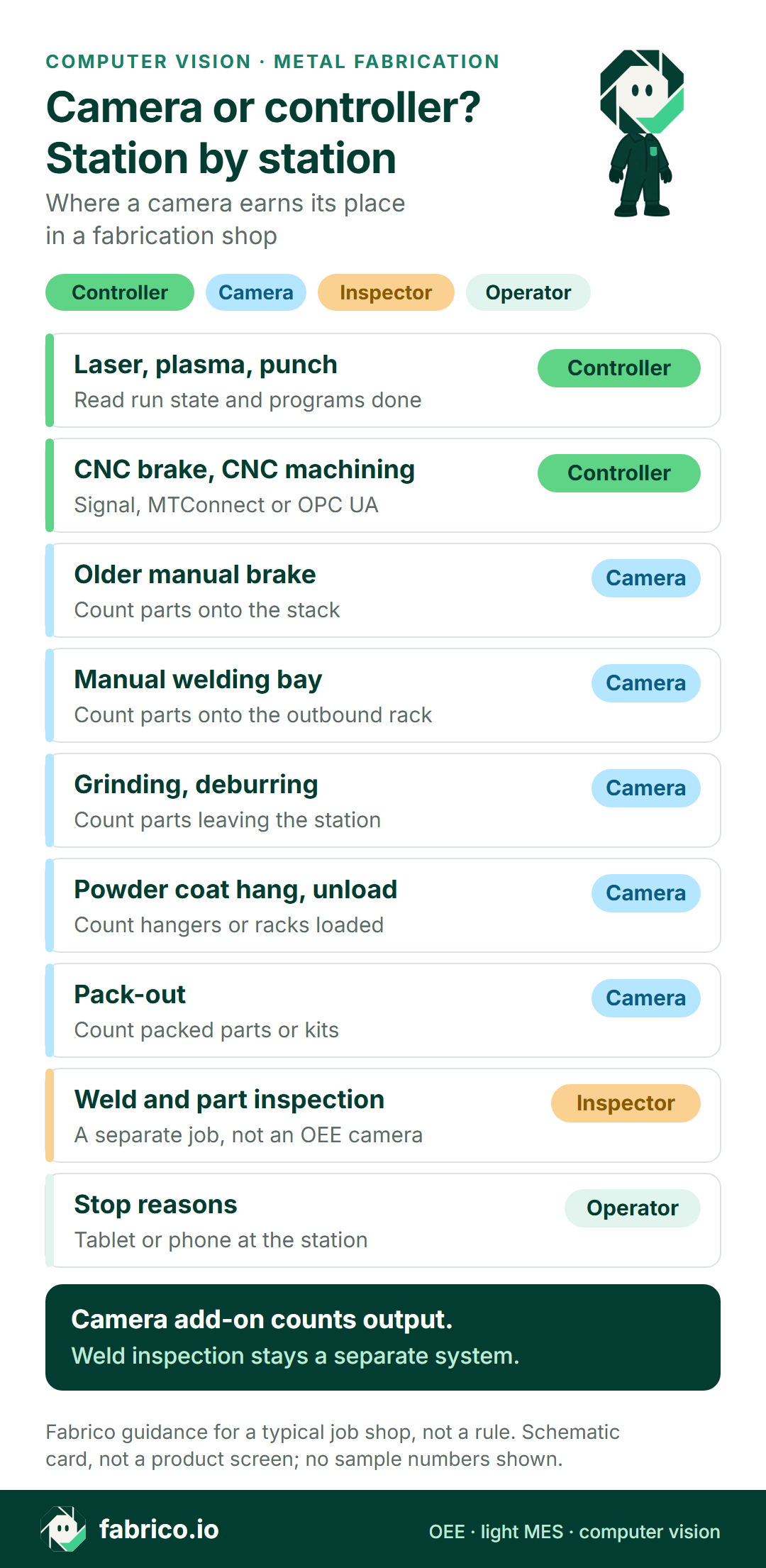
Camera, controller or operator: station by station
This is typical for a fabrication shop, not a rule. Check each machine.
| Station | Count and stops from | What a camera adds |
|---|---|---|
| Laser, plasma, punch | Controller: run state and programs done | Little. Use the signal. |
| CNC press brake | Controller or a run signal | Video of a disputed stop |
| Older manual brake | A stroke sensor at most, which counts hits, not parts | Count of parts onto the stack |
| CNC machining | Controller, MTConnect or OPC UA | Little. Use the signal. |
| Robot weld cell | Robot controller | Video of what led up to a stop |
| Manual welding bay | Nothing, or a paper sheet | Count of parts onto the rack |
| Grinding, deburring, assembly | Nothing | Count of parts leaving the station |
| Powder coating hang and unload | Conveyor speed only | Count of hangers or racks loaded or unloaded |
| Pack-out | Packing list | Count of packed parts or kits |
| Stop reasons, all stations | The operator, on a tablet or phone | Video to check a disputed reason |
For controller data, see our guides to MTConnect and OPC UA for OEE. You rarely need a camera at every station. The card below shows where one pays off.
Bring your station list and one week of job sheets to a demo, and we will go through it station by station.
Worked example: one welding bay, three jobs, one shift
These are example numbers, and they describe no real shop. A manual welding bay runs three jobs in one 480-minute shift: 39 brackets at a standard time of 4 minutes each, 4 frames at 25 minutes and 5 base plates at 10 minutes.
The bay has no signal. A camera at the bay exit counts finished parts as they go onto the outbound rack. The camera does not know which job a part belongs to: the welder records which job is running, from the job sheet, so each counted part is booked against that job's standard time. The welder also logs stops and reasons on a tablet.
Stops took 120 minutes: two setup and fixture changes 50, waiting for material 35, waiting for the crane 20, and waiting for first-off approval 15. Run time is 360 of 480 minutes, so availability is 75%.
With mixed parts, you count in standard minutes. The bay made 39 brackets (156 minutes), 4 frames (100) and 5 plates (50): 306 standard minutes in 360 minutes of run time. Performance is 85%. The gap is 54 minutes of slow running.
Three brackets went back for rework: 12 standard minutes. Good output is 294 standard minutes, so quality is 96.1%.
OEE is 75% x 85% x 96.1% = 61.3%. Check it the short way: 294 good standard minutes of 480 is also 61.3%.
Two things change when the count is right. Waiting for the crane shows up as its own loss, every shift, with an owner. And when the frame job runs long, someone can open the video for those minutes instead of guessing.
For the full OEE method in a shop like this, read OEE for metal fabrication.
Eight checks for any computer vision or OEE vendor in fabrication
Run these with every vendor, and with us. Bring one real shift from last week as the test case.
| Ask | How to test the answer |
|---|---|
| How do you count in high mix? | Ask to see three jobs with different standard times in one shift, counted by part or batch. |
| What exactly does the camera count? | Parts, batches or kits? Run it next to a hand count at one welding bay for a week. |
| How is setup booked? | Ask for setup as its own code, by job, apart from run time. |
| Can you read our controllers? | Name the laser, brake and CNC models. Ask which give a signal, MTConnect or OPC UA. |
| How do waits get a code? | Ask how waiting for material, the crane and first-off approval show up, and who owns each. |
| Does it cope with sparks and dust? | Ask where the camera mounts near welding and grinding, and what happens to the count when the lens gets dirty. |
| Is video kept, and who can open it? | Ask where it lives, for how long, and who sees it. |
| How do scrap and rework get in? | Ask how rework and scrap reach the quality figure, so each part counts once. |
Before you buy, read how accurate camera OEE is, and test one station first with a computer vision OEE pilot.
Cameras, privacy and the works council
A welding bay has a person in it for the whole shift, so a camera pointed into the bay sees that person. Tell staff before any camera goes up. In many European countries, talk to the works council first.
Frame the camera on the outbound rack, the stack or the packing table, not on the welder. Report by station and shift, not by person. Ask each vendor, us included, what privacy masking is live today and what is still roadmap.
Fabrico's camera add-on counts parts, not people. For a fuller checklist, read production line cameras without surveillance.
Where Fabrico fits
Fabrico is a cloud OEE and light MES platform. Here is what it does in a fabrication shop today.
- Stops and counts: from the machine signal, through the controller, a sensor or a counter.
- Stop reasons: the operator adds them at the station, on a tablet or phone.
- OEE and losses: OEE, downtime and losses by station and shift, with losses shown in money. On the web, iOS and Android.
- Cameras, an add-on on request: the AI camera add-on counts output at manual stations, with the camera framed on the outbound rack, stack or packing table rather than on the arc. With the add-on, you can open the camera video for any moment on the shift timeline. In the standard setup, video is streamed on request, not stored in Fabrico.
- Your data: it leaves through a REST API, webhooks and Excel or CSV export.
Roadmap, not live today: stops detected by the camera, and a camera suggesting a stop reason.
What Fabrico does not do: weld inspection or dimensional inspection, which stay with your inspectors and gauges and feed Fabrico's quality figure through scrap and rework counts. Fabrico does not nest parts or write CNC programs. For planning and scheduling, ask us in the demo.
Devices connected in about a month; full rollout in 3 to 4 months.
For the full product, see Fabrico computer vision for OEE. If you are still comparing platforms, read our guide to OEE software, the shortlist of OEE software for metal fabrication and welding, and MES for metal fabrication. All eight checks above apply to us too.
What people ask next
Can a camera inspect welds in a fabrication shop?
Not an OEE camera. Weld inspection is done by qualified inspectors, NDT methods or dedicated weld inspection systems. Fabrico does not inspect welds. Its camera add-on counts parts leaving the welding bay, and your scrap and rework counts feed the quality part of OEE.
Which station should get the first camera?
Usually the manual station that sets the pace and has no count: a welding bay, a grinding and deburring station, or an older brake. Lasers, plasma tables and CNC machines with a controller you can read come last.
Do lasers and CNC press brakes need a camera?
Usually not. They have controllers that know when they run and which programs or sheets they finish; part counts per job come from the nest or the program. Read them by signal, or through MTConnect or OPC UA where the machine offers it. A camera adds video of a disputed stop, not a better count.
How does OEE work in a high-mix, low-volume shop?
Count by part or batch, and give each part its standard time from the routing. Performance is the standard minutes made divided by run time. Quality is good standard minutes divided by all standard minutes made. A units-per-hour target means nothing when every job is different.
Is the camera video stored?
Not in Fabrico. In the standard setup, video is streamed on request, and you can open it for any moment on the shift timeline. Ask every vendor the same question, and where their video lives.
What drives the cost of computer vision in a fabrication shop?
Pricing is set per quote. The drivers are the number of stations and cameras, mounting and housings near welding and grinding, the network to the bays, and training. Give each vendor the same station list so the quotes compare.
Want to see it on a line like yours? Book a demo and bring your station list.








Real Fabrico tiles, sample data.