Login
 Blog
OEE for Wire Harness Assembly: Cutting, Crimping, Boards and Test

Key takeaways
- A harness plant has two kinds of process: cutting and crimping machines with a signal, and manual assembly boards without one. Measure them differently.
- On the machines, set the ideal per wire article and count pieces from the machine; lot changes and crimp checks are Availability.
- On the boards, count finished harnesses against a planned rate per variant and record the stops. Do not time the people.
- Electrical test is the quality gate: first pass at test is good, a repaired harness is not.
- Waiting for wire sets on the boards can be a wire prep loss, so code it to where it starts.
The cut and crimp machine on lane 2 stops for a terminal reel change, and nobody writes it down. Across the hall, the assembly carousel waits for a wire set that has not arrived, and a finished harness fails electrical test for a terminal not fully seated and goes to the repair station. Three losses, in two very different processes, and the shift report shows only the number of harnesses packed. OEE in wire harness assembly has to cover both processes without pretending they are the same.
This guide is for plant managers, production managers and manufacturing engineers in harness plants. It covers OEE on cutting and crimping machines, how to measure manual assembly boards by output, electrical test as the quality gate, changeovers by harness variant, and what each data source can see.
Two processes in one plant
Wire preparation is machine work: cutting, stripping, crimping terminals, applying seals, twisting and ultrasonic splicing. These machines have a piece counter and a state, so OEE fits them directly. Assembly is mostly hand work: routing wires on a board, pushing terminals into connector housings, taping, fitting clips and conduit, on static boards or a moving carousel. Then electrical test checks the circuit, and the harness is packed.
| Area | What to measure | Main data source |
|---|---|---|
| Cut and crimp machines | OEE: state, pieces, rejects, lot changes | Machine signal and counter |
| Twisting and splicing | OEE on each machine where it has a signal | Machine signal |
| Assembly boards | Harnesses against a planned rate, stops and their reasons | Test table count, operator input |
| Electrical test | First pass yield, fail types | Test results |
| Repair station | Harnesses repaired and retested | Test results, operator input |

OEE on cutting and crimping machines
Set the ideal per wire article, from the machine's rated rate or the best stable rate held over long runs for that kind of wire. Rate depends on wire length and on the work per wire: one end crimped or two, seals or none. A single ideal for all articles makes long wires look slow and short ones look fast.
Count pieces from the machine. Stops with the machine standing are Availability: lot changes, terminal reel changes, applicator and seal changes, crimp checks, blade changes and feed faults. Short halts under the stop threshold, such as a wire tangle or a terminal feed jam, are Performance, along with running below the ideal.
Quality on a crimp machine is pieces rejected by crimp force monitoring, bad strips, wrong lengths, and the first pieces cut off for crimp height, pull test or cross-section checks. Count them as produced and not good, with their own reason codes, so the start-up pieces do not hide among real defects.
Lot changes at wire prep
Wire prep runs many small lots, because each harness variant needs its own set of wires. A lot change can mean a new wire, a new terminal reel, a different applicator and seal, a new length, then a crimp check before the lot runs. Book it from the last good piece of one lot to the first approved piece of the next.
Code its parts apart: wire change, terminal change, applicator change, crimp check. Applicators preset off the machine and the next wire and reel staged before the lot ends turn internal time into external time, the method in our guide to changeover time.
Assembly boards: count output, do not time people
On the boards there is no machine cycle to read, and the work is done by people. Do not time them. Measure the line instead: finished harnesses against a planned rate for the variant, the stops of the line and their reasons, and the quality at test.
The planned rate comes from the line's standard for that variant, in harnesses per hour. Planned production time, stops and output then give the same three factors as on a machine: Availability from the stops, Performance from harnesses made against the planned rate, Quality from first pass at test. Report by line, variant and shift, never by operator. An hour by hour board is the simplest way to show output against plan during the shift.
Board line stops are mostly about supply and equipment: waiting for wire sets, a missing connector or clip, a test table fault, a carousel stop. The team records the reason in one tap at the line. A camera does not time manual work steps, and it should not; where one watches the end of the line or a machine, it can keep a clip as evidence for a stop. Our guide to measuring OEE on manual and hybrid lines covers the method in more depth.
Electrical test as the quality gate
Each harness passes through electrical test, so it is the natural place to count both output and quality. The test table checks continuity, shorts, wires in the right cavities, and on some tables the presence of clips or seals. A harness that passes first time is good. A harness that fails goes to repair and retest.
Quality is harnesses passing first time over harnesses tested. A repaired harness ships, but it was not right first time, so it does not count as good. Count the fail types too: open circuits from terminals not seated, swapped wires and missing clips point at different fixes, at the board, the kit or the wire set. The test count also gives the board line its output count, one signal for both.
Changeovers by harness variant
On the boards, a variant change can mean swapping boards or fixtures, changing the kit of wires and components, and loading a new test program or adapter. Book it as an Availability loss with its own code, from the last harness of one variant to the first good one of the next.
Grouping variants that share boards or kits is a planning decision for the plant. What OEE adds is the measured cost of each change, so that decision rests on numbers. For the wider picture in vehicle supply, see our guide to OEE for automotive manufacturing.
A worked shift
Sample line (illustrative numbers, not a customer): one cut and crimp machine and one assembly line, each with 480 minutes of planned production time.
- Machine: the ideal for this mix is 2 seconds a piece. Twelve lot changes of 6 minutes and 18 minutes of other stops make 90 minutes, so run time is 390 and Availability 390 / 480 = 81.3%. It made 10,140 pieces, 338 ideal minutes, so Performance is 338 / 390 = 86.7%. With 140 pieces rejected or cut for crimp checks, 10,000 are good and Quality is 98.6%. OEE is 10,000 x 2 seconds = 333.3 minutes, and 333.3 / 480 = 69.4%.
- Board line: the planned rate for the variant is 12 harnesses an hour, 5 minutes each. Waiting for wire sets took 30 minutes, missing clips 15 and one variant change 25, so run time is 410 and Availability 410 / 480 = 85.4%. The line built 76 harnesses, 380 planned minutes, so Performance is 380 / 410 = 92.7%. At test, 72 passed first time: Quality is 72 / 76 = 94.7%. OEE is 72 x 5 = 360 minutes, and 360 / 480 = 75.0%.
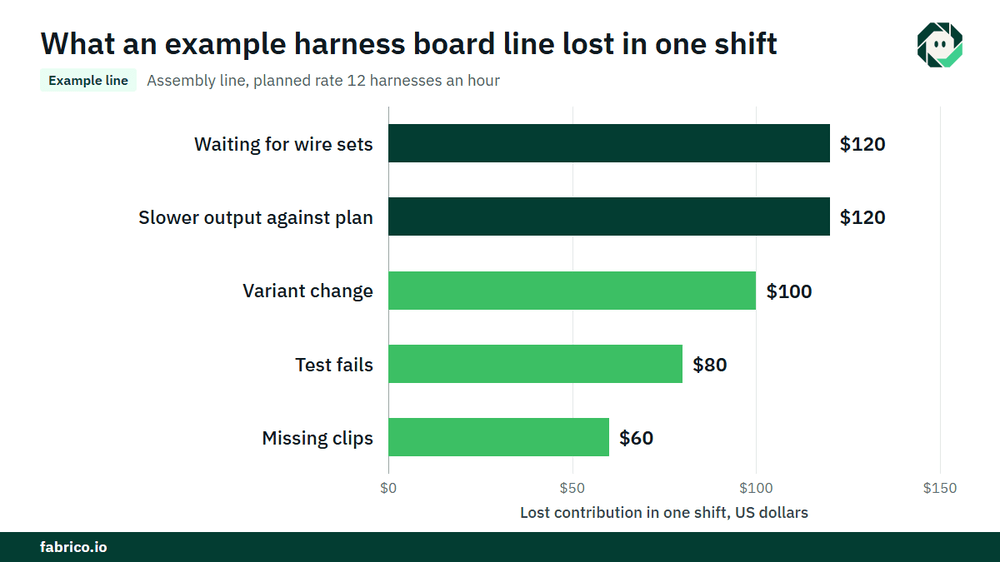
- At a contribution of $20.00 a harness, €20.00 in a euro plant, the board line lost 120 minutes, 24 harnesses, $480 (€480). Waiting for wire sets cost $120 (€120), the variant change $100 (€100), missing clips $60 (€60), slower output against plan $120 (€120), and the four test fails 20 minutes, $80 (€80), plus repair and retest.
The single largest stop on the board line, waiting for wire sets, started at wire prep. On the machine, the lot changes are the largest loss at 72 minutes. The money becomes cash only if the extra harnesses sell or save overtime, so agree that rule with your controller.
What each data source sees
| Source | What it tells you | What it misses |
|---|---|---|
| Cut and crimp machine | State, pieces, crimp force rejects, lot | Why it stopped |
| Crimp check results | Crimp height, pull test, pass or fail | Machine time lost waiting for the check |
| Test table | Harnesses tested, first pass, fail types | Stops on the boards and their reasons |
| Operator input | Stop reasons on the boards and machines | Short halts nobody stops to enter |
| Camera at a machine or the line end | A clip as evidence for a stop | How long people take at a board, by design |
Common mistakes: timing operators on the boards, counting harnesses at packing instead of at first test, counting repaired harnesses as good, one ideal rate for all wire articles, and lot changes booked as general setup with no codes.
Where Fabrico fits
Fabrico is a computer vision enabled Manufacturing Performance Platform. In a harness plant it starts with OEE and light MES: automatic downtime logging from the cutting and crimping machines, OEE live by line and shift, and losses priced in money, so lot changes, board line stops and test fails sit on one list.
- The operator confirms the reason for a stop in one tap, at a machine or a board line.
- A camera clip as evidence for a stop, where a camera watches a machine or the line end.
- Losses ranked by money, so the costliest variant or stop type comes first.
- One view across plants, useful when harness plants sit in several countries.
- When a stop is a breakdown, a work order to the right technician with its cost.
You start on one line, with a baseline and a decision date agreed in advance. Each plant gets a quote after a review of its lines. Read how the platform tracks OEE in the solution overview.
Frequently asked questions
How do you calculate OEE for wire harness assembly?
Separately for machines and boards. On cut and crimp machines, use the machine signal, the ideal per wire article and good pieces. On the boards, use stops, harnesses against the planned rate per variant, and first pass at electrical test.
Can you use OEE on manual harness assembly boards?
Yes, as output against a planned rate within planned production time, with the line's stops and first pass yield at test. Measure the line, not the people on it.
Should repaired harnesses count as good in OEE?
No. A harness that fails electrical test and passes after repair ships, but it was not right first time. Count it in the repair figures, not as good output.
How do you measure OEE on a cut and crimp machine?
Read state and pieces from the machine, set the ideal per wire article, book lot changes and crimp checks as Availability, and count crimp force rejects and check pieces as Quality.
How do you handle changeovers between harness variants?
Book each variant change as an Availability loss with its own code, from the last harness of one variant to the first good one of the next.
See your harness plant's losses in a demo
Bring one crimp machine, one board line and your current shift report. We will show where the time goes on both and what it costs.
Latest from our blog