Login
 Blog
OEE for Wire and Cable Manufacturing: Reels, Spark Faults and Length

Key takeaways
- Measure each process step on its own. Drawing, stranding, insulation and cabling run at different rates, with reels as the buffer between them.
- Use a length based rate: metres a minute at the rated line speed for that product.
- Reel and drum changes are Availability losses with a standard time; the slowdowns around them are Performance losses.
- Spark test faults cost twice: the cut-out length is lost, and the reel may end up too short for the order.
- Find the constraint step before you chase OEE points everywhere.
The insulation line on the building wire floor stops for the third time this shift. A payoff reel has run empty, the conductor ends have to be welded, and while the line ramps back up the take-up winds wire that will be cut out later. Each event is short and normal. Together they decide the OEE of the line, and most of them never reach the shift report.
This guide is for plant managers, process engineers and CI leads in wire and cable plants. It covers how to measure OEE on drawing, stranding and insulation lines, how to set a length based rate, how to book reel changes, breaks and colour changes, and how spark test faults and short reels turn into Quality loss.
The wire and cable process, step by step
- Drawing. Rod is pulled through a series of dies to the wire size, often with an inline annealer. Fine wire goes through further drawing machines.
- Bunching and stranding. Wires are twisted into a conductor on bunchers or stranders, fed from many bobbins.
- Insulation extrusion. Payoff, preheater, extruder with crosshead, cooling trough, capstan, diameter gauge, spark tester, printer, accumulator and take-up.
- Cabling and sheathing. Insulated cores are laid up into a cable and jacketed on another extrusion line.
- Testing and packing. Finished drums are tested, then coiled or packed.
Between each step, product waits on reels and drums. That WIP buffers the steps from each other, so a stop at one step rarely stops the next one at once.

One OEE per step, and the constraint
Because reels decouple the steps, one OEE figure for the whole plant tells you little. Measure each machine or line group on its own, and find the step that limits output for the product mix you run. It may be an insulation line or a strander, but check your own WIP: the step with reels piling up in front of it is the one to protect.
Points gained at a step with spare capacity only build more WIP. Points gained at the constraint become cable you can ship. Our guide to OEE across multiple machines shows how to roll steps up without hiding the constraint.
Setting a length based rate
Wire and cable is sold by length, so measure Performance in metres: metres produced over the rated line speed times run time.
- Insulation lines. The rated speed per product is limited by extruder output and cooling length, so thick insulation runs slower than thin. Set it from the best proven speed with the product in tolerance.
- Stranders. Line speed equals cage rotation speed times lay length. The rated speed follows from the rated rotation speed and the lay length the product needs.
- Drawing. Use the rated finishing speed for the wire size, in metres a minute or per second, at the take-up.
Never use a good day's average as the ideal, and if a product runs above full speed, its rate is set too low. Our guide to ideal cycle time for OEE covers the rule in detail.
Reel and drum changes
Reel changes are among the most frequent events on a wire line, at both ends.
Payoff. When a conductor reel runs empty, the next one is joined, often by welding the ends. Lines without a payoff that changes on the fly stop or slow for each join. Book the stop as Availability with a standard time, and the slowdown before and after as Performance.
Take-up. Dual take-ups transfer to an empty reel at speed. Single take-ups slow the line or stop it, sometimes with an accumulator covering the change. Short ordered lengths mean many changes per shift, so the standard time per change matters more than on long runs.
Code failed transfers, wrong reels and missing empty drums as their own reasons. Waiting for reels is a material and logistics loss, not a line problem. Our guide to measuring changeover time covers how to set the standard.
Breaks and other stops by step
| Step | Typical stops | OEE factor | What to record |
|---|---|---|---|
| Drawing | Wire breaks, die changes, lubricant or annealer faults, spool changes | Availability, short breaks in Performance | Breaks per tonne, die position, rod lot |
| Bunching and stranding | Bobbin changes, strand breaks, lay length changes | Availability | Bobbins changed, break location |
| Insulation extrusion | Payoff and take-up changes, conductor breaks, colour changes, extruder faults | Availability, then Quality for start-up | Change type, start-up scrap metres |
| Cabling and sheathing | Core reel changes, die and tip changes, sheath faults | Availability and Quality | Drum, product, scrap metres |
| All steps | Waiting for reels, waiting for material, no operator | Availability | The source of the wait |
Colour changes on insulation lines usually mean purging the old compound, often changing tip and die, and running until colour and diameter are right. Book the stop in Availability and the start-up length in Quality, and report them as one event. For the restart side, read how to cut start-up and shutdown losses.
Spark test faults and other quality losses
The spark tester puts high voltage across the insulation as the wire runs through it. A pinhole, a thin spot or contamination lets a spark through, and the tester counts a fault. Depending on the product rules, the faulty length is cut out, or the reel is downgraded.
- Spark fault cut-outs. The length removed around each fault.
- Start-up scrap. Wire made after a start or a colour change until it is in spec.
- Dimension faults. Diameter or eccentricity out of tolerance, from the gauges.
- Print and surface faults. Missing or wrong marking, lumps, scratches.
- Short reels. Cut-outs can leave reels shorter than the ordered length.
Decide how remnants count. If a short length is sold later at full price, it is good output. If it is scrapped or sold as seconds, count it as a Quality loss. Copper is recovered from scrap, so price scrap at the value it loses, not at full material cost. More in our guide to the OEE Quality factor.
Data sources: what each one sees
| Source | What it gives you | What it misses |
|---|---|---|
| Line PLC and capstan encoder | Line speed, run state, metres produced | Why the line stopped |
| Spark tester | Fault count and position | The cause of the fault |
| Diameter and eccentricity gauges | Dimensions along the length | Print and surface faults |
| Take-up and reel labels | Length per reel, reel changes | Remnants scrapped later |
| Operator input | Reason, colour, conductor lot | Short stops nobody records |
| Camera at a station | A clip of the payoff or take-up at the moment of a stop | What happens inside the extruder or the crosshead |
The PLC is the clock for each stop. Where a camera watches the payoff or the take-up, the clip shows a tangled reel or a failed transfer that the signal only reports as stopped. A model can suggest the reason, and the operator confirms it in one tap.
A worked shift on an insulation line
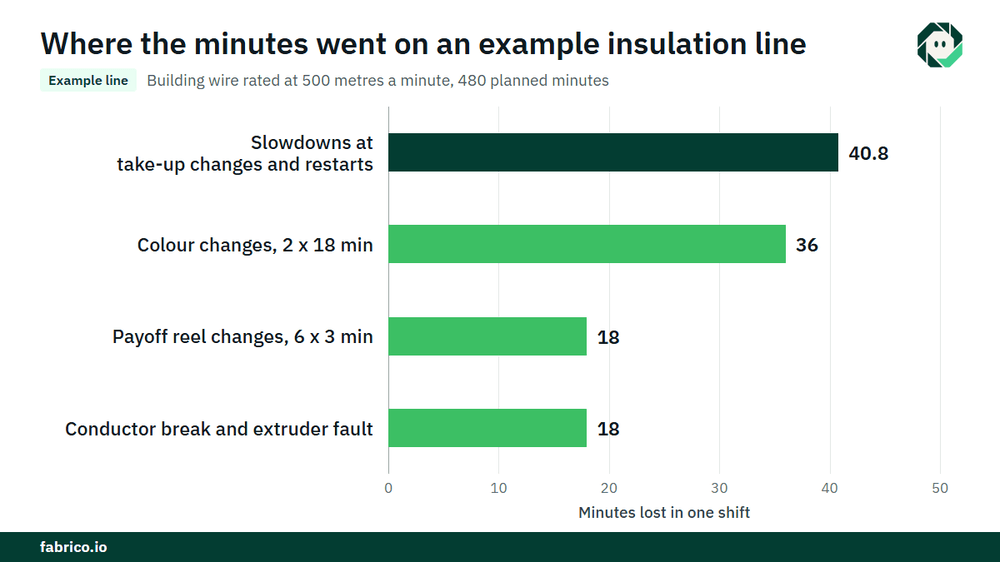
Sample line (illustrative numbers, not a customer): a building wire insulation line runs a product rated at 500 metres a minute. Planned production time is 480 minutes.
- Stops: two colour changes of 18 minutes (36), six payoff reel changes of 3 minutes (18), and a conductor break plus an extruder fault (18). Total 72 minutes, so run time is 408 minutes.
- Availability = 408 / 480 = 85.0%.
- Ideal length = 408 x 500 = 204,000 m. The capstan logged 183,600 m. Performance = 183,600 / 204,000 = 90.0%. The missing 20,400 m are 40.8 minutes at rated speed, lost to slowdowns at take-up changes and ramps after restarts.
- Scrap: 3,000 m of start-up wire after the two colour changes, 600 m of spark fault cut-outs (12 cuts of 50 m) and 990 m of remnants too short to sell. Total 4,590 m, so good length is 179,010 m. Quality = 179,010 / 183,600 = 97.5%.
- OEE = 0.85 x 0.90 x 0.975 = 74.6%. Check: 179,010 / 500 = 358.02 minutes, and 358.02 / 480 = 74.6%.
Price the colour changes. The 36 minutes are 36 x 500 = 18,000 m not made. At a contribution of $0.03 a metre (€0.03 in a euro plant), that is $540. The 3,000 m of start-up wire lose $0.05 a metre after the copper is recovered: $150. Two colour changes cost $690 a shift. On 750 shifts a year, three shifts on 250 days, that is $517,500, or €517,500, if the line is sold out.
Where Fabrico fits
Fabrico is a computer vision enabled Manufacturing Performance Platform. In a wire and cable plant it starts with OEE and light MES: automatic downtime logging from the machine signals and OEE live by line and shift, step by step.
- Losses priced in money and ranked by money, so reel changes, colour changes and spark fault cut-outs are compared in one currency.
- The operator confirms the reason in one tap, including the change type.
- A camera clip as evidence for a stop where a camera watches the payoff or the take-up.
- A work order to the right technician, with its cost, when a stop is a breakdown.
- One view across plants for groups that draw, strand and insulate in different sites.
You can start on one line, with a baseline and a decision date agreed in advance. Each plant gets a quote after a review of its lines.
Frequently asked questions
How do you calculate OEE for a cable extrusion line?
Availability is run time over planned time. Performance is metres produced over the rated line speed times run time. Quality is good metres over all metres, after start-up scrap, spark fault cut-outs and remnants.
Are reel changes planned downtime?
Count them as Availability loss with a standard time per change, and code the overrun. Kept in planned time, they vanish from the loss list.
How do spark test faults affect OEE?
The length cut out around each fault is a Quality loss. If cut-outs leave a reel too short for the order and the remnant cannot be sold at full price, that length is a Quality loss too.
Should wire drawing and insulation share one OEE?
No. Reels decouple the steps, so measure each one on its own and give the constraint step the most attention.
What is a good OEE for wire and cable manufacturing?
There is no standard benchmark for wire and cable lines. Compare each line with its own baseline, by product, and watch reel changes and spark faults per shift.
See your cable line's losses in a demo
Bring one line and its shift reports. We will show where the metres go and what each loss costs.
Latest from our blog