


 Login
 Blog
Computer Vision for Bakeries: Line Cameras From Oven Exit to Crate

In short: computer vision for bakeries means AI cameras that count loaves, rolls and buns on the open band at the oven exit and at manual crate and tray stations, so you can see losses on a line where the oven rarely stops.
- On a bakery line, losses rarely show as a stop. They show as gaps on the oven band and as bread in the waste bin.
- Count in two places: at the oven exit and at the end of the line. The difference is what you lost after baking.
- Machine signals still do most of the work at the divider, slicer and bagger. Cameras fill the places with no usable signal.
- Crust, shape, bag codes and foreign bodies are jobs for inspection systems and metal detectors, not for an OEE camera.
- In Fabrico, AI cameras are an add-on that counts output, and stop reasons come from the operator. Camera-detected stops are on the roadmap.
A bakery line has one machine you cannot pause. Once dough is in the oven, it bakes, whatever happens at the slicer.
So a bakery loses output in its own way. The stop log stays short. The loss turns up as an empty stretch of band, or as a crate of bread nobody counted.
This page is for bakery plant and operations leads choosing camera software for bread, roll and bun lines. We sell Fabrico, so test what we say here like any other vendor's claims.
What computer vision does in bakery production, and what it doesn't
Two kinds of camera sit on bakery lines, and they do different jobs.
| Job | Inspection vision | OEE camera |
|---|---|---|
| Count loaves, rolls and buns on an open band | Sometimes, as a side output | Yes, its main job |
| Judge crust colour, size and shape | Yes | No |
| Check bag print, date code and allergen label | Yes | No |
| Find metal, glass or stones | No: metal detector or X-ray | No |
| Count crates and trays at a manual station | Rarely | Yes |
| Show what happened at a gap or a stop | Rarely | Yes, video for that moment |
| Give the stop reason | No | No: the operator adds it. Camera suggestion: roadmap. |
Inspection systems from vendors such as Cognex, Keyence or Mettler-Toledo judge the product. An OEE camera counts it. Our page on label and code vision vs an OEE camera shows how the two sit side by side.
The link between them is the reject count. If an inspection system or a metal detector gives a reject signal, that count can feed the quality part of OEE.
Label checks matter most at a product change. The FDA says recalls due to undeclared food allergens are a leading cause of all food product recalls. A sesame loaf in a plain loaf's bag is that risk. That check belongs to inspection, on every pack.
Why bakery losses hide: the oven does not stop
On most packing lines a jam stops the machine and the stop gets timed. A bakery line works the other way round.
The oven is the constraint, and it keeps baking. In a 2015 Carbon Trust case study of UK bakery ovens, baking times for 800 g tinned bread run from 18 to 24 minutes in continuous or travelling ovens. The same study says high speed UK bread lines can run at 8,000 to 10,000 units an hour.
At an example 150 loaves a minute, an 18 to 24 minute bake means 2,700 to 3,600 loaves are inside the oven at any moment. When the bagger stops, that bread keeps coming.
So bakery losses take three shapes:
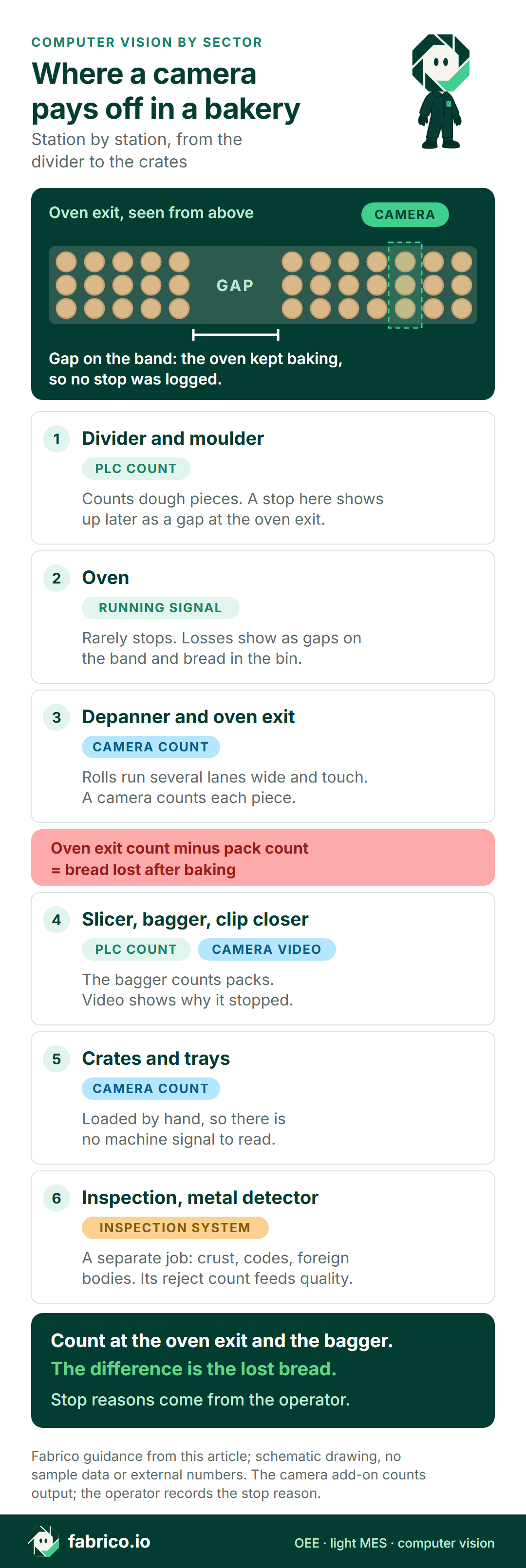
- Gaps on the oven band. The divider or prover hiccups, and an empty stretch of band reaches the oven exit later. The oven never stopped, so nothing was logged.
- Bread in the waste bin. The slicer or bagger jams, the cooler backs up, and good bread goes to a waste crate. The bagger stop may be logged. The loaves usually are not.
- Slow running after a change. The line is running again, but below its rate, and nobody writes that down.
We cover the second shape machine by machine in bakery bagging line stops at the slicer, bagger and clip closer.
The oven is also a major energy user. Carbon Trust figures published in 2015 put ovens at 35 to 45% of a UK bakery's total site carbon emissions. An oven holding its temperature over an empty stretch of band still burns gas, so a gap is gas spent on bread you never made.
Where the camera goes on a bakery line
Most of a bakery line already has PLC signals, and the bagger counts packs. Put cameras where there is no usable signal, or where it counts the wrong thing.
Two places earn a counting camera first:
- The oven exit or the cooler infeed. Rolls and buns come out several lanes wide, often touching. A photo eye counts a beam break, so a row of six touching buns can count as one. A camera looking down at the band counts each piece. On tin bread, mount it after the depanner, where the loaves are out of the tins. Our page on AI visual counting explains how that works.
- Manual crate and tray stations. At the end of many lines, bread goes into crates or onto trays by hand. There is no machine, so there is no signal. Robots are still the exception at this step. In the US, about 6.6% of food manufacturing plants used robots in 2022, though nearly a quarter of food manufacturing employees were exposed to robots in their work, the BLS Monthly Labor Review reports. For counting at hand stations, see OEE cameras at manual packing stations.
At the bagger, a camera is for the video, not the count.
Upstream, the divider's piece count is usually your best first count. A divider stop now becomes a gap at the oven exit later, after proofing. With both on one shift timeline, you can match the gap to its cause.
Steam at the oven exit and flour dust upstream are hard on a lens, so plan the mount and the cleaning before the pilot.
Flatbread lines count pieces at the stacker, covered in OEE for tortilla and flatbread lines. Biscuit lines are covered in OEE for biscuit production lines. Bagged bakery snacks such as pretzels and croutons end on a vertical bagger, covered in VFFS bagger stops.
Camera, sensor or operator, station by station
Use the machine signal wherever it exists. Add a camera only where a count is missing or wrong.
| Station | Count from | Stops from | Watch for |
|---|---|---|---|
| Mixer | Batch signal | PLC | Late batches starve the divider |
| Divider and moulder | Piece count | PLC | Gaps reach the oven later |
| Prover | None: use the divider count | PLC | Overproofed dough is waste |
| Oven | None: count at the exit | Band running signal | Gaps on the band |
| Oven exit | Camera | None: the band keeps moving | Gaps show in the count |
| Cooling spiral | Oven exit vs pack count | Running signal | Bread dumped when it backs up |
| Slicer, bagger, clip closer | PLC pack count | PLC, plus video | Short stops, bread in the bin |
| Crates and trays | Camera | None: no machine | Gaps in the count |
Stop reasons come from people in every row. The operator adds them at the line on a tablet or phone, because no signal knows why the divider stopped. For more machine types, see camera or sensor, machine by machine.
Bring your line layout to a demo and we will go through it with you.
Changeovers: measure the gap on the band
In the US, 3,550 new bakery products launched in 2023, the most of the ten categories in a 2023 Innova Market Insights report for the National Honey Board. Each new product widens the range you change over between, and is another item for a camera to learn.
On a bakery line a changeover is easy to see from the oven exit. On the count chart it runs from the last loaf of one product to the first loaf of the next, whatever the stop log says. The camera counts loaves but does not judge them, so the first good loaf comes from your reject count.
In Fabrico today the changeover stop itself comes from a machine signal, such as the divider stopping, and the operator adds the reason. A camera that marks the gap as a stop on its own is roadmap.
The count also shows what a stop log misses: the real length of the gap, and the slow restart while the divider and prover settle.
Allergen clean-downs are a planned changeover with a longer gap, for example after a sesame product and before the next plain one. Decide once how your plant counts them in OEE, and keep that rule on every line.
Worked example: one bread line, one shift
Here is one shift on a sample bread line. It is example data, describing no real bakery.
- Planned time: 480 minutes.
- Ideal rate at the oven: 150 loaves a minute, or 9,000 an hour.
- One 30 minute changeover from white to seeded, with a seeder set-up and a new bake profile. The stop comes from the divider's stop signal, with the reason added by the operator.
- Camera count at the oven exit: 58,500 loaves.
- Good loaves packed, from the bagger count less rejects: 55,575.
We measure OEE at the oven, because the oven is the constraint. On a tunnel oven the ideal rate follows from bake time, band loading and pieces per row, so set it per product, from the oven, not from the bagger. Short stops upstream then show as gaps on the band, which is lost performance.
The arithmetic:
- Availability: 450 of 480 planned minutes, or 93.8%.
- Performance: 58,500 loaves against an ideal of 450 x 150 = 67,500, or 86.7%.
- Quality: 55,575 good loaves of 58,500 baked, or 95.0%.
- OEE: 0.9375 x 0.8667 x 0.95 = 77.2%, the same as 55,575 good loaves of an ideal 72,000.
Now take the camera away. The oven ran all 480 minutes, the stop log shows one changeover, and the bagger shows 55,575 packs. You know the shift was 16,425 loaves short, and not much more.
With the oven exit count, the 16,425 splits in two. 13,500 loaves, or 90 minutes of oven time, were never baked: the changeover plus the gaps on the band. 2,925 were baked and then lost before the bag. Those are two problems with two different owners.
The money differs too: a loaf lost after the oven has used dough, gas and labour, while a gap costs margin. Fabrico shows losses in money, so price both on your own costs.
For bakery rules on sanitation time and ideal rates, read OEE and maintenance software for industrial bakeries.
Eight questions for any bakery camera vendor
Run these with every vendor, and with us. Bring a real shift from last week as the test case.
| Ask | How to test the answer |
|---|---|
| Can it count touching, multi-lane product at our top speed? | Test your fastest roll line, with steam, against a hand count. See how accurate camera OEE is. |
| How does a gap on the band show up? | Take an hour with a known divider stop. Ask where the report shows the gap. |
| Can it count in two places and show the difference? | Ask for bread lost between the oven exit and the bagger, by shift. |
| How is a changeover measured? | Last loaf to first loaf on the count, with the slow restart visible. Ask what records the stop itself. |
| What does a new product mean for the camera? | Who teaches it, how long it takes, and what the count does until then. |
| Where do stop reasons come from? | Ask to see a stop with no reason. A report that hides it flatters the data. |
| Where does the video go? | Streamed or kept, for how long, and who can open it. |
| How does it sit beside inspection? | Ask how reject counts from inspection or a metal detector feed quality. |
Cameras, bakery crews and the works council
The end of a bakery line is busy with people: loading crates, stacking trays, clearing jams. A camera aimed at the band will see hands.
- Frame the camera on the product, not on the workstation.
- Report by line and shift, never by named person.
- Agree who can open video, and why, before go-live.
- In the EU, plan for GDPR from day one.
In Germany, the Works Constitution Act gives the works council co-determination over technical devices designed to monitor the behaviour or performance of employees. Involve the council before the first camera goes up. Our guide to production line cameras without surveillance covers how to set that up.
Masking people out of the picture beyond Fabrico's standard setup is roadmap or custom work, so ask us to show what exists today.
Where Fabrico fits
Fabrico is a cloud OEE and light MES platform. On a bakery line it works like this:
- Today: stops and counts come from the machine signal (PLC, sensor or counter). The operator adds the stop reason on a tablet or phone. You get OEE, downtime and losses by line and shift, in money too, on the web, iOS and Android.
- Camera add-on, on request: AI cameras count output, for example at the oven exit or a manual crate station. You can open the camera video for any moment on the shift timeline. In the standard setup, video is streamed on request, not stored in Fabrico. See computer vision in Fabrico.
- Roadmap, not live today: cameras that detect stops on their own, jam zones, and a camera suggesting a stop reason to the operator. Ask us about timing.
- Not Fabrico's job: inspecting crust, shape, bag codes or foreign bodies. Keep your inspection systems and metal detectors. Their reject signal can feed the quality part of OEE.
- Planning: we don't claim production scheduling. If you need it, ask us in the demo.
- Your data: it leaves through the REST API, webhooks, and Excel or CSV export.
Pricing is not public. What drives a quote is in the cost answer below. For the wider picture, see our OEE software guide.
Test our claims like any vendor's, with one shift of your own data.
What people ask next
Can a camera count rolls and buns that touch on the belt?
Often, yes, if it looks straight down at the band with steady light, though touching product is the hardest case. It is also where a camera beats a photo eye, which counts a beam break, not a bun. Prove it on your fastest product against a hand count before you buy.
Is an AI camera on a bakery line the same as a vision inspection system?
No. An inspection system judges each product: colour, shape and codes. An AI camera for OEE counts output and gives you video for a moment in the shift.
Should a bakery count at the oven exit or at the bagger?
Both, if you can. The oven exit count shows what you baked. The bagger count shows what you packed. The difference is what you lost in between.
How does OEE work when the oven keeps running?
Set the ideal rate at the oven, in loaves or pieces a minute for each product. Gaps on the band then show as lost performance, and bread lost after baking shows as lost quality.
Do we need a camera on every bakery line?
No. Start with one line and one camera at the oven exit. Compare its count with a hand count and with the bagger count. Add cameras where a count is missing, not everywhere.
What drives the cost of computer vision for a bakery?
The number of lines and cameras, mounting at hot or dusty spots, network work and training. Terms vary by vendor, so give each one the same line list.
Want to see it on your line? Book a demo.
Related articles








Real Fabrico tiles, sample data.