







 Login
 Blog
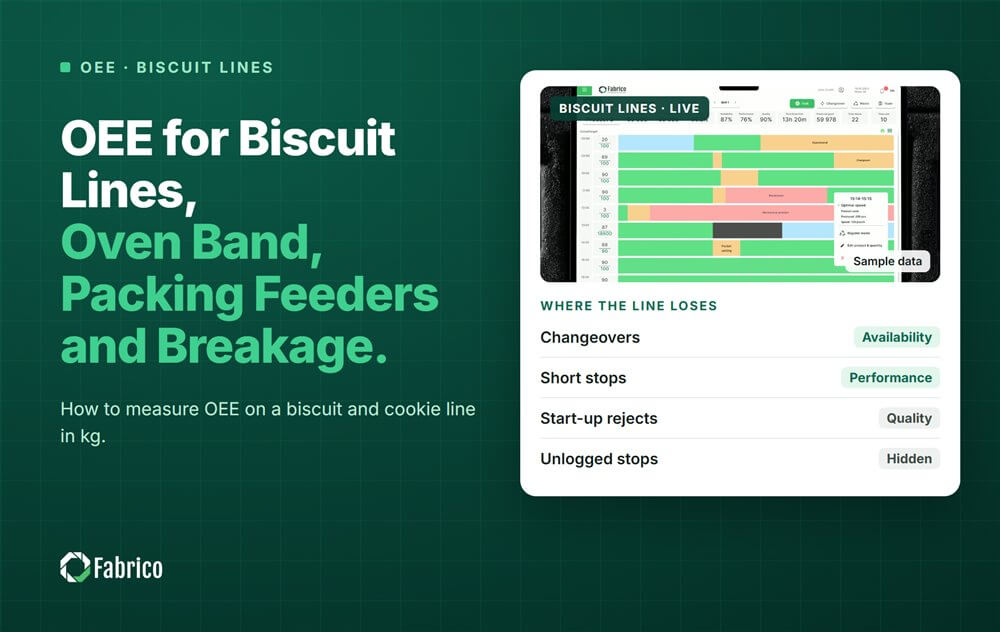
OEE for Biscuit Lines: Oven Band, Packing Feeders and Breakage

Key takeaways
- Measure a biscuit line in kilograms from the oven, then compare with good packed kilograms at the end.
- The oven band sets the pace. Product changes at the moulder or cutter are its longest losses.
- When one of several wrappers stops, biscuits go off line. That is a Quality and yield loss, even though the oven never stopped.
- Breakage at the packing feeders is often the largest hidden loss. Weigh it every shift.
- Rework fed back into dough is not good output. Count it as a loss, then price it.
Biscuit OEE should be measured in kilograms: kilograms the oven could bake, kilograms it did bake, and kilograms that left the line as good packs. The gap between the oven and the packs is where most biscuit plants lose money without seeing it on the stop log.
Fabrico, a computer vision enabled OEE and light MES platform, logs oven and packing stops automatically and keeps them apart, so a wrapper stop that sends biscuits off line is not lost inside a line average. This guide is for plant managers and CI leads on sweet biscuit, cracker and cookie lines.
What does a biscuit line look like?
- Mixing. Batch mixers feed dough to the forming machine.
- Forming. A rotary moulder, a sheeter with a cutter, or a wire cut depositor, depending on the product.
- Oven. A long tunnel oven on a steel or mesh band, often followed by oil spray or decoration.
- Cooling. Long cooling conveyors before the biscuits can be handled.
- Packing. Stacking or slug feeders, then several flow wrappers in parallel, cartoners and case packers. Some lines add sandwiching or enrobing first.
Packing capacity is usually larger than oven output, so a single wrapper can stop without stopping the oven. The biscuits it would have packed are sent off line, to bins or to a recovery buffer.
Where do biscuit lines lose output?
| Area | Typical losses | OEE factor |
|---|---|---|
| Forming | Moulder roll or cutter change, dough sticking, uneven piece weight | Availability, Performance |
| Oven | Profile change between products, band tracking, burner faults | Availability |
| Oven band loading | Gaps, thin rows, lanes running empty | Performance |
| Cooling and feeders | Breakage, stacks falling, feeder jams | Quality, short stops |
| Flow wrappers | Film splice, seal jaw faults, product in seal | Quality (off line) and short stops |
| End of line | Cartoner and case packer stops, checkweigher rejects | Quality, short stops |
Why count biscuit OEE in kilograms?
A biscuit line makes product by weight, then packs it in many formats. Counting packs alone hides the oven, and counting pieces hides weight. Kilograms work at every point:
- Availability = oven run time / planned production time.
- Performance = kg baked / (oven run time x ideal kg a minute). Set the ideal per product from the oven's proven rate for that biscuit.
- Quality = good packed kg / kg baked. Breakage, off line product, checkweigher rejects and colour rejects all count against it.
Weigh the bins. Off line biscuits and breakage only become visible when someone weighs them each shift and codes the cause. Many plants already weigh waste for cost reports, but they never link it to the stop that caused it.
What happens when one wrapper stops?
Each flow wrapper can show a good OEE on its own, because it has spare speed. The line can still lose product. While a wrapper is stopped, its share of the oven output has nowhere to go, unless the line has a buffer that can hold biscuits.
- Log each wrapper's stops with a reason, as you would for any machine. Our flow wrapper OEE guide covers the machine view.
- Weigh what went off line during each stop, or estimate it from the wrapper's share of oven output.
- Charge the off line kilograms to the wrapper that stopped.
- Pareto wrapper causes by kilograms lost, not by stop count.
The same logic applies downstream. A cartoner stop that outlasts the buffer backs up into the wrappers and sends more biscuits off line.
A worked shift on a biscuit line
Sample line (illustrative numbers, not a customer): an oven with an ideal rate of 20 kg a minute (1,200 kg an hour) for a plain sweet biscuit, packed by four flow wrappers rated at 6 kg a minute each. Planned production time is 450 minutes.
| Loss | kg lost | Cost at $1.20 a kg |
|---|---|---|
| Moulder roll change for a new product, 40 minutes | 800 | $960 |
| Dough late from mixing, 10 minutes | 200 | $240 |
| Gaps and thin rows on the band (speed loss) | 400 | $480 |
| Sent off line during wrapper stops | 220 | $264 |
| Breakage at the feeders | 180 | $216 |
| Checkweigher and colour rejects | 100 | $120 |
| Total | 1,900 | $2,280 |
- The oven ran 450 minus 40 and 10 = 400 minutes. Availability = 400 / 450 = 88.9%.
- Performance: 7,600 kg baked against an ideal of 400 x 20 = 8,000 kg, so 95.0%.
- Quality: 7,600 minus 500 kg of losses = 7,100 kg good packed, so 7,100 / 7,600 = 93.4%.
- OEE = 0.889 x 0.950 x 0.934 = 78.9%. Check: 7,100 / 20 = 355 minutes of ideal output, and 355 / 450 = 78.9%.
The sample contribution is $1.20 a kg, or €1.20 in a euro plant. The product change is the biggest single loss. But the three packing losses together, off line, breakage and rejects, cost $600 a shift, while the oven ran the whole time. Over 700 shifts a year, that is $420,000 of biscuits the oven baked and the line never sold.
How do you shorten product changes on a biscuit line?
A change often means a new moulder roll or cutter, new oven settings, new packing film and sometimes a different pack count. Split the steps into internal (line stopped) and external (prepared while it runs), the core idea of SMED.
- Stage the next roll or cutter at the machine, cleaned and checked, before the change starts.
- Record oven profiles per product, so the first rows come out right.
- Change packing film on the wrappers while the last product clears the oven.
- Sequence products so allergen biscuits, such as those with nuts, run last before a clean.
What mistakes do biscuit plants make with OEE?
- Reporting wrapper OEE only, so the line looks good while kilograms go to waste bins.
- Counting rework dough as good output.
- Not weighing breakage, so the feeders never reach the Pareto.
- One ideal rate for every product, whatever its bake time.
- Ranking losses by stop minutes instead of kilograms and money.
Where does Fabrico fit on a biscuit line?
Fabrico is a computer vision enabled Manufacturing Performance Platform. OEE and light MES come first: automatic downtime logging that keeps own stops, starved and blocked time apart, and OEE live by line and shift.
- The operator confirms the reason in one tap, so a film splice and a seal jaw fault get different codes.
- A camera clip as evidence for a stop, where a camera watches a feeder or a wrapper infeed.
- Losses priced in money and ranked, so off line kilograms sit next to stop minutes.
- One view across plants for biscuit lines on several sites.
- A work order with its cost to the right technician when a stop is a breakdown.
You start on one line, with a baseline and a decision date agreed in advance. There is no free plan and there are no tiers: each plant gets a quote. See how computer vision OEE logs and codes stops.
Frequently asked questions
How do you calculate OEE on a biscuit line?
Use oven run time over planned production time for Availability, kg baked over ideal kg for Performance, and good packed kg over kg baked for Quality. Multiply the three.
Is breakage a Quality loss?
Yes. Broken biscuits that cannot be packed as good product count against Quality, even if they are reworked or sold as a lower grade.
Should each flow wrapper have its own OEE?
Yes, for fixing the machine. But judge the line on good packed kilograms, because a wrapper with spare speed can look fine while its stops send biscuits off line.
What is a good OEE for a biscuit line?
There is no standard figure. Lines with many product changes score lower than dedicated lines. Compare a line with its own trend, and price the gap in money. Our guide to confectionery OEE covers a close neighbour.
See your biscuit line's losses in a demo
Bring one line and its waste weights. We will show oven losses, off line kilograms and what each one costs.
Latest from our blog



Real Fabrico tiles, sample data.