Login
 Blog
Flow Wrapper OEE: Film Splices, Seal Rejects and Infeed Gaps

Key takeaways
- Film reel changes and splices are the flow wrapper's routine stops; log each one with its own code.
- Seal rejects, empty packs and product in the seal are the main Quality losses.
- Infeed gaps cost Performance: the wrapper runs, but packs per minute fall.
- The first packs after a restart are a known reject source while seal temperature and film tension settle.
- Where the upstream process cannot stop, a wrapper stop costs product as well as time.
On a biscuit line the flow wrapper takes product from a feeding system fed by the oven. When the film reel runs out, the wrapper stops, product keeps coming, and an operator moves biscuits to a rework tray until the new reel is threaded. The OEE report shows two minutes of downtime. It does not show the product that went to rework.
Flow wrappers, also called horizontal form fill seal (HFFS) machines, form a film tube around the product, seal it lengthwise, then seal and cut it crosswise. This guide covers where their time goes, how to measure each OEE factor, how to handle film changes and seal quality, and why infeed gaps and empty packs belong in the numbers.
How a flow wrapper works and where it loses time
The product arrives on a lug chain or an automatic feeding system. Film comes off a reel, through the forming box, and fin seal wheels close it lengthwise. Rotary cross seal jaws seal and cut each pack, and the packs leave for the checkweigher, the metal detector and the cartoner or case packer.
| Station | Typical stops and losses | OEE factor |
|---|---|---|
| Infeed | Product out of pitch, double product, broken product, gaps | Short stops, Performance, Quality |
| Film unwind | Reel end, splice failure, film break | Availability or short stop |
| Film tracking | Print mark lost, film off centre, cut in the wrong place | Short stop, Quality |
| Fin seal | Seal temperature out of range, weak or burnt seal | Quality |
| Cross seal jaws | Product in the seal, jaw temperature drift, knife fault | Quality, short stop |
| Outfeed | Packs backed up from the cartoner or case packer | Blocked |
| Changeover | New film, new product size, new settings | Availability, minutes over standard |

Film reel changes, splices and film tracking
A reel change is expected, but it is not planned time. On a wrapper without an automatic splicer, each reel end stops the machine while the operator joins the new reel. On a wrapper with one, the stop to watch is a splice that fails or tears. Log reel changes, splice failures and film breaks under separate codes. Reel length divided by pack length gives packs per reel, and the number of changes per shift follows.
Printed film needs registration: a sensor reads the print mark so the jaws cut between images. When registration drifts, packs are cut through the print and rejected, or the machine stops on a registration fault. Film walking off centre shows up the same way. Both are often film or splice problems rather than machine problems. Short as they are, these stops add up; our guide to micro stops covers how to count them.
Seal quality rejects and empty packs
Quality on a flow wrapper is mostly about the seal and the content. A pack with a weak, wrinkled or burnt seal, product trapped in the cross seal, or no product at all is a reject. On products packed in a modified atmosphere, a leaking seal is a reject even when it looks closed.
Product in the seal usually means the pitch is wrong: the product reaches the jaws a little early or late, or a piece sits out of position in the lug. Empty packs come from infeed gaps when the wrapper has no function to skip film for a missing product, or when that function is switched off. Count both at the wrapper. More in our guide to the OEE Quality factor.
Watch the first packs after a stop. On many wrappers seal temperature and film tension need a moment to settle, and those packs are a known reject source. Count them as start-up rejects so they show as their own loss, as our guide on start-up and shutdown losses explains.
Infeed gaps and product pitch: the Performance loss
A flow wrapper's speed is set in packs per minute for the product. When the infeed delivers gaps, the wrapper makes empty packs, skips film or slows down to wait. Each of these costs packs per minute without any stop on the PLC.
Measure Performance against the rated speed for the product, not against whatever speed the infeed allows. If the gaps come from upstream, they belong to the oven, the cooling tunnel or the feeding system, not to the wrapper. If they come from the feeding system's own settings, they belong to the packing area.
On many bakery, confectionery and bar lines the upstream process runs continuously. When a wrapper stops, product goes to another wrapper, to a buffer, to manual rework or to waste. The minutes are only half the loss; price the product as well. Our guide to OEE for food and beverage covers lines that cannot stop.
How to measure Availability, Performance and Quality on a flow wrapper
- Availability = run time / planned production time. Reel changes above the plant's short stop threshold, film breaks, faults and changeover overruns reduce it.
- Performance = packs made / (run time x rated packs a minute). Infeed gaps, slow running and short stops land here.
- Quality = good packs / packs made. Seal rejects, empty packs, product in the seal, misprints and start-up rejects count against it.
Set the rated speed per product and film, from the nameplate or the maximum demonstrated speed. Pack length and film type change what the wrapper can do, so one speed for every product makes some look fast and others slow.
A worked shift on a flow wrapper
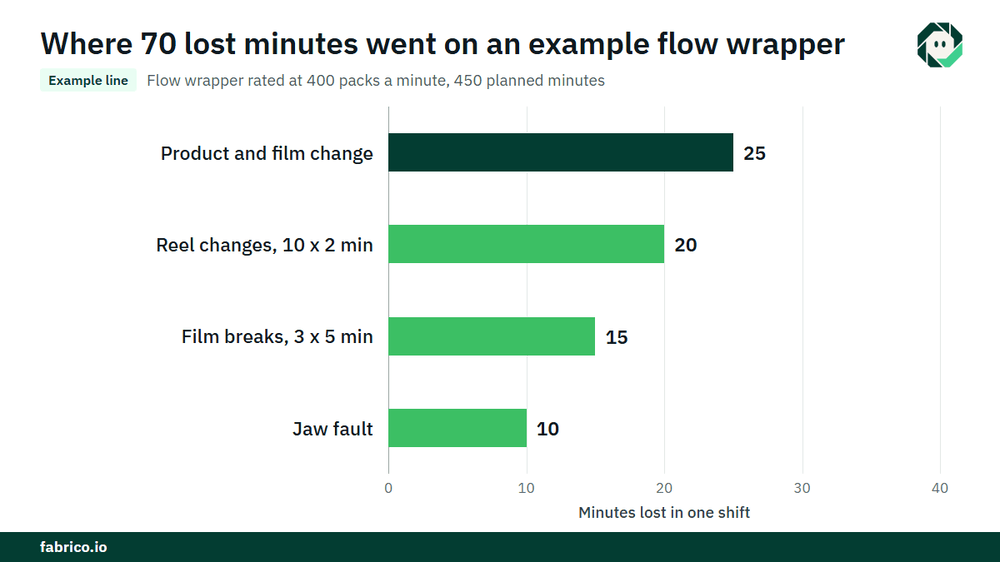
Sample line (illustrative numbers, not a customer): a flow wrapper rated at 400 packs a minute, with 450 minutes of planned production time.
- Lost time: 10 reel changes of 2 minutes (20), 3 film breaks of 5 minutes (15), a jaw fault (10) and a product and film change (25) = 70 minutes. Run time = 380 minutes. Availability = 380 / 450 = 84.4%.
- At rated speed, 380 minutes would make 380 x 400 = 152,000 packs. The wrapper made 136,800. Performance = 136,800 / 152,000 = 90.0%.
- Rejects: 1,368 empty packs and 684 seal rejects = 2,052. Good packs = 134,748. Quality = 134,748 / 136,800 = 98.5%.
- OEE = 0.8444 x 0.900 x 0.985 = 74.9%. Check: 134,748 / 400 = 336.87 minutes of ideal time, and 336.87 / 450 = 74.9%.
Now price the reel changes: 20 minutes x 400 packs = 8,000 packs a shift. At a contribution of $0.05 a pack that is $400 a shift, or €400 in a euro plant at €0.05 a pack. Over 750 shifts a year: $300,000, or €300,000. If the upstream process kept running during those changes and product went to rework, the real cost is higher.
What the PLC says and what a camera adds
The wrapper PLC reports reel end, film break, registration and temperature faults, and counts packs and rejects. It does not see a product sitting crooked in a lug or a gap building at the feeding system. Where a camera watches the infeed or the jaws, the clip shows what happened just before the stop, a suggested reason comes with it, and the operator confirms it in one tap.
Mistakes plants make with flow wrapper OEE
- One code for reel changes, splices and film breaks.
- Counting packs at the outfeed only, so empty packs and seal rejects vanish.
- Measuring Performance against whatever speed the infeed allows.
- Ignoring start-up rejects after restarts.
- Pricing a wrapper stop in minutes only when product went to rework or waste.
Where Fabrico fits
Fabrico is a computer vision enabled Manufacturing Performance Platform. OEE and light MES come first: automatic downtime logging at the wrapper, so reel changes, splice failures and film breaks are counted instead of forgotten, and OEE live by line and shift.
- The operator confirms the reason in one tap, so a splice failure and a film break get different codes.
- A camera clip as evidence for a stop, where a camera watches the infeed or the jaws.
- Losses priced in money and ranked, so the most expensive wrapper loss is fixed first.
- One view across plants for wrapping lines on different sites.
- A work order with its cost to the right technician when a stop is a breakdown.
You start on one line, with a baseline and a decision date agreed in advance. Each plant gets a quote after a review of its lines. See how a stop gets its evidence on our computer vision for OEE page.
Frequently asked questions
What is the difference between HFFS and VFFS?
A horizontal flow wrapper (HFFS) wraps solid products such as bars, biscuits and bakery items as they travel horizontally. A vertical form fill seal machine (VFFS) forms a bag around a vertical tube and drops loose product into it, usually from a weigher.
How do you calculate flow wrapper OEE?
Availability is run time over planned production time, Performance is packs made over what the wrapper could make at its rated speed for that product, and Quality is good packs over packs made. Multiply the three.
What causes product in the seal on a flow wrapper?
Usually the product pitch: product that reaches the jaws early or late, or sits out of position in the lug. Check the infeed timing and the feeding system before the jaws.
Do empty packs count against OEE?
Yes. An empty pack used film and machine time and is not a good unit, so it counts as a Quality loss at the wrapper.
How do you reduce film change downtime on a flow wrapper?
Log each reel change, splice failure and film break separately, prepare the next reel before the current one runs out, and check that the splicer, if fitted, is working. Then compare changes per shift with what reel length divided by pack length predicts.
See your wrapper's losses in a demo
Bring one line and its current downtime log. We will show its film stops, seal rejects and infeed gaps, logged automatically and priced in money.
Latest from our blog