


 Login
 Blog
Computer Vision for Supplement Manufacturing: Where Cameras Help

In short: computer vision for supplement manufacturing earns its place where machine signals can't count or can't explain: hand-fed bottle lines, gift set and rework benches, the tablet counter's short stops and the end of line. Checking each tablet, capsule, pocket, cap and label is a separate job for inspection systems.
- Encapsulators, tablet presses and blister machines already count. A camera there adds video for the minute a stop happened, not a better count.
- On bottle lines the tablet counter usually sets the pace, and its short jams are the ones a paper stop sheet misses.
- Inspection systems check pockets, counts, seals and codes. Their reject counts can go into OEE quality.
- Video can support a line clearance check. It does not replace your checklist, the second person's sign-off or the batch record.
- Fabrico takes stops and counts from the machine and stop reasons from the operator. Its AI camera add-on counts output and lets you open the video for any minute of the shift.
A supplement plant runs on two clocks. The bulk side blends, encapsulates, compresses and coats in batches. The packing side counts, caps, seals, labels and cartons in runs that can change several times a shift.
The product range is what makes it hard. An FDA page from 2024 says the dietary supplement market is worth more than 60 billion dollars, with as many as 100,000 different products available to consumers. Every count per bottle, bottle size, label and market version is a SKU someone has to change over to.
This page is for the plant manager, operations director or CI lead choosing camera and OEE software for vitamin and nutraceutical lines: where a camera helps, where the machine signal already does the job, and what to ask vendors. For the OEE method itself, read OEE for supplement manufacturing. Still comparing OEE software in general? Our OEE software guide is the better first read.
Fabrico is our product, so treat what follows as a vendor's view and test it. Nothing here is regulatory advice. Your QA team decides what belongs in a GMP record.
What computer vision does on a supplement line, and what it doesn't
Camera systems on a supplement line do one of two jobs. One inspects every unit and rejects the bad ones. The other counts output and lets you see the minute a line stopped. A supplement plant often needs both.
| Job | Inspection system or counter | OEE camera |
|---|---|---|
| Tablets or capsules per bottle | The counter's own sensors | No |
| Empty or broken blister pocket | Vision in the blister machine | No |
| Seal, cap, label and lot code | Inspection system | No |
| Count bottles at a hand-fed station | Not its job | Yes |
| Count gift sets and reworked cartons | Not its job | Yes |
| Show why the counter stopped | No | Video for that minute |
The link between them is the reject count. When a checkweigher, seal check or code reader sends a reject signal or keeps a counter, that number goes into OEE quality. The OEE software then knows how many bottles failed, but not why. Our page on label and code vision vs an OEE camera covers the split in detail.
Where the losses hide on supplement lines
In its True Cost of Downtime 2024 report, based on interviews at large plants in automotive, FMCG, heavy industry, and oil and gas, Siemens found that getting production running again after unplanned downtime took an average of 81 minutes, up from 49 minutes five years earlier. That is an average across all four sectors, not a supplement figure.
On a supplement line, the slow restarts and the lost minutes tend to sit in five places.
Encapsulators and tablet presses
The bulk machines count well from their own controls, so a camera there adds video, not a count. The long stops are tooling and change parts: punch and die sets on a press, size parts on an encapsulator, and the cleaning that comes with each change.
Both rooms are dusty, so ask any camera vendor how often a lens needs cleaning there.
Bottle counting lines
On a bottle line the counter usually sets the pace, and every machine around it waits on it.
Its stops are short and frequent. Tablets bridge in the hopper, dust builds on the count sensors, or bottles stop arriving from upstream. Each takes the operator less than a minute to clear, so few make it onto a paper stop sheet. See micro stops for how they add up.
The signal times each stop, but the fault code often says only that the counter stopped. Video for the minute shows which of the three it was, and the third is not the counter's fault at all.
Blister lines
On a blister line, the blister machine sets the pace and usually has its own vision checking each pocket before sealing. A camera can help downstream, at the leaflet feeder, cartoner and case packer, where the short stops start. Our guide to OEE for blister packaging lines covers ideal rates and units.
Hand work: gift sets, bundles and rework
Most supplement plants have work no machine counts: twin packs, gift sets packed by hand, sample sachets added to cartons, and stock relabelled for another market.
These benches often run on a tally sheet, so they sit outside OEE. A camera over the bench outfeed can count finished units at one fixed spot. Our page on OEE for a manual packing station shows the setup.
Changeovers and line clearance
On a bottle line with many SKUs, changeover is often the biggest single loss. A new count per bottle means new counter settings. A new bottle means new change parts. A new label means clearing every reel and carton of the old one.
Clearance takes the same minutes whether the run was 2,000 bottles or 200,000, so short runs make it a bigger share of the shift. It is also where video gets oversold, so it has its own section below.
Line map: where a camera goes on a supplement bottle line
The map follows one capsule or tablet bottle line, bulk machine first and pallet last, and marks which system handles each job.
Two places stand out: the tablet counter, where short stops pile up under vague fault codes, and the hand pack bench, where nothing counts at all.
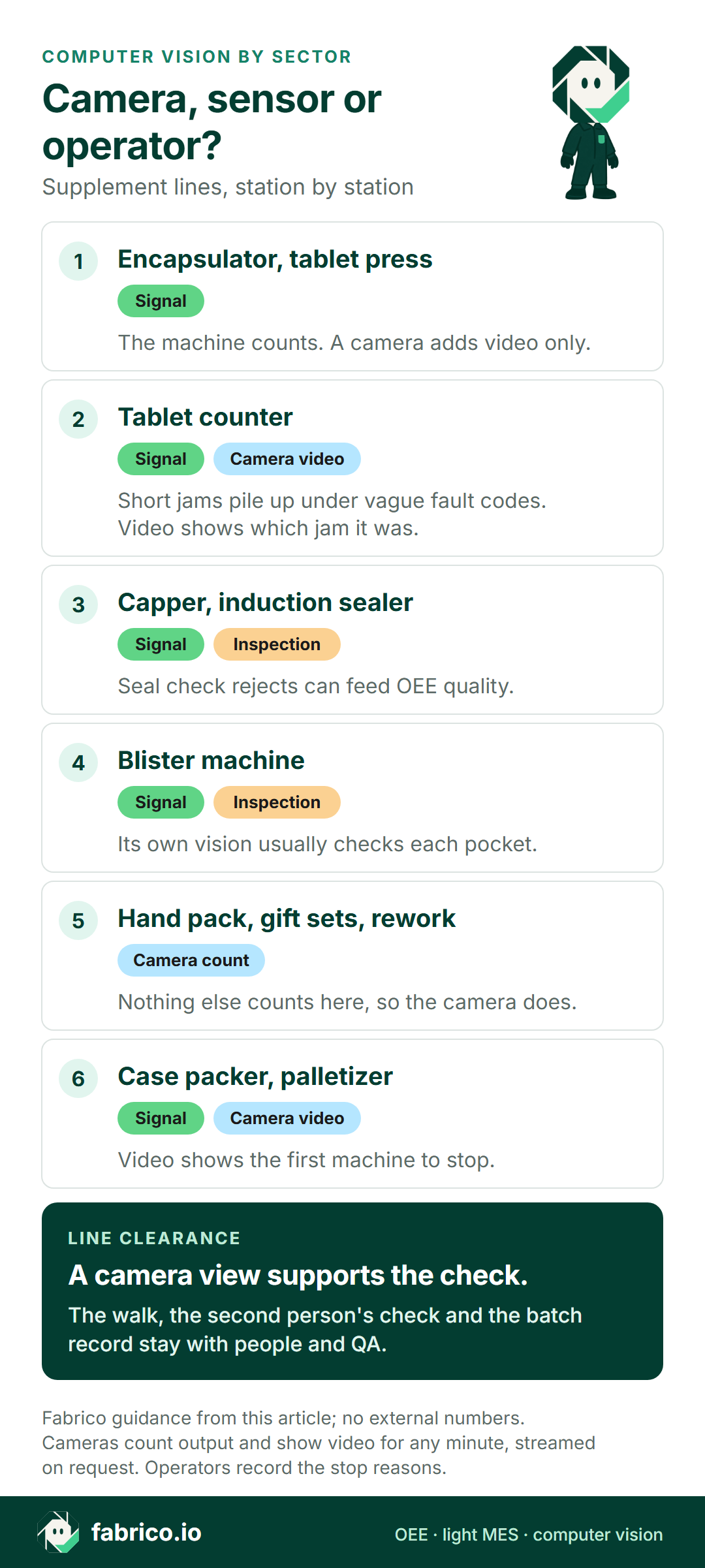
Camera, sensor or operator at each supplement station
Treat the table as a first draft for each line. In every row the operator still gives the stop reason, with video for the unclear cases.
| Station | Signal source today | Camera's role |
|---|---|---|
| Encapsulator, tablet press | Machine controls or PLC | Video for stops, not counts |
| Tablet or capsule counter | PLC signal and bottle count | Video for jams and bridging |
| Capper, induction sealer | PLC signal | Video when the fault code is vague |
| Blister machine | PLC cycle count | Rarely. Its own vision inspects |
| Hand-fed bottle line | Nothing, or a tally | Counts bottles at the outfeed |
| Gift sets, rework, relabel | Tally sheet | Counts finished units |
| Case packer, palletizer | PLC run state | Video for the first machine to stop |
Bring your station list to a demo, marked with what each machine can signal today.
Line clearance: what video can support, and what it can't
The US dietary supplement GMP rule asks plants to dispose of obsolete or incorrect labels and packaging so they are not used again (21 CFR 111.415). The batch record must document packaging and labeling at the time they happen, including the quantity of labels used and, where required, label reconciliation (21 CFR 111.260). Other markets have their own rules, and your QA team owns how you meet them.
None of that is a camera's job. A person walks the line, a second person checks, and the record is signed. What the camera and the signal can add is narrower:
- A look at the moment. QA or a shift leader can open the video for the minute a checkpoint was signed off, and see what that camera showed. A camera over the counter or a bench does not cover the whole line.
- A clock on clearance. The signal times the whole changeover. Ask whether clearance can be logged as its own step with a standard time, so overruns stop hiding.
What it can't do is replace the walk, the second person's check, the label reconciliation or the batch record. Whether a video view belongs in a GMP record at all is a decision for your QA team, not for a software vendor.
Fabrico's standard setup streams video on request and keeps no copy in Fabrico. If QA wants kept images in the batch file, take photos as part of the clearance itself. Our guide to photo evidence for line clearance shows how, and line clearance covers the procedure.
Worked example: one shift, two SKUs on a bottle line
This is sample data for one shift on a vitamin bottle line, not a real line or a product screen.
The shift is 480 minutes with 30 minutes of breaks, so planned production time is 450 minutes. It runs two SKUs with different ideal rates: a 60-count bottle at 45 bottles a minute, then a 120-count bottle at 30 a minute.
The signal timed 88 minutes of stops: 50 for clearance and changeover between the two SKUs, 26 at the counter and 12 at the labeller. That leaves 362 minutes of run time, so availability is 362 of 450, or 80.4%.
The line made 7,920 bottles of the 60-count, worth 176 minutes at its ideal rate, and 4,320 of the 120-count, worth 144 minutes. That is 320 ideal minutes in 362 run minutes, so performance is 88.4%. The other 42 minutes went to slow running and pauses too short to log as stops.
The checkweigher and seal check rejected 90 bottles of the first SKU and 60 of the second. The good bottles are worth 174 plus 142, or 316 minutes. Quality is 316 of 320, or 98.8%.
OEE is 80.4% x 88.4% x 98.8% = 70.2%. As a check, 316 good minutes of 450 planned is also 70.2%. Setting a rate per SKU is covered in OEE for supplement manufacturing.
Now the camera part. The operator logged all 26 counter minutes as a counter fault. The shift leader opened the video for each counter stop and split them: 14 minutes of tablets bridging in the hopper, all on the 120-count run, 8 minutes of the counter waiting for bottles from the unscrambler, and 4 minutes of dust on the count sensors.
That changes the fix list. Eight of the 26 minutes belong to the unscrambler, not the counter, and the bridging belongs to one SKU, not the whole line.
The changeover is a separate question. If the standard for a count and label change is 35 minutes, the extra 15 cost 450 bottles of the 120-count. At an assumed contribution of €1.50 a bottle, that is about €675, but only if you could have sold them. Agree that costing rule with your controller.
Supplement line questions for every computer vision vendor
Use the same list with every vendor, Fabrico too, and bring one real shift from a bottle line and one from a hand bench.
| Ask | How to test the answer |
|---|---|
| Who counts at the counter and the press? | Expect the machine to count. If a vendor wants a camera to count tablets, ask for accuracy data at your speed and fill. |
| Can it count a hand bench? | Film one gift set run, count it by hand, and compare the two numbers. |
| Will it cope with a dusty room? | Ask for the housing rating, where it mounts, and how often the lens needs cleaning with your agents. |
| Where does the video go? | Find out where footage sits, how long it stays, and who has access. QA and the works council will want that in writing. |
| How is clearance timed? | Ask to see clearance as its own changeover type, with a standard time and the minutes over it. |
| What will QA need to assess? | Ask whether the system writes anything into your batch or quality systems, or only reads and reports. |
| What does a pilot look like? | Pick one bottle line, a set number of shifts and a hand count to compare against, all agreed before any contract. |
Our guide on running a computer vision OEE pilot has a plan you can copy.
Privacy, hygiene gowns and the works council
A camera over a counter or a hand bench will see people. Hairnets, masks and gowns don't make them anonymous. Across much of Europe, expect the works council or staff representatives to ask for a say before installation.
- Frame the product. Aim at the hopper, the outfeed or the bench surface, not at faces.
- Write down the purpose. The camera is there to count bottles and explain stops, not to time operators.
- Say what happens to video. Where it is viewed, who can open it, and whether any is kept.
Automatic masking of people beyond today's options is on the roadmap, so ask what is available now. Our page on production line cameras without surveillance covers the approach.
Where Fabrico fits on a supplement line
Fabrico is cloud software for OEE and light MES. Here is what it does on a supplement line today, and where it stops.
- Signals and reasons: stops and counts come from the machine, through a PLC, a sensor or a counter. Operators give each stop a reason on a phone or tablet at the line.
- Results: OEE, downtime and losses for each line and shift, with the losses priced in money, in the web app and on iOS and Android.
- Camera add-on: AI cameras count output, including at hand benches and on machines without a usable signal. Any moment on the shift timeline can be opened as video, streamed on request. The standard setup keeps no video in Fabrico.
- Data out: REST API, webhooks, and Excel or CSV export.
- Roadmap, not live: cameras spotting stops by themselves, jam zones marked at the counter, and a suggested stop reason that the operator confirms.
- Outside Fabrico: inspection of pockets, tablet counts, seals, labels and codes stays with your inspection systems, whose reject counts can flow into OEE. Batch records, cleaning logs and clearance sign-off stay in your quality systems. Raise any scheduling questions in the demo.
Put the seven questions above to us as well, and ask to see the count and the video on a line like yours.
Book a demo, or ask us a question before you do.
What supplement teams ask next
Can a camera count tablets or capsules into each bottle?
Not with an OEE camera. The counter does that with its own sensors, and a checkweigher or count check catches the misses. An OEE camera counts finished bottles, gift sets or cartons, above all at stations with no machine count.
Does camera video count as GMP evidence for line clearance?
We make no such claim. Your QA team decides what belongs in a GMP record. Fabrico's standard setup streams video on request without keeping it in Fabrico, so it supports a check rather than becoming a kept record. If you need kept images, take photos as part of the clearance.
Can the camera tell us why the counter stopped?
Not on its own today. The machine signal records when the counter stopped and for how long. The operator picks the reason and can check the video for that minute. A camera that proposes a likely reason for the operator to confirm is on the roadmap, not live.
Which station should get the first camera in a supplement plant?
Usually at a hand bench that nothing counts today, such as gift sets or rework. The other good start is above the tablet counter on your busiest bottle line, where short stops pile up under vague fault codes.
What decides the price of computer vision for a supplement plant?
Mainly the number of lines and cameras, how they are mounted, the network to reach them and operator training. Send each vendor the same list of lines and stations, and compare the quotes against that list.
Want to see it on a bottle line like yours? Book a demo.
Related articles













Real Fabrico tiles, sample data.