


 Login
 Blog

Computer Vision for Cosmetics and Personal Care Manufacturing

In short: computer vision for cosmetics manufacturing pays off where your machines give no usable count: gift set benches, promotional packs, rework and old fillers with no PLC. On automated fillers, cappers and labellers, the machine signal already gives you stops and counts.
- On short-run lines, product changes, format changes and line clearance can take a large share of the shift. Measure them before you buy cameras.
- An OEE camera counts output and lets you open the video for any minute of the shift. It does not check fill level, labels, codes or seals. Inspection systems do that.
- Point cameras at the product path and the outfeed, not at people, and report by station and shift.
- Fabrico is a cloud OEE and light MES platform. AI cameras are an add-on that count output. In the standard setup, video is streamed on request, not stored in Fabrico.
Many cosmetics lines already have a camera on the labeller or the coder, checking that each pack is right.
The camera on this page does a different job. It counts what the line makes, so OEE (overall equipment effectiveness) covers every station, including the ones run by hand.
This page is for plant managers, operations and CI leads at cosmetics and personal care plants and contract manufacturers who are choosing where cameras go. For the stop modes of one line, read our shampoo and tube line deep dive.
We sell Fabrico, so test what we say here like any vendor's claims.
What computer vision does on a cosmetics line, and what it doesn't
Two kinds of camera get sold under the same name. One judges each pack. The other counts output for OEE.
| Job | Inspection vision | OEE camera |
|---|---|---|
| Fill level or fill weight | Yes, or a checkweigher | No |
| Label, batch code, expiry date | Yes | No |
| Tube crimp, seal, cap torque | Machine checks and inspection | No |
| Count packs at a hand bench | Not usually installed there | Yes, its main job |
| Video of the minute a stop began | No | Yes, from the shift timeline |
| Reason for a stop | No | The operator adds it. Camera help is roadmap. |
The two sit side by side. When your inspection system rejects a pack, that reject can feed the Quality part of OEE through the line's reject count or a reject signal.
Inspection is sold by firms such as Cognex, Keyence and Mettler-Toledo, not by Fabrico. See label and code vision versus an OEE camera for the full split.
Where cosmetics and personal care lines lose time
The product mix drives the losses. Skin care is Europe's biggest category, at €32.3 billion of 2025 retail sales, ahead of toiletries, hair care, fragrances and decorative cosmetics, says Cosmetics Europe. Each brings its own packs: jars, tubes, pump bottles, glass, sticks and compacts. A contract manufacturer can run several of them in one week, for several brands.
- Product changes. Clean the hopper, nozzles and pipes before the next formula, many times a week.
- Format changes. A new tube, jar, pump, cap chuck, label reel or carton blank, then a first-off check.
- Line clearance. Every label, leaflet, carton and coded pack of the last SKU leaves the line. It is a GMP step, so don't rush it, but do time it.
- Start-up stops. Short stops at the cap, pump and tube feeds after each change, covered in the shampoo and tube line page.
- Slow running. Thick creams and foaming gels often fill slower than thin liquids, so each SKU needs its own rated speed. For tubes, see tube filling line OEE.
- Hand work at the end of the line. Gift sets, promo packs with a free sample, display trays and rework. These benches rarely have a PLC, so their minutes live on a paper tally or nowhere.
Unplanned stops are costly on their own. In Siemens' True Cost of Downtime 2024 survey of large plants, downtime costs in FMCG, the sector most cosmetics makers sit in, doubled per plant since 2019, to just over $10 million a year. FMCG was also the exception to the fall in hours lost: its average is similar to 2019. Changeovers and clearance come on top of that, because they are planned.
Where a camera goes on a cosmetics line
Start with the machine signal wherever there is one: most automated fillers, cappers, labellers and cartoners have a PLC or a counter. Add a camera where that signal is missing or tells you too little.
At the amber stations one fault code can hide several kinds of stop. The camera does not replace the signal: the team opens the video for the minutes that matter and can tell a pump jam from a missing cap. The shampoo and tube line page covers those stop modes.
The blue stations are where the camera does its main job. A gift set bench with no count is a blind spot in the line's OEE, and during a promotion it can be the slowest step.
Camera, sensor or operator: station by station
Use this as a first pass on your own line list.
| Station | Count from | Add a camera when |
|---|---|---|
| Tube filler | Machine counter or PLC | Outfeed jams are frequent and the fault code says little |
| Jar or bottle filler | Machine counter or PLC | The filler is old or semi-automatic, with no usable signal |
| Capper: screw, pump, flip cap | PLC, or a sensor at the outfeed | Pump and cap feed stops need a closer look |
| Labeller | PLC. Inspection checks the label. | Rarely, for OEE |
| Cartoner | PLC count | Leaflet and carton feed stops are hard to read |
| Case packer | PLC or a sensor | Rarely |
| Gift set or kitting bench | Nothing, or a paper tally | Almost always: the main use |
| Promo packs and rework | Nothing, or a paper tally | It runs for weeks or sets the ship date |
At every station, the operator adds the stop reason on a tablet or phone. The signal says the line stopped. Only a person can say why.
For the same choice on other machine types, see camera or sensor for OEE, by machine. For the OEE math at a bench, read OEE for a manual packing station.
Want to test this split on your own line list? Book a demo and bring the list of stations.
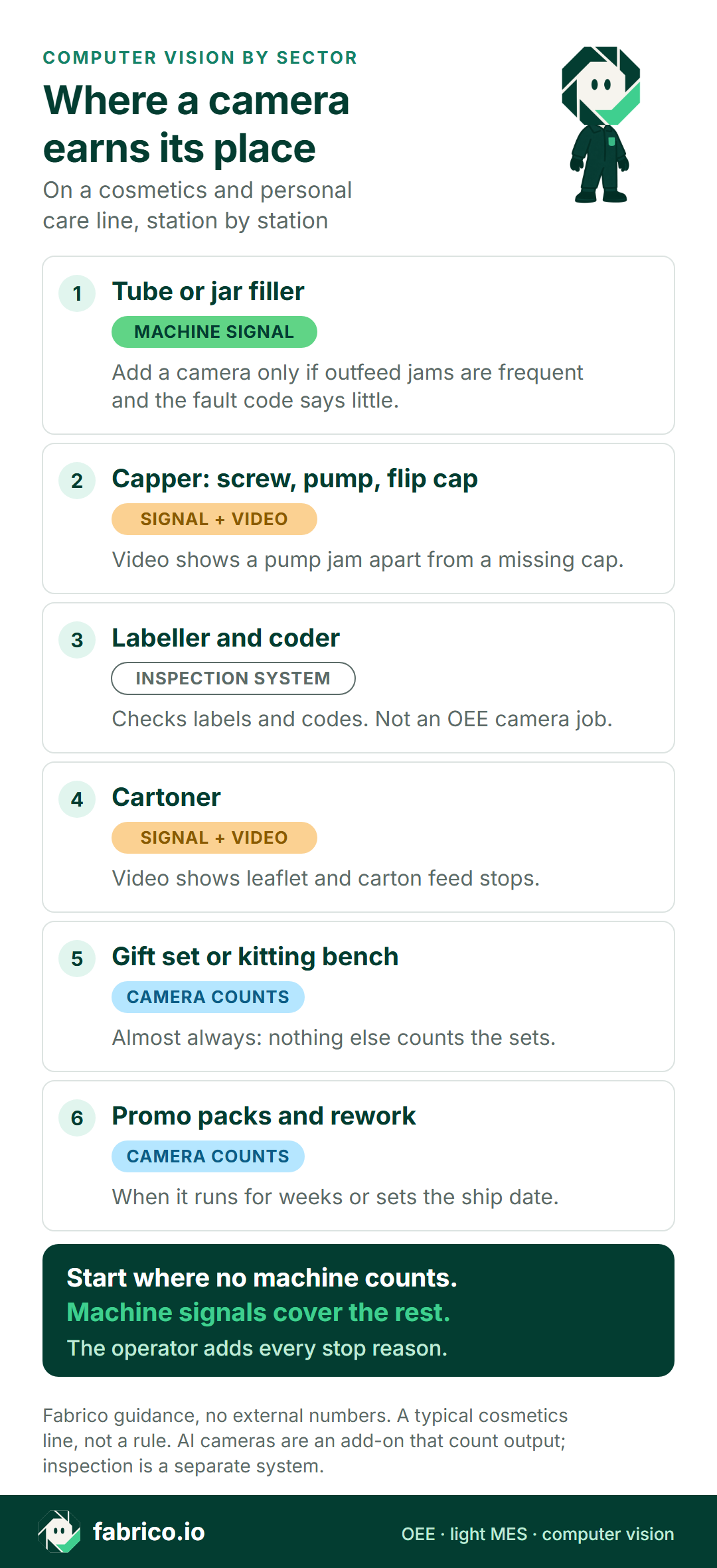
Text version of this infographic
- Tube or jar filler: machine signal. Add a camera only if outfeed jams are frequent and the fault code says little.
- Capper: screw, pump, flip cap: signal plus video. Video shows a pump jam apart from a missing cap.
- Labeller and coder: inspection system. Checks labels and codes; not an OEE camera job.
- Cartoner: signal plus video. Video shows leaflet and carton feed stops.
- Gift set or kitting bench: camera counts. Almost always: nothing else counts the sets.
- Promo packs and rework: camera counts, when it runs for weeks or sets the ship date.
Start where no machine counts; machine signals cover the rest. The operator adds every stop reason. Fabrico guidance, no external numbers: a typical cosmetics line, not a rule. AI cameras are an add-on that count output; inspection is a separate system.
Changeovers and line clearance: what the video can and cannot show
Line clearance is a GMP step. The European Commission lists EN ISO 22716:2007, the guidelines on good manufacturing practices for cosmetics, as the harmonised standard for cosmetic products. The FDA's GMP checklist for cosmetics has no clearance item, but it asks for a related check on labels: "Labels are examined for identity before labeling operations to avoid mix-up."
A camera helps with the time, not the proof.
- The changeover shows up as a timed stop from the machine signal, and the operator adds the reason, such as a product change or a format change.
- Ask whether one changeover stop can be split into steps, so clearance gets its own reason and minutes. If not, the time stamps on your clearance photos split them out. Either way, time it per SKU change without pushing anyone to skip a check.
- The camera video can show, for example, whether the cartoner waited for leaflets after sign-off.
- Camera video is not your clearance record. Keep the checklist, the photos and the second signature in your own quality system.
We make no GMP or ISO 22716 claim about Fabrico. For how plants photograph each checkpoint and time the step, read line clearance photo evidence. For changeovers inside an MES, see MES for cosmetics manufacturing.
Worked example: a contract filler's gift set week
Illustrative, sample data, not a customer. A contract manufacturer runs a jar line in November: filler, capper and labeller, then a bench where four packers put a jar, a leaflet and a sample sachet into each gift box. Jars go straight from the labeller to the bench.
The week: 10 shifts of 450 planned minutes, or 4,500 minutes, with 7 gift set SKUs for two brands and 6 changeovers. The ideal rate is 20 gift sets a minute.
Before the camera, the only count was the filler's counter: jars filled, not gift sets packed. Now a camera counts closed gift boxes on the bench outfeed. When the count stops for longer than the plant's cutoff, the operator logs a stop and picks the reason.
| Loss | Minutes | Sets lost | Who sees it |
|---|---|---|---|
| Slow running at the bench | 573 | 11,460 | Camera count |
| Changeovers, incl. 90 min clearance | 270 | 5,400 | Signal, operator reason |
| Filler, capper, labeller stops | 260 | 5,200 | Signal, operator reason |
| Bench waiting for boxes, inserts | 150 | 3,000 | Count gap, operator logs it |
| Rejects at the final check | 47 | 940 | Reject count |
| Total | 1,300 | 26,000 |
Clearance minutes come from the clearance sign-off times. The camera counted 64,940 sets. 940 failed the final check, so 64,000 were good.
- Run time = 4,500 minus 270, 260 and 150 minutes of stops = 3,820 minutes.
- Availability = 3,820 / 4,500 = 84.89%.
- Performance = 64,940 / (3,820 x 20 = 76,400) = 85.00%.
- Quality = 64,000 / 64,940 = 98.55%.
- OEE = 0.8489 x 0.8500 x 0.9855 = 71.1%. Check: 64,000 good sets / 20 a minute = 3,200 minutes, and 3,200 / 4,500 = 71.1%.
Each lost minute is 20 lost sets. Slow running is run time minus the time the counted sets needed at 20 a minute: 3,820 minus 3,247 = 573 minutes. The 940 rejects are 47 minutes.
The bench holds 723 of the 1,300 lost minutes, or 56%. The filler's counter showed that the line was slow, but not where. Only the bench count put the slow running at the packers. Without it, it would have looked like the filler's problem.
At an example contribution of €0.80 a set, the bench's 14,460 lost sets are €11,568 for the week. That is cash only if you could have sold the extra sets, or the gap costs overtime.
The fix is not a camera job. Slow running at a bench often comes from layout, long reaches and material supply. The video for a few waiting minutes can show an empty box rack, not a slow packer.
What to check when choosing computer vision for cosmetics manufacturing
Ask every vendor the same questions, us included. Bring your own line list and one real week.
| Ask | How to test the answer |
|---|---|
| Does the camera count match a hand count on our gift set? | Count one full shift by hand at the same spot and compare. See how accurate camera OEE is. |
| How does the system know which SKU is running? | Change SKU in the demo. Two gift sets can look alike, so the camera should not have to guess. |
| Can a changeover be split into product change, format change and clearance? | Ask to see one changeover coded three ways, with minutes for each. |
| Where does the video live, and who can open it? | Ask if it is streamed or kept, for how long, and who sets access. |
| How do rejects from our inspection system reach OEE? | Ask which count or signal feeds Quality. The OEE camera should not claim to inspect. |
| Can a contract manufacturer report by SKU and by customer? | Ask for last week by SKU, then by customer, from the same data. |
| How fast can an operator code a stop on a phone? | Hand the phone to an operator in the demo. If it takes many taps, codes go missing. |
| What drives the quote? | Send each vendor the same list: lines, stations, cameras, mounting points, network and training. |
Three of these depend on your setup: where the video sits, how the running SKU is set, and reporting by customer. Ask us in the demo too.
For named tools, see our review of OEE software for cosmetics and personal care. For the ERP and quality side, see cosmetics manufacturing software, and for OEE platforms in general, our OEE software guide.
Cameras, privacy and the works council
Gift set benches and rework stations put people close to the frame. That makes privacy the first question, not the last.
- Point the camera down at the outfeed and the product path, with faces out of the frame.
- Report OEE by station, line and shift, never by named operator. Fabrico's AI camera counts the station's output. It does not time each packer.
- Agree in writing who can open the video and why, before the first camera goes up.
- Talk to the works council or employee representatives early. In Germany, for example, the Works Constitution Act, section 87 gives the works council a say over technical equipment meant to monitor staff behaviour or performance.
Our guide to production line cameras without surveillance covers the policy and the setup.
Where Fabrico fits
Fabrico is a cloud OEE and light MES platform. Here is what it does today.
- Stops and counts: from the machine signal (PLC, sensor or counter).
- Stop reasons: the operator adds them at the line, on a tablet or phone.
- OEE and losses: by line and shift, with losses shown in money.
- AI cameras, an add-on on request: they count output, including at gift set benches and machines with no usable signal.
- Video: open the camera video for any moment on the shift timeline. In the standard setup it is streamed on request, not stored in Fabrico. Where the footage sits in your setup: ask us in the demo.
- Your data: REST API, webhooks, and Excel or CSV export. Web, iOS and Android.
Roadmap, not live today: stops found by the camera, jam zones marked in the frame, and a camera that proposes the reason for a stop.
What Fabrico does not do: inspection of fill level, labels, codes or seals, and formulas, batch records or lot genealogy. Those stay with your inspection systems and your ERP. For production planning and scheduling, ask us in the demo.
See the computer vision OEE and MES page, and our light MES guide if you are weighing it against a full MES.
Here is one result from a maker in a nearby category. Ficosota, a Bulgarian maker of hygiene, tissue and household products, is also an investor in Fabrico. Over 16 lines, June to September 2026, its OEE rose from 53.11% to 59.62%. Good output went from 10.49M to 12.92M units a month, and unclassified stop time fell from 3.20% to 0.40%. That is one company, not a benchmark for your plant. Read the investment news.
All eight checks above apply to us too. Book a demo and run them on your own line.
What people ask next
Can the same camera check fill level and labels on our cosmetics line?
No. Fill level, labels, codes and seals are jobs for inspection systems and checkweighers. The OEE camera counts output.
Do we need cameras if our fillers already have PLCs?
Often not on the fillers. Start with the machine signal there. Add cameras where there is no usable signal: gift set benches, promotional packs, rework and older semi-automatic machines.
Can the camera video be our line clearance record for ISO 22716?
No. Keep the checklist, photos and signatures in your own quality system: that is your record. Fabrico logs the changeover as a timed stop with the operator's reason, and we make no GMP or ISO 22716 claim about it.
How does the system know which gift set is running?
Ask each vendor, and ask us in the demo. Two gift sets can look the same from above, so the running SKU should not depend on the camera guessing.
What drives the cost of computer vision on a cosmetics line?
Prices are not public, ours included. The quote depends on lines and stations, the number of cameras, mounting, network and training. Send each vendor the same line list so the quotes compare.
Will the works council accept a camera on a packing bench?
That depends on your country and your agreements, so talk to them early. Point the camera at the outfeed, not at faces, report by station and shift, and agree in writing who can open the video.
Want to see the gift set bench next to the filler on one timeline? Book a demo or Contact us.
Related articles











Real Fabrico tiles, sample data.