


 Login
 Blog
Computer Vision for Household Products Manufacturing: Where Cameras Go

In short: computer vision for household products manufacturing is most useful at the stations your machine signals can't count or explain: promo pack tables, rework, case packers and palletizers. Fill level, cap and label checks are a separate job for inspection systems.
- On liquid detergent and cleaner lines, the filler and capper usually have good PLC signals. Cameras help most after them, at pack-out and the end of line.
- On tissue, hygiene and nonwovens lines, the PLC already counts at full speed. Video helps explain stops at the wrapper, bundler, bagger and palletizer.
- Inspection systems from vendors such as Cognex, Keyence or Mettler-Toledo check each pack. Their reject count can feed the quality part of OEE.
- Fabrico measures OEE from machine signals plus operator stop reasons. AI cameras are an add-on that count output, with video for any minute on the shift timeline.
Many of the lost minutes don't start at the machine everyone watches. They start at the end of the line, at the promo pack table, or in a changeover between two private label SKUs.
This page is for the plant manager or CI lead choosing camera and OEE software for household products lines. We sell Fabrico, so test our claims like any vendor's.
What computer vision does on a household products line, and what it doesn't
Two kinds of camera system get sold under the same name. Mixing them up leads to the wrong shortlist.
Inspection vision checks each pack against a spec and rejects the bad ones. An OEE camera counts output and gives you video for the minute a line stopped. They answer different questions, and many plants need both.
| Job | Inspection vision | OEE camera |
|---|---|---|
| Fill level, cap present | Yes, its main job | No |
| Label, date code, barcode | Yes | No |
| Leak or seal check | Leak tester or inspection system | No |
| Count hand-built promo packs | Not its job | Yes |
| Show why the case packer stopped | No | Video for that minute |
The link between the two is the reject count. If your checkweigher or label inspection gives a reject signal or counter, OEE software can use it for the quality part of OEE.
It only knows what that signal says: how many rejects, not why. For the full split, read label and code vision vs an OEE camera.
Where the losses hide on household products lines
Siemens surveyed large industrial companies for The True Cost of Downtime 2024. In FMCG, it found that unplanned downtime costs per plant have doubled since 2019, to just over $10 million a year.
It also found that FMCG plants lose about as many hours to unplanned downtime as in 2019, while automotive and heavy industry halved theirs. The report does not split FMCG by product. On a household site, look for the lost hours in five line types.
Liquid detergent and cleaner filling
Thick products such as fabric softener fill slowly, and foaming products force a slower fill too. Our guide to OEE for detergent filling lines covers ideal rates, flushing and fill weight in detail.
Capping is a common home for short stops, above all with trigger sprayers. The feeder has to orient each trigger, and the dip tube has to find the bottle neck. Each misfeed is a short stop that the PLC often logs under one generic fault code.
The video for that minute shows whether it was the feeder, a tipped bottle or an empty hopper.
Powder and capsule lines
Powder fills cartons or bags by weight. Dust settles on photo-eyes and on camera lenses alike, so ask any vendor how often a lens needs cleaning in a powder hall.
Capsule lines form, fill and seal pods in water-soluble film, then count them into tubs or pouches. Humidity and a leaking pod can stop the counter and the tub filler. The machine knows it stopped. The reason usually comes from the operator.
Aerosol filling
Air fresheners, insect sprays and polishes run on aerosol lines. Valve feeding and crimping cause short stops, the propellant goes in inside a separate protected gas house, and every filled can passes a leak test.
Start with a camera at the end of line, away from the gas house, and ask any vendor whether its camera may go nearer. The deep dive is OEE for aerosol filling lines.
Tissue and paper converting
On a toilet tissue or kitchen towel line, web breaks and parent reel changes take the long stops. The log saw, wrapper and bundler take the short ones, and a camera there adds video, not counts.
See OEE for tissue converting.
Hygiene and nonwovens lines
Diaper, incontinence and feminine care lines run very fast. ZUIKO, a hygiene machine maker, lists its premium diaper machines at 1,000 pieces a minute.
At that speed, sensors and PLCs do the counting. Cameras help where the pace drops and people step in: the bagger, the case packer, the palletizer and the table where rejected bags are reworked by hand.
See OEE for nonwovens and hygiene lines for splices, glue faults and restart rejects.
The end of line, on every line type
All five line types end in much the same way: a case packer or bundler, a palletizer and a stretch wrapper. When one of them stops, the line upstream fills its buffer and then stops too.
If only the filler is connected, the software sees the line stop but not where it started. Add a run signal from the case packer and palletizer, and you can see which machine stopped first.
The signals still don't show why. A carton magazine ran empty, a glue gun clogged, a case jammed: that is what the video for the minute shows.
Ask any vendor, us included, how it shows which machine stopped first and which ones were only starved or blocked. Our pages on case packer downtime on camera and palletizer downtime on camera show where those cameras go.
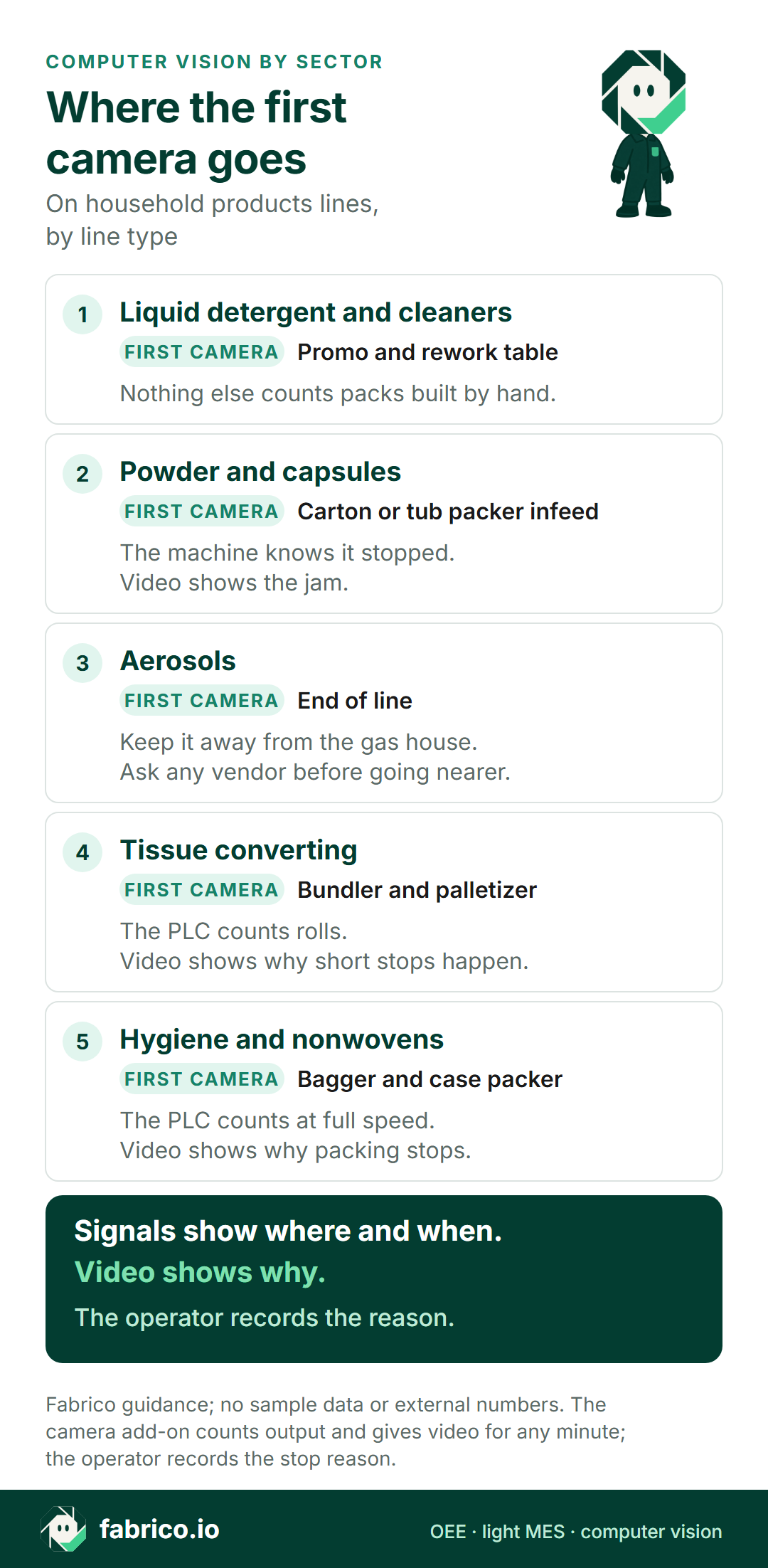
Line map: where a camera goes on a household products line
Here is a liquid cleaner line from bottle to pallet, with the system that owns each job.
Two places get a camera because nothing else does the job as well: the promo and rework table beside the line, where nothing counts, and the end of line, where the signals show a stop but not what went wrong. Start there.
Camera, sensor or operator: station by station
Use this as a first pass for each line. Our guide to camera or sensor by machine goes deeper.
| Station | Counts and stops from | Where a camera helps |
|---|---|---|
| Filler and capper | PLC signal and counter | Video when the fault code doesn't explain the stop |
| Powder or capsule filler | PLC signal | Video for jams at the infeed and the counter |
| Log saw, wrapper, bundler | PLC counts at full speed | Video for short stops |
| Hygiene machine | PLC, at full speed | Not for counting. Video at the bagger |
| Promo or rework table | Nothing, or a tally sheet | Counts packs built by hand |
| Case packer, palletizer | PLC run state | Video shows why it stopped |
| Fill, cap, label, code checks | Inspection system | None. Its reject count feeds OEE |
In every row, the signal says when and for how long, and the operator says why, with the video to check.
Want to map your own lines? Book a demo and bring your station list.
Private labels, many SKUs and promo packs
Household plants often make the same product under their own brand and several retailer brands. PLMA's 2025 market update with NielsenIQ puts private label at 38.7% of the market by value across the 17 European countries tracked. It names paper products as one of the top three private label categories.
For the line, that means many SKUs that differ only in label, bottle colour, case count or language. Every switch is a changeover, and short runs mean many of them each week.
Three things help here, and only one of them needs a camera.
- Time changeovers from the signal. The line stops and restarts, and the software records the minutes. The operator codes it as a changeover and picks the type: label only, colour flush or full format.
- Set a standard time per changeover type. Minutes over the standard are their own loss, so you can see which type runs over, on which line. See changeover standards for FMCG.
- Count promo packs with a camera. Banded packs, bonus packs and display trays are often built by hand, and no PLC counts them. Our page on manual packing station cameras covers how.
Ideal rates matter too. A 500 ml bottle and a 1.5 litre bottle can run on the same line at very different speeds. Set one ideal rate per SKU, or the performance number means little. For the wider FMCG picture, see our FMCG industry page.
Worked example: one shift on a dish liquid line
This is sample data for one 8 hour shift on a private label dish liquid line. It is not a customer's line and not a product screen.
Planned production time was 480 minutes. The filler sets the pace at an ideal 100 bottles a minute.
The line stopped for 75 minutes in total, timed by the signal. That leaves 405 minutes of run time, so availability is 405 of 480, or 84.4%.
In 405 minutes at 100 a minute, the ideal is 40,500 bottles. The filler counted 36,450, so performance is 90.0%.
The checkweigher and label inspection rejected 730 bottles, leaving 35,720 good. Quality is 35,720 of 36,450, or 98.0%.
OEE is 84.4% x 90.0% x 98.0% = 74.4%. As a check, 35,720 good bottles of the 48,000 possible in 480 minutes is also 74.4%.
In this sample, only the filler is connected. Of the 75 stop minutes, 30 started at the case packer and palletizer. The filler's signal timed all of them but could not say where they started or why.
A run signal from the packer would show where. The video shows why, so the operator can give each stop the right cause instead of a guess.
At an assumed contribution of €0.30 a bottle, those 30 minutes cost 3,000 bottles, or about €900 in one shift. The camera does not win that back. It shows which machine and which fault to fix first, so later shifts lose less.
That is only real money if you could have sold the bottles, so agree the costing rule with your controller. The 35 minute promo changeover is its own loss: check it against your standard.
Questions to ask any vendor of computer vision for household products
Run these with every vendor, us included. Bring a real shift from one of your lines.
| Ask | How to test the answer |
|---|---|
| Who counts on our fastest line? | Expect the PLC to count. A camera at full speed needs accuracy data at your speed. |
| Can it count hand-built promo packs? | Film one promo run, count it by hand, and compare. |
| Which machine stopped first? | Take one real packer stop. Ask which signal shows it, and what the video adds. |
| Where do inspection rejects go? | Ask how the reject signal reaches the quality part of OEE. |
| Is video stored, and who can see it? | Ask where it lives, for how long, and who can open it. |
| How does it handle hundreds of SKUs? | Ask who sets ideal rates and changeover types per SKU. |
| What happens to a stop with no reason? | Ask to see the unclassified minutes. |
| What does a pilot look like? | One line, a fixed period and a hand count to compare. Agree it before you sign. |
Privacy and the works council
A camera at a promo table or a case packer will see people. In many European plants, the works council or employee representatives will want to agree before anything goes up.
Three things make that conversation easier:
- Aim at the product. Frame the pack, the infeed or the layer table, not faces.
- Say what happens to video. In Fabrico's standard setup, video is streamed on request and not stored in Fabrico.
- Say what it is for. Counting packs and explaining stops, not timing people.
Roadmap: more automatic masking of people in the frame. Ask us what exists today. For the full approach, read production line cameras without surveillance.
How Fabrico does it
Fabrico is a cloud OEE and light MES platform. Here is what it does on household lines today, and what it doesn't. For a wider comparison, see our OEE software guide.
- Stops and counts: from the machine signal, whether a PLC, a sensor or a counter. The operator adds the stop reason at the line, on a tablet or phone.
- OEE and losses: OEE, downtime and losses by line and shift, with losses shown in money. On the web, iOS and Android.
- Computer vision add-on: AI cameras count output, including at manual steps like a promo table. You can open the camera video for any moment on the shift timeline. In the standard setup, video is streamed on request, not stored in Fabrico.
- Your data: it leaves through the REST API, webhooks, or an Excel or CSV export.
- Roadmap: cameras that detect stops on their own, mark jam zones and suggest a likely reason for the operator to confirm. None of this is live today.
- Not Fabrico: inspection of fill level, caps, labels and codes. Keep your inspection system and feed its reject count into OEE. For planning and scheduling, ask us in the demo.
One FMCG data point. Ficosota, a Bulgarian maker of hygiene, tissue and household products, runs Fabrico across 16 lines. From June to September 2026, OEE rose from 53.11% to 59.62%, and good output rose from 10.49 million to 12.92 million units a month. The share of production time with no recorded stop reason fell from 3.20% to 0.40%. Ficosota is also an investor in Fabrico, as we announced when it invested, so weigh the result with that in mind. The case study is about OEE and stop reasons, not cameras.
Put the eight questions above to us as well.
What people ask next
Can a camera count diapers or tissue rolls at full line speed?
On those lines, the PLC or a sensor already counts at full speed, and that is the count to use. A camera is more useful downstream, at the bagger, case packer and palletizer, and at manual rework.
If a vendor proposes a camera count at full speed, ask for accuracy data at your speed. Our page on how accurate camera OEE is shows how to test it.
Does an OEE camera check fill level, caps or labels?
No. That is inspection, and it needs a dedicated inspection system. Its reject signal or counter can feed the quality part of OEE, so the two systems work side by side.
Can the camera tell us why a line stopped?
Today the signal times the stop and the operator adds the reason, with the video for that minute to check. Roadmap: a camera suggesting a likely stop reason for the operator to confirm. It is not live today.
Is camera video stored?
In Fabrico's standard setup, video is streamed on request and not stored in Fabrico. Ask every vendor the same question, and get the answer in writing for your works council.
Where should the first camera go in a household products plant?
Usually at a station nothing counts today, like a promo pack table. The other good start is the end of line, where the signals show a stop but not what went wrong. One camera there shows you quickly whether more are worth it.
What drives the cost of computer vision on household lines?
The quote depends on the number of lines and cameras, mounting, network and training. Give every vendor the same line and station list, so you compare like with like.
Want to see it on a line like yours? Book a demo.
Related articles








Real Fabrico tiles, sample data.