


 Login
 Blog
OEE for Detergent Filling Lines: Foam, Caps and Frequent Changeovers

Key takeaways
- Set the ideal rate per container size from the filler's rated speed, and book foam slowdowns as a speed loss with a reason.
- Changeovers come in three kinds: product flush, format change, or both. Time each from the last good bottle to the first good bottle.
- Unscramblers, cappers and labellers create most short stops, and those hide in Performance.
- Waiting for a released bulk batch is an Availability loss coded to the batch side, not to the filling crew.
- Count checkweigher rejects, leakers and label faults as Quality, and track giveaway separately in money.
A one-litre bottle of dishwashing liquid comes off the filler with foam running down its neck. The capper chuck slips on the wet thread, the bottle is rejected at the torque check, and two minutes later the labeller stops because a wet bottle will not take the label. None of it is a breakdown, and none of it will be in the shift report. On a detergent filling line, OEE leaks away in exactly these small, linked stops.
This guide is for plant managers, production engineers and CI leads on household chemical lines: laundry liquid, softener, dishwashing liquid, surface cleaners and bleach, in bottles, trigger packs and pouches. It covers where the time goes, how to set the ideal rate when foam and viscosity change by SKU, how to handle flushing and format changes, and how to price the losses.
The filling line, station by station
- Unscrambler and puck system. Orients empty bottles and stands them up. Non-round and unstable bottles often travel in pucks.
- Filler. Volumetric, flow meter or net weight filling. For foaming products, nozzles often dive into the bottle and rise as it fills.
- Capper. Screw caps, push-on caps or trigger sprayers, fed from a sorter. Triggers need orienting, which makes this a common stop point.
- Checkweigher and leak test. Rejects underfilled, overfilled or leaking bottles.
- Labeller and coder. Front and back labels or sleeves, plus the batch code.
- Case packer, shrink wrapper and palletiser. End of line.
Pouch lines replace the first three stations with a pouch filler and sealer, often rotary, fed with premade or spouted pouches. The loss logic is the same.

Where the time goes on a detergent line
| Station | Typical stops | OEE factor |
|---|---|---|
| Unscrambler | Bottles fallen or jammed, wrong orientation, puck jams | Performance (short stops) |
| Filler | Foam overflow, dripping nozzles, valve faults, bulk tank empty | Availability and Performance |
| Capper | Cap feed jam, trigger orientation, chuck slip on wet threads | Performance, Quality for torque rejects |
| Checkweigher and leak test | Reject bin full, false rejects | Quality, short stops |
| Labeller | Label web break, splice, labels not sticking to wet bottles | Performance and Quality |
| Whole line | Flush and format changeovers, waiting for released bulk, no bottles or caps | Availability |
The pattern is typical of high-mix filling: few long breakdowns, many short stops at the stations that handle loose components, and a lot of time in changeovers.
Setting the ideal rate: foam and viscosity
Use one ideal rate per container size and product family: the filler's rated or best proven bottles per minute for that bottle. If the filler is not the slowest machine for a format, use the machine that is.
Foam is the hard part. A foaming product filled at full speed overflows, wets the neck and causes capper and labeller faults, so crews slow the filler down. You then have two honest options:
- Keep the rated speed as the ideal and book the slowdown as a speed loss with the reason foam. The cost stays visible, and it supports a case for different nozzles or a fill profile change.
- Set a lower standard rate for that SKU, approved by engineering and written down. Performance then measures only running below the agreed rate.
Pick one rule and keep it. What you must not do is let each crew choose the speed and then use the average as the ideal. Viscosity matters too: a product that thickens when cold fills slower in winter, and that slowdown also needs a reason.
Changeovers: flushing and format parts
Detergent lines change often, and the changes come in three kinds.
- Product change, same bottle. New fragrance, colour or formula. The tank, pipes and filler are flushed with water or pushed through with the next product, and the first bottles are diverted until colour and scent are right.
- Format change, same product. New bottle size or shape: guides, star wheels, timing screws, filler nozzles, capper chucks and labeller settings.
- Both at once. The longest kind, and the one to plan around.
Time each change from the last good bottle of the old SKU to the first good bottle of the new one at rated speed, and record which kind it was. Some product pairs need a full clean, for example when moving away from a bleach product. Follow the plant's cleaning rules and never shorten them to win OEE.
The flush itself has a cost: product and water to drain or to a rework tank. Weigh it per change. Our guide on how to reduce changeover time covers moving format part preparation outside the stop.
Short stops at the unscrambler, capper and labeller
A fallen bottle at the unscrambler, a cap that will not feed, a trigger that arrives the wrong way round: each is cleared in seconds by the operator, and the run signal barely notices. Together they are usually the largest Performance loss on the line. Our article on micro stops on packing lines shows how to find the station that carries most of them.
Watch the linked effects. A short capper stop that backs bottles up into the filler is a filler stop with a capper cause. Charge it to the capper, the machine that started it. Our guide to starvation and blocking explains the rule.
Quality: fill weight, leakers, labels and giveaway
- Fill weight. Checkweigher rejects for underfill and overfill.
- Leakers and torque. Bottles rejected at the leak test or for wrong cap torque.
- Labels and codes. Missing, crooked or wet labels, unreadable batch codes.
- Diverted product. Bottles filled during a flush until colour and scent are right.
Giveaway is different. An overfilled bottle that passes the checkweigher is a good bottle, so it does not lower OEE Quality, but it gives product away. Track it next to OEE, in money. Our guide to giveaway and overfill shows how.
Data sources: what each one sees
| Source | What it gives you | What it misses |
|---|---|---|
| Filler PLC | Run state, fill count, speed, fault codes | Why the filler waited |
| Checkweigher and leak tester | Accepts, rejects, fill weights | Labels, caps that look fine but leak later |
| Capper and labeller counters | Counts and some faults | Short jams cleared by hand |
| Operator input | Reason, changeover type, bulk batch | Stops too short to record |
| Camera at a station | A clip of the unscrambler or capper at the moment of a stop | What happens inside the filler bowl |
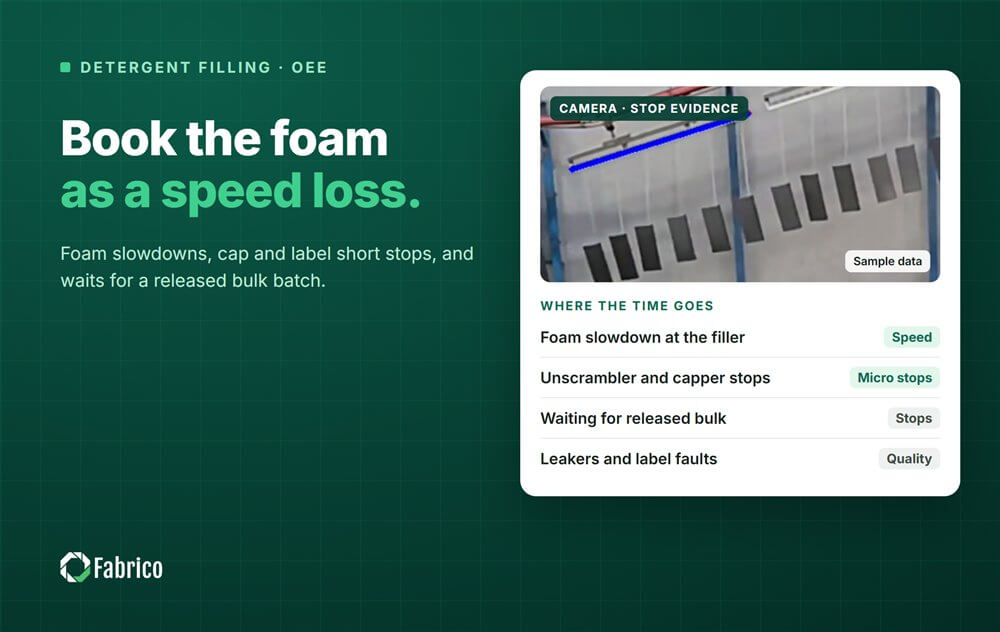
The PLC sets when a stop started and how long it lasted. Where a camera watches the unscrambler or the capper infeed, the clip shows what the run signal cannot: fallen bottles, a cap jam, foam on the necks. A model can suggest the reason, and the operator confirms it in one tap.
A worked shift on a detergent line
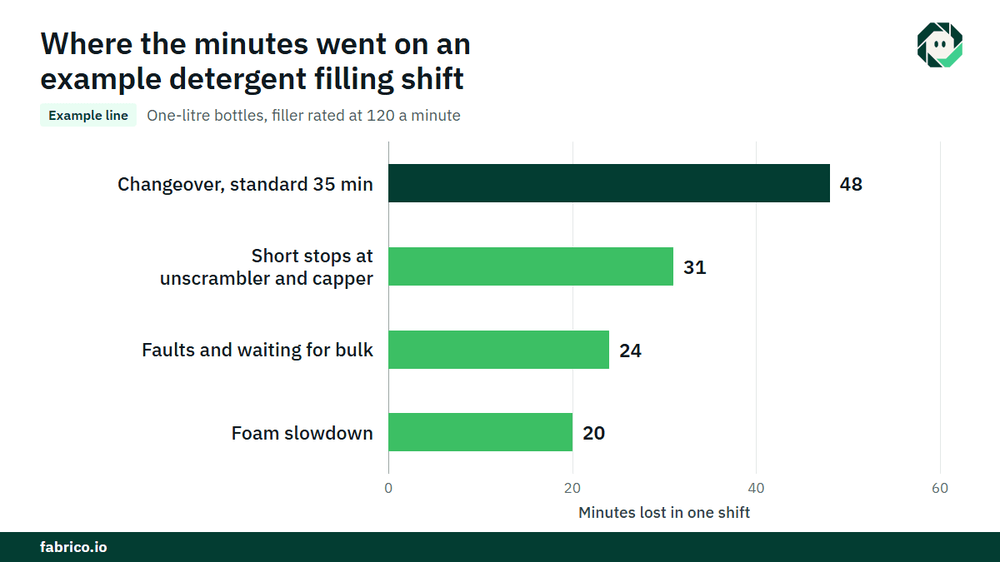
Sample line (illustrative numbers, not a customer): a line fills one-litre bottles, with the filler rated at 120 bottles a minute for this size. Planned production time is 480 minutes.
- Stops: one product and format changeover of 48 minutes (standard 35) and 24 minutes of faults and waiting for bulk. Total 72 minutes, so run time is 408 minutes.
- Availability = 408 / 480 = 85.0%.
- Ideal output = 408 x 120 = 48,960 bottles. The filler counted 42,840. Performance = 42,840 / 48,960 = 87.5%. The missing 6,120 bottles are 51 minutes at the ideal rate: 31 minutes of short stops at the unscrambler and capper and 20 minutes of foam slowdown.
- Rejects: 1,071 bottles. Good bottles = 41,769. Quality = 41,769 / 42,840 = 97.5%.
- OEE = 0.85 x 0.875 x 0.975 = 72.5%. Check: 41,769 / 120 = 348.075 minutes, and 348.075 / 480 = 72.5%.
Price two losses at a contribution of $0.25 a bottle (€0.25 in a euro plant). The 31 minutes of short stops are 31 x 120 = 3,720 bottles, or $930 a shift. The 13 minutes of changeover overrun are 1,560 bottles, or $390. On 500 shifts a year, the short stops alone come to $465,000, or €465,000, if the line is sold out.
Where Fabrico fits
Fabrico is a computer vision enabled Manufacturing Performance Platform. On a filling line it starts with OEE and light MES: automatic downtime logging from the machine signals and OEE live by line and shift, so short stops are counted instead of guessed.
- Losses priced in money and ranked by money, so a capper jam, a foam slowdown and a long flush are compared in one currency.
- The operator confirms the reason in one tap, including the changeover type.
- A camera clip as evidence for a stop where a camera watches the unscrambler or the capper.
- A work order to the right technician, with its cost, when a stop is a breakdown.
- One view across plants for groups with several filling sites.
You can start on one line, with a baseline and a decision date agreed in advance. Each plant gets a quote after a review of its lines.
Frequently asked questions
How do you calculate OEE on a bottle filling line?
Availability is run time over planned time. Performance is bottles filled over the bottles the pace-setting machine could fill in the run time. Quality is good bottles over all bottles. Check it: good bottles divided by the ideal rate, divided by planned time.
Should foaming products get a lower ideal speed?
Either keep the rated speed and book foam as a speed loss, or set an approved lower standard for that SKU. Both work if the rule is written down and applied the same way on every shift.
Is flushing between products planned downtime?
Count it as changeover time in Availability, with a standard per changeover type. The minutes over standard are the ones to work on.
Does giveaway count in OEE Quality?
No. An overfilled bottle that passes the checkweigher is good. Track giveaway next to OEE, in money.
What is a good OEE for a household chemical filling line?
There is no standard benchmark for these lines, and changeover frequency varies a lot between plants. Compare each line with its own baseline and track the trend by SKU and by station.
See your filling line's losses in a demo
Bring one line and its downtime log. We will show where the short stops and changeover minutes go and what they cost. For a wider view, read OEE for CPG manufacturing.








Real Fabrico tiles, sample data.