


 Login
 Blog
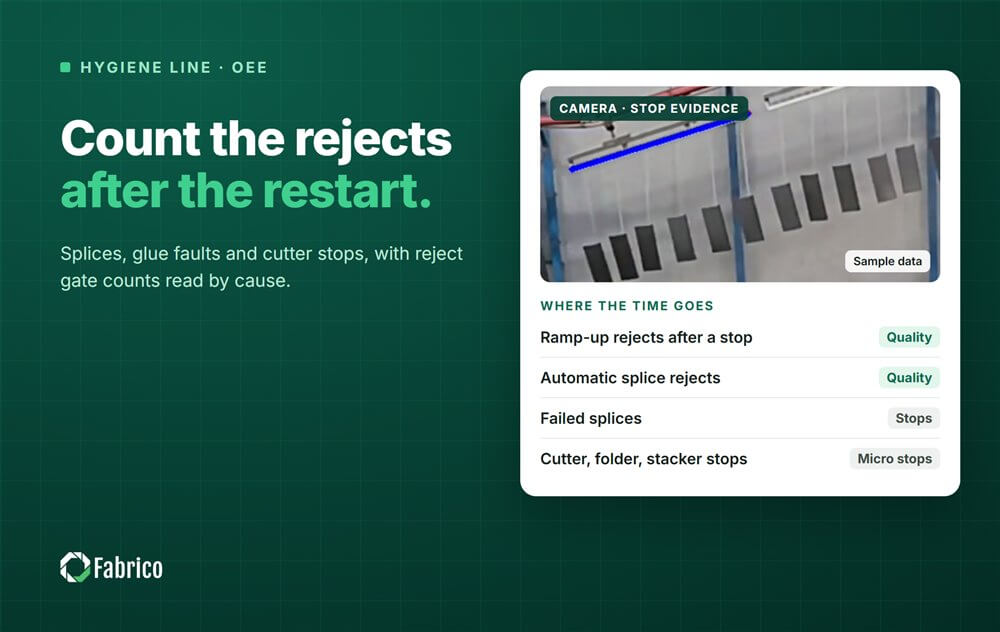
OEE for Nonwovens and Hygiene Lines: Splices, Glue and Rejects

Key takeaways
- On hygiene lines, a stop costs twice: the minutes stopped and the products the reject gate throws out while the line ramps back up.
- Set the ideal rate at the rated products per minute for each size, not at the speed the line usually runs.
- Automatic splices are mostly a Quality loss in rejected products. Failed splices are stops.
- Read the inspection system's reject reasons by cause, and track material waste in kilograms next to OEE.
- Short stops at the cutter, folder, stacker and bagger hide in Performance unless they are logged automatically.
The backsheet splice on line 3 goes through at full speed, and the reject gate throws out a burst of diapers around it. Ten minutes later a glue fault stops the line for forty seconds, and on the restart the gate rejects product again until the speed and the glue pattern are back. Neither event looks big. Both cost OEE twice, in time and in product, and on a line making hundreds of products a minute that adds up fast.
This guide is for plant managers, process engineers and CI leads on baby diaper, adult incontinence, feminine care and wet wipes lines. It covers why short stops cost more at high speed, how to set the ideal rate, how to book splices, glue faults and inspection rejects, and how OEE relates to the waste rate your plant already reports.
How a hygiene converting line runs
- Unwinds and splicers. Many unwind stands feed nonwovens, backsheet film, elastics, tapes and release paper. Automatic splicers join a new roll to the running one, often with a festoon to buffer the web.
- Core forming. A mill turns pulp into fluff, and a forming drum builds the absorbent core with superabsorbent powder dosed in.
- Glue and bonding. Hot melt systems apply glue through many nozzles and slots; some lines also bond layers by ultrasound.
- Elastics, cutting and folding. Leg and waist elastics, ear tapes, die cutting of the shape, final cut and folding.
- Inspection and reject gate. An inspection system checks each product and the gate removes rejects at full speed.
- Stacker and bagger. Products are counted into stacks, compressed and bagged, then cased.
Wet wipes lines differ in the middle: the web is folded and cut, lotion is dosed onto the stack, and a flow wrapper and lid applicator pack it. The loss logic is the same.

Why a short stop costs twice at high speed
When a hygiene line stops, it rarely stops clean. It decelerates, waits, then ramps back up, and during the ramp the glue, the registration and the cut position are not yet stable. Many lines are set to reject product automatically during deceleration and restart.
So each stop has two prices. The stopped minutes are Availability or Performance, depending on length. The products rejected around the stop are Quality. A line with many short stops can lose more good product to restarts than to the stops themselves.
That changes what you fix first. Ten stops of thirty seconds may hurt more than one stop of five minutes, because they mean ten restarts. Count restarts as a number of their own, next to stop minutes. Our guide to cutting start-up and shutdown losses covers the method.
Setting the ideal rate
Use the rated speed in products per minute for each product size, from the machine's design speed or the best proven speed with the product in spec. Bigger sizes often run slower, so one number for the whole line will not work.
Many hygiene lines run below their rated speed most of the time, to keep splices and the glue pattern stable. That may be the right call, but it is a speed loss, and it needs a reason such as raw material or glue stability. If the ideal rate is set to the usual speed, the loss disappears from the report.
Our article on rate loss on high speed lines shows how to split slow running into its causes.
Splices, glue and raw material
| Event | OEE factor | Typical causes | What to record |
|---|---|---|---|
| Automatic splice | Quality (products rejected around the splice) | Normal roll change | Splices per shift, rejects per splice |
| Failed splice | Availability | Tape not holding, wrong roll prepared, festoon faults | Unwind position, roll and supplier |
| Web break | Availability, then Quality on restart | Nonwoven or film defects, tension spikes, elastic breaks | Material, unwind, lot |
| Glue fault | Availability or Quality | Clogged nozzles, temperature faults, empty tank, pattern drift | Glue station, fault type |
| Product jam | Performance (short stops) | Folding, stacker or bagger misfeeds | Station, count of stops |
| Size change | Availability | Planned product change | Last good product to first good product at rated speed |
Split the reason codes by unwind position and by glue station. A generic code such as material fault cannot tell you whether one supplier's nonwoven breaks more than another's. Our guide to operator-friendly reason codes shows how to keep the list short enough to use.
Short stops at the folder, the stacker and the bagger are the micro stops of hygiene lines. Each lasts seconds and the operator clears it without a note. Our guide to micro stops covers how to count them.
Quality: inspection rejects and the waste rate
Count Quality in products: good products over all products made. Split the rejects by reason, because each points somewhere different.
- Restart rejects. Products thrown out around stops and during ramp-up.
- Splice rejects. Products around each splice.
- Inspection rejects. Products the inspection system found faulty: misplaced components, glue faults, missing elastics, contamination.
- Bagging rejects. Wrong stack counts, damaged bags.
Watch the inspection rejects for drift. A sudden rise in one reject reason often means a component placement or a glue pattern has moved. A steady high level can also mean the inspection limits are set tighter than the product needs, so check false rejects with the quality team.
Most hygiene plants also report a waste rate: material scrapped as a share of material used, in kilograms. It catches waste that never became a product, such as web wound off after a break and splice tails. Report it next to OEE, not instead of it. More in our guide to the OEE Quality factor.
Data sources: what each one sees
| Source | What it gives you | What it misses |
|---|---|---|
| Line PLC and drives | Speed, state, fault codes, product count | Why the line stopped when the code is generic |
| Reject gate and inspection system | Rejects by reason | The stop that caused a restart reject burst |
| Splicers | Splice events, failed splices | Defects in the incoming roll |
| Waste scales | Kilograms of waste by shift | Which event made the waste |
| Operator input | Reason, roll and lot, size | Stops too short to record |
| Camera at a station | A clip of the stacker, bagger or an unwind at the moment of a stop | What happens inside enclosed sections |
The line PLC is the clock for each stop. Where a camera watches the stacker, the bagger or a splicer, the clip shows the misfeed or the failed splice that a generic fault code cannot. A model can suggest the reason, and the operator confirms it in one tap.
A worked shift on a diaper line
Sample line (illustrative numbers, not a customer): a baby diaper line runs size 4, rated at 800 products a minute. Planned production time is 480 minutes.
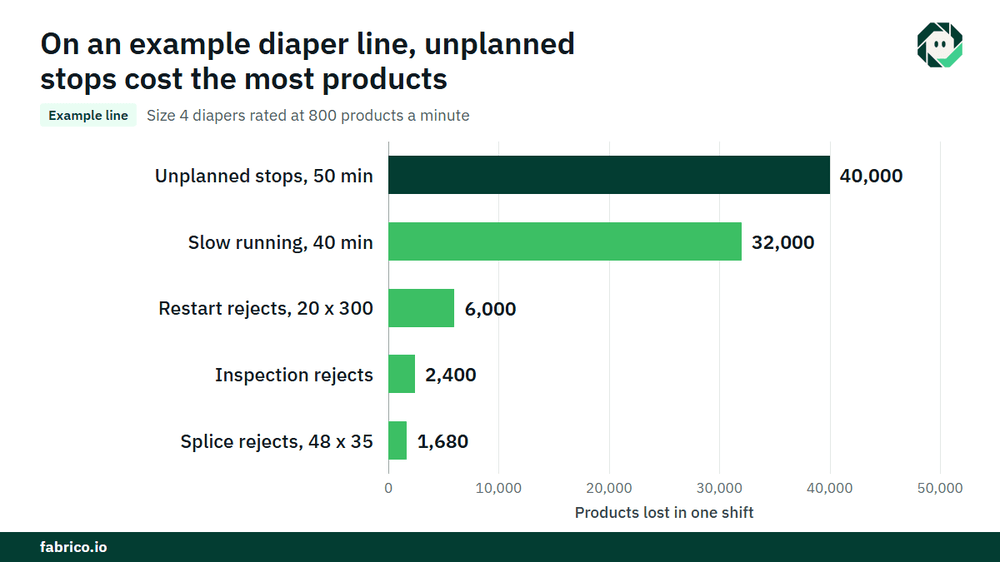
- Stops: 19 unplanned stops totalling 50 minutes and one size change of 30 minutes, so 20 restarts. Total 80 minutes, so run time is 400 minutes.
- Availability = 400 / 480 = 83.3%.
- Ideal output = 400 x 800 = 320,000 products. The cutter counted 288,000. Performance = 288,000 / 320,000 = 90.0%. The missing 32,000 products are 40 minutes at rated speed, mostly running slow on one difficult nonwoven.
- Rejects: 20 restarts x 300 = 6,000; 48 splices x 35 = 1,680; inspection rejects 2,400. Total 10,080, so good products are 277,920. Quality = 277,920 / 288,000 = 96.5%.
- OEE = 0.8333 x 0.90 x 0.965 = 72.4%. Check: 277,920 / 800 = 347.4 minutes, and 347.4 / 480 = 72.4%.
Price the short stops. The 50 minutes are 50 x 800 = 40,000 products not made. At a contribution of $0.03 a product (€0.03 in a euro plant), that is $1,200. The 6,000 restart rejects cost their material, $0.08 a product: $480. Together $1,680 a shift. On 990 shifts a year, three shifts on 330 days, that is $1,663,200, or €1,663,200, if the line is sold out. Rejects are priced at material only here, so no contribution is counted twice.
Where Fabrico fits
Fabrico is a computer vision enabled Manufacturing Performance Platform. On a hygiene line it starts with OEE and light MES: automatic downtime logging from the machine signals and OEE live by line and shift, so short stops and restarts are counted.
- Losses priced in money and ranked by money, so a glue station, an unwind position and a stacker misfeed are compared in one currency.
- The operator confirms the reason in one tap, while the line is still running.
- A camera clip as evidence for a stop where a camera watches the stacker, the bagger or a splicer.
- A work order to the right technician, with its cost, when a stop is a breakdown.
- One view across plants for groups with lines in several sites.
Fabrico does not replace the line's inspection system; it puts the stops and their cost on one timeline. You can start on one line, with a baseline and a decision date agreed in advance. Each plant gets a quote after a review of its lines.
Frequently asked questions
How do you calculate OEE on a diaper line?
Availability is run time over planned time. Performance is products made over the rated products per minute times run time. Quality is good products over all products, after restart, splice and inspection rejects.
Are splice rejects a quality loss?
Yes. Products rejected around an automatic splice are Quality loss. A failed splice that stops the line is an Availability loss as well.
What is the difference between OEE and the waste rate?
OEE counts time and products. The waste rate counts material, in kilograms, including web that never became a product. A line needs both.
Should the ideal rate be the design speed or the usual speed?
The rated or best proven speed per size. If the usual speed is the ideal, the cost of running slow disappears from the report.
What is a good OEE for a hygiene line?
There is no standard benchmark for hygiene lines. Compare each line with its own baseline, by size, and watch restarts per shift as closely as OEE.
See your hygiene line's losses in a demo
Bring one line and its stop and reject data. We will show where the minutes and the products go and what they cost.
Related articles
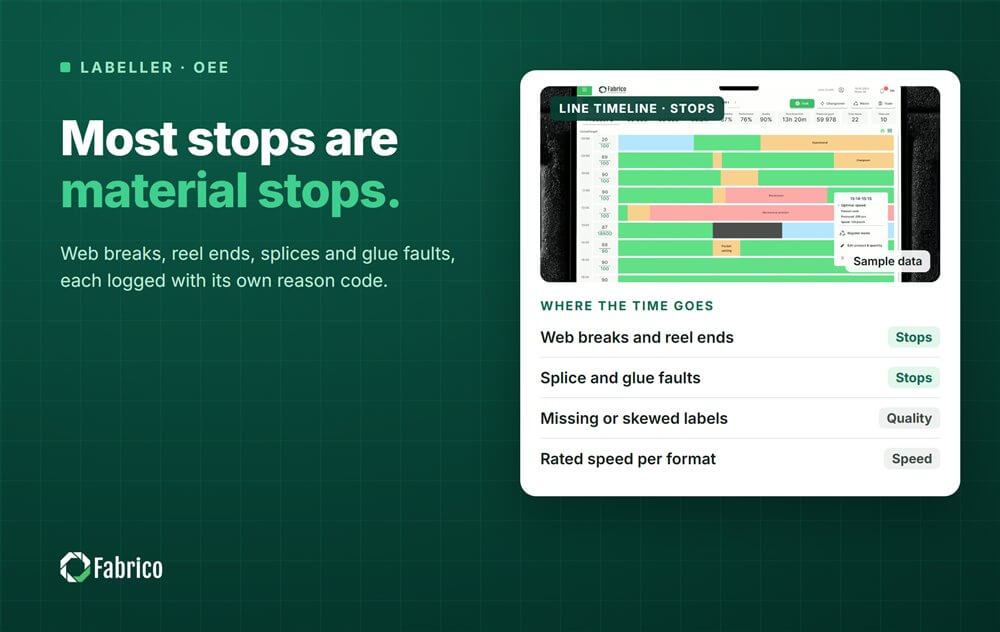
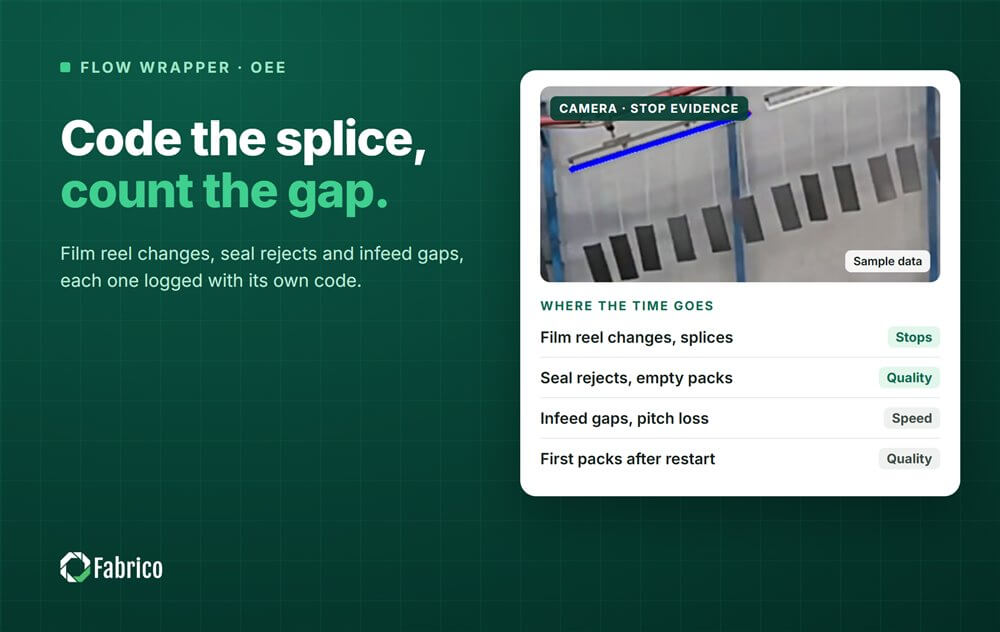





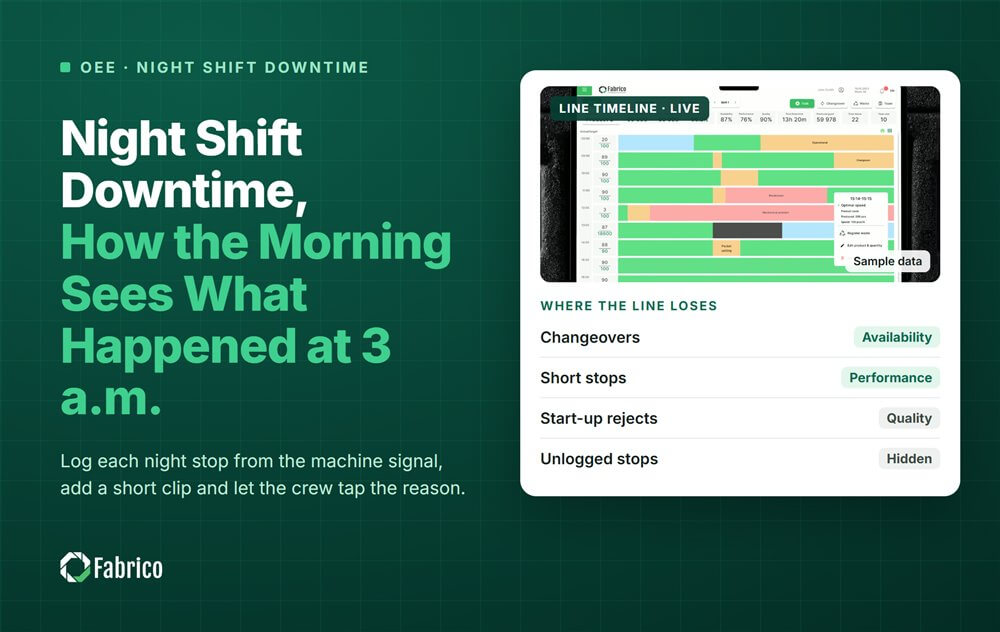


Real Fabrico tiles, sample data.