Login
 Blog
OEE for Blown Film Extrusion: Rate, Bubble Breaks and Gauge Scrap

Key takeaways
- Set Performance against the rated kilograms per hour for each recipe, not against metres per minute.
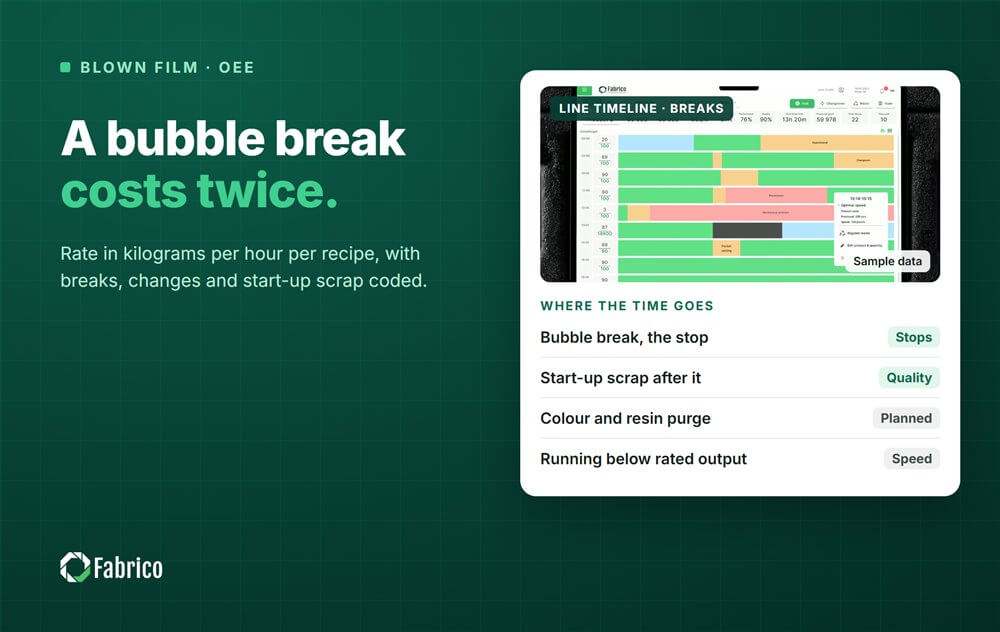
- A bubble break costs twice: the stop is Availability, the start-up scrap is Quality.
- Colour and resin changes cost time and purge scrap. Measure both, from the last good roll to the first good roll.
- Running below rated output to keep the bubble stable is a speed loss, and it needs a reason.
- Decide once how engineered edge trim is counted, write it down and keep it.
The bubble on line 4 breaks twenty minutes after a colour change. The crew stops the haul-off, clears the film from the nip rolls, threads a new bubble and nurses the output back up while the gauge settles. The OEE report for the shift will show one stop, but the line also lost the kilograms it ran slowly afterwards and the film it scrapped before the gauge came back into spec.
This guide is for plant managers, process engineers and CI leads on blown film lines. It covers why kilograms per hour is the right basis for Performance, how to book bubble breaks, roll changes and colour changes, how to measure gauge, gel and purge losses, and which data source sees what.
How a blown film line runs
- Dosing and blending. Gravimetric blenders feed resin, masterbatch and additives to each extruder and report kilograms per hour.
- Extruders and screen changer. One extruder per layer on co-extrusion lines. The screen changer filters the melt; a blocked screen raises melt pressure.
- Die, air ring and bubble. The annular die forms the tube, air inflates it into a bubble, and the air ring, with internal bubble cooling on many lines, cools it.
- Collapsing frame and nip rolls. At the top of the tower the bubble is flattened and pulled by the haul-off.
- Gauge scanner and treater. The scanner measures thickness around the bubble or across the web; the corona treater prepares the surface for printing.
- Winders. Turret or contact winders wind the film into rolls, often with slitting and edge trim before them.
It is a continuous process. Each stop means a restart, and each restart makes scrap until the bubble, the gauge and the colour are stable again.

Why kilograms per hour is the right rate
Line speed depends on the film. Output in kilograms per hour is line speed times lay-flat width times two times thickness times density. Halve the gauge at the same output and the line runs twice as fast in metres per minute, while the extruders do exactly the same work.
So measure Performance in kilograms. For each recipe, meaning structure, gauge and width, set the rated output from the best proven kilograms per hour the line holds with the film in spec. On many lines that limit comes from how much the air ring can cool, not from the extruder.
- Performance = kilograms extruded / (rated kg per hour x run time).
- Use the best proven rate for that recipe, not a good day's average.
- If a recipe often comes out above full speed, its rated output is set too low.
Our guide to the OEE Performance factor covers rate setting in more depth, and OEE for plastics manufacturing compares extrusion with moulding.
Availability: bubble breaks, starts and changes
| Stop type | OEE factor | Typical causes | What to record |
|---|---|---|---|
| Bubble break | Availability, then Quality for start-up scrap | Gels or contamination, melt temperature swings, air ring or IBC faults, drafts in the hall | Time to restart, scrap kg, recipe, resin lot |
| Colour or resin change | Availability, then Quality for purge | Planned product change | Last good roll to first good roll, purge kg |
| Screen change | Availability, or none on continuous changers | Contamination, regrind quality | Stop length, melt pressure before the change |
| Failed roll transfer | Availability | Web wraps, core problems, tension | Stop length, winder position |
| Running below rated output | Performance | Bubble instability, cooling limit, cautious start-up | Reason and actual kg per hour |
| Waiting for resin or cores | Availability | Silo, dryer or supply problems | Waiting for material, with the source |
Bubble breaks deserve their own reason codes, split by the likely cause and tagged with the resin lot. Over time the pattern shows whether breaks follow a resin, a recipe, a season or a shift change.
Changes are planned work, but the time they take is still a loss. Book the full change in Availability with a standard time and code the overrun. Our guide to planned and unplanned downtime definitions explains why hiding changes in planned time inflates OEE.
Roll changes and the winder
On a line with an automatic turret winder, a normal roll change does not stop the extruders. It is not an Availability loss. The few metres wasted at each transfer are a Quality loss in kilograms, small per change but steady.
A failed transfer is different. If the web wraps or the new core does not take the film, the line stops or runs film to scrap until the winder is clear. Code it as a winder stop, not as a bubble problem, so the fix goes to the right place.
Short winder faults, a slitter knife problem or a core that sticks in the loader are the micro stops of blown film. Each is short, and the operator clears it without a note.
Quality: gauge, gels and purge scrap
Count Quality in kilograms: good kilograms over all kilograms extruded.
- Gauge. Film outside the thickness tolerance, or with a profile that gives poor rolls, from the scanner data.
- Gels. Unmelted particles, cross-linked material or contamination. Many lines use an inline film inspection system to count them; rolls over the limit are downgraded or scrapped.
- Purge and transition scrap. Film made while one colour or resin pushes out the last, until colour and properties are back in spec.
- Start-up scrap. Film made after a bubble break or a start, until the bubble and the gauge settle.
- Winding and treatment. Wrinkles, telescoped rolls, low treatment level.
Engineered edge trim is a judgement call. If it is fed straight back into the extruder, some plants count it as neither good nor scrap. Others count it as a loss. Either rule works if it is written down and never changed, so trends stay comparable.
Running colours light to dark, and grouping grades with similar melt flow, often shortens transitions. Our article on changeover sequence by cost shows how to weigh the order. For the restart side, read how to cut start-up and shutdown losses.
Data sources: what each one sees
| Source | What it gives you | What it misses |
|---|---|---|
| Blender and extruder PLC | Kilograms per hour, screw speed, melt pressure, run state | Why output dropped |
| Gauge scanner | Thickness profile and average gauge | Gels, wrinkles |
| Winder | Roll changes, roll length, transfer faults | Rolls downgraded later |
| Roll and scrap scales | Kilograms of good rolls and scrap by shift | Which event made the scrap |
| Operator input | Reason, recipe, resin lot, roll number | Short winder faults nobody records |
| Camera at the bubble or the winder | A clip of the moment of a break or a wrap | What happens inside the die or the extruder |
The PLC is the clock for the stop. Where a camera watches the bubble or the winder, the clip shows the moment it went wrong, and a model can suggest the likely reason. The operator confirms it in one tap.
A worked shift on a blown film line
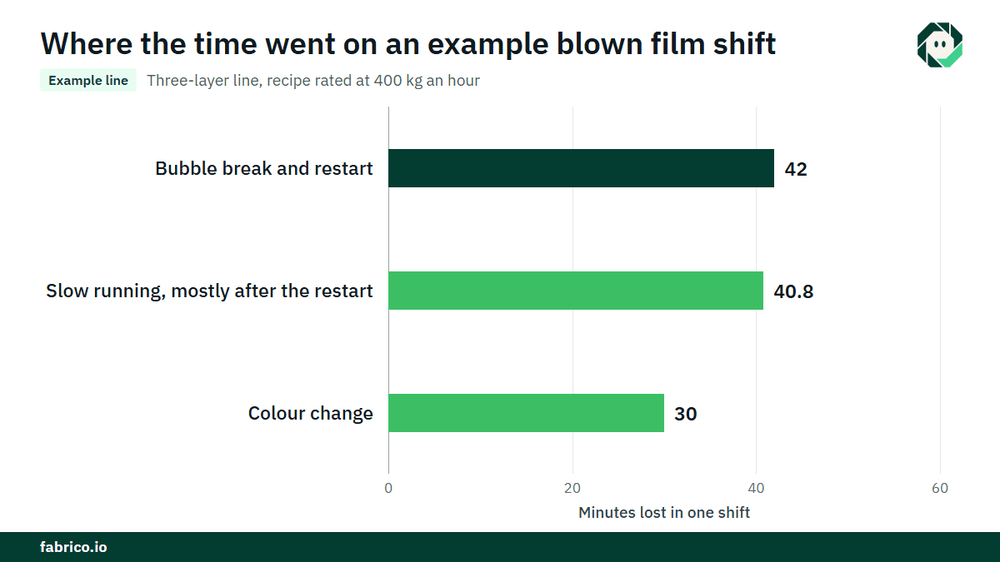
Sample line (illustrative numbers, not a customer): a three-layer line runs a recipe rated at 400 kg per hour. Planned production time is 480 minutes, so the most it could make is 400 x 8 = 3,200 kg.
- Stops: one bubble break with restart, 42 minutes, and one colour change, 30 minutes. Total 72 minutes, so run time is 408 minutes.
- Availability = 408 / 480 = 85.0%.
- Rated output in the run time = 400 x 408 / 60 = 2,720 kg. The blenders logged 2,448 kg. Performance = 2,448 / 2,720 = 90.0%. The missing 272 kg are 40.8 minutes at rated output, mostly slow running after the restart.
- Scrap: 48 kg of purge, 38 kg of start-up scrap after the break, 12 kg of gauge rejects. Total 98 kg, so good output is 2,350 kg. Quality = 2,350 / 2,448 = 96.0%.
- OEE = 0.85 x 0.90 x 0.96 = 73.4%. Check: 2,350 / 3,200 = 73.4%.
Price the bubble break. The 42 minutes are 400 x 42 / 60 = 280 kg not made. At a contribution of $0.60 a kg (€0.60 in a euro plant), that is $168. The 38 kg of start-up scrap lose $1.00 a kg in value when they go to regrind instead of a customer roll: $38. One break costs $206, or €206. At 150 breaks a year, it is $30,900, or €30,900, if the line is sold out.
Where Fabrico fits
Fabrico is a computer vision enabled Manufacturing Performance Platform. On an extrusion line it starts with OEE and light MES: automatic downtime logging from the machine signals and OEE live by line and shift.
- Losses priced in money and ranked by money, so a bubble break, a long colour change and a slow start are compared in the same currency.
- The operator confirms the reason in one tap, while the stop is fresh.
- A camera clip as evidence for a stop where a camera watches the bubble or the winder.
- A work order to the right technician, with its cost, when a stop turns out to be a breakdown.
- One view across plants for groups that run lines in several sites.
You can start on one line, with a baseline and a decision date agreed in advance. Each plant gets a quote after a review of its lines.
Frequently asked questions
Should blown film OEE use kg per hour or metres per minute?
Kilograms per hour. Metres per minute change with gauge and width, so a thin film looks fast and a thick one looks slow. Kilograms per hour against the rated output per recipe compares like with like.
Do roll changes count as downtime in blown film OEE?
Not when an automatic winder changes rolls without stopping the line. The waste at each transfer is a Quality loss. Failed transfers and manual changes that stop the line are Availability losses.
Is edge trim a quality loss?
It depends on your rule. Trim fed straight back into the extruder is often left out of both good and scrap. Choose one rule, write it down and apply it on every line.
How do you count purge scrap in a colour change?
Book the change time in Availability and weigh the purge and transition film as Quality loss in kilograms. Both belong to the changeover, so report them together.
What is a good OEE for a blown film line?
There is no standard benchmark for blown film. Compare each line with its own baseline, using the same rated outputs and the same trim rule, and watch the trend by recipe.
See your extrusion line's losses in a demo
Bring one line and its shift reports. We will show where the kilograms go and what each loss costs.
Latest from our blog