


 Login
 Blog
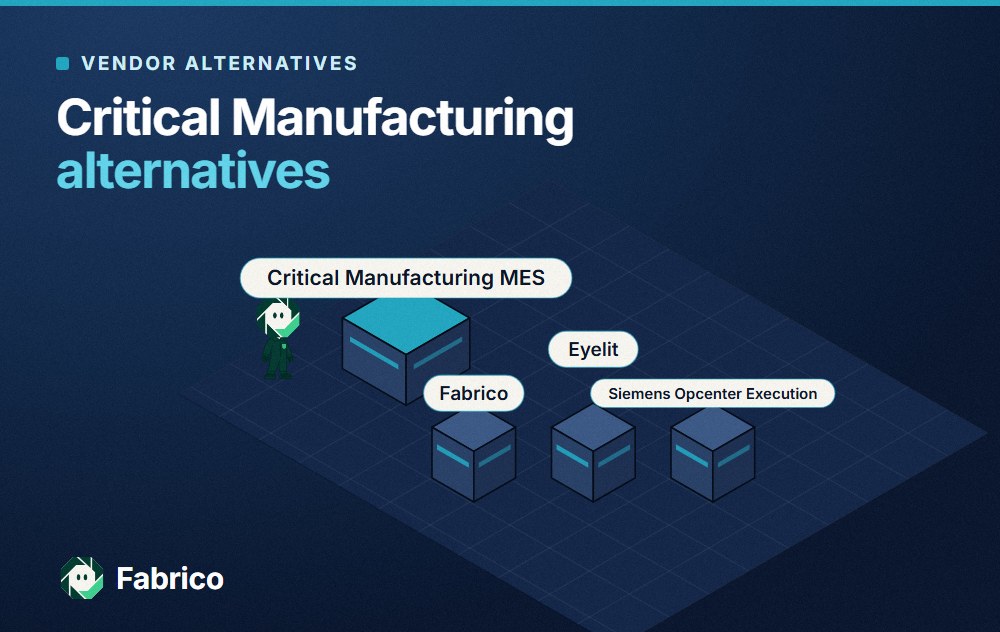
Critical Manufacturing MES Alternatives: Global MES or OEE First

In short: Critical Manufacturing MES alternatives split by scope. For another full MES across complex discrete sites, compare it with Eyelit, iTAC.MOM.Suite and Siemens Opcenter. If the first question is why lines stop and what the stops cost, an OEE-led light MES like Fabrico answers that layer and leaves orders and genealogy in the ERP.
- Critical Manufacturing describes a modular MES with more than 20 modules for semiconductor, electronics, medical device and industrial equipment plants.
- Its pages stress multi-site standards: one baseline MES, central master data and site-level configuration.
- OEE sits inside that platform, in its resource tracking and a Resource Monitor app.
- Facts about each vendor are drawn from its own website on 13.11.2026 and linked in the text. There are no prices here and no league table.
A medical device group runs four plants on three different shop floor systems. Corporate wants one MES standard. The manager of the newest plant has a nearer problem: two of her lines lose an hour a shift, and nobody agrees why.
Both are real needs, and they sit at very different scopes. Below we cover Critical Manufacturing's offer in its own words, the plants it targets, and four other options. We make Fabrico, one of the four, so read our section with the same care as the rest.
What Critical Manufacturing MES is (as of 13.11.2026, per its site)
Its company page says Critical Manufacturing was incorporated in Coimbra, Portugal, in April 2009, released its first MES version in late 2010, and later received a strategic investment from ASMPT, a semiconductor and electronics solutions provider. Its homepage positions it as an industrial operations platform, powered by MES, for makers of discrete products. Its pages, read on 13.11.2026, set out:
- Breadth. Its electronics page counts more than 40 product capabilities across more than 20 interoperable modules, from materials and containers to resource tracking, tooling and process flows.
- Units, lots and batches. Genealogy and traceability at the individual batch, lot or serialized unit, in real time.
- OEE inside the platform. The same page calls OEE a closely monitored indicator, and its Resource Monitor app shows OEE, availability, quality and MTBF by plant, area and machine, with alarm history.
- Equipment connectivity. Connect IoT lists SECS/GEM, OPC UA and OPC DA, MQTT, IPC-CFX and other protocols, configured with drag-and-drop workflows, and can send commands to equipment as well as collect data.
- Scheduling. An integrated APS module builds a processing sequence for each piece of equipment, within constraints such as personnel certifications and planned maintenance.
- Regulated plants. Its medical device page describes electronic DHRs and BRs, EU MDR and UDI tracking, and FDA 21 CFR Parts 11 and 820.
- Multi-site. Its MES overview describes one baseline MES deployed across sites, which each site models to its own processes. Its deployment page says updates can be applied without a maintenance window.
- SaaS for semiconductor. A packaged SaaS offer for semiconductor R&D labs and fabs is cloud-hosted on AWS.
Demo question: what a first site has to license and switch on, and how OEE rules are set centrally and changed locally.
When Critical Manufacturing fits
Its own pages point to a good fit when most of these are true:
- You build complex, high-tech discrete products, such as wafers, PCB assemblies, medical devices or configured equipment.
- Each unit or lot needs a full history, for regulators, customers or recalls.
- Equipment control matters, not only data collection, for example recipes and commands sent to tools.
- Several sites should share one MES standard, with central master data and local changes under control.
If your first question is which losses cost the most on a few lines, a smaller first step may get you an answer sooner. Read on.
Global MES template or one line's losses first?
A platform like Critical Manufacturing is designed to reach from machine connectivity to genealogy, scheduling and multi-site standards. A light MES stops at line and plant performance. Neither is the better design; they answer questions of different size. The trade is weighed in light MES vs full MES, and when a light MES is not enough lists the signs you need the larger scope.
| Question | Critical Manufacturing, per its site | Fabrico, per fabrico.io |
|---|---|---|
| Where OEE lives | Resource tracking, Resource Monitor app | Core of the product, by line and shift |
| Machine data | Connect IoT: SECS/GEM, OPC UA, MQTT, more | PLC, IoT device with sensors, camera add-on |
| Unit history | Batch, lot and serial genealogy, eDHR | Genealogy stays in the ERP |
| Scheduling | Integrated APS module | On the roadmap |
| Several sites | One baseline MES, central master data | Multi-plant view and reports that compare plants |
Comparison table: Critical Manufacturing and four alternatives
Rows summarise each vendor's own pages as of 13.11.2026; the sources are linked further down. Order is not rank: Fabrico leads because this is our page.
| Tool | Product type, as its site puts it | Sectors listed | Demo question |
|---|---|---|---|
| Critical Manufacturing (for reference) | Modular MES platform, 20+ modules | Semiconductor, electronics, medical, industrial equipment | How are OEE rules shared across sites? |
| Fabrico | OEE and light MES, run in the cloud | FMCG, metal, chemical, electronics and automotive | How is a station with no PLC measured? |
| Eyelit | SIOP, APS and MES suite | Semiconductor, automotive, medical, electronics, A&D | How do APS and MES share data? |
| iTAC.MOM.Suite | MES/MOM platform plus manufacturing analytics | Automotive, EMS, medical, metal, injection molding | What do machine and line analytics add? |
| Siemens Opcenter | MES family with products per industry | Discrete, electronics, medical, pharma, semiconductor | Which Opcenter Execution product fits? |
Want to see line losses ranked by cause before you scope a platform? Book a demo; a list of your stations is all we need to begin.
Fabrico: line and plant performance, without a platform project
This is our product, so hold it to the same standard. Fabrico is a cloud light MES and OEE platform for the part of an MES closest to the machine. Per our MES and OEE overview:
- Included: machine data collection, production monitoring, OEE and downtime analytics, and a built-in CMMS.
- OEE you can trace. Counts and stops carry the time they were recorded, so a dashboard figure can be traced back to the shift it came from.
- Machines of any age. Automated lines are read from the PLC, older machines get a Fabrico IoT device with external sensors, and manual steps can use AI cameras, an add-on, that count output. See machine connectivity.
- Stop reasons from the line. Operators tag the cause on a tablet or phone from your own reason codes, and micro-stops are detected from the machine signal.
- Several plants. A multi-plant view puts plants side by side, with reports that compare them, and dashboards are configured for your lines, shifts and KPIs.
- Camera add-on. Video from the camera add-on opens for any moment on the shift timeline and, in the standard setup, is streamed on request rather than stored in Fabrico. A camera add-on that finds stops or offers a reason is roadmap. More on camera-based OEE.
- Rollout. Devices connected in about a month; full rollout in 3 to 4 months.
- Not included: job dispatching, BOMs, routings and product genealogy. Roadmap: production planning and scheduling.
Fits plants that want one OEE rule and stops by cause across lines and plants, with execution records kept in the ERP or an existing MES. EU customers are hosted on AWS in Frankfurt. For consumer goods lines with manual packing steps, see our computer vision for FMCG guide.
Ask in the demo: how OEE from Fabrico could sit next to an MES that owns genealogy, and which data moves between them through the REST API or webhooks.
Eyelit: planning, scheduling and execution as one suite
Eyelit offers SIOP, APS and MES, plus Agent EyeQ, which it describes as agentic AI, and names semiconductor, medical device and electronics among its industries. Its industrial page says labor effectiveness (OLE) and OEE are tracked live, each against its own configured standard, and it keeps genealogy from raw material to finished product.
Compared with Critical Manufacturing: both serve semiconductor, electronics and medical plants and both list scheduling. Eyelit leads with the plan-to-floor loop; Critical Manufacturing leads with the MES platform and multi-site standards. Our OEE vs MES guide helps frame which comes first.
Fits plants that want demand planning, scheduling and execution from one vendor.
iTAC.MOM.Suite: MOM for automotive and electronics plants
iTAC Software calls itself an MES/MOM provider; it is an independent company within the Dürr group, based in Montabaur, Germany. Its homepage, read on 13.11.2026, says:
- On one MES/MOM platform, the iTAC.MOM.Suite handles quality, traceability, maintenance, planning and the control of production.
- The iTAC.MA.Suite adds analysis at machine, line and factory levels, alongside AI-supported solutions.
- Its industries include automotive, e-mobility, electronics and EMS, medical technology, metal and injection molding, and its group includes Cogiscan.
Compared with Critical Manufacturing: both name electronics and medical plants. iTAC's homepage also names automotive, metal and injection molding. Ask both how machine-level analytics connect to the MES record.
Fits plants that run automotive or EMS lines and want MOM plus separate manufacturing analytics.
Siemens Opcenter Execution: an MES product per industry
The Opcenter Execution family from Siemens splits MES into industry products, among them discrete, process, electronics, pharma, semiconductor and medical device and diagnostics. Read on 13.11.2026, its page says Opcenter Execution manages and tracks the movement and storage of materials and work in progress, and tracks resource usage by elapsed time and production quantities so that production does not outpace maintenance.
Compared with Critical Manufacturing: Siemens sells an execution product per industry; Critical Manufacturing describes one platform with industry pages. Ask each how a group with mixed industries keeps one standard.
Fits plants that want an industry-specific MES from a large portfolio vendor.
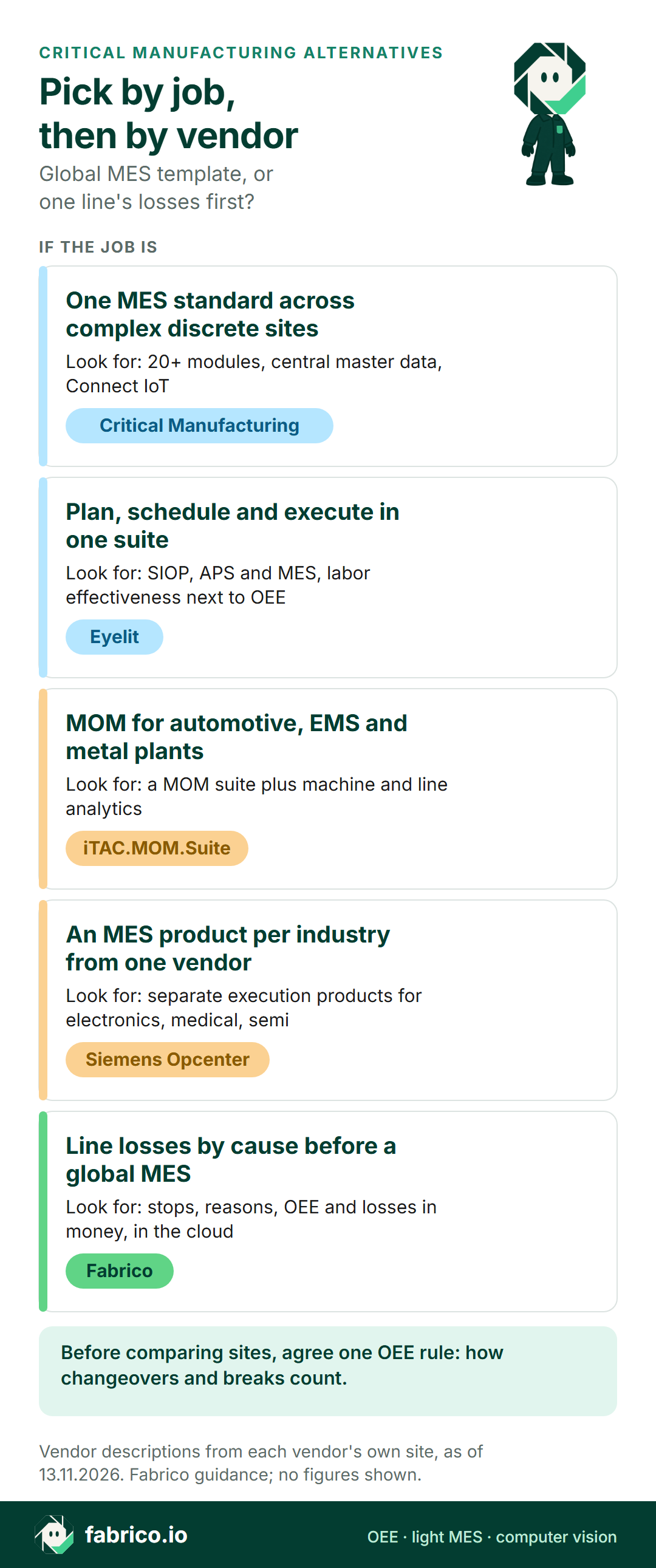
Which Critical Manufacturing alternative fits your plant
- One MES standard across complex discrete sites, with equipment control: Critical Manufacturing.
- Demand planning, scheduling and execution from one suite: Eyelit.
- MOM plus machine and line analytics for automotive and EMS lines: iTAC.MOM.Suite.
- An execution product built for your industry, from a broad portfolio: Siemens Opcenter.
- Line losses by cause and one OEE rule across plants first, with execution records kept elsewhere: Fabrico.
Electronics plants can also read MES for electronics, and a wider list sits in our MES software comparison.
Worked example: two sites, one OEE rule
Multi-site MES projects promise comparable numbers. The numbers are only comparable if the rule is the same. The sample data below is invented: two sites, the same line type, one 450 minute shift, with no real plant or product screen behind it.
Site A had 40 minutes of stops and 50 of changeovers, and treats changeovers as planned downtime. On its own rule, planned time is 400 minutes, run time 360, availability 90.0%, and with 92.0% performance and 99.0% quality it reports 82.0%.
Site B counts changeovers as lost availability. It had 55 minutes of stops and 45 of changeovers, so it ran 350 of 450 minutes: 77.8%. With 93.0% performance and 98.5% quality, OEE is 71.3%.
Put Site A on Site B's rule and its availability is 360 of 450, or 80.0%, so OEE is 80.0% x 92.0% x 99.0% = 72.9%. The gap shrinks from 10.7 to 1.6. Whatever system you choose, write the rule down before you compare plants. See OEE calculation for the formula.
Questions to ask before you choose
Pick one typical line at one site, and give every shortlisted vendor, Fabrico included, this same set of questions.
- What must phase one deliver: line losses, unit records, scheduling or a multi-site standard?
- How is OEE defined, and who can change the rule for changeovers, breaks and ideal cycles?
- How does each machine report: equipment protocol, PLC, sensor, camera or operator?
- Where will orders, BOMs and genealogy live after go-live: in the ERP or in the new system?
- When a new product or site arrives, who sets it up: plant engineers, the vendor's staff or an integrator?
- Which modules, sites and services does the quote assume? Ask for it in writing, on one shared questionnaire.
What people ask next
What is Critical Manufacturing MES?
Per its own site, it is a modular MES, which the company now calls an industrial operations platform powered by MES, for discrete manufacturers in semiconductor, electronics, medical devices and industrial equipment. The company was incorporated in Coimbra, Portugal, in 2009, and ASMPT later made a strategic investment in it.
Does Critical Manufacturing track OEE?
Yes, per its site. Its electronics page calls OEE a closely monitored indicator handled through resource tracking, and its Resource Monitor app shows OEE, availability, quality and MTBF by plant, area and machine.
How does Eyelit compare with Critical Manufacturing?
Both serve semiconductor, electronics and medical plants and both list scheduling, per their own sites. Eyelit sells planning, scheduling and the MES together as a plan-to-floor suite. Critical Manufacturing puts its modular MES platform, multi-site standards and equipment connectivity first. Give both vendors one identical scenario to demonstrate.
Is there a cloud version of Critical Manufacturing?
Its site describes a packaged SaaS offer for semiconductor R&D labs and fabs, cloud-hosted on AWS. Ask the vendor which deployment options apply to other industries.
How is Fabrico different from Critical Manufacturing?
Critical Manufacturing covers execution from equipment control to genealogy, scheduling and multi-site standards. Fabrico covers line and plant performance: counts and stop times read from the machine, causes tagged by operators, and OEE with losses priced per line and shift. Genealogy and orders stay with the ERP.
Could Fabrico sit beside an MES such as Critical Manufacturing?
It can, as a separate OEE layer that exchanges data through its REST API and webhooks. Decide which system publishes the official OEE figure first, so the two never report different numbers for the same line.
Want to see one line's losses before you scope a global MES? Book a demo, or send our team a note.
Related articles


Latest from our blog


Real Fabrico tiles, sample data.