


 Login
 Blog
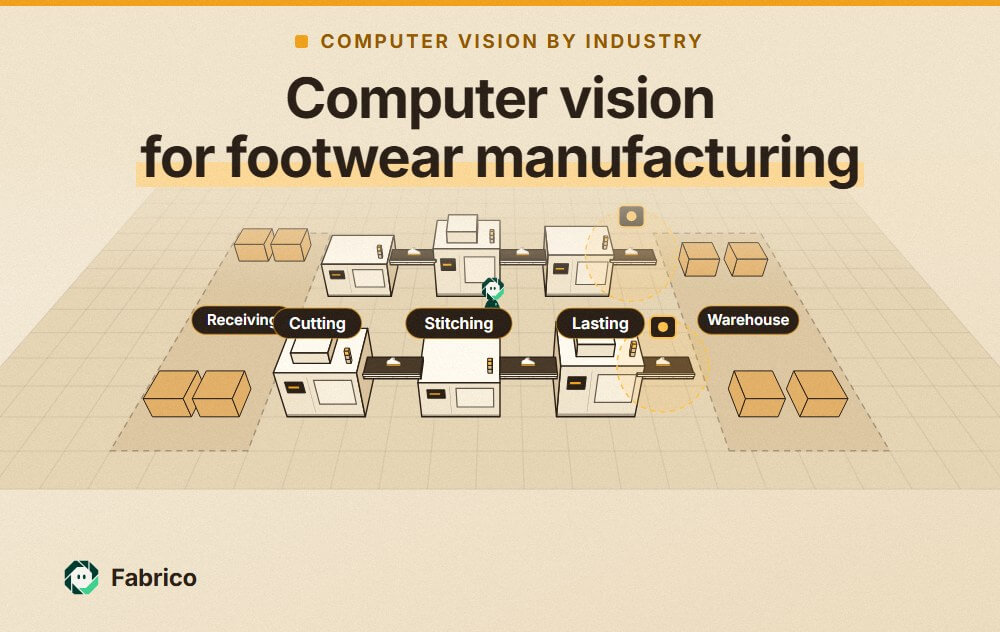
Computer Vision for Footwear Manufacturing: Where Cameras Count Pairs

In short: computer vision for footwear manufacturing pays off as a pair counter: cameras count uppers, lasted pairs and boxes at the stitching line, the lasting and finishing benches and the boxing line, where no machine gives a usable count. Cutting tables and DIP injection machines usually report through their own signals.
- Checking leather, stitching, bonding and size labels is inspection. That is a different system, and Fabrico does not sell it.
- Shoe factory losses hide in style and size-run changes, line imbalance between stitching and lasting, waiting for uppers, lasts or soles, and rework.
- Read the signal where one exists. Put cameras where pairs move through people's hands.
- Fabrico's AI camera add-on counts output, not people, and lets you open the video for any moment on the shift timeline. The operator adds the stop reason.
Your DIP machines count every cycle. Your cutting tables report their run state. Your stitching room counts by bundle ticket or on a whiteboard, often a day late.
This page is for plant managers, operations and CI leads in shoe factories, from leather dress shoes to sports and safety footwear, who are choosing cameras and OEE software.
It shows where a camera earns its place, where the machine signal is enough, and what to ask each vendor.
Computer vision for footwear manufacturing: two different jobs
Two kinds of camera system get sold to shoe factories under one name. Inspection systems look at the leather, the upper or the finished shoe and grade it. OEE cameras count output and show you what happened at a stop.
Comparing whole platforms rather than cameras? See our guide to MES and OEE platforms for footwear manufacturing. This page is about the OEE camera.
| Job in a shoe factory | Inspection system | OEE camera |
|---|---|---|
| Leather and upper defects | Yes, or a trained grader | No |
| Stitch faults, cement marks | Yes, or people at final check | No |
| Size, pair and box label match | Yes, a scanner or vision check | No |
| Count uppers, pairs or boxes | Rarely | Yes, also at manual steps |
| Video of a stop | Defect images, not stop video | Open the video for that minute |
| Feeds OEE through | Its reject or rework count | The output count |
The two work side by side. The rework or reject count from final check, logged by QC staff or read from an inspection system, can feed the quality part of OEE, so a faulty pair is counted once.
Where the losses hide in a shoe factory
Footwear is made at a huge scale. The World Footwear Yearbook 2026 from APICCAPS, the Portuguese footwear association, puts global production in 2025 at 24.6 billion pairs, broadly unchanged on the year before, as reported by World Footwear.
Much of it is still made by hand. A 2020 ILO and IFC discussion paper on automation says apparel and footwear manufacturing is "characterized by routine and repetitive work, yet automation remains limited." Respondents saw some automation in cutting and stitching, and in molding and injecting in footwear production. That split decides where a camera goes.
Cutting room: clicking presses and cutting tables
Leather is still often cut on clicking presses: an operator places a die on the hide around the scars and strikes. Automatic cutting tables nest the parts by software and log each job.
Read the cutting table's PLC, or fit a run-state sensor. A clicking press stroke counter says the press worked, not how many pairs it cut: one stroke can cut one part or several, and a shoe has many parts. The number that matters is complete kits for a size run. A camera over the kitting area can count kits leaving, so you see when cutting falls behind.
Stitching room: the labour-heavy middle
The stitching (closing) room joins cut parts into an upper: skiving, folding, then flat-bed and post-bed stitching. It is the most labour-intensive stage. In the same ILO and IFC paper, a sports brand said training for complex footwear stitching can take up to six months.
One upper passes through many machines and hands, so no single machine gives a useful count. The count that matters is finished uppers leaving the line. A camera at the line end gives it by hour, and the video shows when the flow stopped.
Where operators are paid by the piece, bundle tickets already give a count per operation, often a day late and keyed by person. A camera at the line end gives a count by line and hour that does not depend on tickets, and it should never be used to check anyone's piece rate.
Balance inside the line works as on a garment sewing line (see computer vision for textile manufacturing). In footwear, the imbalance that hurts most is between stitching and lasting.
Lasting: where the shoe takes its shape
Lasting pulls the upper over a last and fixes it to the insole. Toe lasting, heel and seat lasting and side lasting are often separate machines, then a heat setting tunnel holds the shape. Newer lasting machines can report cycles; older ones report nothing.
Many sports and DIP shoes are strobel-stitched and slip-lasted instead, so the count point is the lasted upper going onto the conveyor or the DIP machine.
Lasting lines can hide a lot of idle time. A 2023 case study of one shoe model at one company, published in the International Journal of Business Excellence (Reda and Dvivedi), put line balance efficiency, a measure of how evenly work is spread across a line's stations and not OEE, at 68.3% in stitching and 17.6% in lasting. In simulation, its best alternative raised them to 90.1% and 76%. That is one company and one model, worked out in a model rather than measured on the floor, but it shows how unevenly work can sit across a lasting line.
Lasts are a constraint too. If a size run needs more lasts in one size than the plant owns, lasting waits. A camera counting lasted pairs on the conveyor shows that gap by hour.
Sole attaching: cementing and DIP injection
Cemented construction runs on a conveyor: roughing, primer, cement, drying, reactivation, then the sole press. The conveyor, the reactivator and the press often have a signal you can read, or take a simple sensor.
Direct injection (DIP or direct-to-upper) machines inject PU, TPU or rubber onto the lasted upper in a mould, usually on a rotary table. The PLC knows its cycles and alarms. Read that signal: a camera adds little here.
Finishing benches
Delasting, sock lining, cleaning, spraying and lacing are mostly people at benches, counted on paper. A camera over the bench output gives a pair count by hour.
Boxing and packing
Pairs are matched, wrapped, boxed, labelled and packed into cartons. The box count is often the first number anyone trusts. A camera at the boxing outfeed gives it by hour, not just at shift end. Size and label checks stay with a scanner. See OEE at a manual packing station.
Style and size-run changes
A style change can mean new dies in cutting, new thread colours in stitching, new lasts, and new DIP moulds for each size. So the ideal rate has to change with the style: a lined boot and a canvas sneaker do not move at one speed.
Waiting for components and rework
Lasting waits for uppers, soling waits for soles, stitching waits for cut kits. In one "idle" bucket, nobody knows which stage to fix, so give each its own reason code. Rework is the quiet quality loss: count a pair sent to the rework bench as a first-pass loss, and make sure it is not counted twice at boxing.
Where a camera goes in a shoe factory
Here is one example, a factory from cutting to boxing.
For a longer list by machine type, see camera or sensor for OEE, machine by machine.
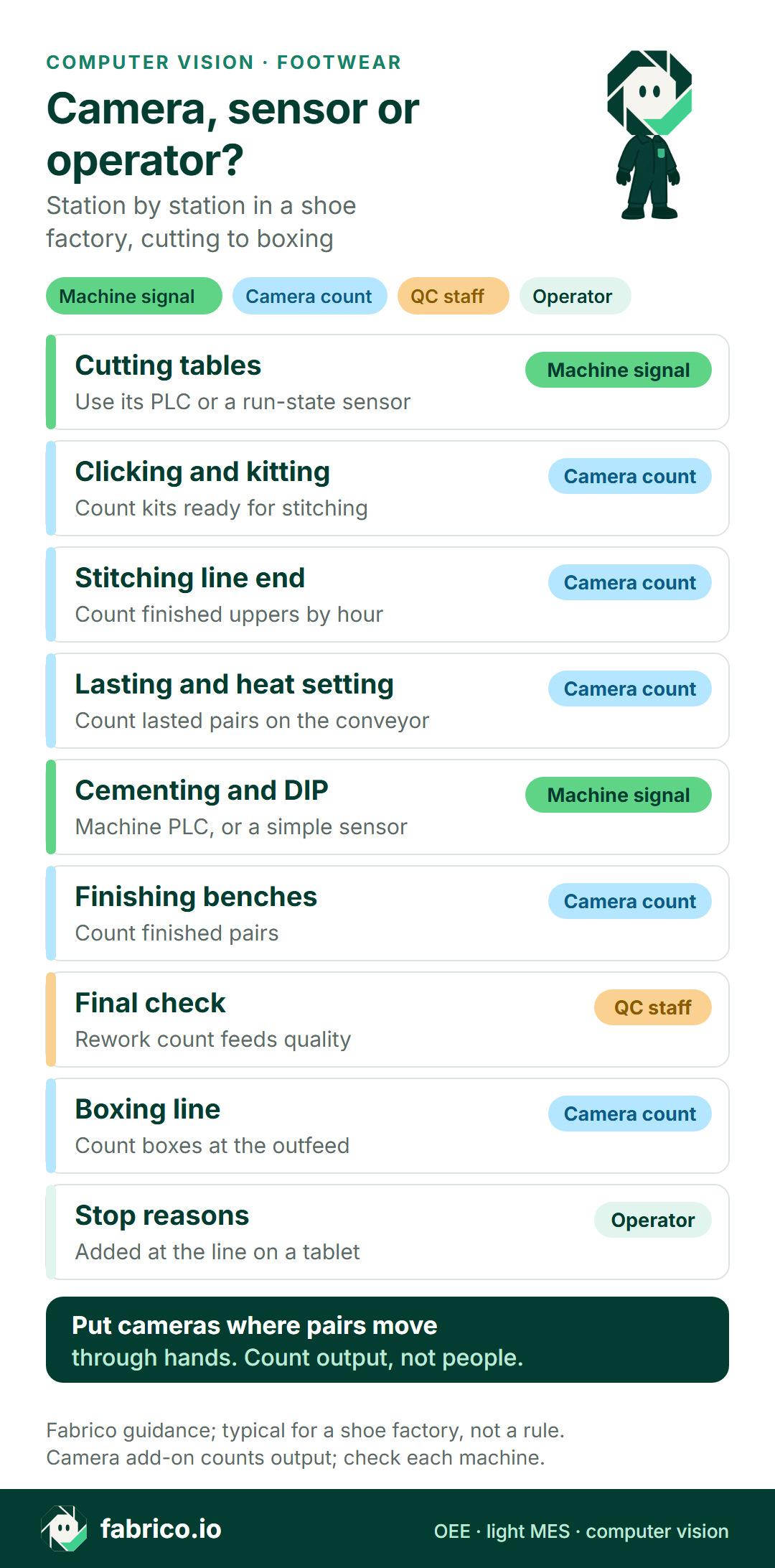
Camera, sensor or operator: station by station
This is typical for a footwear plant, not a rule. Check each machine.
| Station | Count and stops from | What a camera adds |
|---|---|---|
| Automatic cutting table | Its PLC or a run-state sensor | Little. Use the signal. |
| Clicking press, kitting | Stroke counter, if wired. Strokes are not pairs. | Count of kits or bundles ready for stitching |
| Skiving, prep, stitching | Bundle tickets, if scanned; rarely a machine count | Count of finished uppers at the line end |
| Toe, heel and side lasting | Newer lasters have cycle counts; old ones, nothing | Count of lasted pairs on the conveyor |
| Cementing line, sole press | Conveyor and press signals | Video of what led up to a stop |
| DIP injection machine | Machine PLC: cycles, alarms | Little. Use the signal. |
| Finishing benches | Nothing | Count of finished pairs |
| Final check | QC staff: rejects and rework | Nothing. Feed rework to quality. |
| Boxing line | Label printer or scanner, if reachable | Count of boxes at the outfeed |
| Stop reasons, all lines | The operator, on a tablet or phone | Video to check a disputed reason |
Bring your station list and one week of stop sheets to a demo, and we will go through it station by station.
Line imbalance: what station counts show
With a count at each stage, the bottleneck stops being an argument. Here is an example line, with what each stage can do at full flow (sample data).
Here, speeding up stitching only builds a pile of uppers. The fix is at lasting: more lasts in the busy sizes, or a second toe laster. For more on cameras at manual stations, see computer vision OEE for manual assembly.
Worked example: one shift from lasting to boxing
These are example numbers, and they describe no real plant. The line's ideal rate is set by lasting, 90 pairs an hour, or 1.5 pairs a minute. It runs one 480-minute shift, on a line with little stock between lasting and boxing.
A camera on the conveyor after the heat setting tunnel counts lasted pairs. QC staff at final check log pairs sent to rework, and a camera at the boxing line counts boxed pairs. The operator adds the stop reasons.
Stops took 120 minutes: a style change 45, waiting for uppers 35, short stops at the lasters 25 and one breakdown 15. Run time is 360 of 480 minutes, so availability is 75%.
At 1.5 pairs a minute, 360 minutes could make 540 pairs. The camera counted 486 lasted pairs, so performance is 90%. The gap is 36 minutes of slow running.
Final check sent 18 of the 486 pairs to the rework bench, so 468 were good first time and quality is 96.3%. Those 18 pairs are 12 minutes of line time.
OEE is 75% x 90% x 96.3% = 65%. Check it the short way: 468 good pairs of 720 possible is also 65%.
Eight checks for any footwear camera or OEE vendor
Run these with every vendor, and with us. Bring one real shift from last week as the test case.
| Ask | How to test the answer |
|---|---|
| What exactly does the camera count? | Uppers, lasted shoes or boxes? Ask how each converts to pairs, and run it next to a hand count. |
| How does it handle a style change? | Ask to see the count hold when colour or shape changes mid-shift. |
| Can the ideal rate change with the style? | Ask to see the rate set per style and size run. |
| How is waiting for components booked? | Ask for separate codes for waiting for uppers, lasts, soles or kits. |
| How does rework reach quality? | Ask how rework bench pairs count, and that none is counted twice. |
| Where does each camera mount? | Ask for each position on a drawing, with people out of frame. |
| Is video kept, and who can open it? | Ask where it lives, for how long, and who sees it. |
| How do machine signals get in? | Ask how cutting tables, DIP machines and the sole press connect. |
Before you roll out across the plant, test on one line first. See our guide to a computer vision OEE pilot.
Cameras on a labour-heavy floor: count output, not people
Stitching rooms and finishing benches are full of people. A camera that films workers to measure them will lose the floor's trust, and in Europe it may break the law.
Point the camera at the output point: the bin at the stitching line end, the conveyor after lasting, the box outfeed. Report by line and shift, never by person. Tell staff before any camera goes up, and in many European countries talk to the works council first.
For a fuller checklist, read production line cameras without surveillance and the guide to GDPR and production line cameras. Ask each vendor, us included, what privacy masking is live today and what is still roadmap.
Where Fabrico fits
Fabrico is a cloud OEE and light MES platform. Here is what it does in a shoe factory today.
- Stops and counts: from the machine signal (PLC, sensor or counter), for example on a cutting table, DIP machine or sole press.
- Stop reasons: the operator adds them at the line, on a tablet or phone.
- OEE and losses: OEE, downtime and losses by line and shift, with losses shown in money. On the web, iOS and Android.
- Camera add-on, on request: AI cameras count output, including at the stitching line end, lasting and finishing benches and the boxing line, where no signal exists. With the camera add-on, you can open the video for any moment on the shift timeline. In the standard setup, video is streamed on request, not stored in Fabrico.
- Your data: it leaves through a REST API, webhooks and Excel or CSV export.
Roadmap, not live today: stops detected by the camera, jam zones on the video, and a camera suggesting a stop reason.
What Fabrico does not do: inspection of leather, stitching, bonding or labels, which stays with your inspection systems and QC staff and feeds Fabrico's quality figure through a reject or rework count. For planning and scheduling, ask us in the demo.
For the full product, see Fabrico computer vision for OEE. If you are still comparing platforms, read our guide to OEE software. All eight checks above apply to us too.
Bring one shift's stop sheet and your station list to a demo, and ask us to show which numbers we can fill and which we cannot.
What people ask next
Which footwear station should get the first camera?
Usually the end of the stitching line or the lasting exit, because that is where pairs flow through people with no machine count. The boxing line comes next, since its count is the one finance trusts. DIP injection machines and cementing lines with a signal you can read come last.
Can a camera check stitching quality or sole bonding?
That is an inspection job, not an OEE camera job. Stitch faults, cement marks, bond strength and colour matching are checked by inspection systems, test labs or trained people at final check. Fabrico does not sell inspection. Their reject or rework count can feed the quality part of OEE.
Will cameras on a stitching floor watch the workers?
They should not. Frame the camera on the output point, such as the bin, conveyor or box outfeed, not on the people. Report by line and shift, never by person. Where there is a works council or union, talk to it first. See production line cameras without surveillance.
Is the camera video stored?
Not in Fabrico. In the standard setup of the camera add-on, video is streamed on request, and you can open it for any moment on the shift timeline. Ask every vendor the same question, and where their video lives.
What drives the cost of computer vision in a shoe factory?
Pricing is set per quote. The drivers are the number of lines and cameras, mounting over conveyors and benches, the network to the floor, and training. Give each vendor the same station list so the quotes compare.
Want to see it on a line like yours? Book a demo and bring one shift from a stitching or lasting line.
Related articles









Real Fabrico tiles, sample data.